





Abstract
Several necessary shifts have been proposed in occupational therapy education, including antiracist pedagogies, inclusive teaching, competency-based education, and holistic admissions. These shifts are intended to prepare competent practitioners who serve diverse groups of clients and advocate for themselves and the profession. This shift may also call for significant changes to curriculum designs and instructional methods. Such changes require not only time, effort, and resources, but also a mindset open to change. Educators may resist this change for various reasons, including personal views on the proposed changes, limited time and resources, professional obligations, and lack of training necessary for successful implementation of change. Fostering a growth mindset for educators may facilitate accepting, implementing, or transitioning to new educational practices. Here, we propose an eight-step model for implementing change while following Kotter’s model for implementing major changes. The model provides a road map for implementing major changes at various levels of systems that shape occupational therapy education.
The authors outline eight action steps that can prepare educators for the impending and necessary shifts in occupational therapy education. Guided by a growth mindset approach, these steps emphasize educators’ ability to adapt, modify, or create new educational methods and strategies when navigating change at the national or local level.
These daring shifts are meant to prepare diverse, innovative, inquisitive learners to embrace the evolution of health care, emerging technology, and translational research in delivering quality, culturally relevant occupational therapy interventions (Thibault, 2020). These shifts also aim to revive our sense of cultural humility (Grenier, 2020) and occupational justice, recalibrate de facto theories and frameworks in our curricula, and question the vitality of diversity, equity, inclusion, and other related topics (DEI+) in our educational programs (Muñoz, 2007; Muñoz et al., 2023; Suarez-Balcazar et al., 2023). Whereas some educators may welcome these changes with a flexible mindset, others may greet them with resistance, skepticism, or rejection (Dei, 2016).
Resistance to Change in Academia
Research in higher education has shown that faculty resistance to change is a key challenge when implementing pedagogical reforms (Lane, 2007; Westberry et al., 2014). Resistance to change may stem from multiple factors, including a fear of losing one’s professional identity, a lack of training, the amount of time allocated to change, and incentives for reform (Brownell & Tanner, 2012). Although established educator competencies in occupational therapy do not exist, some health profession education research suggests that pedagogy design, curriculum development, learning theory, scholarship, assessment, leadership, and educational research are core competencies for health care educators (Chen et al., 2017). Resistance to change could stem from the educator’s perceived competence (or lack thereof) in any or all of these areas.
The nature of change may also cause resistance. For example, some changes (e.g., antiracist and decolonized pedagogies; Johnson et al., 2022) are complex and require advanced training, whereas others (e.g., CBE; Hamed et al., 2023) and simulated experiences in fieldwork) may be underconceptualized and require training, resources, and significant curricular renovation. Finally, competing career goals (e.g., tenure, promotion, recognition) and academic assets (e.g., course evaluation and continuing education) may occupy a significant portion of an educator’s plate, which could eventually impede their commitment to change (Murray et al., 2014).
In addition, occupational therapy educators enter or transition to academia from various roles (e.g., clinicians, researchers, students) and with different backgrounds (e.g., clinical, research, and education doctorates; Cabatan et al., 2019). This means that educators assume (or grow into) teaching roles at different baselines of academic experience and often need more organized preparation (Allgood et al., 2018; Marx et al., 2016). Previously existing faculty development programs (e.g., the American Occupational Therapy Association [AOTA] Academic Leadership Councils and New Educators Mentorship Program) and currently existing ones (e.g., the Scholarship of Teaching and Learning program) serve essential roles, yet their focus has not been directed toward the core knowledge and skills required by didactic and clinical educators. Despite the consistent call for evidence-based practices in occupational therapy education, research on educators’ readiness to approach and implement innovative change is scarce.
Regardless of resistance triggers, when educators are not ready, any change can be perceived as forced, unnecessary, or simply fixing the unbroken. Educators may be skeptical of the value behind the change and consequently assume a mindset to protect familiar instructional practices (Lane, 2007). This conservative mindset can stifle the adoption or implementation of innovative pedagogies. Although training-related concerns, the complexity of change, and teaching competencies are multifaceted and likely to require institutional support, they are not insurmountable. An educator’s inflexible mindset, however, may pose a barrier to accepting, adopting, or implementing change, even with abundant top-down support (e.g., the AOTA Academic Education Special Interest Section). On the contrary, a flexible growth mindset can facilitate the change process and the navigation of new pedagogical approaches.
With the aspiring shifts in occupational therapy education, an unshakable buy-in by educators is a critical component if necessary and intentional changes in educational practices are to be made. Educating and equipping educators with a flexible and adaptable mindset is a worthy investment, not only for local advances in teaching practices and in mitigating bias but also, more widely, as the very foundation of impactful changes in occupational therapy education.
Growth Mindset: What Is It, and How Might It Help Educators?
There exists a clear need for specific, evidence-informed teaching competencies for occupational therapy faculty and fieldwork educators to use as they prepare future practitioners. This challenge includes instilling a willingness to attempt novel and engaging instructional strategies, curricular enhancements, and guidance on creating inclusive learning environments (Taff & Clifton, 2022). A growth mindset (Dweck, 2008) could serve as a core element of an energizing paradigm to guide the future of occupational therapy education. In contrast to a growth mindset, a fixed mindset refers to the notion that one’s innate cognitive capabilities are unchangeable and remain stable throughout the life course. People who believe that their intelligence and other personal attributes are fixed may feel an increased need to prove themselves and avoid challenges or perceived obstacles. Fixed mindsets often synergize with stereotype threat (Pennington et al., 2016; Steele, 2011), whereby inaccurate perceptions of certain (typically marginalized) groups unsettle confidence and minimize engagement and effort. Alternatively, people with a growth mindset hold that one’s cognitive capabilities are not static but somewhat shaped and enhanced through consistent effort, persistence, and support from others. Growth mindset theory does not necessarily endorse unlimited potential but instead maintains that one’s prospective learning is unknown and achieved through effort, the taking on of challenges, and resilience (or grit; Duckworth et al., 2007) in bouncing back from failure. Learners with a growth mindset are more likely to respond to feedback with a renewed effort to achieve, use deeper learning strategies, and engage in more reflective self- regulation to improve their performance. This likely carries over into future receptivity to client feedback, unique strategies to address client concerns, and dedication to lifelong learning to maintain competency in practice (Aronson et al., 2002; Clifton et al., in press). Research has demonstrated that adopting a growth mindset approach can promote key learner-centered outcomes, such as CBE (Richardson et al., 2021), antiracist health care (Theard et al., 2021), and academic retention and success (Broda et al., 2018).
In addition to the benefits to learners, adopting a growth mindset approach offers educators key opportunities to embrace change, spark innovation, and enrich their own professional development. Fundamental to the change process is visioning, or “futuring” (Meharry & Carey, 2024), a structured process aligned with growth mindset principles. Similarly, a growth mindset orientation facilitates the metacognitive, motivational, and emotional characteristics necessary for successful navigation of transitions and change (Bridges & Mitchell, 2000; Kotter, 2012; Miles et al., 2023). Viewing change through a growth mindset lens includes framing change as involving learning and improvement, acknowledging discomfort or unease as natural elements of growth, and acknowledging successes during the process. Educators can use core growth mindset principles to build or revise their teaching philosophies (Taff, 2023b) and improve the quality of didactic and clinical education. A growth mindset helps educators perceive change as an opportunity rather than a threat to authority or expertise; confront implicit biases; seek out innovative teaching methods; disrupt routines of comfort; and demonstrate commitment to growth by sharing challenges, failures, and successes (Sahagun et al., 2021). Clinical education could be reimagined by using growth mindset concepts to support innovative supervision arrangements, outcomes, and context-specific teaching approaches. The core principles of a growth mindset encourage inclusive education and serve as disarming mediators that merge evidence-based teaching practices and conceptual foundations (decolonization, critical theory) into an ethical and practical road map for change in local learning spaces, educational programs, and, more broadly, within the profession. If implemented collectively, a growth mindset could prepare educators to embrace and take action on visionary changes and subsequently act as a paradigm for CBE, accreditation standards, and organizational or professional strategy.
Strategies to Prepare Educators to Move Forward
Change is best when it is a dynamic participatory process in which stakeholders are informed, engaged, and empowered. We propose eight action steps (Figure 1) to prepare educators for change centered on a growth mindset approach. The steps follow Kotter’s (2012) framework for change management, which is based on an evidence-based model for leading complex changes that is widely used in multiple health care fields (Campbell, 2020), including medicine (Miles et al., 2023), nursing (Mount & Anderson, 2015), and public health (Carman et al., 2019). The steps can be used as a road map to implement change at the national (e.g., if adopted by AOTA) or local level (e.g., if adopted by occupational therapy programs or state associations) when preparing educators for the impending and necessary shifts in occupational therapy education. A growth mindset approach guides these steps by emphasizing the educator’s ability to adapt, modify, or create new educational methods and strategies when navigating change.
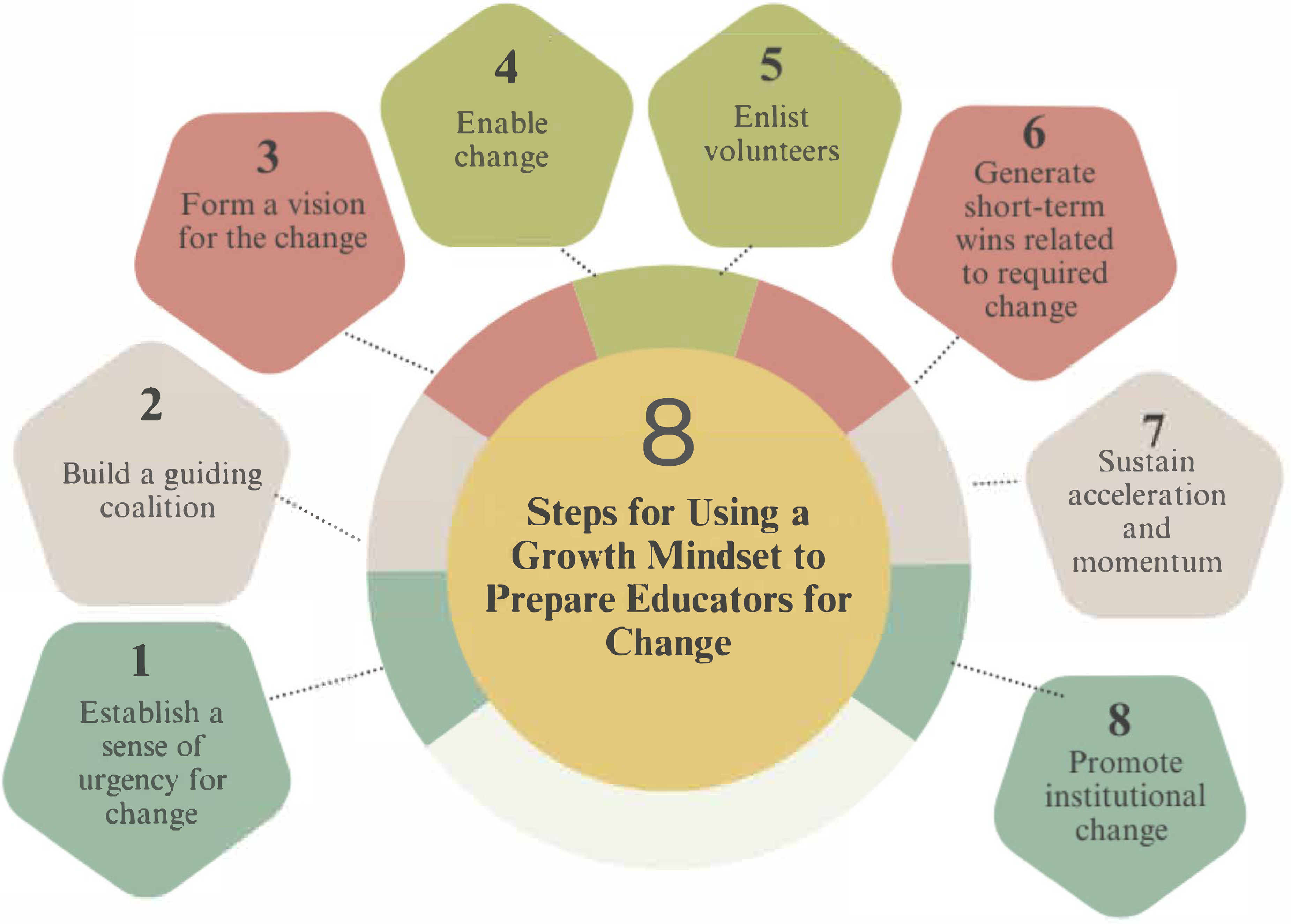
Steps to prepare educators for change using a growth mindset.
Establish a sense of urgency for change. This can be done by providing educators with literature-based and data-driven information about not only the threats posed by outdated teaching approaches and unwelcoming learning environments but also the opportunities associated with the proposed changes and highlighting the significance of these changes for the future of occupational therapy practice (e.g., the need for shifting to CBE or projected diversity figures in the future occupational therapist/occupational therapy assistant workforce). Growth mindset training can enhance educators’ situational awareness of gaps and needs in the education landscape and their potential role in and impact on changes toward a shared vision.
Build a guiding coalition of diverse internal or external subgroups. These groups can guide educators in implementing or accelerating change (e.g., the AOTA Commission on Education). They also can provide perspectives on the proposed change and insight into navigating the change process (e.g., applying DEI+ in curricula). Growth mindset training allows educators to proactively and effectively communicate with these subgroups to implement the necessary change.
Form a vision for change. AOTA, state associations, and occupational therapy programs must provide clear information on a shared vision for change, address misinformation, and promote accurate and realistic outcomes (Lane, 2007). Adequate knowledge of significant reforms (e.g., CBE) can motivate educators, clarify the future vision, and facilitate processes that lead to change (e.g., through the creation of strategic plans). Offering regular opportunities to ask questions (e.g., through the American Journal of Occupational Therapy’s social media series), and holding conferences (e.g., the annual AOTA INSPIRE conference, the AOTA Education Summit) and rotating consortiums may offer places for educators to learn more about complicated concepts (e.g., decolonizing occupational therapy curricula; Simaan, 2020). A growth mindset will prepare educators to identify future goals that are consistent with the shared vision rather than being trapped in the minefield of logistics.
Enable change. Seeking input from educators about change will eliminate uncertainties surrounding that change. Structured listening sessions by AOTA, state associations, and occupational therapy programs will allow instructors and fieldwork educators to share their questions and concerns about, and their perceptions of, the proposed change. They will also offer the opportunity for educators to share input on their readiness for change and the resources needed to succeed. These listening sessions can be synthesized into shareable (and updatable) documents that allow educators to learn from the collective experiences of other occupational therapy programs that have navigated similar changes or reforms (e.g., success stories about holistic admissions).
Enlist volunteers. AOTA can collaborate with volunteer pilot institutions or early adopters who can share their experiences with implementing a particular change. Growth mindset–infused modules offered through AOTA (or a collaborator) can affirm the potential growth associated with that change (e.g., the benefits of implementing inclusive teaching practices for increasing program enrollment).
Generate short-term wins. Educators are more likely to adopt a change if they identify attainable short-term outcomes. They are also more likely to implement and commit to the outcomes if they see sustainable personal and professional gains associated with the change. A growth mindset is built on the idea that learning is not a binary phenomenon but a process built on persistence and self-efficacy generated through incremental improvements.
Sustain acceleration and momentum. When educators and administrators feel well equipped to navigate change, they are more likely to keep momentum toward the intended outcome. Comprehensive growth mindset training can help educators commit to change, especially that associated with long-term outcomes (e.g., the benefit of holistic admissions to increased diversity in the workforce (Anvarizadeh et al., 2023). AOTA can offer capacity-building workshops with educational materials and practical training (including growth mindset modules) for implementing change.
Promote institutional change. Program directors, administrators, and educators in leadership positions can identify ways to integrate the proposed changes in their mission, vision, and strategic planning goals. They can also advocate for the institutional resources that will be necessary to prepare the faculty members and clinical instructors to adopt and implement the change. Those who have a growth mindset accept change as a fundamental reality and necessary evolution for better versions.
The evolving needs of U.S. society, the rise of emerging technologies, and the challenges inherent to the health care industry dictate that we adopt daring shifts in occupational therapy education. These shifts are unlikely to be operationalized if didactic and clinical educators are not prepared or motivated to make significant changes or if they are not confident in doing so. If adopted collectively, a growth-oriented mindset informs both a metacognitive approach for individual educators and a structured road map to guide change with intentionality (Taff, 2023a). Although change in occupational therapy education has historically been sporadic and reactive to new research and prevailing practice trends, we extend the invitation to readers to view educators (and educational programs) as the tipping point to influence the changes needed to make the profession more innovative, inclusive, and growth oriented.