





Abstract
This review found that scientific literature on the Cognitive Orientation to daily Occupational Performance (CO-OP) has significantly increased to include a wider range of clients, including people with developmental coordination disorder (DCD), ADHD, and cerebral palsy.
In the past two decades, health practitioners working with people with developmental disorders or other health conditions have been encouraged to direct their professional efforts toward the impact of disability rather than the cause (World Health Organization [WHO], 2001). This has been a major focus shift, because interventions are now aimed at people’s level of health instead of people’s cause of disability. Thus, the goal is no longer to minimize physical or mental impairments but to promote functioning.
In this regard, the WHO (2001) operationalizes its understanding of health and functioning through the International Classification of Functioning, Disability and Health (ICF). In the ICF framework, functioning transcends body functions and structures and encompasses what a person with any health condition does in their daily life (i.e., their activities) and how their performance contributes to their social roles (i.e., their participation), all while considering the person’s environmental and personal contexts. This framework has been comprehensively expanded and used to advocate for children with disabilities through the publication and further use of the “F-words” (function, family, fitness, fun, friends, and future; Rosenbaum & Gorter, 2012), incorporating the ICF model into a practical proposal for clinical research on and advocacy for those with childhood disability. Consequently, the current guidelines and recommendations acknowledge that rehabilitation goals should be focused on children’s performance of daily activities, participation, and quality of life.
Multiple interventions exist to address these rehabilitation goals. Traditionally, interventions for motor-related functioning problems have been classified into bottom-up or process-oriented approaches, targeting the underlying performance problems at the ICF body functions and structures level, and top-down or activity-oriented approaches, aimed at addressing performance itself at the ICF activities and participation level. In the past decade, accumulative research has consistently shown that top-down approaches yield more benefits for children with disabilities than bottom-up interventions, resulting in better performance and participation outcomes (Blank et al., 2019; Novak & Honan, 2019; Novak et al., 2020; Smits-Engelsman et al., 2013, 2018). Top-down, activity-oriented interventions should (1) be client centered, in that they should target goals that are meaningful for the client; (2) be goal oriented, in that they should aim to promote activity performance and daily participation as described in the ICF; (3) be activity and context specific, in that they should address the specific occupational demands in the client’s current environment; (4) actively involve the client; (5) be aimed at functioning, not at normality, in that they should incorporate activity or environmental adaptations if and when needed; and (6) promote active and collaborative involvement of parents or caretakers to facilitate the transfer of learning to the child’s daily context (Novak & Honan, 2019; Smits-Engelsman et al., 2018). In addition, incorporating cognitive strategy training is recommended to enable improvement in daily performance beyond the specific activities addressed in therapy (Butchereit et al., 2022 ; Miller et al., 2001).
Overall, the characteristics of top-down interventions can be summarized as targeting the client’s meaningful activity- or participation-focused goals, in a manner such that learning can later be transferred to their daily context and generalized to untrained activities outside the therapeutic environment. Thus, the process of transfer and generalization is an essential but usually overlooked element of intervention (Houldin et al., 2018).
One of the few interventions specifically aimed at transferring and generalizing daily living skill training is the Cognitive Orientation to daily Occupational Performance (CO-OP) approach. CO-OP is a customized, performance-based, client-centered approach aimed at daily living skill acquisition using a tailored cognitive strategy and guided discovery (Polatajko & Mandich, 2004). CO-OP uses motor learning and acquisition principles to enable people to develop cognitive strategies to improve performance of activities of daily living. Using a problem-solving framework, therapists train the client to learn and use a global strategy to make and perform a plan to achieve a specific goal, and they then evaluate whether the plan was used and yielded an effective outcome. Afterward, therapists use guided discovery to encourage the client to identify specific cognitive strategies to improve performance, such as mental self-guidance, task specification and modification, supplementing task knowledge, verbal self-instruction, or body position (Butchereit et al., 2022; Mandich et al., 2001). In addition, CO-OP includes a distinct feature to analyze actual activity performance rather than inferring underlying performance deficits, which is used to guide the client in identifying the optimal problem-solving cognitive strategy.
Although CO-OP was originally designed and is currently recommended as a preferred intervention for children with developmental coordination disorder (DCD; Blank et al., 2019; Polatajko, Mandich, Miller, & Macnab, 2001), accumulative research indicates that it also yields significant improvements in activity and participation for other populations, such as those with attention deficit hyperactivity disorder (ADHD), cerebral palsy, childhood-onset dystonia, and stroke (Gharebaghy et al., 2015; Ghorbani et al., 2017; Gimeno et al., 2021; Izadi-Najafabadi, Gunton, et al., 2022; Novak & Honan, 2019; Saeidi Borujeni et al., 2019). Although there has been a growing interest in and an increasing scientific body of knowledge regarding this approach in the past two decades, quantitative analysis of the research is lacking. Bibliometric analysis can be of significant relevance in obtaining a better understanding of the current state of research focusing on CO-OP interventions, which would better inform researchers, health practitioners, and policy makers by identifying trends in publication rates and topics, helping the decision-making about future research directions. Thus, in this study we aimed to analyze the literature published on CO-OP research.
Method
Search Strategy and Data Extraction
Research literature related to CO-OP was searched using the Web of Science (WoS) database via the WoS Core Collection on June 15, 2024. The WoS database is highly regarded as an excellent resource for metric evaluation because it offers extensive coverage of content and thorough citation analysis (Agarwal et al., 2016). To conduct the search, we used a strategy that involved terms in the topic field (“cognitive orientation to occupational performance” OR “cognitive orientation to daily occupational performance" OR "cognitive orientation to (daily) occupational performance”), which encompasses the title, abstract, author keywords, and keywords-plus terms. We obtained the raw data in BibTeX format from the WoS database using its extraction tool. Because the aim of bibliometrics is to analyze all the available literature on the topic of interest, all articles resulting from the established search strategy were included in the following analyses, regardless of date of publication or study type. To ensure data accuracy and mitigate potential inadequate or missing information, we completed the search manually, and two researchers (Eva María Navarrete-Muñoz and Desirée Valera-Gran) independently reviewed all retrieved documents. The bibliometric analysis included relevant information from each document, such as title, journal, article type, author details, affiliations, keywords, publication date, research field, and abstract, providing valuable insights into the CO-OP research field.
Data Analysis
R software (Version 4.4.0) was used to perform the analysis of the raw data retrieved from the WoS database. In particular, the analysis was conducted using the Bibliometrix R package (available at https://www.bibliometrix.org/home/index.php), which consists of an extensive array of bibliometric techniques centered on annual scientific publications. To comprehensively analyze the CO-OP research, various bibliometric methods were used. These techniques facilitated the examination of time trends; the identification of highly cited articles; the detection of prolific authors, journals, institutions, and countries; and the calculation and ranking of scientific productivity and collaboration. The descriptive bibliometric analysis was focused on source, author, and document metrics. To examine the conceptual and social structures of scientific production, a science mapping of the CO-OP research was conducted through coword analysis and collaboration network analysis, respectively. Furthermore, to enrich the bibliometric findings and assess the influence and quality of scientific output, the journal impact factors (JIFs) from the most recent Journal Citation Reports released by Clarivate Analytics (2022) were retrieved.
Results
Publication Analysis Based on Numbers
The search strategy provided 128 publications on the CO-OP approach, of which 102 were original research articles. Figure A.1 in the Supplemental Material (available online with this article at https://research.aota.org/ajot) shows the annual performance of scientific production on the CO-OP approach from 2001 to 2024. Since its beginning, the annual growth rate in this research area has been 0.8%. During the first part of the scientific trajectory, from 2001 to 2014, the evolution was slow moving, with an average of 2.1 documents published per year. The volume of publications has experienced a period of high growth since 2015, albeit with marked fluctuations in some years, reflecting different rapid development cycles. From 2015 to 2019, the average production was 7.2 documents per year, increasing to an average of 13.8 documents per year from 2020 onward.
The 128 publications on the CO-OP originated from a pool of 53 different sources, 30 (56.6%) of which contributed to at least one document. A subset of 15 (28.3%) sources produced between two and four documents, whereas six sources (11.3%) published between five and nine documents. Only two sources (3.8%) generated 10 or more documents in this field. When categorizing the documents by type, the primary source of scientific output related to CO-OP was research articles, making up 79.7% (102) of the total. The remaining documents fell into various categories, with reviews accounting for 8.6% (11 documents); meeting abstracts, 6.2% (8 documents); and proceedings papers and early access articles, 3.9% (5 documents). Book review and editorial material, representing only 2 documents, constituted 1.6% of the total document collection.
Publication Analysis Based on Journals
Table 1 presents the general characteristics of the 10 most prolific journals with CO-OP research articles published from 2001 to 2024. These journals published 70 articles, making up 54.7% of all scientific publications on CO-OP from 2001 to 2024. The most substantial impact on this research area was steered by highly regarded journals that are predominantly classified under the “Rehabilitation” category in WoS. At the forefront of this research area, the Canadian Journal of Occupational Therapy (JIF = 1.8), American Journal of Occupational Therapy (JIF = 2.9), Physical and Occupational Therapy in Pediatrics (JIF = 2.1), Disability and Rehabilitation (JIF = 2.2), and the British Journal of Occupational Therapy (JIF = 1.3) made the most significant contributions, publishing more than one-third of the total research output.
Top 10 Most Prolific Journals Publishing Articles on the Cognitive Orientation to daily Occupational Performance Approach
Note. JIF = journal impact factor; SCIE = Science Citation Index Expanded; SSCI = Social Science Citation Index.
aPercentage calculated on the basis of 102 retrieved documents.
bImpact factor obtained from Journal Citation Reports as of 2022.
Publication Analysis Based on Authors
Between 2001 and 2024, the research literature on CO-OP was authored by 377 individuals, appearing in publications 648 times. On average, there were 2.9 authors per document, and authors had an average of 0.34 publications each. According to the author productivity index (PI), 287 authors (76.1%) had a single paper (PI = 0; i.e., transience index), 85 authors (22.5%) wrote between two and nine papers (PI 0–1), and five authors (1.3%) had a PI of 1 or more, having written 10 or more papers. The largest producers (PI ≥ 1) in the CO-OP research area were Helene J. Polatajko (n = 33), Sara E. McEwen (n = 17), Dierdre R. Dawson (n = 13), and Anne Hunt (n = 13). The analysis of collaboration revealed six authors (1.6%) who contributed single-authored papers, an average of 5.1 coauthors per document, and a 24.2% international coauthorship.
Publication Analysis Based on Countries or Regions and Institutions
Data were analyzed with regard to countries or regions and institutions, based on the corresponding author’s country affiliation (n = 120; 93.8%). The publications were distributed throughout 16 countries, encompassing the geographical regions of North and Latin America, Europe, Asia, and Australia. The analysis of corresponding author countries publishing CO-OP research are presented in Table A.1 in the Supplemental Material. The most productive countries in this research area were several English-speaking countries, with Canada (n = 48; 40.0%) leading the way, followed by the United States (n = 12; 10.0%), Australia (n = 12; 10.0%), and the United Kingdom (n = 10; 8.3%). These countries accounted for almost two-thirds of the scientific output. In terms of intracountry collaboration, the analysis of single-country publications revealed that Canada led with 41 publications, followed by Australia with 11 and the United States with eight. The United Kingdom had the highest international collaboration, with eight multiple-country publications, followed by Canada with seven and the United States with four. However, considering the total number of publications per country, the Netherlands and Denmark had the highest level of collaboration (multiple country ratio [MCPr] = 1.000), followed by the United Kingdom (MCPr = 0.800) and France and Japan (MCPr = 0.500).
Figure A.2 depicts a network map of global collaborative connections among the 21 countries that published articles on CO-OP. Canada (n = 9) led in establishing the most international collaborations, followed by Iran (n = 5); Australia (n = 5); and the United States, United Kingdom, and Kuwait (n = 3). Table A.2 provides an overview of the top 15 research institutions with the highest productivity in publishing CO-OP research. A total of 670 affiliations were extracted from the 128 publications retrieved. Canada had the highest number of research institutions, representing 39.8% of the total scientific output. The remaining institutions, accounting for 10.9%, were located in Iran (2.4%), the United Kingdom (1.9%), Israel (1.6%), Sweden (1.6%), and Australia (3.4%).
Publication Analysis Based on Citations
In this bibliometric analysis, the 128 documents accumulated a total of 2,321 citations, resulting in an average of 18.1 citations per document and an annual average of 1.7 citations. Among these documents, 25 (19.5%) were uncited, and 50 (39.1%) received between one and 10 citations. Additionally, 44 (34.4%) documents garnered citations in the range of 11 to 50, and 9 (7.0%) were cited more than 50 times. The 377 authors considered in this bibliometric analysis garnered 1,077 citations, with an average of 2.9 citations per author. Among these authors, 224 (59.4%) had no citations, 118 (31.3%) were cited between one and 10 times, 20 (5.3%) had citation counts from 11 to 20, and 15 (4.0%) were cited more than 20 times. Canada (n = 1,187) topped the list in terms of total citations, with Australia (n = 199), the United States (n = 188), and the United Kingdom (n = 124) also performing well. Articles from these countries received average citation rates of 24.7%, 16.6%, 15.7%, and 12.4%, respectively.
Table 2 presents an overview of the top 10 most cited authors in CO-OP research, who collectively received a total of 2,129 citations. Several metrics are used to evaluate an author’s research impact, including h-index, g-index, and m-index. The h-index and g-index consider both productivity and citation, with the g-index favoring highly cited works more than the h-index. Polatajko (n = 1,334) and Dawson (n = 324) emerged as the most cited authors, a distinction reflected in their author-level metrics, including h-indexes of 18 and 8 and g-indexes of 33 and 13, respectively. The m-index analysis, which considers the length of academic career, shows that Polatajko (0.7) and Izadi-Najafabadi (0.6) have experienced the most substantial growth in their scientific productivity since their first publications.
Top 10 Most-Cited Authors Publishing on the CO-OP Approach, by Number of Citations in the Documents Included in the Collection
Note. Local citations measure how many times an author included in this collection was cited in the documents also included in the collection; total citations measure how many times an article was cited in documents indexed in the Web of Science database. CO-OP = Cognitive Orientation to daily Occupational Performance; g-index = the largest number of top g articles that have received together at least g 2 citations; h-index = number of h articles that have received at least h citations; m-index = h-index / number of years since the author’s first paper was published.
The top 10 most cited articles on CO-OP are displayed in Table 3. These articles were published in six scientific journals. Three of these articles were published in Human Movement Science (Green et al., 2008; Mandich et al., 2003; Miller et al., 2001), and three were published in Physical and Occupational Therapy in Pediatrics (Missiuna et al., 2001; Polatajko, Mandich, Miller, & Macnab, 2001; Polatajko, Mandich, Missiuna, et al., 2001). One article was published in each of the following journals: Canadian Journal of Occupational Therapy (Dawson et al., 2009), Neurorehabilitation and Neural Repair (McEwen et al., 2015), American Journal of Occupational Therapy (Polatajko et al., 2012), and Disability and Rehabilitation (Thornton et al., 2016). The articles by Mandich et al. (2003) and Miller et al. (2001) emerged as the most influential, each receiving more than 100 citations in total. On average, Mandich et al.’s (2003) article received 7.5 citations per year, and Miller et al.’s (2001) article had an average of 5.3 citations annually. Furthermore, the results highlight the enduring impact of three articles on the foundations of the CO-OP approach, which was developed by Polatajko and Missiuna in 2001 (Missiuna et al., 2001; Polatajko, Mandich, Miller, & Macnab, 2001; Polatajko, Mandich, Missiuna, et al., 2001). These articles continued to be highly cited, with around 100 or more citations collectively, averaging 4.5 citations per year. Another notable contribution to the field was the article by McEwen et al. (2015), which garnered 82 citations in total and an annual average of 8.2 citations. Among the authors of the top 10 most cited articles, only two, Polatajko (with three articles) and Dawson (with one), had high citation counts, as evidenced by the widespread referencing of their work (Table 2).
Top 10 Most-Cited Articles on the Cognitive Orientation to daily Occupational Performance Approach, by Total Number of Web of Science Citations
Publication Analysis Based on Frequency of Terms
Figure 1 depicts a network analysis of the 30 most commonly used author keywords and keyword-plus terms that define the CO-OP research field. It showcases distinct clusters of keywords, each represented by a different color, highlighting their frequent co-occurrence within CO-OP literature. In terms of author keywords, a total of 286 unique keywords were identified, collectively appearing 586 times. These terms ranged from being mentioned just once to being mentioned a maximum of 27 times. Among the most prominent author keywords were rehabilitation (n = 27), developmental coordination disorder (n = 22), occupational therapy (n = 19), stroke (n = 18), CO-OP (n = 14), cognition (n = 13), children (n = 11), cerebral palsy (n = 9), Cognitive Orientation to daily Occupational Performance (n = 9), and CO-OP approach (n = 8).
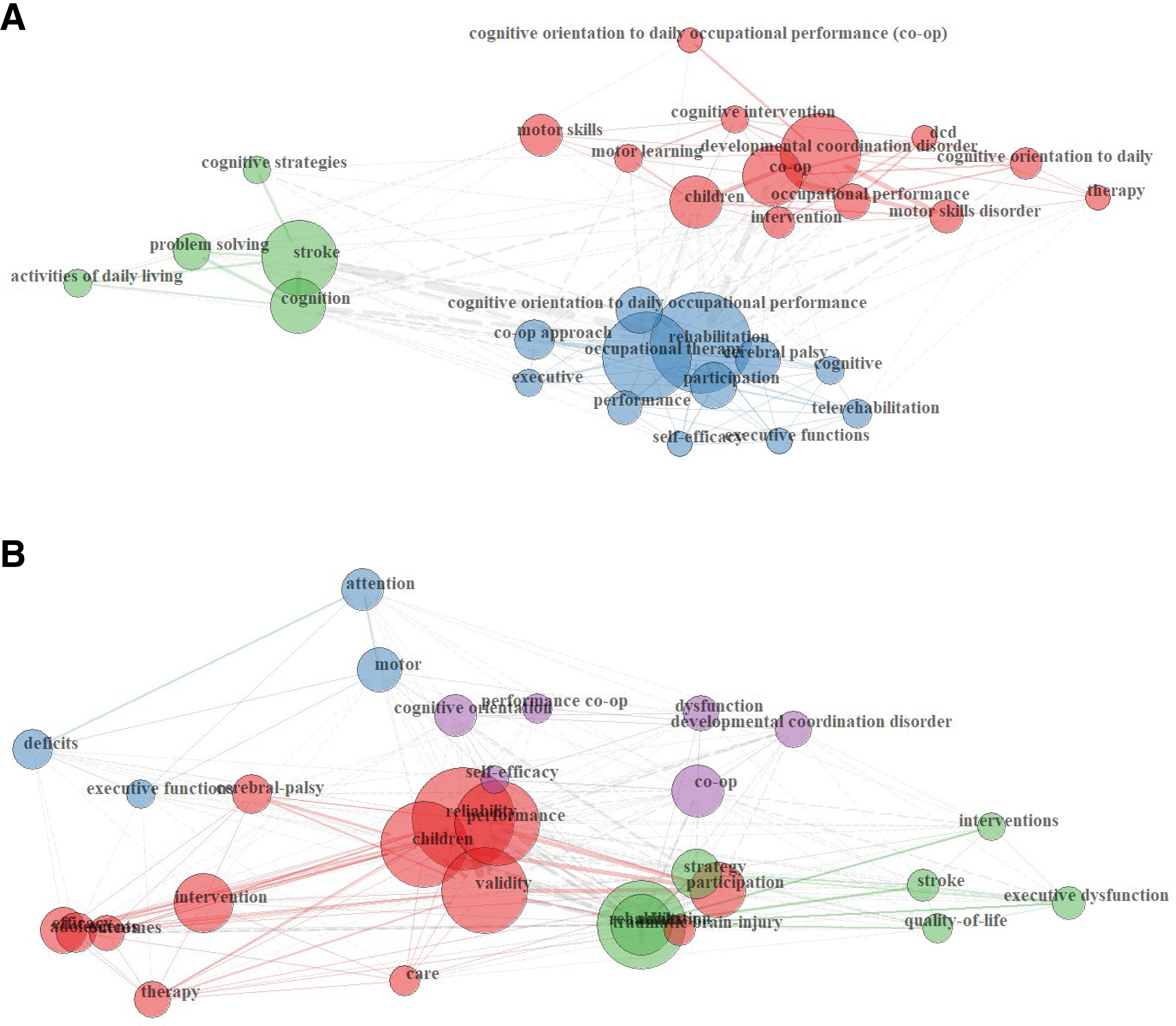
Network map of the 30 most frequently used author keywords (A) and keywords plus co-occurrences (B) in articles on the Cognitive Orientation to daily Occupational Performance (CO-OP) approach.
Figure 1a shows that the analysis of author keyword co-occurrences, when both their frequency and connections are factored in, uncovered a network structure featuring three distinct clusters of interconnected keywords. These clusters were prominently influenced by the terms developmental coordination disorder, occupational therapy/rehabilitation, and stroke/cognition. Regarding keyword-plus terms, a total of 279 unique terms were identified, with the highest frequency being 714 occurrences. The usage of these terms varied from a minimum of one appearance to a maximum of 27. The most frequently encountered keyword-plus terms were reliability (n = 27), children (n = 26), rehabilitation (n = 26), validity (n = 24), performance (n = 22), adults (n = 16), participation (n = 16), intervention (n = 15), strategy (n = 14), and CO-OP (n = 12). The examination of keyword co-occurrences, depicted in Figure 1b, pinpointed four different clusters that characterize the knowledge structure of CO-OP research between 2001 and 2024.
Discussion
Our bibliometric analysis of the CO-OP research from 2001 to 2024 reveals a research landscape characterized by gradual but fluctuating growth. The evolution of publications in this research field can be divided into two distinct phases. The initial phase, up to 2014, was characterized by slow growth, potentially because application of the CO-OP approach was in its early stages. During this phase, research on CO-OP expanded beyond its initial focus on children with DCD to encompass diverse populations and clinical conditions. However, the limited accumulation of evidence during this period, as shown by a large proportion of authors making a single contribution, may have contributed to the slow growth. In contrast, the second phase witnessed a substantial increase in scientific output, driven by factors such as the emergence of prolific authors, growing recognition of the potential applications of CO-OP, and collaborative efforts. This upward trend in research output reflects the maturation and impact of CO-OP research. In this comprehensive analysis, the results underscore both the strengths and the shortcomings of CO-OP research, emphasizing its potential to benefit health care and rehabilitation while recognizing the need for a more concerted and diversified research effort.
Starting with the original series of articles introducing CO-OP’s theoretical, operational, and empirical foundations (Mandich et al., 2001; Missiuna et al., 2001; Polatajko, Mandich, Miller, & Macnab, 2001) and protocol (Polatajko, Mandich, Missiuna, et al., 2001) in 2001, the evolution of publications in this research field unfolded in two distinct phases. The initial phase, spanning from 2001 to 2014, was characterized by a slow growth, which may be because application of the CO-OP approach was in its early stages. According to a scoping review that assessed the extent and nature of literature on CO-OP during this period (Scammell et al., 2016), most research was conducted with many diverse populations with different clinical conditions, including children, adults, and older adults. Although CO-OP was initially introduced as an innovative approach to treating children with DCD (Mandich et al., 2001), it showed versatility during this initial phase by being applied to people with a broader spectrum of clinical conditions. This included its application in diverse populations, ranging from children with autism spectrum disorder or with acquired brain injury to adults with stroke or cognitive impairment (Scammell et al., 2016). This broad scope of research, encompassing various populations and clinical conditions, might account for the limited accumulation of evidence during this first period. Moreover, the presence of a large proportion of authors (76.1%) with a transient index (PI = 0), indicating a single contribution to the field, may have contributed to the slow initial growth phase. In contrast, the substantial increase in scientific output observed in the second phase may be attributed to various factors, including the emergence of prolific authors, the growing recognition of the potential applications of the CO-OP approach, and the cumulative impact of collaborative efforts. As the research landscape evolved, the contributions of highly cited authors and the collective efforts of a more diversified group of researchers may have led to notable peaks in performance, driving the upward trend in scientific production.
The CO-OP approach, renowned for its client-centered and occupation-based nature, has predominantly been documented in rehabilitation journals, highlighting its significant influence and impact in the field of occupational therapy. However, the limited quantity of published work on CO-OP over the past two decades can be attributed to various factors, including the complexity of researching interventions such as CO-OP and the necessity for robust study designs to evaluate its effectiveness and impact. This scarcity of research studies on the application of CO-OP has been evident in scoping reviews examining the extent and nature of the CO-OP literature (Houldin et al., 2018; Scammell et al., 2016). Indeed, one important facet of research on the application of the CO-OP approach is case reports and case series.
Specifically, researchers have focused on applying the CO-OP approach with people with conditions such as DCD (Polatajko, Mandich, Miller, & Macnab, 2001), stroke (Henshaw et al., 2011; McEwen et al., 2009, 2010, 2017; Skidmore et al., 2011), ADHD (Gharebaghy et al., 2015), acquired brain injury (Lebrault et al., 2021, 2024; Ng et al., 2013), cerebral palsy and dystonia (Cameron et al., 2017; Ghorbani et al., 2017; Gimeno et al., 2019, 2020; Peny-Dahlstrand et al., 2020), and Asperger syndrome (Rodger & Brandenburg, 2009; Rodger & Vishram, 2010). These case studies have played a crucial role in advancing the understanding of the CO-OP approach and its effectiveness with various clinical populations. Case study research, contrary to misconceptions, has the potential to foster a dynamic understanding of complex challenges, enhance causal inferences, and offer valuable insights into the conditions necessary for successful intervention implementation and its subsequent effects (Flyvbjerg, 2006; Koenig, 2009). It provides context-specific, practice-based evidence and is a flexible methodology that can explore intervention efficacy and feasibility in real-life practice settings, making it valuable for demonstrating clinical impact and investigating complex phenomena (McQuaid et al., 2023a; Paparini et al., 2021). In particular, with complex interventions, such as the CO-OP approach, case study research allows for individual tailoring of interventions and has been used across various occupational therapy practice contexts, especially in areas of innovation or when resources are limited, thus contributing to the evidence base for occupation and health (McQuaid et al., 2023a, 2023b).
However, several clinical trials on this topic have been published. Although most of them have focused on school-age children with DCD (Araujo et al., 2021; Novak & Honan, 2019), yielding significant improvements not only in activity or performance but also in neuroplasticity (Izadi-Najafabadi, Gunton, et al., 2022; Izadi-Najafabadi, Rinat, & Zwicker, 2022; Izadi-Najafabadi & Zwicker, 2021), randomized controlled and uncontrolled trials have been also conducted with other populations, such as people with autism spectrum disorder (Jin et al., 2023), burn injuries (Khanipour et al., 2023), multiple sclerosis (Saeidi Borujeni et al., 2023), stroke (Dawson et al., 2024), Down syndrome (Özbeşer et al., 2024), cerebral palsy (Kolit & Ekici, 2023), or spina bifida (Peny-Dahlstrand et al., 2023), and preschoolers with DCD traits (Yasunaga et al., 2023), finding that CO-OP enables people to achieve both trained and untrained self-identified occupational-focused goals. The wide range of health conditions and populations benefiting from this approach suggests that, within the scope of top-down interventions, those interventions that explicitly teach performance-based problem-solving techniques and cognitive strategies to aid in meaningful daily challenges have the potential to be used regardless of the cause of disability.
The results of this bibliometric analysis also show that the evolution of research output in the field of the CO-OP approach may be influenced by the regional dynamics of research publication. The results suggest that Canada not only holds a prominent position in terms of research output but also plays a crucial role in fostering the growth and productivity of the field. It is important to highlight that the foundations and protocol of the CO-OP approach were developed by authors from Canadian research institutions (Mandich et al., 2001; Missiuna et al., 2001; Polatajko, Mandich, Miller, & Macnab, 2001; Polatajko, Mandich, Missiuna, & Macnab, 2001). Moreover, the affiliation of the most prolific authors in CO-OP research (Polatajko, McEwen, Dawson, and Hunt) with Canadian research institutions further reinforces Canada’s leading role in CO-OP research. Their affiliation with Canadian institutions signifies the concentration of expertise and research culture in the country, contributing to the overall CO-OP research output and impact. In parallel, it is noteworthy that Australian researchers, such as Michelle Jackman, Natasha Lanin, Iona Novak, and Elspeth Froude, have also played a significant role in the dissemination and application of the CO-OP approach on a global scale, particularly in the context of cerebral palsy and brain injury. This corroborates the versatility of CO-OP research, incorporating diverse international perspectives and contributions that have enriched both the scholarly discourse on and practical applications of the CO-OP approach.
The analysis of keywords provides valuable insights into the conceptual structure and knowledge landscape of the CO-OP research field. The prominence of certain keywords and clusters reflects the significant influence and impact of CO-OP in rehabilitation, especially in the context of children with DCD. However, it is noteworthy that the CO-OP approach has shown versatility by being applied to a broader spectrum of clinical conditions, including stroke in adults and other neurodevelopmental conditions, such as cerebral palsy. The keyword networks verified this versatility of the CO-OP approach, as evidenced by its application with diverse clinical conditions, which underscores its potential to benefit health care and rehabilitation across a broad spectrum of populations and challenges. The adaptability and effectiveness of the CO-OP approach align with its evolution from its initial development for children with DCD to its broader application in addressing a wide range of clinical conditions, contributing to the evidence base for occupation and health. Additionally, the analysis of the conceptual framework uncovered that a key aspect of CO-OP research centers on achieving a more comprehensive understanding of the underlying cognitive processes implicated in CO-OP, further enhancing the knowledge about and effectiveness of this intervention.
Limitations
We acknowledge several potential limitations that should be taken into consideration. The bibliographic data used in the analysis were obtained by conducting a search and retrieval process using the WoS database. Subsequently, these data were imported into the analysis using the Bibliometrix R package. Although the WoS database is widely used by researchers and academics to assess the significance and impact of scientific publications, it is important to note that it may have certain drawbacks (Agarwal et al., 2016; Falagas et al., 2008).
One limitation of the WoS is that the complete electronic database of journals may not be available in the WoS Core Collection. As a result, it was necessary to manually complete the search strategy to ensure comprehensive coverage of relevant CO-OP research literature. Moreover, although WoS offers detailed information for citation analysis, Scopus provides a more comprehensive overview (Agarwal et al., 2016). Notably, Scopus can provide more accurate author name information by matching authors with their affiliations (Agarwal et al., 2016). However, to mitigate potential limitations, the bibliographic information underwent independent revision by two researchers (Valera-Gran and Navarrete-Muñoz) to identify any potentially misleading or missing data.
Despite these limitations, the findings of this study offer valuable insights into the CO-OP approach, serving as an important resource for scientific researchers and clinicians in the field. For instance, occupational therapists interested in the application of CO-OP with people with several health conditions can use these findings to identify the potential strengths and limits of this approach in each case and thus better inform their clinical decisions and evidence-based practice. Moreover, this study pinpoints the special interest of published research on this topic regarding the underlying mechanisms responsible for CO-OP’s effectiveness, which can be used by clinicians to better understand and pay attention to the cognitive strategies that need to be used to aid in the transfer and generalization of learning.
This bibliometric analysis also makes a great contribution to future research because it shows the areas in which the body of knowledge on CO-OP is growing in interest and robustness. Researchers can use the findings of this study to easily identify potential topics that may be promising for further investigation, such as conducting more randomized controlled trials and expanding the research focusing on the mechanisms underlying CO-OP’s effectiveness with different populations. Therefore, the results of this bibliometric analysis can optimize the personal and economic resources required for future research. In addition, it is worth emphasizing that other researchers have conducted bibliometric analysis with the Bibliometrix R package, allowing for potential comparability with future studies.
Implications for Occupational Therapy Practice
This bibliometric review has the following implications for occupational therapy practice: ▪ The CO-OP approach has a relevant impact in clinical rehabilitation, especially in the context of children with DCD. ▪ The CO-OP approach is a highly versatile intervention that can be effectively used with a wide range of clients, including people with DCD, ADHD, or cerebral palsy. ▪ The findings regarding the underlying cognitive processes involved in this intervention approach can inform occupational therapists to further improve task learning and transfer. ▪ The CO-OP approach can be used to increase occupational performance and participation.
Conclusion
This study shows that CO-OP is an area of research that has garnered significant relevance in recent years. The scientific production in this field has seen a gradual evolution, with a notable increase in the number of publications observed recently, particularly in specific study areas. Currently, research on CO-OP encompasses a wide range of different study areas, but significant efforts seem to be aimed at developing two main lines of research. One line of research focuses on acquiring a better understanding of the underlying cognitive processes involved in CO-OP, including detailed knowledge of the cognitive strategies and mechanisms that contribute to improved occupational performance. The other line of research adopts a clinical epidemiology approach, seeking to establish the relationship between CO-OP and various disease processes to enhance the understanding of how this intervention can be used to effectively address the needs of individuals with different conditions. This study offers great potential as a bibliometric pattern for scientific researchers and clinicians engaged in the CO-OP field. By providing comprehensive analyses and structured information, it enables researchers and practitioners to discern research focal points and identify areas that require further investigation. We hope this study will facilitate the advancement of knowledge and enhance the practical application of CO-OP interventions within the process and outcomes of occupational therapy.
Supplemental Material
Supplementary material for Research on the Cognitive Orientation to daily Occupational Performance Approach: A Bibliometric Review
Supplementary material, sj-pdf-1-aot-10.5014_ajot.2024.050802.pdf for Research on the Cognitive Orientation to daily Occupational Performance Approach: A Bibliometric Review by Desirée Valera-Gran, Laura Delgado-Lobete, Rebeca Montes-Montes and Eva María Navarrete-Muñoz in The American Journal of Occupational Therapy
References
Supplementary Material
Please find the following supplemental material available below.
For Open Access articles published under a Creative Commons License, all supplemental material carries the same license as the article it is associated with.
For non-Open Access articles published, all supplemental material carries a non-exclusive license, and permission requests for re-use of supplemental material or any part of supplemental material shall be sent directly to the copyright owner as specified in the copyright notice associated with the article.
