





Abstract
The articles for the Special Section on Play highlight the complexity of play and the many ways occupational therapy practitioners study and promote play with children, families, and adults across individual, school, family, political, and cross-cultural settings. The authors of the articles in this issue view the importance of play across the lifespan and through multiple research lenses, including play preference, environmental supports for and barriers to play, the skills required to succeed in play, and the extent to which play is self-determined. The guest editors offer suggestions for how to enhance occupational therapy’s voice in the study and promotion of play as a primary lifelong occupation.
The guest editors for the Special Section on Play offer suggestions for how to enhance occupational therapy’s voice in the study and promotion of play as a primary lifelong occupation.
Occupational therapy practitioners claim play as a primary lifelong occupation. Linking play with belonging, recent occupational therapy theorists have identified the importance of play to well-being (Bundy et al., in press). Thus, occupational therapy practitioners have a responsibility to assess it, promote it, and study it. In the occupational therapy literature (American Occupational Therapy Association [AOTA], 2020), play is defined as “activities that are intrinsically motivated, internally controlled, and freely chosen and that include freedom to suspend reality” (e.g., fantasy; Skard & Bundy, 2008, as cited in AOTA, 2020, p. 34). In addition to activities people commonly think of, play can involve exploration, humor, risk-taking, contests, and celebrations (Eberle, 2014; Sutton-Smith, 2009). Importantly, play is self-determined. What one individual considers to be play (e.g., taking a bubble bath or skydiving) may be viewed by another as self-care or just plain risky behavior.
The Complexity of Play
Play is a complex, multidimensional phenomenon shaped by sociocultural factors (Lynch et al., 2016; Lynch & Moore, 2016). As a complex occupation, many factors contribute to and affect play. Bundy (2011) listed five such factors: preferred play activities, skills one uses in play, playfulness (i.e., the approach to play and other activities), physical and social environment, and source of motivation for play. Depending on the needs of a particular individual, occupational therapists choose which area or areas to target for assessment, intervention, or research (Figure 1). Although, in general, no one of these factors is more important than any other, for any individual one or more may have the greatest positive or negative influence and, thus, may be the best target for assessment or intervention.
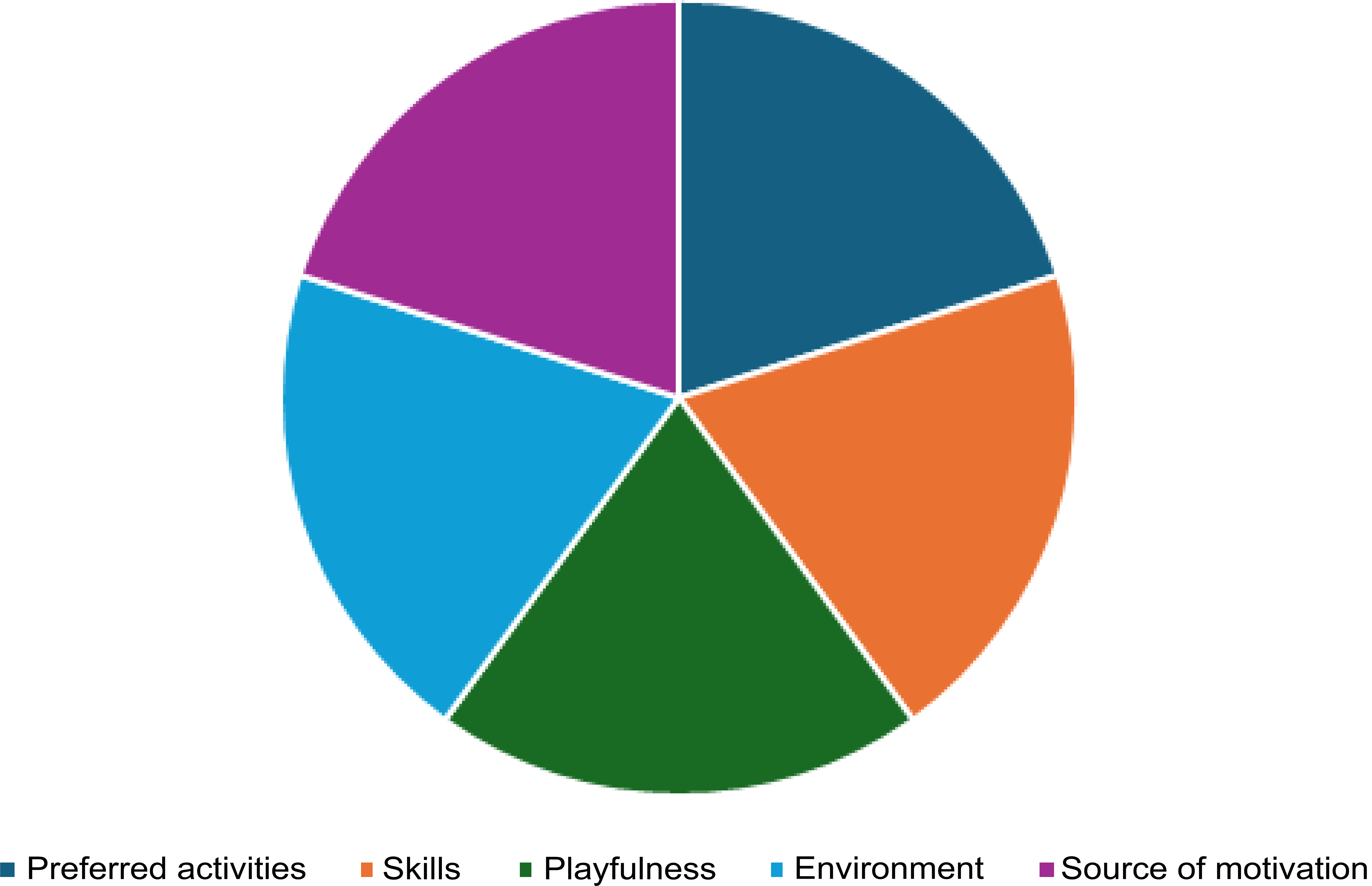
Factors contributing to play.
In this special issue, the guest editors highlight the complexity of play and its myriad features across the lifespan, viewing it through multiple research lenses (Kuhaneck et al., 2024). The articles included provide insights into ways occupational therapists study and promote play with children, families, and adults across individual, school, family, political, and cross-cultural settings. These articles can be categorized by the play-related factors they highlight.
Of the listed play factors, supportiveness of the environment is, arguably, the most important. Morgenthaler et al. (2024) report on environmental affordances and barriers in the physical environment, and Fabrizi and Tilman (2024) focus on the social environment, studying parent and teacher behaviors. In a related vein, articles by Alarawi et al. (2024) and Román-Oyola et al. (2024) reveal new instruments for assessing the social environment, specifically adults’ promotion of their children’s play.
Having the skills to succeed in play is an additional factor. In this issue, Flanagan et al. (2024) and Inamdar et al. (2024) focus on particular skills they relate to children’s play. Serrada-Tejeda et al. (2024) describe the contribution of praxis to play skills and playfulness. Wadley and Stagnitti (2024) report on the results of a study to support the development of pretend play and related skills. Play objects also affect play skills, and there is a clear need for research focusing on objects that promote skill development in a playful way. Here, Srinivasan et al. (2024) report on an adapted single joystick–operated ride-on toy aimed at increasing the engagement of children with hemiplegic cerebral palsy while also facilitating use of their affected arms.
Play preference is another important play factor. Rivas-Quarneti et al. (2024) used Photovoice and participatory action methods to learn children’s priorities for playgrounds and document conflicting agendas between adults and children. In reporting on adults’ preferences for and perceptions of play, Blanche et al. (2024) offer insights into play as a lifelong occupation.
Finally, and as noted previously, play is self-determined. Prior occupational therapy researchers (e.g., Blake et al., 2018; Fahy et al., 2021) examined play using a neurodiverse lens and portrayed autistic play as “differently social.” In this issue, Coughlan and Lynch (2024) describe playing alongside others as social, rather than solitary, and onlooking as a form of participation. If viewed through a purely developmental lens, this play would be labeled deficient. However, because play is self-chosen, when children choose to participate as onlookers, their choice must be honored.
Opportunities to Promote and Support Play
The articles in this special issue also consider the effectiveness of occupational therapy and explore ways in which occupational therapists support and promote play through their intervention. For example, McQuiddy et al. (2024) report the long-term impact of occupational therapy intervention using the play-based intervention of Ayres Sensory Integration®, focusing on the just-right challenge for each child. The just-right challenge is a critical aspect of all occupational therapy intervention. Occupational therapists’ skill in creating the just-right challenge allows children receiving intervention to experience the joy of play. The important concept of the just-right challenge is explored historically by Kuhaneck and Spitzer (2024).
Occupational Therapists as Champions of Play as an Occupation
Although occupational therapy has made great strides, there is a long way to go. Students and practitioners need to consistently learn about play as an occupation, existing measures for play assessment, and means of promoting play as an occupation. Survey research continues to call into question the extent to which this is occurring (Couch et al., 1998; Lynch et al., 2018; Miller Kuhaneck et al., 2013; Mitchell et al., 2018).
The editors suggest the following possibilities to enhance occupational therapy’s voice in the study and promotion of play. First, perhaps researchers and play experts can jointly create training modules and make them freely available on the web. Second, although professionals from many disciplines study and use play and multidisciplinary international organizations and conferences exist that focus on play, occupational therapists do not always belong to these groups and attend these conferences. Perhaps new spaces could be created at these events, and elsewhere, for occupational therapy researchers and practitioners to gather on a regular basis to support research collaboration and enhance continuing education opportunities specifically about play. Third, although practitioners often endorse play as an important lifelong occupation, in practice play is more often used as a medium than an occupation. This must change if we are to fully embrace our role as champions of play. Occupational therapists need to advocate for play in every space in which they work, fighting for the important right of children to be able to play. The editors of this special issue offer this warning to all readers: If you take play seriously (and we hope you will), it may cause you a great deal of difficulty.