





Abstract
This is a scale development study of the Occupational Justice Scale for Refugees, which was developed by the authors and is the first scale designed specifically to measure the levels of occupational justice experienced by refugees.
Refugeeism is a large and complex problem internationally. By the end of 2022, there were 108.4 million forcibly displaced people worldwide (United Nations High Commissioner for Refugees [UNHCR], 2023). People who have crossed an international boundary in search of protection in another nation after fleeing war, violence, conflict, or persecution are considered refugees (Fabianek et al., 2023). One of the biggest mass population movements in global history is that of Syrian refugees. With 3.6 million refugees, or 10%, of all people displaced across borders, Turkey remains the world’s largest host country (UNHCR, 2023).
It is hard for someone who has never experienced refugee status to comprehend the difficulty in being excluded from fulfilling occupations that you have valued. Many refugees are fleeing situations where they have been victims of violence or persecution and have often experienced a level of trauma from which they may never fully recover. This trauma can be further intensified by a prolonged period of deprivation from participating in familiar activities that typically provide structure, meaning, and coherence to daily life. Refugees are one of the most disadvantaged groups to experience occupational injustice (Mirza, 2012; Shannon et al., 2015; Shin & Lee, 2015).
It is known that engaging in occupations has a positive effect on a person’s health and well-being (Bar & Jarus, 2015). However, as refugees practice their professions in their daily lives, they experience injustice in various areas. With the development of community-based occupational therapy practices and occupational science, the issue of occupational justice has begun to be discussed. Refugees are the natural population of this issue (Hocking, 2017).
The difficulties that refugees experience negatively affect their quality of life, motivation, well-being, and participation. Occupational justice is a comprehensive concept that gathers these difficulties under a broad umbrella. Many studies that were conducted with refugees have explained these difficulties in the context of occupational justice and emphasized their importance (Cipriani et al., 2020; Krishnakumaran et al., 2022). Therefore, we think that it is extremely important to determine the levels of occupational justice to maintain the health and well-being of refugees. We think that the Occupational Justice Scale for Refugees (OJS–R) will help occupational therapists determine the levels of occupational justice experienced by refugees, shape the intervention programs to be developed, and conduct studies of refugees.
Occupational Justice
The World Federation of Occupational Therapists (WFOT; 2019) emphasizes that displacement indirectly influences the ability to engage in occupational opportunities. Because they support occupational justice, occupational therapists provide care to displaced people. Occupational justice is defined as the right of everyone to equal opportunities, the fulfillment of their potential, and the satisfaction of their fundamental needs. This is specifically accomplished by engaging in a variety of fulfilling occupations (Wilcock & Townsend, 2009).
Occupational justice is a powerful concept that connects people’s well-being with social conditions that may limit their potential (Aldrich et al., 2017). The concept of occupational justice is often considered a subset or complement of social justice, emphasizing the fair distribution of social resources and respectful treatment of people. It is important to maintain objectivity and avoid subjective evaluations when discussing this topic (Hocking & Townsend, 2015; Nilsson & Townsend, 2010).
The idea of occupational justice includes a critical view of social institutions that supports political, social, and economic transformations so that people may realize their full potential in the workplace and enjoy well-being (full citizenship) (Crepeau et al., 2003). The concept is closely related to Wilcock’s vision of a world that supports occupational justice through public health and social initiatives, as well as Townsend’s ethical, moral, and social inclusion of people in the everyday occupations of societies to ensure empowerment and engagement in professional practices with a civic commitment (Townsend & Wilcock, 2004; Wilcock & Townsend, 2000).
Although the concepts and definitions are evolving, the concept of occupational justice, such as any concept, will vary depending on sociocultural contexts such as age, ability, gender, social class, or other differences (Christiansen & Townsend, 2010; Townsend & Wilcock, 2004; Wilcock & Townsend, 2000). Occupational injustice is the result of social policies and governance that restrict the participation of a particular group in daily activities (Townsend, 1993).
The governance of societies is structured in a way so that some individuals enjoy social acceptance, privilege, and the freedom to choose their actions but others face restrictions such as social exclusion and limited participation in daily activities (Whiteford, 2003). It is important to prevent such situations, to determine the areas in which people experience occupational injustice, and to examine the impact of this situation on people.
Occupational Injustice
The term occupational injustice was first introduced in 2004 to describe situations that lead to stressful occupational experiences and the lingering effects of those situations (Hammell & Beagan, 2017; Olivares-Aising, 2018). By discussing the relationship between occupational justice and client-centered practices, Townsend and Wilcock (2004) developed the concepts of four types of occupational injustice: occupational alienation (in which people are unable to participate in an occupation for some reason), occupational deprivation (in which an occupation is not available to people), occupational marginalization (in which the occupations of certain people are considered unimportant), and occupational imbalance (in which people experience too much or not enough of their occupations; Townsend & Wilcock, 2004). Later, the concept of occupational apartheid (in which participation in occupations is denied through discrimination) was added (Durocher et al., 2014).
Especially disadvantaged people—such as prisoners; homeless people; battered women; people who identify as lesbian, gay, bisexual, transgender, queer, or questioning; and refugees—experience occupational injustice. Refugees, whose population is increasing around the world, are facing problems in many areas. Limited social rights and the fact that they are not in their homeland draw refugees into circumstances where they experience occupational injustice. In this context, we try to evaluate the concept of occupational justice and the positive changes that these concepts create in human life and societies. For this reason, we think that, in this study, the occupational injustice experienced by refugees, who perhaps constitute the numerically largest part of the disadvantaged groups, should be measured primarily.
Various scales are related to occupational balance (OB), social justice, and racism and discrimination. However, it is noteworthy that there is a lack of a scale that examines occupational justice in a broad framework and expresses the feelings of refugees on this issue well. For these reasons, we developed the OJS–R specifically for refugees.
We conducted an in-depth study of the occupational injustices that refugees experience, covering the five basic subareas that constitute occupational injustice. We wanted to highlight the great contribution that occupational justice can make to the creation of an inclusive society. In this study, we aimed to develop a comprehensive scale to evaluate justice for refugees in Turkey according to the OJS–R. Additionally, the study aimed to explore the five-factor structure of OJS–R through the developed scale and examine its psychometric properties, validity, and reliability.
Method
Study Design
The present research is a methodological study in which the OJS–R was developed and validated. Although there are publications about occupational justice in the literature, there is no scale that evaluates occupational justice. The present study is based on the Framework of Occupational Justice, which explains occupational justice using five factors (Townsend, 2012). We also used the Occupational Balance Questionnaire–11, Turkish version (OBQ11–T) to assess OB (Günal et al., 2020). The standardization and scale development procedures created by Kyriazos and Stalikas (2018) were followed in a four-step procedure. Each participant received an informed consent form and the OBQ11–T at every stage of the study.
Participants
The study included participants who were refugees residing in various cities across Turkey with different cultures. Among these cities, Istanbul and Ankara are the largest, most cosmopolitan metropolises in the west of the country, where living conditions are difficult. Elazığ and Bingöl are small cities located in the east of the country, where living conditions are easier and the people are from a culture closer to that of the refugees. These features were effective in the selection of these cities.
Participants had to fulfill the following requirements for inclusion: They had to be age 18 yr or older, be Syrian, and have arrived in Turkey after the onset of the Syrian Civil War, which began in March 2011. Exclusion criteria were not an oral proficiency in Turkish and a cognitive problem that would prevent understanding the questions.
We first conducted a pilot study. The pilot study participants (n = 30) were different from the study participants (n = 603), but they met the same criteria.
Developing the Scale
The scale was designed to assess occupational justice with refugees. The five main components created based on the Framework of Occupational Justice (Fabianek et al., 2023) are occupational deprivation, occupational alienation, occupational imbalance, occupational marginalization, and occupational apartheid. We carried out extensive literature research on refugees to find relevant articles and created a pool of 69 potential items. The literature recommends using 5-point Likert-type scales with midpoints for participants to choose between disagreement or agreement options (Chyung et al., 2017).
In the item construction phase, using the Davis technique, a group of 12 experts, including 7 occupational therapists, 2 psychologists, 2 physical therapists, and 1 sociologist (10 academics, 2 clinicians, and 5 experts who were both clinicians and academics), evaluated the draft items for importance, content, clarity, and appropriateness. Each item was evaluated by experts as “appropriate,” “requires significant revision,” “needs small revision,” and “inappropriate” (Davis, 1992). According to the Davis technique, the equation for the content validity index (CVI) is as follows: (number of experts who say the item is appropriate + number of experts who say the item needs minor revision)/total number of experts. A CVI greater than .80 is required for each item and scale total. For this reason, items with a CVI less than .80 were excluded from the scale (Davis, 1992). After expert consultation, the scale was reduced to 52 items.
For the pilot study phase, according to the literature, a minimum of 30 pilot study samples is required (Morgado et al., 2018). The draft scale was applied to refugees in different provinces of Turkey. In the pilot application, inclusion criteria were also applied. The refugee was given the scale draft form and asked to respond to the following questions: Can you understand the items on the scale? Are there any misunderstandings? Are there any items that you would recommend? To improve comprehension, eight items were rearranged.
Pilot participants asked for items such as “I feel guilty about being a refugee,” “I feel assimilated,” “I am having an identity crisis,” and “I feel stateless” to be removed from the scale because they did not reflect their true feelings. They also stated that they did not want to answer the questions about “polygamy” and the “social life of their daughters,” because they were related to their private lives. They also asked for these questions to be removed from the scale because they did not have any knowledge or opinion about the “Turkish economy” or “Turkish politics.” Refugees found the items on “being forced to engage in illegal activities,” “being inclined to acts of violence,” and “being inclined to radical tendencies” incriminating and asked for these items to be removed from the scale. In response to the participants’ feedback, the experts reduced the number of items to 36. Thus, the universality of the scale was also preserved by removing items specific to Turkey. Before proceeding to the analysis, we revised the scale to its final version. The sample size for the analysis was calculated as 15 times the number of items (N = 603; Morgado et al., 2018).
Measures
Informed Consent Form
We used the sociodemographic information form to collect the basic demographic characteristics of the participants. This form includes variables such as participants’ age, gender, marital status, ethnicity, education level, place of residence, and number of people living in the house (Table 1).
Participant Sociodemographic Information
Note. N = 603. Participants’ ages ranged from 18 to 80 yr (M = 38.6, SD = 3.42). Number of years that participants lived in Turkey ranged from 1 to 8 yr (M = 4.82, SD = 1.3).
Occupational Balance Questionnaire–11, Turkish Version
OB, one of the subfields of occupational justice where refugees experience problems (Darawsheh, 2019), was measured with the OBQ11–T (Wagman & Håkansson, 2014). Because we included refugees who speak Turkish in our study, we used the Turkish version of the OBQ11–T as the gold-standard scale in our study (Günal et al., 2020). Responses were provided on a 4-point Likert scale, with values ranging from 0 (strongly disagree) to 3 (strongly agree). The total score is obtained by summing the individual items and ranges from 0 to 33, with higher scores indicating a higher level of OB.
Occupational Justice Scale for Refugees
The OJS–R is a scale consisting of five subdomains developed to assess occupational justice for refugees: Occupational Deprivation (six items), Occupational Alienation (six items), Occupational Marginalization (five items), Occupational Apartheid (six items), and Occupational Imbalance (seven items), totaling 30 items. The scale uses a 5-point Likert structure, ranging from 1 (strongly disagree) to 5 (strongly agree). All items on the scale are positively worded, and as the total score increases, the level of occupational justice decreases.
Main Data Collection Procedure
For the data collection, which the researchers conducted using their own means, the researchers went to the regions where the refugees who had been informed about the research interest lived, contacted the authorized persons related to the refugees, and moved to those regions. Researchers (n = 2) conducted face-to-face interviews with refugees living in different accommodation conditions (villas, residences, apartments, refugee camps, and homeless) in four different cities in Turkey. Individuals were excluded from the study if any language barrier was encountered. These interviews were held in quiet environments (e.g., home gardens, private offices, cafes, and parks) where participants could understand and answer questions freely. During these interviews, participants were asked to complete the informed consent form, the OBQ11–T, and the OJS–R. The contact information of the participants who agreed to be interviewed again for the retest was obtained; the participants were contacted again 14 days later, and the scales were administered again in the same environment. Data collection continued between January 2022 and March 2023.
Statistical Analysis
After the data were collected, all information was imported into the IBM SPSS Amos 23 and IBM SPSS Statistics (Version 23) programs. We assessed the study data using the frequency distribution for categorical variables and descriptive statistics (mean and standard deviation) for numerical variables. Table 2 and Table 3 display Cronbach’s α values for reliability, Pearson correlation analysis for test–retest fit, interclass correlation coefficient (ICC) analysis for interrater fit, and exploratory factor analysis and confirmatory factor analysis (CFA) for scale validity. This study used a significance threshold of 0.05. In CFA, the model’s compatibility with the theory is determined on the basis of the results of various fit indexes. To test the goodness of fit of the model, we used the ratio of the chi-square and degrees of freedom (χ2/df), goodness-of-fit index (GFI), Tucker–Lewis index (TLI), incremental fit index (IFI), comparative fit index (CFI), root-mean-square error of approximation (RMSEA), and standardized root mean square (SRMR; Table A.1 in the Supplemental Material, available online with this article at https://research.aota.org/ajot; Albright & Park, 2009). The study had four phases: item construction, scale development, data collection, and scale assessment. A diagram of this study process is shown in Figure A.1 in the Supplemental Material.
Results of Confirmatory Factor Analysis Testing Factorial Validity of the OJS–R
Note. OJS–R = Occupational Justice Scale for Refugees.
Internal Consistency and Reliability of the OJS–R
Note. OJS–R = Occupational Justice Scale for Refugees.
Results
Sociodemographic Information
In the present findings, 62.6% of our participants were male, and 37.4% were female; 45.6% were married, and 54.4% were unmarried. Because our participants are Syrian refugees, ethnically, the majority were Arab (54.2%). With regard to education level, 4.4% were illiterate, and 6.4% reported having a graduate-level education, but most of the participants (35.7%) reported having a primary school. With regard to place of residence, 52.9% of the participants, like most of Turkey, lived in an apartment, 16.5% were in refugee camps, and 5.2% were homeless. The number of people the participants reported living with was 3 (19.4%); 4 (23.7%) and 5 (24.4%) constituted the majority. The sociodemographic characteristics of 603 Syrian refugees are presented in Table 1.
Psychometric Scale Properties
Construct Validity Results
Interscale correlations of the OBQ11–T and OJS–R were examined as convergent validity, and a statistically significant correlation was found between the scales (r = .285, p < .001).
Exploratory Factor Analysis Results
First, we conducted an exploratory factor analysis, using principal components as the method for factor extraction. There was no restriction on the number of parameters, and the varimax transformation was applied. Expressions greater than .500 were added to the factor loadings.
The Kaiser-Mayer-Olkin value of the measurements was found to be .905. Consequently, it was found that the practical and advantageous factor analysis findings applied to the data were obtained. Strong correlations between the variables were found using the Bartlett sphericity test, suggesting that component analysis may be performed with the data, χ2(435) = 3,748.899, p < .001.
It was required that the factor load in the literature be more than 0.4 (Ferguson & Takane, 1989). The bigger the factor load, the more the explanatory power of the items is taken into consideration (Tabachnick et al., 2013). The result of the applied factor analysis was to reduce the number of items from 36 to 30. After it was determined that these 12 items had content validity, they were grouped into five factors with factor loadings that were all more than .500.
For these five components, Table 2 shows the factor loadings, item distribution, and total variance explained. The OJS–R explains 70.179% of the overall variance. Moreover, the eigenvalues are equal to the sum of the squares of the factor loadings. The fact that there are many sums for each dimension indicates that, when considered collectively, the questions grouped under this dimension are sufficient to characterize it. The eigenvalue of the dimensions can be seen to be greater than 1.
Confirmatory Factor Analysis Results
On the data for 603 participants, we conducted confirmatory factor analysis using the IBM SPSS Amos 23 program. The first step was to create the first-order CFA model (Figure 1) to which the five-factor dimensions were added as endogenous factors, and the expressions that make up these factors were included as indicator variables. Because the latent variables are not metric, one of the routes constructed from the latent variables to the observed (indicator) variables must be assigned a value of 1 (factor loading equal to 1), or the variance of the latent variable must be assigned a value (usually 1) (Hair et al., 2006).
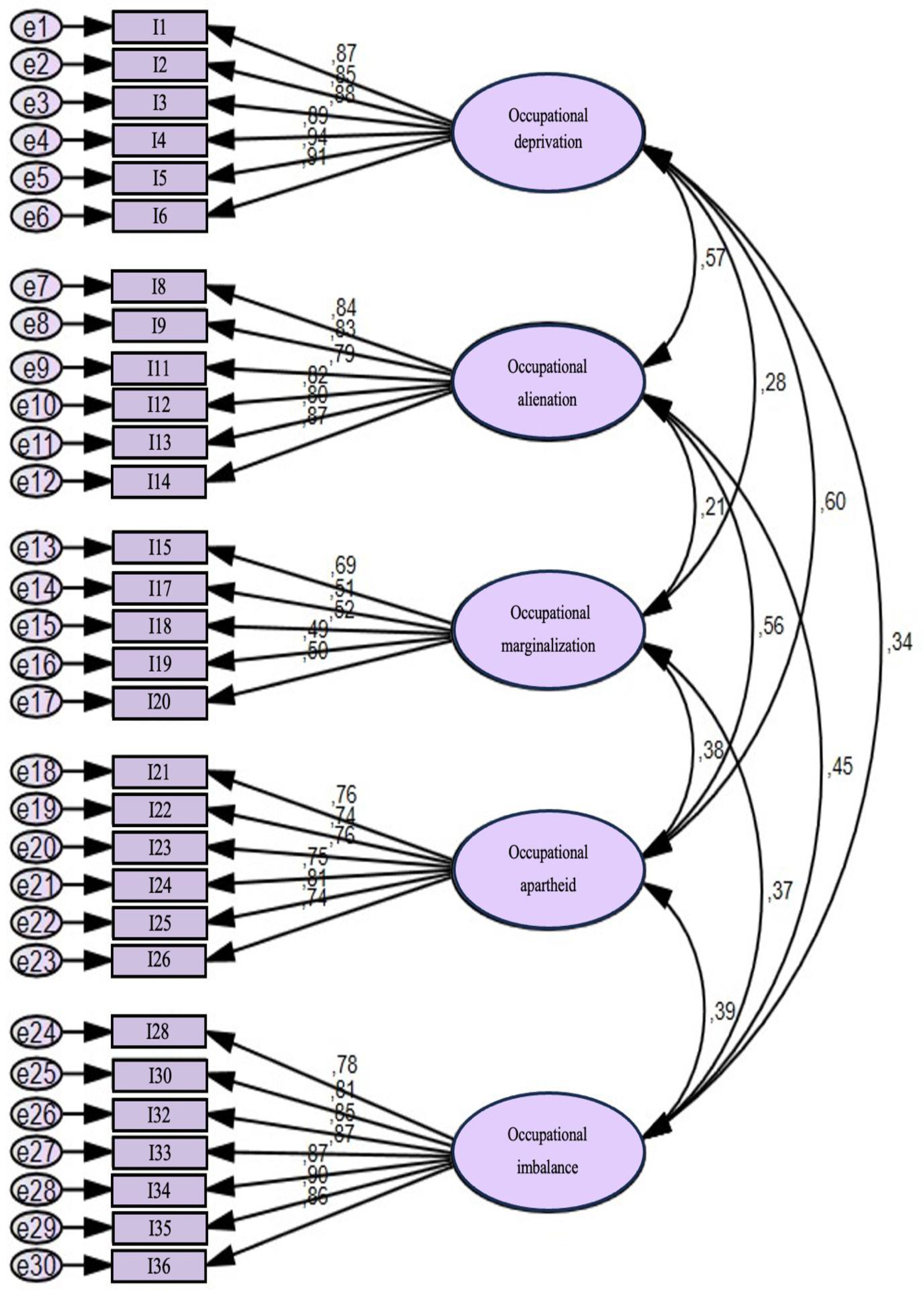
Five-dimensional first-order CFA model of the OJS-R
The model was estimated in the second stage using the maximum-likelihood technique, which is widely used in structural equation models and produces reliable results even when the data are not normally distributed. The latent variable variances, the observed variable errors, and the regression coefficients of the routes connecting the latent variables to the observed variables were among the parameters that needed to be evaluated. A bidirectional association between the highest modification index value mistake words observed in the OJS–R Item i35 and Item i36 questions was discovered to improve the fit indices.
The fit indices for the five-dimensional, first-order CFA model were examined in the last stage. In an examination of the results, the five-factor structure of the OJS–R, consisting of 30 statements, generally fits well.
The fit values obtained were examined and found to be good: χ2/df = 1.455, TLI = .945, IFI = .950, CFI = .950, RMSEA = .053, and SRMR = .049 (Hu & Bentler, 1999; Meydan & Şeşen, 2011; Tabachnick et al., 2013). The fit indices of the OJS–R were generally acceptable (Table A.1).
Reliability Analysis Results
In the assessment of the dependability of scales, one of the most used measures is Cronbach’s α, which is a measure of internal consistency. The Cronbach’s α was calculated in conjunction with the Occupational Justice Scale parameters. This value is generally above the suggested cutoff point of .70 (Nunnally, 1978).
If the item–total score correlation coefficient is less than .30 (with a sample size of 400 or more, .20 is acceptable), it is deemed that there is a substantial problem with these items, and they can be removed from the scale. An item–total correlation value of .30 or more is regarded as dependable. However, it is not the only criterion used to exclude items below this cutoff; the item’s effect on the Cronbach’s α coefficient is also taken into account (Alpar, 2022; Sencan, 2005). The investigation revealed that Items i18, i19, and i20 had Cronbach’s α values less than .30. Nevertheless, when conducting an item analysis, we concluded that no item needed to be removed from the scale, because the removal of an item did not materially change the Cronbach’s α.
After the scale’s second application to 155 refugees, the test–retest analysis revealed that the Pearson correlation coefficients and ICCs for all of the subdimensions were found to be greater than .90.
With an ICC analysis for interrater evaluation, the OJS–R’s ICC value was found to be .991. The results of the applied Pearson correlation analysis indicated a flawless positive relationship between the scale readings from the test and the retest (14 days later; r = .987, p < .001).
A complete positive connection between the OJS–R subscales and the overall scores was discovered when the correlations between the variables and the total scores were examined (Occupational Deprivation, r = .987, p < .001; Occupational Alienation, r = .978, p = .009; Occupational Marginalization, r = .979, p < .001; Occupational Apartheid, r = .967, p < .001; and Occupational Imbalance, r = .983, p < .001).
Discussion
The purpose of this research was to develop the OJS–R, a tool for examining the occupational injustices experienced by refugees. The study found that a new 30-item scale, based on the Framework of Occupational Justice, theoretical background, and experience, has suitable psychometric properties for therapists and reflects Turkish culture. The importance of policy and legislation relevant to the rights of refugees to receive meaningful services is emphasized by both the WFOT and the current literature (Maroney et al., 2014; Smith et al., 2014; Wilcock & Townsend, 2009). In addition, there are many publications on the theoretical background and philosophy of occupational justice (Whiteford et al., 2018). Townsend and Whiteford (2005) stated that the Participatory Occupational Justice Framework (POJF) is a relevant and valuable tool for understanding occupational justice. However, we found no scale in the literature that evaluates occupational justice. We developed the OJS–R as based on the core values of the POJF and developed the first (to our knowledge) occupational justice scale.
All participants reported that living in a refugee camp, being homeless, and living with too many people at home negatively affected occupational justice. Notably, living conditions affect both social justice and occupational justice (AlHeresh et al., 2013). There would be no occupational justice without social justice (Jakobsen, 2004). We believe that the OJS–R examines in depth the sociodemographic situations, living conditions, and occupational injustice that refugees experience. In the interviews, female refugees reported that being unmarried was one of the most important reasons why they experienced occupational injustice. Being unmarried is difficult for a woman because of the culture of Syria, where the refugees come from, and the culture of Turkey, where they live. Additionally, married refugee women were hesitant when answering questions. Therefore, culture directly affects occupational justice and the scales to be developed in this regard.
One of the key ideas in occupational therapy that always interests occupational therapists is OB (Wagman et al., 2012). Occupational therapists believe that OB is the foundation of well-being, happiness, and health (Hernandez et al., 2023). We used the OBQ11–T when examining the participants, because we thought that refugees also had difficulties in occupational imbalance, which is one of the subfields of occupational justice (Belhan Çelik et al., 2022; Huot et al., 2016). When the results were examined, a positive and significant correlation was found between the OJS–R and the OBQ11–T. In other words, as the refugees’ level of occupational injustice increased, their level of occupational imbalance also increased.
Although there are good reasons to suspect a connection between refugees and occupational justice (as measured by the OJS–R), to our knowledge, this is the first study that empirically demonstrated an association between the two. Our expert panel, assembled within the scope of the study, ensured alignment between the purpose of the study and the data collection tool, and high CVI scores indicated that the OJS–R had good content validity. The scale’s construct validity was confirmed through the analyses. Exploratory factor analysis results revealed that the OJS-R has a five-dimensional structure consisting of all subdomains. All these factors are discussed in detail elsewhere.
Cronbach’s α coefficient measures the relationship between different elements or items of a measurement instrument and indicates, with a value between 0 and 1, how well different elements of a scale agree with each other: The higher the value, the higher the internal consistency of the measurement tool. We found the Cronbach’s α used in the scale reliability analysis to be higher than .70 (Nunnally, 1978), which is the acceptable value for the OJS–R (.937). Cronbach’s α values for the subdomains of the OJS–R are as follows: Occupational Deprivation, .958; Occupational Deprivation, .958; Occupational Alienation, .927; Occupational Apartheid, .891; and Occupational Imbalance, .947. The high α value in these subdomains indicates that there is very strong internal consistency among the items used to measure these subdomains of the OJS–R. This suggests that the OJS–R reliably measures these domains and that items in this domain are consistent with each other. These results show that the OJS–R is a reliable scale.
An examination of the Cronbach’s α of the Occupational Marginalization .670 subdomain shows some weak internal consistency among the items in this subdomain of the OJS–R. This may indicate that when measuring the OJS–R’s “occupational marginalization” concept, refugees give different answers, and there is no clear consensus. However, we think that the weak internal consistency is due to the refugees’ inability to interpret the occupational marginalization they experience because their social environment is generally composed of other refugees.
First and foremost, refugees who live in poor conditions, under political and social pressure, and experience the deepest social and occupational injustices face the problem of being seen as human. If this problem is not well assessed and various intervention and integration programs are not implemented, the problem may grow and worsen. Eventually, no one will be able to escape the consequences of this injustice, and, unfortunately, it is an inevitable fact that everyone will be negatively affected. Perhaps more than anyone else, the burden falls on the shoulders of occupational therapists in this regard. Because occupational therapists, who aim for everyone in society to participate in life in an independent and well-being state, will find it difficult to practice without confronting this great problem. This is why the OJS–R provides a way for occupational therapists to assess the occupational injustices experienced by refugees and, most important, to develop intervention and integration programs. Developing new assessment tools that consider the cultural characteristics of refugee communities in Turkey and around the world is crucial for enhancing clinical practices related to refugees, particularly in occupational therapy. Furthermore, it will be necessary to evaluate the validity and reliability of the OJS–R in diverse societies and cultures to promote the use of this scale.
The participants in this study were refugees living in Turkish culture. Refugees live within the political, social, and cultural structures of their host country. Therefore, the occupational justice of refugees depends on these structural factors. It is important to consider culturally appropriate services to address occupational injustices (Darawsheh, 2019; Maroney et al., 2014). One of the strengths of the scale is that the study applies to refugees living in different cities, different cultures, and different living conditions. However, the limitations of our study were that we chose only four cities to test the scale and that negatively worded items were not added to the scale to avoid reverse scoring.
Implications for Occupational Therapy Practice
The problems encountered in supporting refugees are increasing and becoming more complex. Although we have theoretical knowledge about occupational justice, there is no scale to evaluate occupational justice.
This study has the following implications for occupational therapy practice: ▪ The OJS-R has the potential to help occupational therapists evaluate the occupational injustice experienced by refugees. ▪ The OJS-R can help encourage occupational therapists to work with refugees and enable planning interventions and comparing results. ▪ The OJS-R can help occupational therapists engage in political advocacy to support the needs of refugees.
Conclusion
In conclusion, the presented psychometric properties support the use of the 30-item OJS-R, which includes five subscales, as a criterion for assessing the official legal status of refugees. This tool is designed to identify areas where refugees experience injustice while combating occupational injustice. Use of the OJS-R will facilitate the development of refugee-specific occupational therapy interventions.
The OJS–R can be studied in refugees from various sociocultural and socioeconomic backgrounds. The scale can be used separately to measure occupational justice levels in the same refugee groups living in the same countries, in different refugee groups living in the same country, in the same refugee groups living in different countries, or in different refugee groups living in different countries. To our knowledge, this scale is the first occupational justice scale in the world for use by refugees.
Refugees encounter numerous emotional, psychological, and social challenges when it comes to forming meaningful relationships, including social integration, education, employment, and financial stability. Thanks to the WFOT guidelines (2019), occupational therapists can reduce occupational injustice by increasing the occupational participation of refugees by taking into account the collective occupations between groups. In this context, many action programs have been published that meet the expectations of refugees and encourage further research (Saadi et al., 2021). The OJS–R can be used in these calls to action. If occupational therapists plan and implement programs prepared for refugees by considering injustices toward the individual, values, and country, they can ensure occupational justice for refugees.
Supplemental Material
Supplementary material for Development of the Occupational Justice Scale for Refugees and Investigation of Its Psychometric Properties
Supplementary material, sj-pdf-1-aot-10.5014_ajot.2025.050741.pdf for Development of the Occupational Justice Scale for Refugees and Investigation of Its Psychometric Properties by Muhammed Rohat Yazici and Gokcen Akyurek in The American Journal of Occupational Therapy
Footnotes
Acknowledgments
We thank all of the people who participated in this study. Data are available on reasonable request from the corresponding author and are otherwise restricted for ethical considerations, as instructed by the ethical committee. The study was approved by the local institutional ethical board (Ethics Committee at Uskudar University Non-Invasive Clinical Investigation Ethics Committee), and it was examined by the Ministry of Health and was found in accordance with the regulation (No. 61351342/ARALIK 2021-28). All procedures were performed in accordance with the ethical standards of the national research standards and with the 1964 Helsinki Declaration and its later amendments.
References
Supplementary Material
Please find the following supplemental material available below.
For Open Access articles published under a Creative Commons License, all supplemental material carries the same license as the article it is associated with.
For non-Open Access articles published, all supplemental material carries a non-exclusive license, and permission requests for re-use of supplemental material or any part of supplemental material shall be sent directly to the copyright owner as specified in the copyright notice associated with the article.
