





Abstract
The study findings suggest practical implications and insights for occupational therapy practitioners to strengthen and foster caregiver resilience and well-being in the autism community.
In recent decades, the global prevalence of autism spectrum disorder (ASD; Durkin & Wolfe, 2020) has aggravated the burden on the primary caregivers of autistic individuals (Drogomyretska et al., 2020), raising concerns about their mental health (Chiarotti & Venerosi, 2020). Research consistently shows that parents of autistic children report lower social support, reduced quality of life, and heightened mental health issues, including anxiety, depression, and hopelessness (Althiabi, 2021; L. Li et al., 2021; Naci & Koletsi, 2021). Addressing the mental health of caregivers of children with autism (CCAs) is crucial for functional participation and outcomes for these children (Kütük et al., 2021; Q. Li et al., 2021; Schnabel et al., 2020).
Resilience, defined as the capacity to adapt to external crises or challenges (Mo et al., 2022; Tkach & Mendoza Ortega, 2020), is essential in occupational therapy practice. It supports caregivers in their daily roles, enhancing both caregiver well-being and children’s participation in meaningful activities (American Occupational Therapy Association [AOTA], 2020). In this study, grounded in positive psychology and the developmental assets framework, we explored how perceived social support, hope, and gratitude collectively boosted CCAs’ resilience.
Perceived social support (PSS) refers to an individual’s subjective interpretation of social support (Drogomyretska et al., 2020). Although some literature highlights the positive effects of PSS on resilience and subjective well-being among caregivers of critically ill patients (Palacio & Limonero, 2020; Wu et al., 2021), research specifically on CCAs is limited. A recent study found that increased social support improved well-being among Israeli families with autistic children, influencing life satisfaction through normalization (Hamama, 2024). High PSS levels also promoted family adjustment and life satisfaction among Chinese parents of children with autism (Drogomyretska et al., 2020; Lu, Chen, et al., 2021; Lu, Wang, et al., 2021). Therefore, the present study aimed to explore the association between PSS and resilience among CCAs, proposing Hypothesis 1: PSS is positively associated with resilience.
Hope, defined as a strong belief in life despite uncertainty (Snyder, 2002), plays a crucial role in psychological adaptation. Hope has been shown to alleviate loneliness and depressive symptoms among parents of children with special needs and to enhance family support, resilience, and mental well-being (Mo et al., 2022). Qualitative research revealed that parents of autistic children attached importance to hope (An et al., 2020), and hope interventions have improved parenting abilities (Kuravackel et al., 2018). Hope also reinforced resilience and mediated the relationship between social support and resilience (Namvar & Ghasedi, 2020). Thus, we propose Hypothesis 2: Hope significantly mediates the relationship between PSS and resilience for CCAs.
Gratitude, by acknowledging others’ support in one’s positive experiences (McCullough et al., 2002), significantly promotes mental health and positivity (Wood et al., 2010). Studies have demonstrated that gratitude can mitigate stress and depression across diverse groups, including parents of children with autism (Hizbullah & Mulyati, 2022). It has been established that PSS is linked to mental health, with gratitude acting as a mediating factor that bolsters resilience (Peng, 2019; X. Q. Wang et al., 2018; Yang, 2013). Furthermore, interventions focused on cultivating gratitude have been shown to enhance the mental health of mothers of autistic children (Timmons & Ekas, 2018). Therefore, we propose Hypothesis 3: Gratitude mediates the relation between PSS and resilience among CCAs.
Hope, as a future-oriented construct, and gratitude, as a past-oriented one, are distinct yet related in a directional manner where hope may pave the way for gratitude, fostering a positive outlook on life’s experiences (Martin et al., 2019; McCullough et al., 2002; Wood et al., 2010). Studies showed that hope predicted gratitude (Ling et al., 2020), and both contribute to psychological well-being of mothers of children with autism (Martin et al., 2019). We propose Hypothesis 4: PSS is positively associated with resilience through the serial mediation of hope and gratitude. This study aims to develop a model linking PSS, hope, gratitude, and resilience, validating the mediation effect among CCAs.
In occupational therapy, caregiver resilience is vital for improving outcomes for individuals with ASD. AOTA (2020) emphasizes nurturing caregiver well-being to support those with ASD. In this study, we explored how hope and gratitude mediated the relationship between PSS and resilience among CCAs. Grounded in the occupational therapy practice framework (AOTA, 2020), this study highlighted how occupational therapists could enhance caregiver resilience, ultimately improving the well-being of both caregivers and children with ASD. This aligns with the framework’s focus on client-centered practice and promoting health through meaningful occupations (AOTA, 2020). Recent literature supports this connection, indicating that, compared with their counterparts who were less involved in meaningful activities, caregivers who were actively engaged in meaningful activities demonstrated higher resilience and well-being, which in turn significantly boosted their mental health and quality of life (Y. H. Huang et al., 2022).
Method
Participants
Using convenience sampling, we recruited 193 CCAs through the social media platform WeChat. The inclusion criteria were (1) parents or primary caregivers of autistic children from autism rehabilitation institutions, special education schools, and communities across mainland China; (2) individuals without cognitive or speech impairment; and (3) individuals who participated voluntarily in the study and provided informed consent. The exclusion criteria were individuals with severe cognitive impairments and patients with severe physical or mental illnesses. Data security and confidentiality were ensured through a secured passcode link. Participants provided electronic consent forms and completed an anonymous online survey. The research was approved by the ethical review board of the local university.
Measures
Perceived Social Support Scale
For this study, we adopted the Chinese version of the Perceived Social Support Scale (PSSS) developed by Zimet et al. (1988) and revised by L. Huang et al. (1996), with good internal consistency and validity across diverse samples. The scale assesses individuals’ self-perception of social support. A total of 12 items were scored on a 7-point scale (from 1 = very strongly disagree to 7 = very strongly agree), with higher scores indicating more PSS. The alpha coefficient for the total scale in this study was .95, suggesting high reliability.
Herth Hope Index
The Herth Hope Index was developed by American scholar Peggy Herth in 1992 to assess the hope of clinical patients. The Chinese version has been highly validated across various patients and their family caregivers, indicating good validity (Cao et al., 2021; Wang, 2010). The scale consists of 12 items in three dimensions. Each item is rated on a scale of 1 to 4 (from 1 = strongly disagree to 4 = strongly agree, with some items reversed-coded), with higher scores indicating higher levels of hope. The total Cronbach’s alpha coefficient for this scale in this study was .85, suggesting good reliability.
C–GQ–6 Gratitude Questionnaire
The C–GQ–6 Gratitude Questionnaire, translated by Yang (2013), is the Chinese version of the GQ–6 Gratitude Questionnaire–6 developed by McCullough et al. (2002). Both English and Chinese versions have been widely used and highly validated across diverse population, indicating good validity. This one-dimensional questionnaire includes six entries scored on a 7-point scale (from 1 = strongly disagree to 7 = strongly agree), with higher scores indicating a person’s higher level of gratitude. The alpha coefficient of this questionnaire in this study was .85, suggesting good reliability.
Resilience Questionnaire for Parents of Special Children
Xu (2010) developed a questionnaire to examine the resilience of parents of children with special needs, with high reliability (Cronbach’s α = .89) and good construct validity. The questionnaire consists of 26 questions scored on a 5-point scale (from 1= strongly disagree to 5 = strongly agree), with higher scores indicating higher levels of resilience. The overall Cronbach’s coefficient for the questionnaire in this study was .93, suggesting even higher reliability.
Data Analysis
In this study, we adopted a comprehensive analytical framework, using variance analysis, descriptive statistics, and correlational assessments within SPSS (Version 26.0) to map out the data landscape. This laid a solid foundation for our in-depth exploration of the hypothesized mediation model.
Hayes’s (2013) SPSS PROCESS (Model 6) was central to our analyses, facilitating serial mediation analyses that went beyond the regression results to directly explore the mediating role of hope and gratitude in the relationship between PSS and resilience.
To ensure rigor, we followed established guidelines and used 5,000 bootstrap resamplings for 95% confidence interval (CI) estimation (Hayes, 2013). This approach balances computational efficiency with statistical power, resulting in stable estimates. We mitigated common methodological biases through various measures and considered alternative explanations. We also evaluated model assumptions to ensure validity (Vo et al., 2020).
Our methodology precisely quantified and interpreted the mediating effects, offering profound insights into the mechanisms underlying the relationship between PSS and resilience. This approach aligns with our research objectives, enhancing understanding of dynamic relationships and contributing to the rigor and reproducibility of research in this field.
Results
Common Method Bias Test
The data obtained in this study were self-reported. We conducted the common method bias test using the Harman one-way test. The results showed that there were 14 factors with characteristic roots greater than 1, and the degree of variance explained by the largest factor was 32.98% (less than 40%), suggesting that there is no serious common method bias. Table 1 shows the demographics of the participants and their autistic children.
Demographic Characteristics of the Autistic Children and Their Caregivers (N = 193)
Descriptive and Correlation Analysis
The results in Table 2 showed a 2 × 2 significant positive correlation between PSS, hope, gratitude, and resilience among CCAs. The correlation coefficients ranged from .54 to .72.
Descriptive Statistics and Correlations for Study Variables (N = 193)
**p < .001.
Regression Results of the Serial Mediating Effects Model
The results showed (see Table 3 and Figure 1) that all path coefficients in the model were significant. The models, with F(7, 185) = 15.63, F(8, 184) = 23.16, F(9, 183) = 47.27, and F(7, 185) = 36.80, all ps < .001, explained significant variance and met the criteria established by Wen and Ye (2014). The regression model showed that PSS was significantly and positively associated with hope (β = 0.45, p < .001). When PSS and hope were considered together as predictors of gratitude, both variables maintained their significant and positive association with gratitude; PSS (β = 0.42, p < .001) and hope (β = 0.38, p < .001). When PSS, hope, and gratitude were included as predictors of psychological resilience, all three variables were positively associated with psychological resilience; PSS (β = 0.37, p < .001), hope (β = 0.37, p < .001), and gratitude (β = 0.13, p < .001).
Regression Results of the Serial Mediating Effects Model (N = 193)
Note. All estimated coefficients are standardized. The number of bootstrap samples for percentile bootstrap confidence intervals is 5,000. CI = confidence interval; LL = lower limit; UL = upper limit; PSS = perceived social support.
*p < .05. **p < .001.
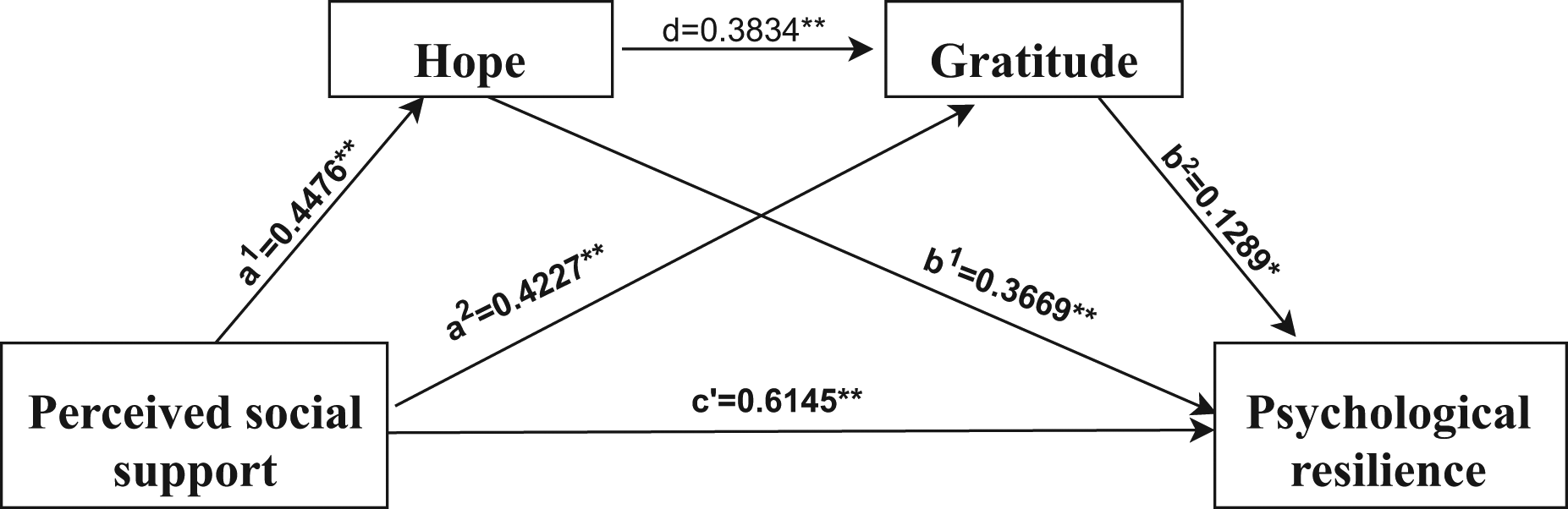
Modeling the relationship between perceived social support, hope, gratitude, and resilience.
The bootstrap test further showed that the mediating effect consisted of three pathways of indirect effects (see Table 4). Indirect effects accounted for 39.34% of the total effect and were generated through three mediating sequences: the first was the indirect effect of PSS on resilience via hope (β = 0.16, 95% CI [0.06, 0.30]), accounting for 26.23% of the total effect; the second was the indirect effect of PSS on resilience via gratitude (β = 0.05, 95% CI [0.00, 0.11]), accounting for 8.20% of the total effect; and the third was the indirect effect of PSS on resilience via hope and gratitude (β = 0.02, 95% CI [0.00, 0.05]), accounting for 3.28% of the total effect. Hope and gratitude separately and serially mediated the relationship between PSS and resilience among CCAs.
Results and Comparison of Serial Mediating Effect (N = 193)
Note. Ind1 is the mediation effect model of perceived social support (PSS) → hope → resilience; Ind2 is the mediation effect model of PSS → gratitude → resilience; and Ind3 is the mediation effect model of PSS → hope → gratitude → resilience. Boot = bias-corrected percentile bootstrap method; LL = lower limit of the 95% confidence interval; UL = upper limit of the 95% confidence interval; Boot LLCI and Boot ULCL do not overlap with zero.
Discussion
This study endeavored to elucidate the relational model of PSS, hope, gratitude, and resilience among CCAs. The results showed that the PSS of the CCAs had a significant effect on their resilience directly and indirectly through the independent mediating effects of hope, gratitude, and the sequence mediating effect of hope–gratitude.
The results showed significant positive correlations between PSS, hope, gratitude, and resilience, with PSS strongly associated with the other three variables. This result supports Hypothesis 1 and is consistent with those of previous empirical studies (Jiao, 2020; Palacio & Limonero, 2020; Wu et al., 2021). The positive correlations between variables emphasized the interactive and mutually reinforcing roles of developmental resources; thus, the theoretical developmental assets framework (Chang & Zhang, 2013) was supported. It indicated that CCAs harnessed their inherent positive resources to effectively mitigate the impact of adversity, including the severity of their children’s condition and the challenges entailed in caregiving. Table 4 shows that the direct effect of PSS on resilience explained 60.66% of the total effect, suggesting that guiding CCAs to fully appreciate the presence of social support is an even more important way to nurture resilience.
The association between resilience and PSS was mediated by hope and gratitude, respectively, thus confirming Hypotheses 2 and 3. More emphasis may be placed on enhancing parents’ sense of hope in the intervention, because hope emerged as a stronger mediator. It was possible that hopeful caregivers were more sensitive to the support they received from society and positively used resources to reduce stress and increase parenting competence (Kuravackel et al., 2018), thus reinforcing resilience. This supports what An et al. (2020) voiced in a qualitative study of parents of children with autism, that “It’s all about hope” (p. 1827). Hope seemed to be the foremost and utmost strength for these parents to navigate their special caregiving trajectory.
The mediating effect of gratitude, although relatively smaller, was also significant, indicating that the pathway of gratitude to resilience through PSS was also effective. This is consistent with the literature that gratitude not only relieves stress and depression of parents of autistic children but also influences their subjective well-being or satisfaction (Hizbullah & Mulyati, 2022). More important, the unique role that gratitude plays, differing from hope, is that it is past-oriented and centers on the acknowledgment and appreciation of received benefits; thus, it can directly strengthen relationships with others (Timmons & Ekas, 2018). Therefore, this pathway may also have a very positive impact on interventions.
This study showed that PSS could also contribute to resilience through the serial mediation of hope and gratitude, confirming Hypothesis 4. This pathway aligns with Ling et al.’s (2020) study of a sample of Chinese left-behind children (children who stay in their hometown while their parents work away, often for economic reasons, leading to separation and potential challenges in their upbringing and well-being), in which hope– gratitude mediated the relationship between family support and life satisfaction. Our study validates and extends the application of this sequence by demonstrating its important mediating role in PSS and resilience with a sample of CCAs. On another note, the mediating effect of hope in the relationship between PSS and resilience is stronger than that of gratitude (26.30% vs. 8.20% of the total effect; see Table 4), suggesting a sequential process in which hope precedes gratitude. This finding is consistent with theoretical perspectives that position hope as a foundational personal quality that typically comes before and may cultivate gratitude (Martin et al., 2019; McCullough et al., 2002; Wood et al., 2010).
Occupational therapy practitioners are uniquely equipped to incorporate interventions that focus on building resilience through hope and gratitude, both of which are critical for the caregiver’s capacity to manage daily caregiving demands. These strategies are integral to occupation-based practice, because they support caregivers in their primary role and improve children’s engagement in meaningful activities, addressing both client and family-centered goals (AOTA, 2020; Y. H. Huang et al., 2022).
Strengths and Limitations
To the best of our knowledge, this is the first holistic pathway to demonstrate the presence of hope– gratitude serial mediators and their operational mechanisms among autistic individuals within the framework of developmental assets model. This study provides new perspectives for families with autism to proactively negotiate the challenges, seek paths for coping, and ultimately promote a better quality of life.
However, some limitations must be recognized. First, mothers far outnumbered fathers and other caregivers in this study, which may have affected our overall understanding of resilience among CCAs. Although it is common for mothers to be more involved in childcare and parenting in the Chinese context, the role and influence of fathers and other caregivers should not be overlooked, especially when supporting children with autism. Follow-up studies should aim to seek more representative samples to make the findings generalizable. Second, this study only adopted cross-sectional design; future studies could use a longitudinal strategy to validate the findings of this study. Finally, this study investigated the relational model of only four positive factors; future research needs to explore other factors such as optimism, self-efficacy, and persistence among CCAs.
Implications for Occupational Therapy Practice
This study has the following implications for occupational therapy practice: ▪ Occupational therapy practitioners hold an important role in caregiver support, reinforcing the psychological resilience of the caregiver by incorporating hope-building strategies into the treatment plan. This involves assisting CCAs to set realistic goals and encouraging them to move forward, which are key to maintaining positive attitudes and relieving stress. Integrating these approaches with the core concepts of occupational therapy can enhance caregiver efficacy while promoting the child’s career development and family well-being. ▪ Integrating gratitude and reflective practices into CCAs’ daily lives can be effective in increasing their resilience. Occupational therapy practitioners can guide CCAs to focus on positive events in their lives by keeping a gratitude journal or engaging in reflective activities. These occupational therapy−guided activities can help to develop a positive mindset and emotion management skills, which are extremely important to support CCAs as they face the challenges of raising a child with autism. ▪ Occupational therapy practitioners can use their professional strengths to enhance social support and family bonds by organizing structured family gatherings and facilitating connections between CCAs and community resources. Such practices contribute to the establishment of a more cohesive and supportive family environment, which not only expands the caregiver’s social network but also has a positive influence on the child’s capability to engage in daily activities, in line with the principles of occupationally centered practice in occupational therapy (Malloy et al., 2021).
Conclusion
The study found that PSS promoted resilience among CCAs through pathways involving hope, gratitude, and their combined effect. PSS had the strongest impact on resilience, with hope playing a particularly influential role as a mediator. These findings provide a strong foundation for occupational therapy practitioners to design interventions that enhance caregivers’ PSS, hope, and gratitude, directly improving their ability to perform caregiving occupations and fostering better occupational outcomes for children with ASD. Such interventions reflect the core of occupation-based practice, in which boosting the family’s overall function leads to more meaningful participation in daily life (AOTA, 2020).