





Abstract
Given the number of occupational therapy doctorate (OTD) programs and graduates with professional doctoral degrees, the concept of practice scholarship is increasingly important. The scholarly work of occupational therapy practitioners guided by a research model is appropriate for those who have trained as researchers or OTD students and practitioners receiving mentorship from occupational therapy research scientists. A research model of scholarship may not fit the scholarly work of most occupational therapy practitioners with an OTD. We propose the Scholarship of Knowledge Discovery in Practice model, which emphasizes how contextual factors influence the generation and application of knowledge, particularly in addressing feasibility and sustainability challenges when integrating evidence into practice. This model prioritizes discovery when solving practice problems through quality improvement, program development, and innovation. OTD students and occupational therapy practitioners may use this model in generating scholarly work through capstones and ongoing enactment of the scholarly role. The recognition of practice scholarship as making important contributions to the profession may generate multiple vehicles through which to disseminate the discovery of knowledge in practice.
The authors propose a Scholarship of Knowledge Discovery in Practice model, which prioritizes discovery when solving practice problems through quality improvement, program development, and innovation.
There are 102 entry-level doctoral programs in occupational therapy, with an additional 118 in development (Kilburg et al., 2024). This expansion in programs indicates a need for dialogue about the importance of practice scholarship to advance the profession. Practice scholarship involves the discovery of knowledge in practice. In the past, the discovery of knowledge has been associated with empirical research. The discovery of knowledge in practice may inform empirical research, leading to a recognition of the collaboration between practitioners and research scholars.
The purpose of this column is to give a rationale for the Scholarship of Knowledge Discovery in Practice model (Quint & Moyers Cleveland, 2024) and to specify the differences between practice knowledge discovery and the discovery that is typical of empirical research. We propose this new model as an addition to the Boyer (1990) model, which was designed for university faculty. The Scholarship of Knowledge Discovery in Practice model guides the doctoral capstones of students and career ladders, thereby facilitating the practice scholarship role of the occupational therapy practitioner.
Rationale for the Scholarship of Knowledge Discovery in Practice Model
With increasing numbers of graduates from occupational therapy doctorate (OTD) programs both at the professional and postprofessional levels, there may be a misunderstanding among occupational therapy practitioners about what constitutes scholarly work outside of research. The question is whether precise terminology for practice scholarship would lead to clarity about methods for discovering knowledge in occupational therapy practice. Zaccagnini et al. (2020) said there is minimal understanding of how practitioners operationalize scholarship and knowledge translation.
Boyer’s Scholarship Model
The American Occupational Therapy Association (AOTA; 2022) has adopted the Boyer model of scholarship, which broadened the acceptance in academia of multiple types of scholarship. The Boyer model created scholarship categories that include the Scholarship of Discovery, the Scholarship of Integration, the Scholarship of Application, and the Scholarship of Teaching and Learning (Boyer, 1990, p. 16). Boyer (1990) described the Scholarship of Discovery as basic research. The Scholarship of Integration occurs at the boundaries of multiple disciplines to “bring new insight to bear on original research” (Boyer, 1990, p. 19). Boyer meant for the Scholarship of Application to unite practice and research in solving problems. The Scholarship of Application often involves clinical effectiveness research, and the Scholarship of Teaching and Learning eases the transmission and transformation of knowledge (Rice, 2002).
AOTA (2022) delineated examples of research scholarship and incorporated the Scholarship of Engagement, an addition to the Boyer model (Rice, 2002). The Scholarship of Engagement uses engaged pedagogy (e.g., service learning), community-based research, and collaborative practice designed to improve community life (Rice, 2002, p. 14); however, the emphasis remains on community collaboration for faculty scholarship.
The Scholarship of Knowledge Discovery in Practice model would give occupational therapy practitioners an alternative to Boyer’s model in describing their work. According to Boyer (1990), basic or academic-led research are the sources of knowledge applied in practice. The application of discovered knowledge from traditional research is critical for scholarly practice. There may be a misleading assumption, however, that occupational therapy practitioners can directly apply research without addressing feasibility and sustainability (White et al., 2021). Context is a rich source of new knowledge regardless of whether one is applying research.
Generalizability and Practice Evidence
The Accreditation Council for Occupational Therapy Education (ACOTE®; 2023) standards indicate that scholarship is “designed to increase the generalizability of knowledge” (p. 51). The role of the occupational therapy practitioner as a practice scholar is to also understand the influence of context on research. The work of the occupational therapy practitioner as a practice scholar is transferable but may not be generalizable. Most evidence-based practice strength and quality guidelines, such as the Oxford Levels of Evidence 2 (OCEBM Levels of Evidence Working Group, 2011), rank only research evidence. However, the Johns Hopkins Nursing Evidence-Based Practice (JHNEBP) model (Dang et al., 2022) is one that ranks the strength of practice scholarship. According to Dang et al. (2022), practice guidelines, consensus panels, expert opinions based on evidence, and position papers are ranked higher than quality improvement (QI), program or financial evaluation, scoping and integrative reviews, literature reviews, case reports, and expert opinions based on experiential evidence. The JHNEBP model (Dang et al., 2022) gives both of these evidence categories a lower ranking compared with systematic reviews and research, whether experimental, observational, or qualitative.
Because the scholarly work of occupational therapy practitioners is ranked as having a lower level of evidence, members of the profession often view practice scholarship as less important compared with research scholarship. Compared with research scholarship, occupational therapy journals publish fewer case reports or series, program development and evaluation, QI reports, and implementation science projects. Recognition that these types of evidence contribute to understanding practice change that is not only evidence based, when possible, but also feasible and sustainable in addressing patient values and outcomes, must occur (Tringale et al., 2022).
Given the rapid changes in technology and service delivery (Kelly & Young, 2017), there is often minimal research evidence on which to base practice changes compared with an organization’s internal evidence from outcome studies and QI data. In fact, newer models of evidence-based practice incorporate decision trees about whether to take an inquiry-, improvement-, or innovation-focused approach to changing practice (Hagle et al., 2020).
Doctoral Capstones as Practice Scholarship
The purpose of the doctoral capstone must be preparation of the occupational therapy practitioner for the scholarly role of discovering new knowledge. The ACOTE (2023) standards describe the capstone as “in-depth exposure” (p. 42) in a concentrated area, with the capstone project promoting synthesis and application of knowledge. The process for discovering new knowledge with practice scholarship could guide the capstone process. Without identifying practice scholarship theories and methodologies, the curriculum may have missing or cursory content on QI, innovation, implementation science, or program development and evaluation.
Definition of and Process for the Scholarship of Knowledge Discovery in Practice Model
We define practice scholarship as the discovery of transferable knowledge in context that the occupational therapy practitioner integrates with research and experiential and organizational evidence to resolve practice problems (Quint & Moyers Cleveland, 2024). These practice problems involve challenges related to population health that may not align with patient values and desired outcomes in occupational therapy. Our definition of practice scholarship adds a post-positivist description that recognizes the transferability of practice scholarship. The onus is placed on the user of practice scholarship to decide the similarity of the populations and settings before applying that scholarship to their situation (Lincoln & Guba, 1985).
Practice knowledge requires dissemination so that other occupational therapy practitioners can modify the work to fit similar practice contexts. This transferable information strengthens practice and may be the basis for empirical testing and increasing generalizability. Figure 1 illustrates the interaction between practice and research scholarship.
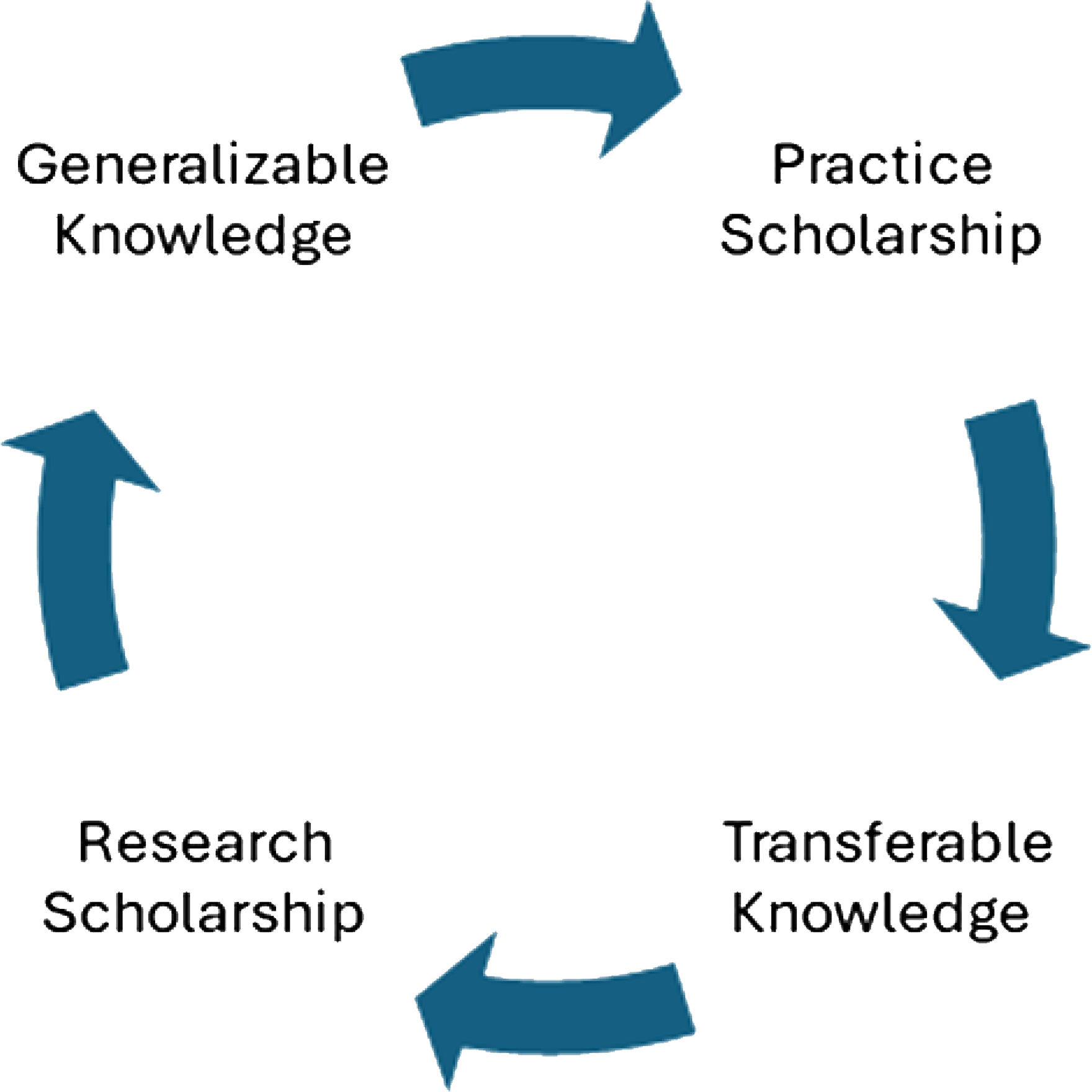
The relationship between practice and research scholarship.
Practice scholarship that has a focus on discovering knowledge and empirical research are both critical. Discovery of knowledge through practice scholarship may resolve practice problems in an expedited manner compared with the 17 years it normally takes for research evidence to be adopted in practice (Hanney et al., 2015). For example, when evidence is limited, an innovation project to improve patient navigation can enhance service outcomes. However, results from practice scholarship also need empirical research if reliability and validity are to be established or effectiveness evaluated. Figure 1 not only shows this interaction between research and practice scholarship but also indicates how occupational therapy practice scholars and traditional researchers work together to enhance practice and increase the profession’s knowledge base.
Types of Practice Scholarship for Discovering New Knowledge
The Scholarship of Knowledge Discovery in Practice model groups scholarship types for the discovery of new knowledge into 10 areas: (1) advocacy/policy development, (2) practice reasoning/decision-making, (3) consumer issues, (4) evidence-based practice, (5) implementation science, (6) innovation, (7) leadership/administration, (8) program development/evaluation, (9) QI, and (10) teaching/learning. The categories are associated with a range of theories and methodologies, much like the way the Boyer model categorizes research scholarship. Table 1 lists some practice scholarship groupings and examples.
The goal of these practice scholarship groupings is to foster the use of appropriate theoretical and methodological approaches when occupational therapy practitioners choose a purpose for the practice scholarship (see theory examples in Table 1). These approaches guide the practice scholarship cycle for discovering new knowledge (Quint & Moyers Cleveland, 2024), including
The Scholarship of Discovery in Practice Model
▪ conducting needs-assessment phases (exploratory and in-depth organizational assessments to determine feasibility);
▪ developing a theoretical framework and determining project methodologies;
▪ designing project interventions that are based on evidence;
▪ choosing evidence-based strategies for implementation;
▪ conducting alpha/beta testing, pilot testing, or prototyping products or processes;
▪ implementing interventions with fidelity and sustainability; and
▪ evaluating outcomes.
In terms of capstone doctoral projects, project-related time restrictions may cause OTD students to focus on one phase of the scholarship cycle for discovering new knowledge. Graduates can fully include all relevant processes. For instance, a capstone student might stop the project after beta/prototype testing and before full implementation. Dissemination involves publication in journals or presentations given at professional conferences. We suggest in addition, broader dissemination to organizational leaders and staff, interdisciplinary professional communities, third-party payers, legislators, clients, the public, and social media (Carpenter et al., 2005).
Conclusion
Practice scholarship shares the discovery of new knowledge in practice that is transferable to other contexts and that may form a basis for empirical research. One purpose of the OTD degree, whether at the entry level or postprofessional level, should be to develop students who understand their role as a practice scholar and accept their responsibility for discovering new knowledge in practice. Occupational therapy practitioners must firmly tie practice scholarship to specific theories, methodologies, and processes that guide each kind of practice scholarship. The Scholarship of Knowledge Discovery in Practice model includes 10 distinct types of scholarship that members of the occupational therapy profession can use in addition to the Boyer model or as a basis for career ladders.