





Abstract
Focusing on racial and ethnic diversity, this study captures the perspectives of first-year occupational therapy students who participated in a student-led outreach initiative.
According to the most recent American Occupational Therapy Association (AOTA) Academic Programs (APs) Annual Data Report (Harvison, 2022), there continues to be a significantly low amount of occupational therapy students who belong to an underrepresented ethnic group. These percentages do not reflect the current U.S. population (U.S. Census Bureau, 2021). Recognized as a social justice issue, increasing the diversity of the health care workforce can be one way to mitigate health disparities among diverse populations (Wilbur et al., 2020; Pittman et al., 2021). There has been a call to action from within the profession to develop effective and intentional strategies to find solutions to enhance diversity, equity, and inclusion (DEI; Johnson et al., 2024), especially to improve workforce diversity (AOTA, 2020a). As the profession continues to advance DEI efforts, it is critical to construct thoughtful, evidence-informed initiatives to recruit and support the next generation of occupational therapy practitioners (AOTA, 2020b).
Considered gatekeepers to the profession, occupational therapy APs are uniquely positioned to spearhead select DEI initiatives. To complete this task, APs must be intentional with their efforts by understanding the circumstances that have resulted in a need for increasing workforce diversity. It is important to note that Black, Indigenous, and People of Color (BIPOC) youth lack awareness of—and even interest in—occupational therapy as a career choice (Collins & Carr, 2018; Ford et al., 2021; Ramirez & Kiraly-Alvarez, 2023). BIPOC youth can be discouraged from pursuing health care careers because of experiencing racism in educational settings and having limited information regarding the diversity of health care careers (Zayas & McGuigan, 2006).
Moreover, occupational therapy students from underrepresented backgrounds are often exposed to occupational therapy at a later age than their White, female counterparts (Colaianni et al., 2022). At a systemic level, Accreditation Council for Occupational Therapy Education (ACOTE®; 2024) standards have evolved to require APs to demonstrate efforts to recruit a diverse student population. With these factors in mind, deliberately reaching out to middle school (MS) and high school (HS) students to create relationships and to expose the pathways to the profession can be one means that an AP might take to promote DEI. Introducing the occupational therapy profession to MS and HS students at an early age through tailored outreach initiatives can be one way to accomplish this endeavor.
Outreach initiatives tailored to underrepresented youth have demonstrated enormous potential to promote DEI in the health care workforce (Lauver et al., 2011; Jenkins et al., 2022). Although these efforts have varied significantly—in time, funding, format, content, and follow-up—MS and HS students are ideal participants for such programming (Lauver et al., 2011; Rookwood et al., 2022). Brief but interactive outreach initiatives geared toward MS and HS students of underrepresented backgrounds can promote interest in health care careers and reach a wider audience (Goldsmith et al., 2014), especially when embedded within their regular educational programming (Berk et al., 2014; Harlan-Williams et al., 2024). With active learning as a key element to outreach programming for youth (Rookwood et al., 2022), occupational therapy students and practitioners are ideally positioned to facilitate meaningful outreach initiatives.
Despite outreach initiatives being well documented by other health professions, the literature is minimal on this topic within occupational therapy. Evidence is emerging that shows the positive impact of an occupational therapy and physical therapy student–led camp for HS students (Taylor et al., 2023). Occupational therapy has been urged to implement tailored outreach initiatives among underrepresented youth (Wilbur et al., 2020; Salvant et al., 2021; Colaianni et al., 2022). Outreach initiatives can be a platform for occupational therapy APs to not only promote the profession but to serve as a valuable learning experience for all stakeholders, including current occupational therapy students.
Apart from building a diverse occupational therapy workforce, there is also a need and opportunities to implement DEI initiatives within current members of APs (Ford et al., 2021; Ramirez & Kiraly-Alvarez, 2023). Johnson et al. (2022) have advocated for occupational therapy faculty to incorporate a variety of strategies to promote reflection regarding racist structures between themselves and their students. Moreover, occupational therapy faculty are tasked to infuse cultural humility within their curricula (Agner, 2020). Best practices suggest that occupational therapy students should participate in intentional, experiential learning activities that introduce students to diverse communities (AOTA, 2020a; Johnson et al., 2022). These learning activities can be especially productive because they can be designed to meet ACOTE Standards B.2.4 and B.2.12, which are related to communicating the distinct nature of occupation and applying instructional design, respectively (ACOTE, 2024).
Strategically leveraging university resources, learning objectives, and DEI initiatives, occupational therapy faculty have opportunities to create learning activities such as outreach initiatives that go beyond the classroom so that current occupational therapy students can “prepare to contend with and redress racist structures influencing their institutions and practices” (Johnson et al., 2024, p. 3). It is important to understand the perspectives of stakeholders involved in these initiatives to not only further the evidence base of this underresearched topic within occupational therapy but to also help faculty understand the benefits of implementing learning activities grounded in DEI. This undertaking is especially important because long-term outcomes of DEI efforts such as workforce diversity are dependent on systems, policies, cultural change, and require time. Therefore, the purpose of this study is to describe occupational therapy students’ perceptions of a piloted, evidence-informed, and occupational therapy student–led outreach initiative tailored for underrepresented MS and HS students.
Method
Conceptual Frameworks
The outreach initiative was designed on the basis of the framework developed by the Coalition of Occupational Therapy Advocates for Diversity to facilitate DEI efforts within health care professions (Hoyt et al., 2021). Stratified in three levels of person, group, and population, the initiative aimed to promote occupational therapy to underrepresented communities while ensuring its sustainability by embedding it within an occupational therapy curriculum.
Transformational learning (TL) theory (Mezirow, 1978), specifically Mezirow’s (2012) view of perspective transformation, also guided this project. TL theory presumes that student exposure to new experiences creates a disorienting dilemma of personal convictions resulting in critical reflection of assumptions. This process creates opportunities for change through discovery and trial of new beliefs that result in new perspectives (Mezirow, 2012). Evidence supports that other occupational therapy educational experiences—primarily fieldwork experiences—can produce this transformational process (Mattila & Dolhi, 2016).
Design
This qualitative, cross-sectional pilot project was a community-based educational experience in which we used a novel Doctor of Occupational Therapy (OTD) student outreach assignment as a means to attend to the 2018 ACOTE Standards B.6.6 and B.7.3 within their sociocultural aspects of care course. This study was a retrospective analysis of 68 students’ reflections performed 6 mo to 1 yr after students completed the course and did not affect their experience or grade in the course. As such, the institutional review board at RUSH University determined that this study had exempt status.
Participants and Setting
A total of 68 1st-yr students enrolled in their second semester at an ACOTE-accredited, entry-level OTD program located in an urban Midwestern city participated in this educational outreach experience during the Spring 2023 and 2024 semesters. In-person outreach presentations led by the OTD students took place in MS and HS schools where the majority of the MS and HS students were from BIPOC backgrounds.
Procedures
Experience
This group assignment required OTD students to develop an introductory, age-appropriate presentation of 45 to 60 min for MS and HS students. OTD faculty provided guidance, and MS and HS staff provided input to meet the needs of their students. OTD student presentations included a plain language definition of occupational therapy, examples of populations served by occupational therapy practitioners, examples of practice settings, average salaries, and educational pathways delineating the processes required to be an occupational therapy assistant and occupational therapist. OTD students were required to include resources to fund higher education and to speak to their lived experience regarding career exploration. To promote engagement, OTD students developed at least three interactive learning activities. MS and HS students had opportunities to ask questions at the end of the presentations.
Data Collection
OTD students completed an open-ended reflection of at least 250 words discussing their outreach experience and how it related to the concepts covered in their course throughout the semester, such as cultural humility, antiracism, DEI, and occupational justice. The reflections were collected 1 mo after the presentations and were stored on a password-protected computer. The first author, who was also the course instructor, removed all identifiers from the reflections and collected them into one document.
Data Analysis
We used the qualitative approach of thematic analysis to identify and define common themes within the reflections because it allowed us to identify patterns in the OTD students’ reflections (Braun & Clarke, 2006). We used an iterative and inductive, multiphase approach in analysis (Braun & Clarke, 2022). In the first phase, both authors independently coded one half of the data using Microsoft Word. We met to reach consensus in codes and to define inductively developed codes, resulting in a coding dictionary. When a disagreement in codes occurred, we engaged in an extensive discussion in which we reflected on the meaning of the text and referenced relevant literature until we reached an agreement. Relationships among the defined codes were schematically mapped to better understand developing thematic categories. The first author used the coding dictionary and map to analyze the second half of the data. Both authors met after all the data were coded to collapse codes and to define mutually agreed on themes.
To enhance the trustworthiness of the findings, we implemented strategies to boost rigor. The first author maintained a detailed audit trail, updating the document throughout the research process on the basis of collaborative decisions made with the second author. The first author also had prolonged engagement in the field, implementing separate outreach presentations to MS and HS students (Creswell & Miller, 2000). Moreover, the first author had prolonged engagement with data. The second author received de-identified OTD students’ reflections and did not have a strong relationship with the students at this time. We also received feedback via anonymous paper surveys to MS and HS students with open-ended comments regarding their experiences with the occupational therapy students for curricular program development. Lastly, we continuously reflected on how our own beliefs and roles as educators influenced our interpretations (Olmos-Vega et al., 2023).
Results
Two cohorts of 1st-yr OTD students participated in this study, resulting in a total of 68 students who submitted reflections. All OTD students led in-person presentations, and each presentation group comprised an average of 6 OTD students. Table 1 illustrates the OTD student demographic characteristics. In total, OTD students facilitated 11 in-person presentations to 203 MS and HS students. MS presentations occurred within the context of a seventh- and eighth-grade science class, with OTD students presenting to a total of 168 MS students. Because of scheduling logistics, four HS presentations were offered as extracurricular programming to 35 HS students.
Demographic Characteristics of the OTD Students (N = 68)
Three primary themes were salient among OTD students’ reflections: (1) knowledge translation, (2) opportunity versus assignment, (3) and practical insights (Figure 1).
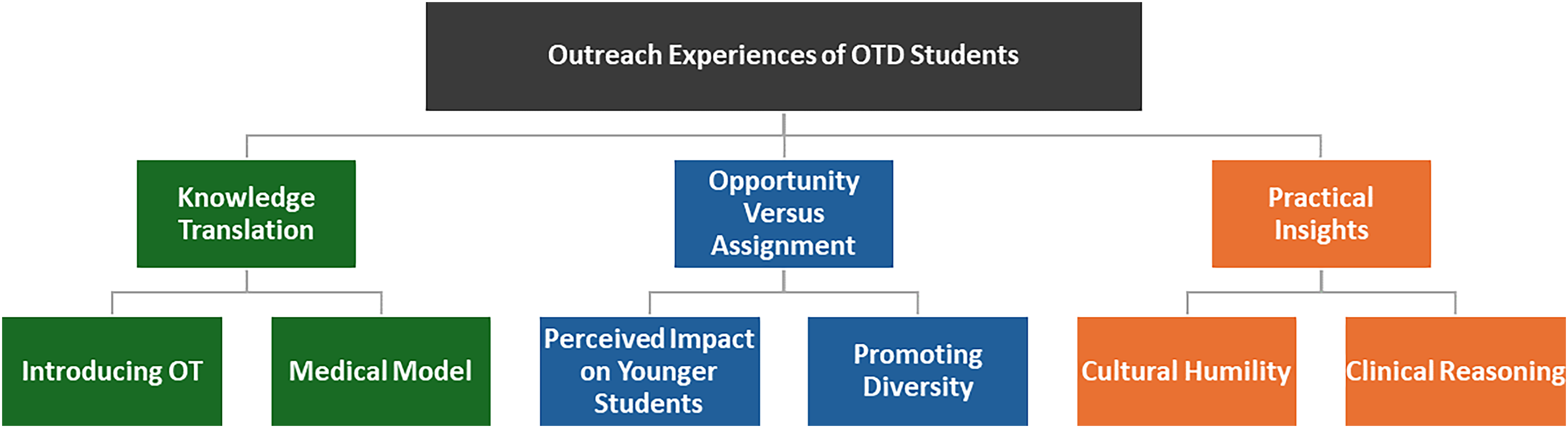
Major themes and subthemes of OTD students’ reflections.
Knowledge Translation
All OTD students described the process they engaged in to synthesize the content they learned within their curriculum thus far. OTD students described the experience as “extremely gratifying” to use what they learned in the classroom “in a more formal capacity” as they designed culturally relevant outreach presentations. To supplement their didactic content, OTD students facilitated a variety of kinesthetic learning activities centered around occupations such as charades, relay races, and “trendy” dances.
Introducing Occupational Therapy
OTD students underscored the significance of introducing the occupational therapy profession. With most MS and HS students unfamiliar with occupational therapy, OTD students described the rewarding experience of witnessing the younger students “open their eyes to a different side of health care.” OTD students frequently reported navigating questions regarding the distinction of occupational therapy from physical therapy and expanding the younger students’ understanding of occupation.
OTD students also spoke to the importance of promoting awareness of the profession. Through their presentations, OTD students saw themselves as advocates for the profession because they hoped to advance “one step closer to making OT [occupational therapy] a more widely understood and appreciated profession.”
Medical Model
As OTD students grappled to “entertain” the MS and HS students and to make their content digestible, they frequently relied on the medical model. This model was most notable during their interactive learning activities. Most groups guided the younger students with hands-on practice using tools frequently used in physical rehabilitation practice. One OTD student reflected on balancing both understanding and engagement: We carefully planned various activities to actively involve the HS students and demonstrate OT principles in action. One such activity involved hands-on learning of tools like gait belts and goniometers, allowing students to grasp the practical application of biomechanical concepts in OT practice.
Opportunity Versus Assignment
Across all reflections, OTD students expressed that they viewed this assignment more as a meaningful opportunity to “be part of the change.” OTD students appreciated that their outreach experiences were opportunities to put their “words into action.”
Perceived Impact on Younger Students
Although their interactions with the MS and HS students were brief, OTD students believed that they positively influenced the younger students. One OTD student highlighted the potential impact of their outreach presentation: “Whether these students actually go into the field of OT or not, it was fulfilling to know that we were able to introduce the idea to them and make a potential difference in their future career.”
With hopes to inspire future occupational therapy practitioners, OTD students expressed gratitude when their efforts were well received: The students from the [medical] club are from underrepresented groups, and many were not familiar with OT … a few were interested in learning more about OT … now they know more about it and have the opportunity to consider it.
Promoting Diversity
OTD students felt empowered because they saw their efforts as a small but meaningful step in diversifying the profession. Many OTD students reported that it is “necessary” to promote diversity as future occupational therapy practitioners. One OTD student stated, It is important to be able to spread awareness surrounding what OT is to a diverse population of students because the demographics … lean strongly towards the White, female demographic … As future occupational therapists, we want to help promote diversity in the profession for the future, and this outreach presentation was the perfect way to do that.
Recognizing the realities of the profession, the outreach sessions were also challenging for OTD students: It felt uncomfortable to say that the field of OT is welcoming and accepting to all when the statistics are contradictory. Nevertheless, this was an important assignment to help us communicate the meaning of OT to new populations and potentially challenge the status quo.
Moreover, BIPOC OTD students used their lived experiences to welcome all forms of diversity: This was a great way to show these students that you do not have to look a certain way to be a part of this White-dominated profession, and there is always space for people from different backgrounds, beliefs, and identities that can be amazing OT practitioners.
Understanding that DEI efforts require commitment, students called for the sustainability of this initiative “so that more students from diverse backgrounds can learn about, become interested in, and apply to OT programs.”
Practical Insights
Outreach experiences also served as a learning experience for the OTD students beyond the direct application of didactic content. Distinct from the theme of knowledge translation, this theme encompasses the individual takeaways that OTD students gained as a result of the outreach experience. In fact, it is the opposite of knowledge translation, and instead this theme describes how OTD students used this experience to further knowledge acquisition. One OTD student summarized the transformative nature of this theme by describing that the outreach sessions provided “valuable practical insights that will undoubtedly inform my future endeavors in the field.”
Cultural Humility
OTD students expressed how the outreach sessions were an ideal platform for them to apply cultural humility. Not only did OTD students report using cultural humility as a “lens” but they also described it to further acknowledge their positionality, become self-aware of biases, and engage in self-critique.
Takeaways on positionality was an important thread that many OTD students incorporated within their reflections: “We were able to reflect on our own lives prior to the presentation and acknowledge the privilege we have as three cisgender, White women who are pursuing a clinical doctorate degree.”
OTD students recognized that their own biases were challenged: “I had preconceived notions that students may not be receptive to us as well or what we wanted to teach, which I’m so happy was far from the truth.”
OTD students also pinpointed takeaways relating to health literacy in their use of professional jargon because they realized that they needed to do more than regurgitate occupational therapy terms. They earned a deeper level of understanding that they still have a lot of learning to do to best communicate with diverse communities: We failed to explain certain OT-specific words such as “fieldwork” and “OTD.” Although these words are familiar to us, within our OT bubble, and we have learned about the importance of not making assumptions … explaining these words would have been beneficial to expand the students’ knowledge about OT.
Clinical Reasoning
The outreach experiences were also viewed by OTD students as a catalyst for their own clinical reasoning, specifically, pragmatic, procedural, and interactive reasoning.
Pragmatic.
OTD students recognized their own limitations and the needs of their audiences. They reported instances in which they could have implemented more practical solutions to promote health literacy best practices. As one OTD student recalled, We feel like giving examples and “breaking it down” instead of just telling helps with the understanding of the material … After some reflection, we think it would be an important step to stop throughout the presentation to do a check in.
Procedural.
Procedural reasoning was also emphasized because OTD students recognized the importance of creating content that was culturally tailored and accessible to students: We often talked about culturally relevant methods of providing care, but in practice, it was more difficult … This activity truly encompassed what it means to culturally adapt to meet the needs and characteristics of different cultures and populations … The process of creating our presentation helped me develop a skill that I will continue to use in the future as an occupational therapist.
Interactive reasoning.
OTD students also endorsed insecurities with their interactive reasoning because they used this experience to develop their therapeutic use of self. The outreach experience provided opportunities for them to practice a variety of skills, especially public speaking: “The biggest component I struggle with in any assignment is public speaking. I was very worried about speaking in front of HS students … This experience pushed me out of my comfort zone.”
Although the OTD students identified areas for improvement, they also recognized that they had a variety of skills that they had developed over the course of two semesters. OTD students felt validated with their emerging clinical reasoning, resulting in increased self-efficacy in their abilities: “It was an interesting experience to take what we have learned during our time in OT school and share it with the community to encourage outreach and awareness for the wonderful field of OT.”
OTD students highlighted the challenges of this assignment because it required them to critically reflect on their understanding of occupational therapy and refine their “elevator pitch.” An epitomizing quote emphasizes this effort: “[This] experience tested me to truly understand the basic concepts of OT and know how to explain this health care profession to others in a simple manner.”
Discussion
In this study, we examined the acceptability of an innovative, student-led outreach program from the perspectives of OTD students. OTD students’ reflections shed light on the transformative nature of these brief but meaningful experiences with MS and HS students. Many of the OTD students’ narratives support TL theory in that active processes are critical to perspective transformation (Mezirow, 2012). OTD students benefited from this experiential learning opportunity to practice transformative cultural awareness and humility (Anderson, 2022).
Moreover, OTD students’ reflections on “What did I learn from this?” triggered perspective transformation (Johnson et al., 2022; Suarez-Balcazar et al., 2023). It is important to note that the timing of this outreach before the OTD students’ fieldwork lays a foundation for professional role identity as future practitioners (Clarke et al., 2014). In fact, experiential opportunities have increasingly been shown to support professional identity development of occupational therapy students (Walder et al., 2022). Apart from OTD students discussing the positive impact of this experience on their clinical reasoning, they described the rewarding process of using their own power and privilege to contribute toward the profession’s DEI efforts.
It is important to note that although targeting the course objective of developing skills in communicating the distinct nature of occupation and applying instructional design, the outreach experience worked to address the profession’s Vision 2025 commitment to DEI (AOTA, 2020b). Although measuring the effect of this experience on the MS and HS students is beyond the scope of this study, the experience clearly provides exposure of the profession to MS and HS students who are likely to learn about occupational therapy at a much later age (Colaianni et al., 2022). This outreach initiative is one example of how a course instructor, informed by evidence, might implement AOTA’s recommendations for embracing cultural humility in occupational therapy curricula with the goal of increasing workforce diversity.
Limitations
Limitations of this study include the failure to gather the perspectives of the MS and HS students. Understanding the long-term impact of MS and HS students’ knowledge of and intrigue to explore the occupational therapy profession would be invaluable to furthering DEI efforts. This area should be explored in future research. It is important to note that the OTD students’ reflections were part of a course assignment, and it is possible that responses were based on presuming what the course instructor “wanted to hear.” There may be limited transferability to other students from other regions or other APs. Finally, although exposure occurred, an understanding of any lasting impact of this experience for all students involved is limited.
Implications for Occupational Therapy Education
To our knowledge, this is the first study to evaluate an occupational therapy student–led outreach experience tailored for underrepresented MS and HS students. Lessons learned from this pilot project expose how occupational therapy APs can create synergies among accreditation standards, experiential learning, and the profession’s DEI priorities. Our findings have the following implications for occupational therapy education: ▪ By examining ACOTE standards that align with DEI initiatives, occupational therapy educators can develop transformative learning opportunities that give back to the profession. These learning opportunities with diverse communities can empower occupational therapy students and provide a conduit for them to practice cultural humility. ▪ Occupational therapy APs should cultivate relationships with local and diverse MSs and HSs to facilitate occupational therapy student–led outreach initiatives that can promote occupational therapy students’ knowledge translation and clinical reasoning. These initiatives can also further expose the profession to diverse communities.
Conclusion
In this qualitative study, we explored OTD students’ experiences with an innovative, educational outreach experience for MS and HS students belonging to underrepresented groups within the profession. On the basis of reflections from the OTD students, this study has revealed that these occupational therapy student–led experiences embedded within an OTD curriculum can be successful and satisfactory. OTD students applied the knowledge that they learned in the classroom, felt that they had an impact on the younger generation, and further developed their professional identity. Occupational therapy APs should consider implementing similar learning experiences because they can meet ACOTE requirements while actively contributing to the profession’s DEI efforts to increase the exposure of the field to underrepresented groups within occupational therapy.
Footnotes
Acknowledgments
We thank our OTD students for their efforts during this experience, as well as the staff and students at the middle and high schools who welcomed us. We express our appreciation to Dr. Becky Ozelie for her support throughout this process.