





Abstract
This study reviewed literature from occupational therapy and other health professions literature to determine how the concept of intersectionality is used to inform practice, education, and research.
People with intersecting identities from multiple marginalized groups have less access to and ability to participate in quality health care, leading to health inequities (Albrecht et al., 2023; Diemer et al., 2022). Approximately 13.4% of the U.S. population identify as disabled; 4.1% identify as lesbian, gay, bisexual, transgender, intersex, queer/questioning, and asexual (LGBTQIA+); 38.4% identify as racial and ethnic minorities; and 11.5% identify as living at or below the poverty line (U.S. Census Bureau, 2020).
The term intersectionality conceptualizes that all aspects of a person’s identity (e.g., race, socioeconomic status [SES], gender, sexuality, religion, ability) intersect and should not be separated when examining a person’s life experiences (Crenshaw, 1991). Therefore, as the population becomes increasingly diverse, occupational therapy practitioners, students, researchers, and educators should incorporate an intersectional lens to serve clients better, decrease health inequities, and increase participation (Sabik, 2021).
Recent research has explored the experiences of occupational therapy students and occupational therapy practitioners from marginalized racial and ethnic groups (Luong et al., 2023) and how using an antiracism and diversity, equity, and inclusion (DEI) approach can affect occupational therapy research, education, and practice (Johnson et al., 2024; Lerner, & Kim, 2022; Murphy et al., 2024). However, the experiences of persons belonging to multiple marginalized groups are often not considered across health care professions, including occupational therapy. Though limited, health care researchers have begun using an intersectional approach to understand these experiences (Fuentes et al., 2024); however, there is a gap concerning its specific application to occupational therapy research, education, and practice.
Objective
We conducted a scoping review to systematically map the research in intersectionality and identify gaps in knowledge. The following research question was explored to guide the review: “How is intersectionality represented in the scholarly literature used to inform occupational therapy practice, research, and education?”
Method
Protocol
Arksey and O’Malley’s (2005) framework, elaborated by Levac et al. (2010) and guided through the Preferred Reporting Items for Systematic Reviews and Meta-Analyses extension for Scoping Reviews (PRISMA-ScR) checklist (Tricco et al., 2018), was used to structure the review. The checklist included the following: (1) identify the research question; (2) identify relevant studies; (3) select studies; (4) chart the data; and (5) collate, summarize, and report the results.
Eligibility Criteria
Inclusion criteria consisted of articles written in English that addressed intersectionality in practice, education, or research and were published between 2013 and 2023 in a peer-reviewed journal. Because of the limited occupational therapy literature addressing intersectionality found during the search, we broadened the literature search to include other health professions. We were intentional about applying literature from other health professions to determine the effect of intersectionality on occupational therapy practice, education, and research, understanding that the application is not direct but offers a point of departure.
Information Sources and Search
Our research team, consisting of one occupational therapy faculty member (Smith) and two practicing clinical occupational therapy practitioners (Ford and Samson), initially searched for peer-reviewed literature from August 15, 2023, to September 21, 2023, with a library consultant using a comprehensive database that included CINAHL, MEDLINE, and PsycINFO. An additional follow-up search was done to capture articles published later in 2023 and in 2024.
Our search strategy combined “intersectionality” with occupational therapy, physical therapy, social work, health care, rehabilitation, education, special education, and work using the “AND” operator to narrow results. Search strings included “intersectionality AND occupational therapy,” “intersectionality AND physical therapy,” “intersectionality AND social work,” “intersectionality AND health care,” “intersectionality AND rehabilitation,” “intersectionality AND education,” “intersectionality AND special education” and “intersectionality AND work.” This search strategy was developed and used by all three authors.
Selection of Sources of Evidence
Identified articles were entered into Covidence for initial screening. To increase consistency among reviewers, two authors (Ford and Samson, or Samson and Smith, or Ford and Smith) randomly assigned and screened publications and discussed the results, revising the screening process as appropriate. To resolve uncertainty about the nature and extent of the data extracted, pairs of authors reviewed the same articles independently and then met biweekly to determine whether their approach was consistent with the research question and purpose (Levac et al., 2010). Any disagreements were resolved by consensus or by Smith, although this did not occur.
Data-Charting Process and Items
We developed a data-charting form to determine which variables to extract. Data extraction, using Covidence, is an iterative process in which researchers continually update the data abstraction form. To determine whether our approach to data extraction was consistent with the research question and purpose, pairs of researchers tabulated the same articles independently and then met biweekly (Levac et al., 2010). Any disagreements were resolved by consensus or by Smith.
We performed data extraction using Covidence as an appraisal tool to collect relevant characteristics from included studies, including author(s), publication year and location, study design, level of evidence (Melnyk & Fineout-Overholt, 2018), population and sample size, aims or purpose of study, methodology, outcome measures (if applicable), and key findings related to intersectional experiences of persons and how these experiences can influence education, practice, and research (Levac et al., 2010).
Synthesis of Results
The extracted data were divided by two authors (Ford and Smith, or Samson and Smith, or Ford and Smith). For systematic and scoping reviews, we counted the number of studies included in the review that met our inclusion criteria. We conducted a content analysis using qualitative strategies recommended by Levac et al. (2010). The analysis included three steps: (1) analyzing the data, (2) reporting the results, and (3) applying meaning to the results. We analyzed the data by first summarizing the characteristics of the article, such as type of study, study methods, key findings, and recommendations for future education, research, and practice changes. We then conducted further content analysis by chunking the article text into meaning units and labeling the units (Creswell & Creswell, 2018). We placed the generated codes in a taxonomy to create themes. Finally, we used the taxonomy to generate thematic descriptions.
Results
Selection of Sources of Evidence
We each conducted an extensive search separately using identified databases and search terms. Then we met, and through consensus, extracted an initial title search from the original search to yield 4,937 articles. After applying the inclusion criteria, we entered 80 studies into Covidence for further screening (Figure 1). After removing three duplicates from these 80 studies, we further screened 77 studies by title and abstract using eligibility criteria, resulting in 56 studies identified for full-text review. Twenty studies were excluded: 8 used the wrong intervention, 7 examined the wrong patient population, and 5 used the wrong study design, resulting in 36 studies deemed relevant for the final data charting. Of the 36 articles reviewed, 11 were identified as commentary or opinion pieces directed at occupational therapy or other health professionals focused on consideration of intersectional client factors for practice, education, and research. Seven articles were identified as theoretical or concept pieces that typically discussed the development of critical and intersectional frameworks for practice, education, and research. Six review articles (i.e., scoping, systematic, and narrative) were identified that examined lived experiences of marginalized people in employment, education, and specific intersections such as race, ethnicity, gender, and disability. Twelve research articles (4 quantitative, 7 qualitative, 1 mixed method) focused on inequitable receipt of services, leisure, educational, and employment opportunities.
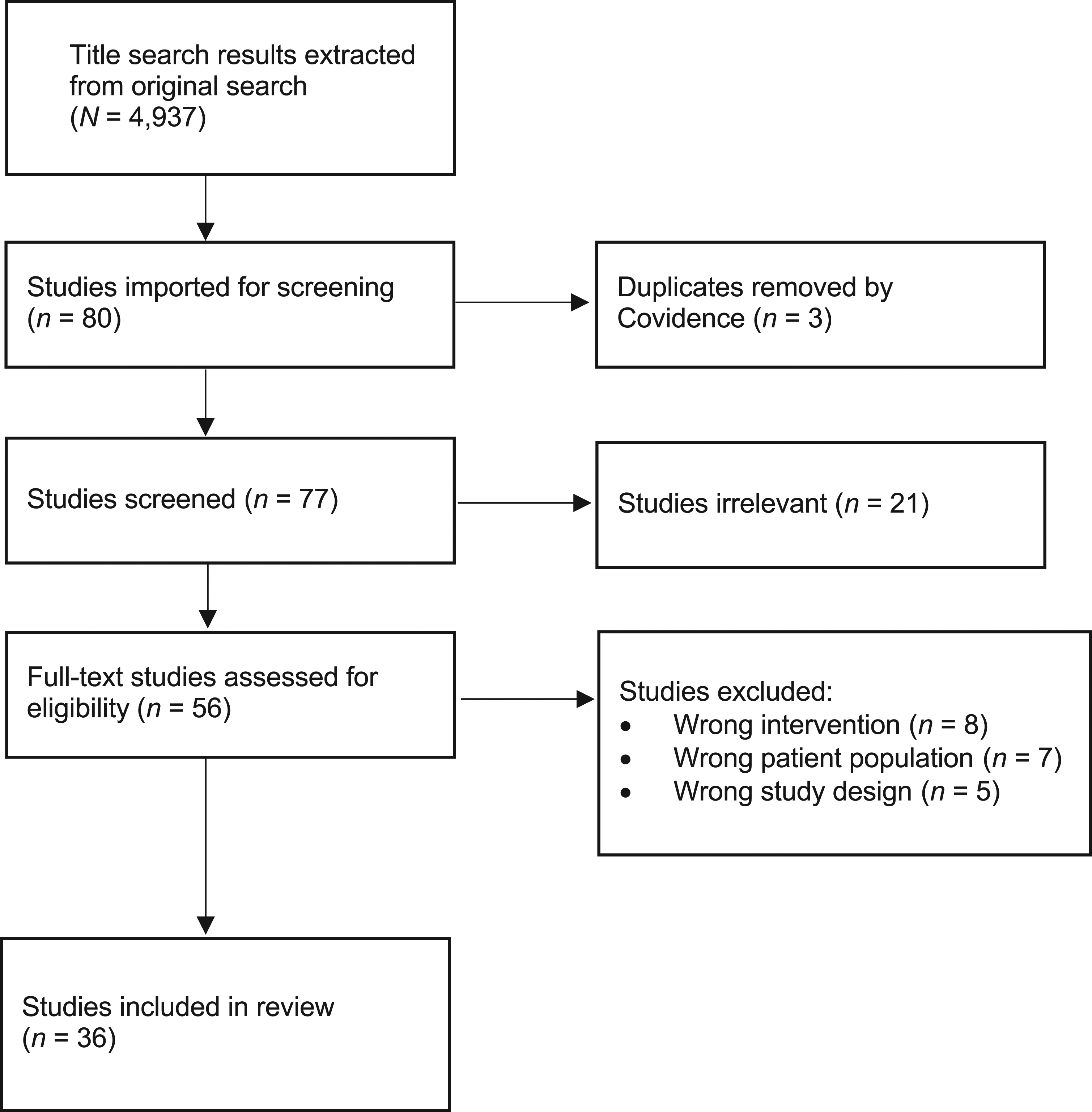
Preferred Reporting Items for Systematic reviews and Meta-Analyses extension for Scoping Reviews (PRISMA-ScR) flow of study selection process.
Characteristics of Sources of Evidence
Results from the review are presented in Table A.1 in the Supplemental Material, available online with this article at https://research.aota.org/ajot. Table A.1 includes the studies’ place of origin, publication year and location, study design, level of evidence, population and sample size, aims/purpose of study, methodology, outcome measures (if applicable), and key findings.
Synthesis of Results
We used a deductive approach to group the evidence into three themes: education, practice, and research. Many of these topics crossed themes but were assigned a topic area through consensus. We used inductive–thematic analysis to develop the subthemes.
Education
Experiences of students of intersectional backgrounds.
Individuals from multiple intersecting marginalized groups reported negative experiences during occupational therapy school (Evans-Winters, 2021). In a study specific to students in occupational therapy programs, Ford et al. (2021) found that lack of diversity in education programs resulted in adverse outcomes for students of color. Five themes from the participants’ responses were identified: (1) lack of representation in knowledge about occupational therapy, (2) feeling like an outsider, (3) the need for financial support, (4) individualized mentor–mentee relationships, and (5) connections with national organizations specifically for students of color. Recommendations were made to use an intersectional approach for purposive recruitment, faculty professional development, mentoring provision, and financial support.
McCarthy et al. (2023) explored the experience of imposter phenomenon among first-generation college students. Participants commented that imposter syndrome and issues of intersectionality contributed to barriers to belonging. Although the sample was not specifically occupational therapy students, these results are applicable. Strategies to address these barriers included creating smaller communities with peers in which students felt they belonged.
Teaching intersectionality.
Studies consistently showed that current teaching practices do not effectively address diversity and intersectionality (Grenier, 2021; Grenier, et al., 2020; Hendricks et al., 2023). Moreover, Grenier (2021) found that diversity in occupational therapy education programs is taught with five main underlying educational paradigms and theories: competency-based (44%), social justice (29%), critical (11%), social accountability (10%), and constructivism (6%). Findings suggest problematic cultural competency theories and uncritical international service-learning practices continue to dominate occupational therapy diversity education. Recommendations were made for a radical shift toward identity-affirming disability discourses in pedagogical materials and practices to align with the profession’s values.
Intersectionality as an analysis tool to address educational challenges.
Incorporating intersectionality as an analysis tool within occupational therapy curricula can inform and expand upon current occupational therapy frameworks and models. Specifically, Galvaan et al. (2022) interviewed occupational therapy educators and reviewed curriculum documents focusing on consciously resisting coloniality in the curriculum design. By using an intersectional approach, strategies to address these issues included partnering to bring out critically reflexive and authentic selves, working with individual and systemic processes of struggle, and being committed to facing uncertainty together. Mahoney and Kiraly-Alvarez (2019) further suggested that teaching approaches need to focus on decoloniality by using inclusive frameworks such as the creative abilities model and the Kawa model and providing community-based and nontraditional settings for fieldwork and capstone experiences.
Applicable to occupational therapy education, Sabik (2021) evaluated an intersectionality toolbox as a framework to apply intersectional perspectives to public health issues. The toolbox included a list of readings and associated questions to apply an intersectional lens to a specific topic. Results showed that students grasped the core concepts and could apply them to current health issues and trends independently, skills that are essential and relevant in occupational therapy education.
Practice
Changing approach to evaluating and treating clients in occupational therapy.
An intersectional lens can inform and change how occupational therapists evaluate and treat clients. Studies focused on occupational therapists’ approach with clients reinforced the use of strategies to practice cultural humility (Agner, 2020; Hammell, 2013); increase the consideration of context and intersectionality, the issues of power, and inequities (Ambrosio & Silva, 2022; Camacho & Henderson, 2022); and expand beyond an approach focused on individualism (Balanta-Cobo & Padilla-Muñoz, 2019; Pooley & Beagan, 2021). Specifically, Yao et al. (2022) found that ableism and the use of medical models in occupational therapy continue to support oppressive discourse for the evaluation and treatment of persons with disabilities and recommended a shift in models and approaches, such as the intersectionality, to better support identity-affirming disability discourse (Grenier, 2021). Finally, recommendations were made for all health care professionals to have an interdisciplinary focus on intersectionality (Straus & Brown, 2021).
Access and participation in occupations and health care services.
Intersectionality can affect access to and participation in health care services, especially occupational therapy. Research showed that intersectional factors such as SES, race/ethnicity, and lack of health insurance led to reduced access to rehabilitation and increased caregiver burden (Ott et al., 2022). Albrecht et al. (2023) and Diemer et al. (2022) found that disparities in access to services were often due to race and ethnicity, reducing the opportunities for functional recovery. Specifically, literature showed that intersectionality can be used as a frame for access and participation in all occupations (Fuentes et al., 2024; Lindsay et al., 2023).
Intersectional approaches are also crucial for supporting specific client populations. Data gathered from low-income stroke survivors showed that occupational therapy practitioners need to use an intersectional approach to understand how SES can affect access to interventions and modify interventions to fit the client’s needs (Bernard et al., 2019). Similarly, Ross et al. (2018) surveyed women and transgender persons and found that intersectional oppression, along with a lack of knowledge from service providers on how to address issues related to the LGBTQ population, can lead to mental health needs not being met.
Reitzel et al. (2021) and Gerlach (2015) stressed that an intersectional lens can allow practitioners to understand how social and environmental factors affect participation in therapy and identify facilitators and barriers to client participation to create systematic changes. These authors agreed that an intersectional framework is important in working toward social justice and health equity by moving from normative assumptions in practice and discourse and using a critical lens to center research and interventions to involve more marginalized populations.
Research
Access and participation.
Lack of an intersectional lens can limit access to and participation in crucial research. Research on intersectionality shows that disparities in access to occupations vary by income, caste, gender, sexuality, context, and occupational choice (Hammell, 2020; Mielke et al., 2022; Pooley & Beagan, 2021), resulting in social injustice. Recommended strategies consistently show a need for an intersectional approach in research to increase participation (Balanta-Cobo & Padilla-Muñoz, 2019; Brown & Moloney, 2019; Cantor et al., 2022; Hammell, 2020).
Intersectionality’s effect on research and program development.
Intersectionality can inform the conduct of research and inclusivity in program development. Saia et al.’s (2024) call to action suggests that disability researchers (including occupational therapists) (1) value intersectional and multidimensional identities, (2) amplify voices and experiences of historically excluded populations, (3) prioritize access, (4) recognize wholeness, (5) choose inclusive and intersectional methodologies, (6) apply an anticapitalist stance, and (7) consider coexisting experiences. They suggested using several frameworks and theories to guide occupational therapists in considering an intersectional approach with clients, including dis/ability critical race theory and disability justice models. Suggestions were also made to increase the inclusion of diverse clients in occupational therapy and related research (Hammell, 2013; Holman et al., 2021; Steinbrenner et al., 2022).
Discussion
Summary of Evidence
This scoping review identified themes in the literature that begin to answer the research question of how intersectionality can be used to inform occupational therapy practice, research, and education. Strategies for educators include faculty professional development, mentoring provision, and intentional retention strategies (Ford et al., 2021), including intentional conversation and provision of resources for students related to DEI topics (Luong et al., 2023). Education that focuses on cultural humility by using difficult discourses involving issues of oppression in health care is suggested to provide a more appropriate reflection of the experiences of diverse clients (Agner, 2020; Galvaan et al., 2022; Grenier, 2021; Pooley & Beagan, 2021). Sterman et al. (2022) recommended that educators use collaborative, antiracist teaching strategies; engage in reflexivity; decolonize curricula; increase representation of Black, Indigenous, and other people of color students and faculty; and strengthen educators’ capacity to engage in antiracist actions.
In practice, identified strategies include the importance of practitioners showing cultural humility, intentionally shifting intervention models, and considering context and intersectionality with diverse clients (Gerlach, 2015; Hammell, 2013; Mahoney & Kiraly-Alvarez, 2019). Specific suggestions include using inclusive language, ensuring inclusivity, promoting self-education, and building individual and institutional commitments (Marjadi et al., 2023). As occupational therapy progresses as a profession, occupational therapy practitioners should be sensitive to intersecting issues to ensure that interventions appropriately target needs. This requires broadening consideration beyond the medical model to a social model and use of frameworks such as the equity lens for occupational therapy (Restall et al., 2018) and the LGBT Development of Clinical Skills Scale (Nowaskie & Najam, 2022) to provide a starting point for reflection.
The use of intersectionality in occupational therapy research is limited, predictably overlapping with education and practice, and focused on inequities in access and participation (Steinbrenner et al., 2022). Strategies suggested are to avoid positivism and individualism and analyze all influences that affect clients (Holman et al., 2021) and to make intersectionality research accessible through development of tools or guidelines for establishing DEI priorities for research and policy audiences (Johnson et al., 2024). Lerner and Kim (2022) suggested journaling, race caucusing, deepening relationships, deep listening, body awareness, and somatic healing as strategies to develop antiracist practice in occupational therapy and occupational science research. However, incorporating intersectionality in research can be challenging in the current political and social environment (Kelly et al., 2021). Use of these strategies is imperative to provide effective interventions to increase participation for all clients.
Limitations
Although this review emphasized the critical need to integrate intersectionality into various aspects of occupational therapy, it was not without limitations. First, a dearth of research on intersectionality within occupational therapy made it difficult to reach broad conclusions. This gap emphasizes the need for more research, the goal of this scoping review. Second, some of the examined articles were commentary or opinion pieces, which provided insightful analyses but lacked strong empirical evidence to support their claims. Third, some of the studies had small sample sizes, which can reduce a study’s ability to represent the wide range of experiences of different intersectional identities. Finally, many of these articles originated from disciplines outside of occupational therapy and focused on specific populations, which can limit applicability of the findings. The limitations listed only further the importance of this scoping review and emphasize a need to explore intersectional methodologies within occupational therapy.
Implications for Occupational Therapy Practice, Research, and Education
The reviewed literature demonstrates the following implications for occupational therapy across education, practice, and research. ▪ Education: Students’ experiences of intersectional backgrounds highlight the need to focus on strategies to reduce isolation, improve representation, provide financial support, establish sound mentoring programs, and create smaller, supportive communities to help mitigate imposter syndrome and other barriers to belonging. This scoping review emphasizes a need to move toward inclusive pedagogies that promote decolonial practices and are genuine to the experience of diverse students. Occupational therapy programs should also develop educational frameworks that go beyond acknowledging intersectionality and center and amplify students’ experiences of intersectional backgrounds. ▪ Practice: Occupational therapy practitioners should actively combat oppressive practice methods within occupational therapy. Practitioners should focus on affirming clients’ multilayered identities and intersectional practice methods to improve the therapeutic relationship and lead to more effective treatment. Occupational therapy practitioners should adopt cultural humility and actively seek to recognize, respect, and accommodate their clients’ diverse backgrounds and experiences. ▪ Research: For research to be equitable, marginalized communities must be at the center of the process. To better understand the experiences of intersectional identities, frameworks such as dis/ability critical race theory should be used. In addition, these populations should be included and amplified within the research process by utilizing collaborative research approaches to fully capture the experiences of intersectional needs.
Conclusion
This scoping review explored intersectionality as a tool for analysis within occupational therapy research, education, and practice. Recent literature has begun to understand the experiences that exist for people in marginalized groups; however, there is a lack of literature examining the application of intersectionality methodologies within the profession. This review provides a unique analysis of existing literature and synthesis of information that can help encourage the profession of occupational therapy to move toward the application of intersectional methodologies. The common themes that emerged from this review are that negative experiences are a reality for people of intersectional identities, and utilizing intersectional frameworks, centering and amplifying marginalized voices, and moving past acknowledgment and toward intentional action are encouraged methods to combat oppressive practices within occupational therapy research, education, and practice. Future research should examine how intersectionality, as an analysis tool, can benefit various aspects of occupational therapy and those we serve.
Supplemental Material
Supplementary material for How Intersectionality Informs Occupational Therapy Practice, Education, and Research: A Scoping Review
Supplementary material, sj-pdf-1-aot-10.5014_ajot.2025.050970.pdf for How Intersectionality Informs Occupational Therapy Practice, Education, and Research: A Scoping Review by Diane L. Smith, Alesia Ford and Helina Samson in The American Journal of Occupational Therapy
Footnotes
*Indicates articles included in the scoping review.
Acknowledgments
We thank Saskia Darnley, who contributed to the initial conceptualization of the manuscript.
References
Supplementary Material
Please find the following supplemental material available below.
For Open Access articles published under a Creative Commons License, all supplemental material carries the same license as the article it is associated with.
For non-Open Access articles published, all supplemental material carries a non-exclusive license, and permission requests for re-use of supplemental material or any part of supplemental material shall be sent directly to the copyright owner as specified in the copyright notice associated with the article.
