





Abstract
This study examines concerns related to belonging and inclusion among racialized students with mental illness.
The growing public mental health crisis and health disparities have led occupational therapy scholars to advocate for a diverse workforce and scholarship informed by diversity, equity, and inclusion (DEI)–related perspectives (Johnson et al., 2024; Keptner et al., 2024). These calls are timely, given that the public mental health crisis in the United States is growing and continues to disproportionately affect racialized people—that is, Black, Indigenous, and People of Color (BIPOC)—especially BIPOC youth (Lipson et al., 2022; Office of the Surgeon General, 2021). Between 2013 and 2021, depression and suicidal ideation increased most significantly for BIPOC college students, but rates for therapy did not (Lipson et al., 2022). Evidence further highlights that these disparities are not consequent to BIPOC identity but rather are related to challenges that stem from historical marginalization of BIPOC communities. For example, material hardships (such as housing and financial challenges) among Black students contribute indirectly to their depression symptomatology (Jabbari et al., 2022). Disparities in the mental health of young adults are particularly concerning because mental health symptomatology often appears during teen years, and experiences of stigma and disparities during onset can delay service engagement among BIPOC students, prolonging unmet mental health needs (Livingston et al., 2022; van der Ven et al., 2020). A persistent determinant of the mental health and health care disparities is the intersectional stigma of mental illness and race/ethnicity (Abdullah & Brown, 2011; Goodwill & Zhou, 2020; Misra et al., 2021). Although stigma for mental health services and racism have been studied in isolation, there is a lack of scholarship examining this intersectional stigma. Theoretical and analytic approaches informed by intersectionality challenge the single-axis identity frameworks, advocating for a more nuanced approach to understanding the complexity of individual experiences and outcomes (Cho et al., 2013).
The limitations in contemporary science regarding intersectional stigma stem from a decades-long reliance of the scholarship on a language of attributes to study or examine stigma (Tomar & Thornicroft, 2020). Despite Goffman’s (1963) assertion to study stigma through relationships, his definition of stigma as “an attribute that is deeply discrediting” (p. 3) and the labeling theory have been used to conceptualize stigma as a process of stereotyping and labeling a marginalized group or individual, leading to discrimination at both the interpersonal and structural level (Link & Phelan, 2001; Pescosolido & Martin, 2015; Thornicroft et al., 2007). However, because of such reliance on the language of attributes, evidence regarding stigma is primarily descriptive, and consequent interventions (education and social contact) are noted to have almost no effect on reducing stigma and changing behaviors in the long term, with no interventions that can help address structural stigma (Mehta et al., 2015; Pescosolido & Martin, 2015; Thornicroft et al., 2007). Finally, attribute-based conceptualizations of stigma have limited research regarding intersectional stigma, because such conceptualizations obfuscate the variability in the experiences of stigma and of the people experiencing stigma, leading scholars to advocate for theoretical innovation in this area (Fox et al., 2018; Misra et al., 2021).
Recent theoretical advancement in this area has led to the generation of the Principle of Gradient Rationality (PoGR), a theoretical framework that can help examine stigma through an intersectional lens. The PoGR conceptualizes stigma as a process of othering that is based on a hierarchy of perceived roles and social capital of individuals that both reflect and reinforce societal hierarchy (Tomar & Thornicroft, 2020). The PoGR also embeds stigma experiences in a language of relationships, as Goffman (1963) advocated, that allows individuals fluidity in their identities instead of conflating individuals with their seemingly fixed attributes. Thus, the PoGR allows an examination of stigma from an intersectional perspective while simultaneously highlighting the link between experiences of stigma within daily interactions and their relevance for maintaining structural stigma (Tomar & Thornicroft, 2020).
There is also limited evidence regarding the relationship between intersectional stigma and occupational engagement. For example, only recently have stigma, caregiving concerns, and mental health help seeking been examined among Asian caregivers (Huang et al., 2022). Emerging evidence has also highlighted the influence of intersectional identities on occupational engagement. Specifically, Nirmul et al. (2023) highlighted that having identities that are historically stigmatized can lead to experiences of structural or organizational challenges in advancing one’s professional engagement through various factors, such as a lack of supportive mentorship and organizational culture. Although the evidence is advancing, the lack of theoretical advancement in this area is concerning given that the recent World Health Organization’s (WHO) framework on meaningful engagement, which aligns with conceptualization of occupation, included elimination of stigma as a key component for enabling engagement while appreciating inclusivity and intersectionality (Dickie et al., 2006; Fisher et al., 2024; Hammell, 2013). Evidence regarding mechanisms through which intersectional stigma influences occupational engagement is urgently needed to prepare the future occupational therapy workforce and advance interdisciplinary scholarship. Thus, the purpose of this study was to examine the intersectional stigma of mental illness and race/ethnicity and its relationship with occupational engagement among BIPOC students.
Method
Design
We used a qualitative descriptive design to conduct this study (Colorafi & Evans, 2016). We chose this design because it allowed us to conduct preliminary research using a broad range of theoretical frameworks and methodologies to generate evidence that is closely linked to participants’ narratives (Colorafi & Evans, 2016).
Recruitment and Participants
Participant recruitment was conducted at two campuses of a higher education institution in the Northeastern United States. Participants were recruited using electronic communication and physical flyer postings. Recruitment assistance was sought from the university’s Psychological and Counseling Services, Student Wellness Center, and a DEI-focused campus organization. Students identifying as BIPOC were recruited via purposive sampling using the following criteria: (1) ages 18 yr or older; (2) either having a diagnosis of a mental illness or having undiagnosed mental health concerns, which were assessed using the Kessler–6 screening measurement with an eligibility score of 5 or higher (Prochaska et al., 2012); and (3) ability to communicate in English. Because BIPOC students are less likely to use mental health services despite having higher unmet mental health needs (Lipson et al., 2022; Livingston et al., 2022), we recruited students with unmet mental health concerns. To avoid potential confounders of stigma, we did not include students receiving concurrent treatment for substance abuse or a developmental disorder. We used purposive sampling as an overarching sampling strategy because this method is often used in qualitative research to recruit participants who are likely to provide information, based on their lived experiences, that can help answer the research question (Campbell et al., 2020).
Because the study was conducted at a higher education institution with majority White students, we used strategies to protect participants’ identities from deductive disclosure. Participants provided only verbal consent, and a unique code was generated for each participant. No participant names were recorded on the consent forms or on any data collection documents or audio recordings. Participants could also choose to withhold demographic information, which was collected using an anonymous online survey. Finally, participants were given the choice to provide any preferred email address to receive a $25 gift card for participating in the study. The institutional review board at the University of New Hampshire approved the study procedures.
Data Collection
Each potential participant completed an online eligibility questionnaire. If eligible, the potential participant met with the primary author (Nikhil Tomar) via Zoom, when they were informed about the study and could ask any questions. The consent process and interview scheduling for interested students were completed during the initial meeting. Interviews were conducted using a semistructured interview guide that we developed for the study. The interview guide included questions pertaining to participants’ understanding and experiences related to their identity and its perception by others, the stigma of mental illness and its intersection with the stigma of race/ethnicity, and occupational engagement in mental health care and community. All interviews were conducted by Tomar between August 2021 and May 2022 via Zoom or in person, depending on a participant’s preference. All interviews were audio recorded with permission and ranged from 42 to 81 min (average 58 min). All interviews were transcribed verbatim through Rev (https://www.rev.com). To ensure accuracy and quality of transcripts, two graduate student researchers independently checked each transcript. Any disagreements during the transcript check were resolved through peer debriefing.
Theoretical Framework
Two theoretical frameworks, the PoGR and the moral economics of occupations framework, informed the development of the semistructured interview guide and the codebook for the data analysis. As highlighted earlier, the PoGR is a theoretical framework of stigma that can accommodate intersectionality via its reliance on social capital, allowing examination of the dynamic processes through which individuals experience stigma and negotiate their identities (Tomar & Thornicroft, 2020). The moral economics of occupations framework conceptualizes occupations as assets that can help perpetuate or eliminate hierarchies and inequities (Tomar & Bailliard, 2020). The PoGR guided development of interview questions aimed at understanding participants’ experiences of stigma as relational and dynamic, rather than as fixed attributes. The moral economics of occupations framework informed questions related to how occupational engagement reflects and perpetuates social hierarchies. During the data analysis process, the frameworks were integrated in the initial coding stage. The PoGR informed how we coded for relational dynamics in stigma experiences, and the moral economics of occupations framework helped us interpret perspectives related to occupational engagement and agency–power dynamics. These theoretical frameworks enabled us to approach the data with an intersectional lens, allowing us to examine not just the mechanism underlying experiences of stigma but also the nuanced ways in which power and social capital influenced participants’ occupational engagement. We used these frameworks because they were developed within the context of stigma and mental illness.
Data Analysis
We used an inductive approach to conduct the analysis. Preliminary analysis was conducted by a team of three interdisciplinary researchers (Nikhil Tomar, Ryan Gibson, and Kathryne Brewer), which led to the generation of the preliminary codebook. To ensure effective collaboration, preliminary analysis was conducted using ATLAS.ti software. Given his background in occupational therapy–related practice and research, Tomar conducted final codebook generation and analysis. An additional team member (Ryan Gibson) reviewed the final codebook and findings. Thus, multiple analysts along with transcript checks and peer debriefings helped increase the methodological rigor of this study.
We conducted thematic analysis using open and focused coding (Braun & Clarke, 2006; Saldaña, 2016). Per thematic analysis, we conducted analysis by first familiarizing ourselves with the data to generate the codes. We then used open coding to consolidate data across participants into sets with common ideas. Next, we used focused coding to identify and establish patterns that exist between the coded sets. Focused coding helped generate potential themes, which were then reviewed to generate final themes.
Results
Thirteen participants (12 identifying as female and 1 as male) completed the interviews. Participants’ ages ranged from 19 to 37 yr. Five participants were enrolled as graduate students, and the remaining were undergraduates. Most participants (n = 6) had a diagnosis of depression. Other diagnoses among the participants included anxiety disorder (social anxiety, generalized anxiety disorder), bipolar disorder, eating disorder, and obsessive–compulsive disorder. Most participants (n = 7) had more than one diagnosis. Three participants were not diagnosed but were identified as having unmet mental health concerns based on the Kessler–6 screening measurement. In terms of racial/ethnic identity, participants identified as Vietnamese American, Chinese, African American, East Asian, Latino/Latina, Mexican American, Biracial and Hispanic, Afro-Latina, American Filipino, and Haitian. Aggregate demographic information is provided to limit deductive disclosure of the participants.
The analysis led to the generation of four interconnected themes (Figure 1): identities and their negotiations, mental health journey, intersectional stigma of mental illness and race/ethnicity, and occupational engagement. We discuss each of the themes in the following sections.
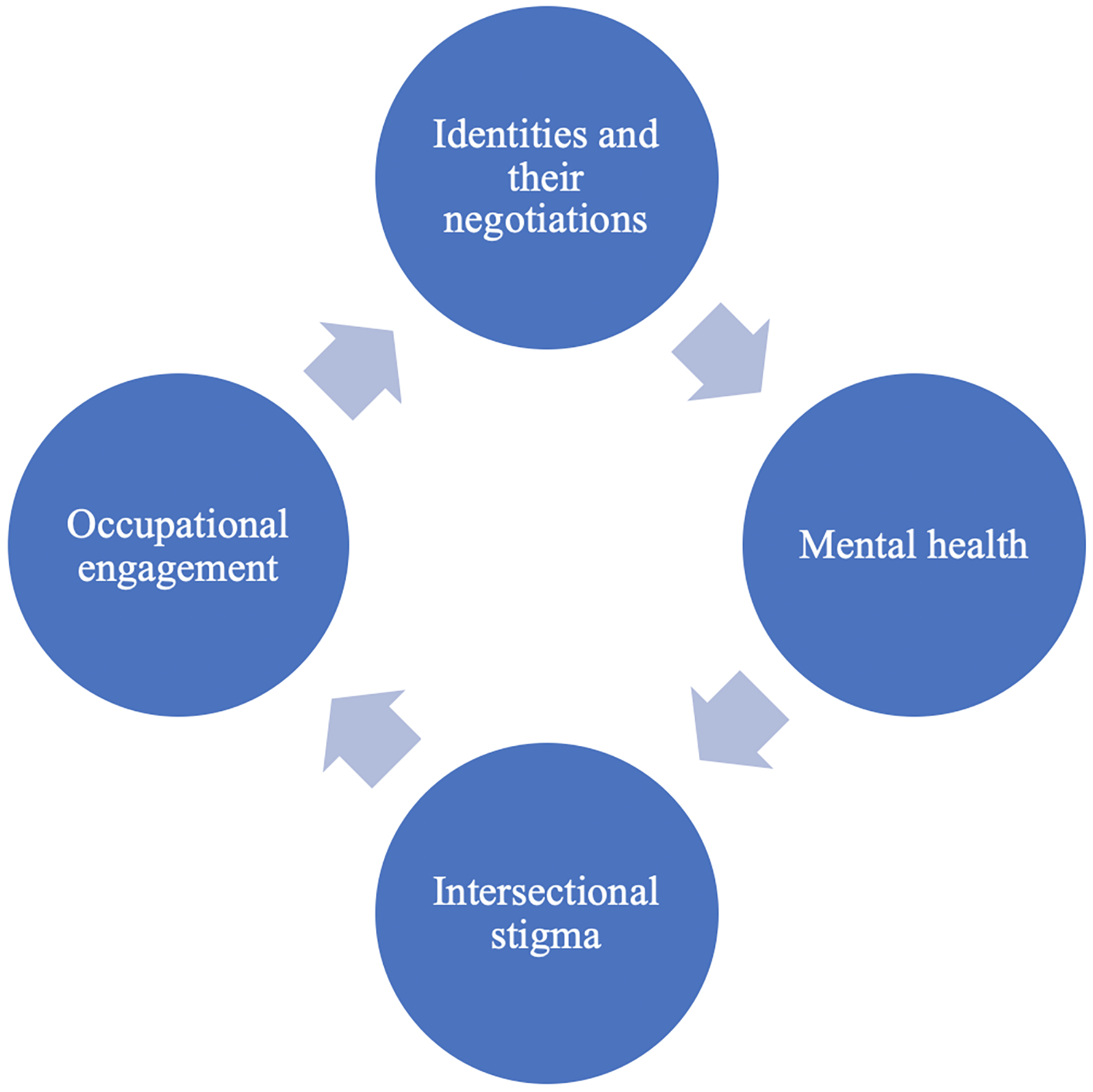
Core themes and their relationships.
Identities and Their Negotiations
This theme highlighted the complexity of racial/ethnic identity construction and its perception. A participant shared, People from my country [Brazil], since we are the only ones who don’t speak Spanish there, we never know how to classify ourselves. So, I don’t want to say Latino, but I think that’s the closest one.… So, I’m kind of on no man’s land.
Such sentiments were shared by participants who described themselves as White-passing. A participant identifying as Latino shared, “I am perceived as White some of the time. And otherwise, unknown.… So, kind of a mixed bag there.”
Participants also described the sociocultural influences on their racial/ethnic identity. A male participant identifying as Mexican American shared, “I would identify as Mexican American but more toward American … I feel like a lot of my kinda values, kinda cultural beliefs, uh, all resulted from me growing up in America.” Another participant shared, “I think of myself like as a Black female … I then go [in my hometown in Florida] and say I identify as Haitian and … I don’t think I’ve ever used African American.” Another participant who identified as Afro-Latina highlighted the complexity of racial/ethnic identity: I don’t really have a home within the African American community … and even within the Latino community, we end up with subsets, where I am half Puerto Rican and half Dominican.… So, even within just the ethnicity of being Latina, that’s a huge issue on its own.
She further shared her challenges with perceptions of her racial/ethnic identity:
One of the biggest challenges I’ve faced is if I get angry at any point in time or if I show that I am displeased with something,… I end up falling into the stereotype of the “angry Black woman.” And I’m seen as nothing else.
Participants also shared familial challenges related to the intersection of their BIPOC identity and mental illness patienthood. A participant with depression identifying as Chinese shared, My parents don’t believe in like the depression and like mental illness. They think that, oh, since like we raised you well, and you grew up with food on the plate, house to live in, clothes to wear and like a good education, there’s like, no way you could be depressed.
Mental Health Journey
Many participants shared that they experienced mental health concerns during their teenage years. An African American female participant shared, “I was having some physical symptoms. … The doctors decided that the problem was probably emotional and so, I saw a therapist. I was probably 15 or so at the time.” She further shared, I, for a long time, had many issues with depression, feelings of inferiority and probably some level of trauma from, you know, things that were said to me or done to me out of racial animus. And so it’s left its mark.
A male Mexican American participant shared similar sentiments: “Like you’re Mexican, you should be good at soccer or … kind of like harmful stereotypes.… It’s a huge kind of like burden to kind of sift through and carry.” A Latina participant shared: “A lot of my mental health concerns, um, a lot of them had to do with a loss of a sense of belonging that I used to feel a lot, um, and still do feel sometimes.”
When asked about racial animus and its relationship with mental health, a Latina student shared, My status as a person of color affects my ability to feel safe in a lot of scenarios. It is something that I am cognizant of, especially up here. I very quickly feel alienated in certain environments.… I’m not really sure how to differentiate which, they’re kind of like chicken and the egg for me.
A female Vietnamese American student also shared the impact on her mental health of racial stereotypes that she heard from her family and friends: “I think not being kind of recognized as Asian and being like made fun of because of my weight, um, lowered my self-esteem, led me to like depression and all that stuff.”
Intersectional Stigma of Mental Illness and Race/Ethnicity
Participants reported experiencing stigma of mental illness and race/ethnicity both distinctly and at their intersection. A participant identifying as Afro-Latina shared that she had to “tame” her curly hair because of bullying related to her racial/ethnic identity: “I got bullied a lot for my hair and it lasted a few months.… I did have a teacher spit in my hair once.”
Participants also described experiencing the stigma of mental illness from both inside and outside of their community. An American Filipino student shared, “If you have a mental illness … you’re just rendered crazy … Like, I didn’t wanna be called crazy … it basically was the fear of being stigmatized, mainly in my family.”
When asked about the intersectionality between the two stigmas, a Chinese student shared concerns about representation: “I think of like mental illness and like the image that society like puts forth for mental illness is like White. So, um, you don’t really see any like people of color struggling with mental illness.” A participant identifying as Latina explained, The stigma of mental health is so great that it is just one more barrier for people of color, um, to cross, to address in any way, because I think that … our burden is so heavy in that, culturally, many non-White cultures are hyper in the sense to even talk of mental health.
A Mexican American participant shared similar sentiments: “I wanna say being a minority, the stigma [of mental illness] is a lot more powerful. Because you never know how someone is going to perceive you as.” Another participant identifying as Biracial and Hispanic shared, “The stereotype is that Hispanics and Latinas are crazy and psychotic … and if we show a moment that resembles that, then it proves it to be true. And that kind of like sticks with you.”
Occupational Engagement
Participants highlighted that occupations became the site where stigma, mental health, and identities intersected. They described experiencing the intersectional stigma in two areas of their occupational engagement: mental health care and community participation.
Mental Health Care
A Haitian participant described the impact of intersectional stigma on Black communities’ mental health care engagement: “The stigma and mental health intertwine so heavily in Black communities … it’s a contributing factor to the stigmas you have, but then the stigma keeps you away from addressing the mental health.” A Vietnamese American student shared similar sentiments: “I receive like a shit ton of criticism for being on Prozac or Zoloft just because they [family members] don’t really see depression or anxiety as like a true ailment.” The same participant shared the difficulty of discussing family dynamics with providers who are not BIPOC: When I am in therapy, I’m like really kind of hesitant to reveal like all the dynamics of my family.… All my therapists have been White, but I feel like some of them … like don’t understand … if I were to share something about my parents and how they behave, which is like influenced by their culture, and I were to get feedback from the therapist … as like a negative … I feel like they’re judging my parents.
Other students described experiences of their identity being ignored or even invalidated. An African American student shared challenges within mental health care: I did not feel that intersectionality was addressed or appreciated at all.… I don’t wanna generalize across all of my counselors.… But the vast majority of them I think addressed my mental health issues as they would for anyone else without any consideration of the intersectionality of my race.
An East Asian participant shared a similar experience:
I would, like, have these instances of, like, racism and … I would be upset. But then he [mental health provider] would come back to me, and be like, “Are you sure … that’s racism and not like prejudice?”… And I’m just like, “Are you serious?”
Community Participation
Participants also shared influences of intersectional stigma on their community participation, including education. A Latina participant shared, I remember one time the professor saying that mental illness affects more Black people, uh, non-White. And so I remember that kind of like look of like the confirmation.… I was the only one non-American in my class at that time. So … I knew it was directed to me.
The same participant also shared apprehension about her future opportunities: “I’m going to look for internships. … They have my file, they know what I struggle with. They would never like give me an internship. So, yeah, that’s a major anxiety, and … it makes me really, really apprehensive.” An East Asian student shared similar concerns, saying, “My career, it’s very White woman dominated. I’m in my internship … where I want to be in the future and it’s, like, all White people. So, it does feel kind of isolating.” She further shared, Within my cohort there’s, like, a lot of ignorance surrounding racism and stuff like that … which I found really interesting considering that they are in a field that they educate themselves and, like, research on or they interact with clients [of color].
Participants also shared the complexity of racial/ethnic identity and community participation. An Afro-Latina participant shared, If I walk into a Hispanic bodega, or a corner store, they immediately speak to me in English, even though I speak Spanish, because they see me as an African American and do not see me as someone who is Latina.
The same participant also shared concerns regarding community participation and disclosure of her mental health concerns: “That’s [being identified as Black and having mental illness] just too many things for me to feel comfortable sharing. … They either see you as a functioning member of society or you’re crazy.” However, a few participants expressed ignoring or resisting stigma. A Haitian student shared, “Being Black is sometimes, it’s more like a confidence, like a boost, like, oh, I’m just a Black girl. I’m going to speak up.”
Discussion
This study identified four key themes critical to understanding how multipositionality and life course are crucial in shaping intersectional stigma and occupational engagement. More specifically, our research supports existing evidence highlighting the negative influence of racial stigma on mental health concerns (Kalibatseva et al., 2022). Our findings also corroborate the fluidity of racial/ethnic identity construction and the impact of familial relationships on stigma (Gee et al., 2020; Nirmul et al., 2023). However, as highlighted by the participants, these findings need a more nuanced understanding. Stigma is not a fixed process but a hierarchical one that is dependent on social capital and expression of symptomatology (Tomar & Thornicroft, 2020). Given that BIPOC individuals and communities have less social capital as a result of historical marginalization, it is not unusual that family members are reluctant to seek mental health care, which adds an additional layer of stigma on their family (Abdullah & Brown, 2011). Because of the exclusion of BIPOC individuals from occupations that help in socioeconomic mobility, such as education and employment, across generations, it is understandable that reluctance in seeking mental health care complicates intergenerational relationships and mental health care utilization (Bailey et al., 2017; Gee et al., 2020). The persistence of stigma toward mental illness and its forced relationship with stigma of race/ethnicity across history further contribute to the intersectional stigma, resulting in experiences of racism and sanism for BIPOC individuals (Oexle & Corrigan, 2018). Consequently, this study also corroborates existing evidence regarding stigma and lack of cultural competence among mental health care providers (Misra et al., 2021). Thus, the findings highlight the need for and complexity of engaging in culturally sensitive mental health care and the utility of family education.
Participants also highlighted that stigma formed the foundation on which issues of belonging and inclusion were experienced. Often issues related to DEI are framed using the ideas of bias (implicit or explicit) and discrimination, and relatively less attention is given to the process of othering, that is, stigma itself, leading to several limitations. Evidence highlights the inefficacy, especially in the long term, of implicit bias trainings on changing individual- and organizational-level outcomes (Onyeador et al., 2021). Furthermore, it is problematic to assume that simply increasing diversity in a profession will address DEI-related concerns; the onus for addressing provider- and organization-level disparities should not be placed primarily on providers who share identity with a historically marginalized population, given the psychological toll of such care and disparities (Norris & Primm, 2024). Thus, in contrast to bias approaches, intersectional stigma approaches may be more suitable for cultivating inclusive and equitable communities.
In addition, this study clarifies theoretical linkages between intersectional stigma and occupational engagement using voices of BIPOC individuals with mental illness. Throughout the literature, stigma and its intersectionality have been examined using the language of seemingly fixed attributes that are highly discreditable or undesirable (such as mental illness or racial/ethnic identity), providing limited guidance for generating effective and meaningful measurements and interventions regarding intersectional stigma (Fox et al., 2018; Misra et al., 2021; Tomar & Thornicroft, 2020). This study, using the PoGR as a theoretical framework, highlights that stigma is a process of othering that is dependent on relationships and context, which are key components for understanding occupational engagement (Dickie et al., 2006; Hammell, 2013; Tomar & Bailliard, 2020). In our study, participants described intersectional stigmas of mental illness and racial/ethnic identity within both familial and social contexts, exemplifying how stigma is not a fixed attribute but a relational and intersectional process influenced by race, culture, social capital, and context. Thus, further examination of stigma using the unit of occupation can yield effective measurements and intervention strategies that can help address intersectional stigma. Ongoing research in this area will also help establish a link between the American Occupational Therapy Association’s (AOTA) efforts to address stigma and WHO’s framework on meaningful engagement, helping occupational therapy scholars to engage in interdisciplinary scholarship to address the ongoing public mental health crisis (AOTA, 2020a; Fisher et al., 2024; Keptner et al., 2024).
Limitations and Strengths
Limitations of this study included a small sample size (N = 13) and lack of male representation. Furthermore, six participants did not disclose their age, which they may have chosen to do to limit deductive disclosure. Data were also collected through one methodology, limiting triangulation in data collection. However, transcript checks, peer debriefings, and multiple analysts helped strengthen the rigor and trustworthiness of the study.
Implications for Occupational Therapy Practice
This study provides evidence to better understand the influence of intersectional stigma on community participation and health care engagement, which are key instrumental activities of daily living (AOTA, 2020b). The study has the following implications for occupational therapy practice: To bolster culturally sensitive care, occupational therapy practitioners should consider the impact of intersectional stigma when providing care to BIPOC individuals and communities. Occupational therapy practitioners working in secondary or higher education settings with BIPOC students should consider implementing mental health screenings. Occupational therapy practitioners working in mental health settings should consider providing mental health education to family members, especially when working with BIPOC individuals.
Conclusion
This qualitative study examined the influence of intersectional stigma of mental illness and race/ethnicity on occupational engagement among BIPOC university students. Our findings yield critical evidence regarding fluidity of racial/ethnic identity construction, experiences and expression of mental health concerns, and factors influencing mental health care engagement, such as family and cultural knowledge. Further research is needed in this area to examine experiences of other historically marginalized individuals, such as BIPOC men with mental illness and sexual and gender minority individuals. Research regarding intersectional stigma can help occupational therapy practitioners to develop strategies for culturally sensitive care and form an evidence base to advocate for policy or structural-level changes in health care, aiding in efforts to reduce health disparities.
Footnotes
Acknowledgments
This study was supported by a Research Support Initiative grant from the University of New Hampshire. We are also thankful to graduate students Pilara Bauer, Paige DePasquale, Emily Morris, and Camden Tillinghast for their support in data collection and analysis.