





Abstract
This article highlights the unique challenges Black occupational therapy practitioners face in their leadership paths.
Before 2020, there was minimal emphasis on the importance of and need for diversity, equity, inclusion, justice, and accessibility (DEIJA) initiatives across the occupational therapy profession, outside of legislative priorities. The tragic deaths of Ahmaud Arbery, Breonna Taylor, and George Floyd in 2020 forced a widespread reckoning, including the profession’s critical reflection on its practices, policies, and commitment to DEIJA. In 2021, the American Occupational Therapy Association (AOTA) further elaborated on its commitment by releasing a diversity, equity, and inclusion strategic plan; one of its four goals is to expand diverse representation in the occupational therapy profession (AOTA, 2021). Despite the increased focus and movement on DEIJA initiatives, a persistent lack of diverse representation in leadership continues to limit progress toward true inclusivity and equity.
Occupational therapy was founded in 1917 by White, upper-middle-class, educated individuals. At its conception, occupational therapy focused on occupations as actions and overlooked the impact of race and other social contexts on occupations, which exacerbated a legacy of exclusion as part of the foundation of occupational therapy (Johnson & Lavalley, 2021). Exclusionary practices point to the historical and systemic barriers and discrimination Black individuals have experienced with respect to access to higher education and, ultimately, occupational therapy (Johnson & Lavalley, 2021). Today, occupational therapy leadership positions are predominantly held by White cisgender women (84.2%) at the local, state, and national levels (Salvant, et al., 2021). Since AOTA’s inception, 100% of its past presidents have been White. This pattern was only recently disrupted with the election of Arameh Anvarizadeh, OTD, OTR/L, FAOTA, a Black Iranian woman, scholar, and full professor, as AOTA president-elect in 2024.
Leaders hold significant influence and power in organizations, and they are expected to set a vision and direction, foster innovation, provide support, and empower individuals to contribute to the organization’s mission and vision in meaningful ways (Nirmul et al., 2023; van Diggele et al., 2020). Ascending to leadership can be challenging for many, and individuals with minoritized identities often encounter additional obstacles imposed by the ever-present prevalence of racism and ascribed power and privilege within society. Individuals with historically excluded identities can provide a unique lens that adds distinct value to an organization. The lived experiences and perspectives of those with historically excluded identities position them to be adept at critically analyzing the ecosystem of the organization or academic institution and addressing unconscious biases that may subtly influence decision-making processes, therefore priming the institution for belonging (Aldridge et al., 2023; Suarez-Balcazar et al., 2023; Taff & Blash, 2017). Belonging is a deeply felt sense of being valued, respected, and accepted within a community, and it is fundamental for establishing inclusive environments that empower individuals to engage and contribute meaningfully (Khan et al., 2025). To garner insight into successful pathways to leadership for individuals with minoritized identities, this qualitative phenomenological research study aimed to explore the journey and lived experience of Black occupational therapy practitioners who currently hold or have previously held positions of leadership.
Theoretical Foundation
Social network theory (SNT) offers a valuable framework for understanding the dynamics of ascension to leadership. According to SNT, a social network is a social structure of relationships among different entities (Hansen, 2009). Individuals are embedded in networks of relationships that provide the social capital necessary to promote access to resources, support, and information. These networks can profoundly shape career development and professional identity formation. These relationships can be classified as ties, and people have strong and weak ties. Strong ties represent deep connections, whereas weak ties symbolize shallow connections (Granovetter, 1973). Weak ties tend to connect people to various groups, and when a person is connected to multiple groups, they have access to more opportunities because of transitivity. For example, leadership in the context of occupational therapy education resembles the guidance and mentorship provided by academics and program directors, which can profoundly influence students’ trajectories as they develop their professional identities and transition to becoming occupational therapy practitioners. The ties formed between students and their mentors, peers, and professional leaders can create a supportive environment that fosters growth and development and opens doors for opportunities.
Critical race theory (CRT) is a framework that aims to critically examine and challenge the ways race and racism influence laws, policies, social structures, and culture (Delgado & Stefancic, 2023). Grounded in the belief that racism is not an aberration but a systemic and ingrained aspect of American society, CRT recognizes that social institutions inherently uphold White supremacy and minoritized people of color. CRT also emphasizes the importance of storytelling and counternarratives from minoritized communities to illuminate the pervasive and often subtle forms of racism that persist. CRT challenges social structures that prioritize assimilation, which supports the persistence and codification of racism.
Method
Study Design
This interpretive phenomenological research study included a nine-question questionnaire and a one-time, 60-min semistructured interview to answer the research question “What supports and barriers do Black occupational therapy practitioners face while pursuing leadership?” This design allowed for a nuanced examination of how people make sense of their personal and social worlds and captures the complexity of individual experiences shaped by social, cultural, and historical factors (Eatough & Smith, 2017). This research study was approved by the University of St. Augustine for Health Sciences Institutional Review Board and deemed exempt.
Participants and Data Collection
The inclusion criteria required that participants identify as Black occupational therapy practitioners who currently hold or have held a leadership position within the past 5 yr. Individuals of all genders were encouraged to participate, and eligible participants were ages 18 to 65 yr (see Table 1). Participants were recruited through purposive sampling using social media and snowball sampling. The 60-min interviews were conducted and recorded on the Zoom platform, transcribed verbatim, deidentified, and uploaded to Dedoose software for data analysis.
Participant Demographic Data
Data Analysis
Interpretive phenomenological analysis was conducted to uncover various dimensions of the journey to leadership. Reflexive thematic analysis followed six key steps: (1) becoming familiar with the data by reading and rereading the transcripts; (2) generating initial codes through inductive coding, allowing themes to emerge organically from the data, and using latent coding to help uncover the underlying meaning and contextual factors influencing the participants’ lived experience; (3) identifying initial themes; (4) reviewing and refining themes to ensure accurate representation of the data; (5) defining and naming themes; and (6) compiling the analysis into a narrative that integrates themes with relevant data excerpts (Braun et al., 2023). See Figure 1.
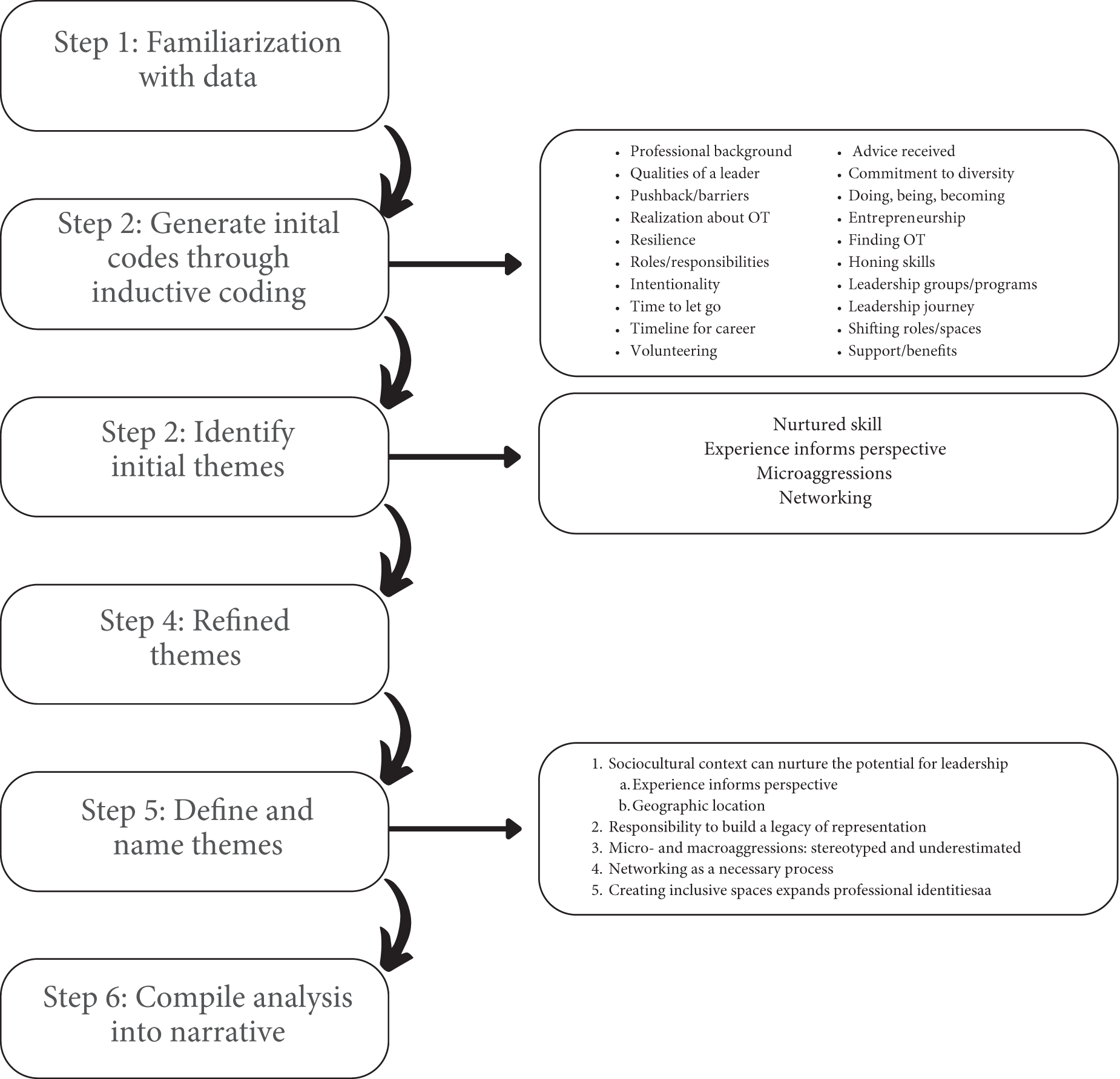
Researcher triangulation was used, and all three researchers participated in collaborative coding of transcripts and peer debriefing to enhance rigor and credibility. Member checking was attempted with preliminary themes to ensure our interpretations aligned with the participants’ perspectives. Trustworthiness was bolstered by engaging in critical reflexivity of our assumptions and positionality through an intersectional lens. This reflexive practice involved ongoing individual and collective examination of how our identities and lived experiences influenced our interpretations, understanding that our subjectivity is not viewed as a bias to be eliminated but as a resource to enhance the depth and quality of analysis (Thambinathan & Kinsella, 2021). Last, theory triangulation was implemented to validate findings, credibility, and depth of the study’s findings (Bans-Akutey & Tiimub, 2021). SNT was applied to examine the role of social networks and relationships in facilitating or hindering leadership opportunities. CRT was used to explore how systemic racism influences social structures that affect the experiences of Black leaders in occupational therapy. Using these theories for triangulation, the study aimed to provide an all-encompassing understanding of the multifaceted and nuanced challenges and supports Black occupational therapy practitioners experience in leadership. The data, thematic analysis, and theoretical triangulation are presented in Table 2.
Themes, Data, and Theory Triangulation
Results
Seven participants completed the demographic questionnaire and interview. All participants self-identified as Black or African American, and three reported an additional racial/ethnic identity. Six participants ranged in age from 31 to 40 yr, and one participant was older than age 61 yr. Five identified as women, and two identified as men. Six participants had doctorates, and one had a master’s degree (see Table 1). Participants represented the Eastern, Western, and Southern United States, and their leadership experiences ranged from academia and rehabilitation management to involvement with state, national, and international organizations.
On the basis of the thematic analysis of qualitative interviews, five major themes emerged, providing an understanding of the challenges and triumphs faced by these practitioners: (1) sociocultural context can nurture the potential for leadership, (2) responsibility to build a legacy of representation, (3) micro- and macroaggressions: stereotyped and underestimated, (4) networking as a necessary process, and (5) creating inclusive spaces expands professional identity. These themes collectively underscore the complexities and resilience inherent in the leadership journeys of Black occupational therapy practitioners. The data highlight the systemic challenges faced, the strategies used to overcome these challenges, and the impact of cultural and social contexts on participants’ professional development.
Theme 1: Sociocultural Context Can Nurture the Potential for Leadership
The theme of the sociocultural context influencing leadership potential includes two subthemes. On the basis of participant narratives, the sociocultural context includes (1) previous experiences that were encouraged by others (non–occupational therapy practitioners) and (2) geographical or physical location within the United States. It was notable that several participants described themselves as “falling into leadership,” although when reflecting on their lives, they identified how their family, friends, and community influenced their development as leaders during their formative years. One reported, Both my parents were very involved in the community.… Both of them were heavily involved in their [respective colleges and universities and held influential leadership roles within their careers].… They made sure we saw that,… I think I didn’t necessarily understand it at the time; some seeds were planted.
A subset of participants reported that their parents were heavily involved in leadership, allowing them to have early exposure to positions of authority. Another participant’s parents were intentional about ensuring their children were involved in leadership activities: “[Hard work and leadership] comes from the core values of my deep-rooted family values.… In [grade school], I was running for [class] president.… My dad walked around helping me put posters up.”
Geographic location within the United States had varying correlations with participants’ pursuit of leadership. Participants who grew up in predominantly Black environments noted that they seldom experienced feelings of exclusion and were surrounded by several role models in leadership positions within their community. One participant stated, “I think I just benefit from living in a really culturally aware environment …a lot of college-educated folks are here.”
The data illustrate a combination of community and family support through words of affirmation that generated expectation and responsibility of leadership from a young age. Personal factors such as confidence, passion for leadership or advocacy, and life purpose or a calling were cultivated by the sociocultural communities in which they were immersed.
Theme 2: Responsibility to Build a Legacy of Representation
This theme provides insight into how participants intentionally navigate professional arenas to ensure equitable representation. The theme also encompasses the additional burden and unspoken responsibilities carried by Black occupational therapy practitioners to ensure there are Black faces, perspectives, and a method to challenge the status quo as part of their personal legacies.
The sense of duty extended beyond their professional careers as they sought to create a lasting impact on organizational cultures rooted in societal norms to pave a smoother path for others to follow. They commonly reported being the only Black person in contexts in which they held a leadership position. A participant described this unique position and responsibility as a “huge, huge weight to carry” for Black occupational therapy practitioners. One participant stated, “It’s just the right thing to do, pay it forward,… there has to be more of us in all spaces, not just [occupational therapy].” This responsibility was expressed as a critical part of participants’ personal legacy within the profession: I know that I have a part in somebody else’s legacy, and I have a part in improving the quality of somebody else’s life. And that goes really, really far when it comes to feeling like you made a dent and a change. I can tell you unequivocally that I have been a positive influence in more lives than I’ll ever know. [I] always think about what doors am I opening that I leave open for this next generation of folks.… I don’t take that lightly.
This theme highlights the profound sense of duty participants felt to advance equitable representation and to establish pathways for others in White-dominated professional spaces.
Theme 3: Micro- and Macroaggressions: Stereotyped and Underestimated
Theme 3 highlights the subtle and overt racism participants experienced in the form of micro- and macroaggressions. Microaggressions are indirect, subtle, or unconscious discrimination against members of a minoritized group. Macroaggressions are overt acts of racism toward people of a particular race. Participants recalled frequent occurrences where they had their own or witnessed others’ expertise questioned. “People try to question your knowledge and expertise about it.… They really need an opinion of somebody else and [will] not take your word for it.” Another participant recounted an all-too-common assumption and stereotype that they were part of the service staff rather than an occupational therapy professional. “That person leaning over and say[ing], ‘Hey, how do you like working in housekeeping here?’… That’s happened to me more times than I can count.”
Micro- and macroaggressions demonstrate the underestimation of the participant’s knowledge or capabilities while discrediting and undermining their professional competence and authority, affecting their reputation and ability to engage with social networks. Participants also depicted instances of mistaken identity based on skin color, lack of individual recognition and identity, and bias in discriminatory hiring practices disguised as cultural fit. One stated, “I get called the name of somebody who looks totally different, but we just share the same brown skin.… I’m like, I’m not, that’s [not me].” This theme reveals the pervasive impact of micro- and macroaggressions on Black occupational therapy practitioners, exposing how bias and stereotypes often undermine their professional identity and subtly or overtly question their competence and belonging in the profession.
Theme 4: Networking as a Necessary Process
Networking allowed participants to establish or expand connections for new opportunities to open up. Several participants described their occupational therapy leadership journey as beginning with volunteering with various organizations. Volunteering allows occupational therapy practitioners to expand their networks, demonstrate their work ethic, and develop leadership skills organically. Participants communicated how they became aware of opportunities through the meaningful relationships cultivated within various organizations. Participants elaborated on the sponsors who vouched for their reputations of competency, debunking stereotypes. These sponsor relationships positioned participants in networks that led to both horizontal and vertical opportunities, as described by one participant: When I went into my [company] interview,… I had to interview with like 20 people. This could be intimidating for people. When I went in the room … I knew everybody already well because I was so involved in volunteer leadership.
This emergent theme also highlighted the importance of building networks through active involvement to ensure sustainability in leadership. Exposure and acceptance in social networks led to open pathways for participants and other occupational therapy practitioners. One participant stated, “Our reputations are far and wide. And I stepped into a lot of roles that I’ve had previously with a phone call based on my reputation.” Participants expressed that networking was not solely for increased opportunities but also facilitated connections with like-minded individuals who had similar perspectives on goals of equity, representation, and a sense of belonging in the profession. One participant explained, As you become more mature in leadership … your village becomes smaller, and the trusted people that are in your circle becomes smaller.… You got to lean into the people that you trust, people who are your mentors, the people who are your sponsors, the people who can support [you].
Networking serves as a crucial pathway for Black occupational therapy practitioners to cultivate connections and gain access to opportunities, mentors, and partnerships with individuals who share common goals for the profession.
Theme 5: Creating Inclusive Spaces Expands Professional Identity
The final theme highlights the transformative power of inclusivity, exemplified by the deliberate creation of spaces that not only allow but also listen to and celebrate minoritized voices. Without diverse representation, participants recognized a lack of inclusive spaces in the occupational therapy profession. The experience of navigating predominantly White spaces or dismantling systems and structures that have been entrenched in racist ideology has been a challenge. One participant stated, “It’s not easy to be in these spaces because they really want to destroy you in these spaces.” Participants emphasized the need for individuals to undertake grassroots efforts to cultivate their environments, where they experienced a sense of belonging: “We didn’t have a space where I knew my people. I graduated, and I had to find my way.… I mean, grassroots.”
Participants emphasized that inclusive spaces are pivotal in broadening their professional identities. The participants spoke about how their professional identities were organically expanded to include scholar, researcher, or entrepreneur.
Discussion
The findings of this study provide a nuanced perspective on the complex factors that influence the leadership development of Black occupational therapy practitioners. The five themes, further examined through the lens of CRT and SNT, provide a context to understand social structures, power, and the impact of these structures on developing leaders.
CRT provides a lens to analyze these themes, specifically related to how social structures perpetuate racial inequalities and how the dominant cultural narratives and ideologies reinforce the exclusion of diverse voices and faces from positions of power (Ladson-Billings, 2021; Ray, 2023). Participants explicitly and implicitly highlighted their experiences with racism and the racialized environments that undermine their professional competence and legitimacy in the form of microaggressions and macroaggressions. Frequent micro- or macroaggressions have a cumulative effect over time, and Black people have often felt the need to assimilate to demonstrate their capability and disprove stereotypes (Anderson, 2015; Delgado & Stefancic, 2023). Despite the profession’s ongoing efforts to address systemic racism, the themes further support the notion that institutional racism and its role in maintaining social inequalities persist in the leadership journey. The participants emphasized the profound sense of responsibility for creating counternarratives to actively resist the dominant discourse by building a legacy of representation for future Black occupational therapy practitioners (Blaisdell, 2023; Jones, 2023). These counternarratives serve to dismantle stereotypes, provide an accurate and robust representation of the social realities of Black occupational therapy practitioners, and amplify the long-standing inequities in occupational therapy leadership. Connections with students or occupational therapy practitioners with similar backgrounds or identities, including the stories they tell, can be a form of resistance to oppressive structures. Counterstorytelling or counternarratives can lead to stronger professional identities grounded in the knowledge that one’s contributions are seen, valued, and needed in the occupational therapy profession (Jones, 2023; Tan & DeFrank-Cole, 2023). This commitment to mentorship and role modeling reflects a strategic effort to increase diversity and inclusion in occupational therapy leadership. In addition to counternarratives, the participants described their invisible labor in creating inclusive counterspaces for safety, community care, and validation (Jones, 2023; Reid & Pride, 2023; Teachman, 2023). These spaces go beyond mere inclusion to establish collective social settings that prioritize well-being and belonging while reconciling “colliding identities” (Reid & Pride, 2023, p. 23; Teachman, 2023).
CRT also provides insight into the influential nature of the sociocultural context, including the geographical location of participants, in shaping the identity of a leader, starting in early childhood (Delgado & Stefancic, 2023). In conjunction with CRT, Chunoo and Torres (2023) discussed the multiple dimensions of identity model, which conceptualizes identity as a dynamic and multifaceted construct. Professional identity evolves with additional education, practice, mentorship, and critical reflection. The collective power of the sociocultural context, systems of power, and oppression can also lead to the saliency of identity (Chunoo & Torres, 2023). Participants in the current study spoke of the importance of familial and community support in attaining access and opportunity and early exposure to models of authority. Those who were raised in predominantly Black communities noted that they seldom experienced feelings of exclusion and were surrounded by inspiring role models. The representation of Black leaders and the counternarrative modeled by community leaders created culturally affirming spaces that promoted an emerging leadership identity while nurturing the skills and confidence of a leader (Anyiwo et al., 2018).
CRT and SNT together emphasize the critical role of social connections and strategic networking in leadership development. On the one hand, CRT highlights how systemic racism and power dynamics shape opportunities and the need to challenge the inherently biased and privileged ways in which the dominant group attains and maintains power. SNT, on the other hand, examines the patterns and dynamics within social networks that influence access to resources and support. Black occupational therapy practitioners described the relational ties or relationships within their immediate social networks that allowed them to grow as leaders (Gamper, 2022; Hansen, 2009). Strong ties, such as those found in counterspaces, provide essential support and affirmation, whereas weak ties offer valuable access to information or opportunities, although they may not always provide the same level of safety and validation (Liu et al., 2017). The sociocultural context of family, friends, and community was a form of “bonding social capital” before they transitioned to professional settings (Gamper, 2022, p. 210). By cultivating relationships throughout their careers, active community involvement, and volunteerism, these occupational therapy practitioners were able to bridge social capital, allowing them a broader landscape in which to navigate leadership development and gain access to leadership roles.
Limitations
The inclusion criteria regarding what qualifies as a leadership role were intentionally left broad. Therefore, a limitation could be whether some Black occupational therapy practitioners view themselves as leaders because leadership was not specifically defined. Member checking was attempted with preliminary themes; however, only two participants responded and confirmed agreement with the themes. Like any research study focused on race, some potential participants may have felt hesitation regarding how their stories would be presented because the occupational therapy profession tends to consist of a small network of occupational therapy practitioners. Last, the study was not designed for prolonged engagement with participants, which may have limited the opportunity to build trust and gain a deeper understanding of their experiences.
Implications for the Occupational Therapy Profession
As we move toward equity and inclusion, we must acknowledge the profession’s history and dismantle the systems rooted in whiteness that harbor obstacles to diverse leadership (Lavalley & Johnson, 2022; Suarez-Balcazar et al., 2023). It is imperative to critically interrogate the problematic patterns entrenched in occupational therapy leadership, which has historically favored a singular group in establishing and consolidating power. Occupational therapy practitioners have opportunities for influence, underscoring the need for diversity and representation for occupational therapy to be a truly thriving profession. Emerging practitioners who observe individuals resembling them in leadership positions can subconsciously embody the qualities of a leader and affirm their potential to attain positions of power and influence (Hendricks & Toth-Cohen, 2018). The occupational therapy profession must acknowledge and address the lack of progress in expanding representation across all domains, including governance and leadership. A significant limitation of the profession’s recent commitment to DEIJA is the “othering” effect when those who have the power to drive change are not directly affected by the same systemic challenges as individuals with excluded identities (Nirmul et al., 2023, p. 8). Societal norms continue to prioritize White leadership perspectives and behaviors, leading to the need to assimilate or face additional hurdles in pursuing leadership roles (Aldridge et al., 2023; Santiago et al., 2021). The current racialized factors within the profession generate missed opportunities for crucial insight into ways of being and knowing in macro and micro contexts, creating additional barriers to progress.
Conclusion
This study engaged in counterstorytelling by reporting the experiences of seven Black occupational therapy practitioners in their journey to leadership within the primarily White occupational therapy profession. Although this study focused on Black occupational therapy practitioners, we anticipate that the findings can assist in laying the groundwork for other minoritized communities and serve as a resource for all occupational therapy practitioners aspiring to leadership. However, further research on specific minoritized communities’ journeys is needed. For practitioners who aspire to hold leadership positions, this research can serve as a reference point for initiating their journey and engaging in the process of creating a counternarrative.