





Abstract
This scoping review identifies key roles for occupational therapists in supporting the feeding needs of children school settings.
Feeding is a lifelong occupation, essential to survival and quality of daily life. Feeding, eating, and swallowing are terms that encompass the entire process of feeding. From setting up, bringing food or fluid to the mouth, manipulating the substance in the mouth, and moving the food from the mouth to the stomach, these essential activities of daily living are heavily guided by physiological, psychosocial, cultural, and environmental factors (American Occupational Therapy Association [AOTA], 2006).
Inadequate intake of nutrition will affect occupational performance and participation in other occupational domains (Thoyre et al., 2018). Feeding challenges may involve difficulty with age-appropriate oral intake, affecting nutritional status and potentially be linked to medical, developmental, or psychosocial factors (Goday et al., 2019). Individuals experiencing feeding challenges who are not receiving the appropriate support to provide their bodies with necessary nutrients may not have the capacity to engage meaningfully in their daily life. Despite limited current data, it is estimated that 20% of typically developing children, 80% of children diagnosed with a developmental disability, and 85% of children with complex medical conditions experience feeding challenges (Benfer et al., 2013; Lefton-Greif & Arvedson, 2007; Mascola et al., 2010; Thoyre et al., 2018). It is important that children in the school system are given the support they need for feeding and access to the capacity to participate in their academic and peer occupations.
School-based occupational therapists are well positioned to provide this pediatric population with the necessary feeding support, evaluation, and assessment. This scoping review aimed to summarize the existing literature regarding feeding management in school-based occupational therapy and to highlight the research gaps in this field. This review is the first step in guiding future research and practice.
Role of Occupational Therapy in Feeding Management
Occupational therapists are equipped to work across a diverse range of settings and with individuals throughout their life course to facilitate independence and meaningful engagement and participation in feeding (AOTA, 2017b; Bruns & Thompson, 2014; Clark, 2003; Paul & D’Amico, 2013). The evaluative role of occupational therapists in feeding management includes observations and interviews, as well as selecting, administering, and interpreting assessment measures with the clients and their families to assess feeding needs (AOTA, 2017b; Clark, 2003). Occupational therapists are trained to holistically and comprehensively evaluate and address physical, sociocultural, psychological–emotional, and environmental factors (McColl et al., 2015). These factors have an influence on occupational performance and are necessary considerations when implementing intervention plans for feeding, eating, and swallowing (AOTA, 2017b; Clark, 2003; Helminger & Hartmann, 2023).
Occupational therapy’s scope of practice enables occupational therapists to address these factors through a variety of interventions, with existing AOTA practice guidelines and the Canadian Association of Occupational Therapists (CAOT) position statements in this area (AOTA, 2017b; CAOT, 2010). Occupational therapists can acquire skills needed for work in the feeding and swallowing field of practice, such as using adaptive equipment, body positioning and posture strategies, swallowing techniques, managing sensorimotor needs, and compensating or remediating fine and gross motor skills (Bruns & Thompson, 2014; Paul & D’Amico, 2013).
Role of Occupational Therapy in Schools
Occupational therapy is a crucial school-based service that can be provided to ensure students can meaningfully engage in their education. AOTA has existing practice guidelines to direct occupational therapy practice in this area (AOTA, 2017a). Occupational therapists have the ability to consider how children’s needs can affect their participation in the physical, cultural, and social contexts of the school setting to facilitate student success (Cahill & Bazyk, 2015; Lowman et al., 1999; O’Donoghue et al., 2021).
Occupational therapists are important members of the multidisciplinary school-based team and contribute to the referral, evaluation, intervention, and outcome processes. They provide resources to teachers to improve students’ ability to participate in school (AOTA, 2016; Cahill & Bazyk, 2015; Clark, 2003). Some areas of focus for school-based occupational therapists are classroom seating, handwriting and fine motor skills, self-regulation, sensorimotor processing, classroom transitions, and executive functioning skills (Cahill & Bazyk, 2015). Occupational therapists can integrate their direct services through a multitiered model by providing services to the entire class or small groups in the classroom environment, or one-on-one using a pull-out approach (Cahill & Bazyk, 2015; Lynch et al., 2023; O’Donoghue et al., 2021). They can also provide indirect services in the school on behalf of the students. Practitioners can contribute consultation-based services to school staff and parents to ensure students are supported (AOTA, 2020b; Bolton & Plattner, 2020; Cahill & Bazyk, 2015; O’Donoghue et al., 2021). In addition, practitioners can advocate for accessibility and inclusion for students (AOTA, 2020b; Bolton & Plattner, 2020; Cahill & Bazyk, 2015). Occupational therapists are well established in the school system and have the potential to enhance student well-being and participation from a variety of different approaches.
In school settings, occupational therapists can collaborate with the multidisciplinary school team to create service and support plan documents for students. Throughout this scoping review, individual education plans (IEPs) were used when discussing these documents. An IEP legally documents an individualized support plan outlining appropriate and needed services from the multidisciplinary team for the individual (Cahill & Bazyk, 2015). It is worth noting that other documentation might be used for students, depending on context and location.
Role of Occupational Therapy Feeding in Schools
More recently, practice settings predominantly consider a client’s natural environment when assessing feeding and implementing intervention (Diaz & Cosbey, 2018, as cited in Helminger & Hartmann, 2023). In the past, relevant feeding literature largely took place in clinics and hospital settings, because occupational therapy feeding assessments and interventions were heavily situated in these environments (An, 2014, as cited in Helminger & Hartmann, 2023).
Feeding plays a large role in the daily routine of children attending school. Mealtime provides an opportunity for students to engage and socialize with their peers (Bruns & Thompson, 2014; Clark, 2003; Helminger & Hartmann, 2023). A lack of proper nutrition can interfere with other school occupations and affect the child’s ability to learn (Clark, 2003; Goday et al., 2019; Helminger & Hartmann, 2023). Food provides energy needed to focus, participate, and process information. Children who have difficulty eating and drinking independently will require additional support to sustain themselves throughout the school day, and occupational therapists are equipped to provide that support (Frolek Clark & Chandler, 2019).
Objective
Feeding is listed as a vital content area for educational programming in occupational therapy schools and is well within occupational therapy’s scope of practice. However, there is scarce literature on the practice of feeding assessments and interventions for occupational therapists working in school-based settings, and little is known about the role and scope of practitioners (Helminger & Hartmann, 2023; Powell, 1994). Given the established literature for school-based practice and for feeding practice, the high rates of feeding problems among children, and the importance of feeding for participation and engagement, occupational therapists are uniquely placed to work with children on feeding-related difficulties in school-based settings. This scoping review aimed to investigate the existing knowledge on this subject and determine the quantity and quality of the existing literature. We aimed to discover whether there is a need for further research in this field. In doing so, the scope of occupational therapy can be further clarified to provide practitioners with future practice guidelines and role recommendations. This scoping review will identify central themes, significant barriers to practice, and knowledge gaps in the literature by answering the following question: What is the role of occupational therapy in pediatric feeding management in school-based settings?
Method
We conducted a scoping review to synthesize all previous literature on this topic and to identify existing gaps in the knowledge. We used the Preferred Reporting Items for Systematic reviews and Meta-Analyses extension for Scoping Reviews (PRISMA-ScR; Tricco et al., 2018) as a guideline for conducting the present review.
Identifying Relevant Studies
We used the keywords feeding, school, and occupational therapist to search titles, abstracts, and keywords to identify relevant research. Variations of those keywords were used to ensure comprehensive coverage of relevant literature. Initially, we each searched two databases from a list of six databases (CINAHL, Medline, PsycINFO, Embase, Web of Science, and Google Scholar). Because of the limited quantity of literature, no date restriction was set for the database search, and all levels of evidence (AOTA, 2020a) were included. In addition, we included studies in this report if a portion or more of the text met the following criteria: (1) written in English, (2) services provided in a school setting, (3) involved children from junior kindergarten to Grade 12, and (4) involved the management of feeding by the occupational therapist in schools. Studies with the following criteria were excluded: (1) services provided in a clinical setting; (2) involved adults; (3) services provided in community settings beyond schools; (4) related to the following DSM–5 feeding and eating disorders: anorexia nervosa, bulimia nervosa, binge eating disorder, and other specified feeding or eating disorder (American Psychiatric Association, 2013); and (5) involved books. A gray literature search can be included in scoping reviews to capture relevant literature that is not found in the academic database search. We made the decision to search the gray literature with the search engines Bing, Google, Yahoo, and Ask.com to identify any non-peer-reviewed publications that were relevant to the study. Because of the lack of academic literature about this topic, we felt it was important to have an understanding of what non-peer-reviewed sources exist. The strategy for a gray literature search is often not as standardized as an academic literature search. It requires several search strategies with multiple keywords, and researchers must rely on the most relevant results because it is difficult to screen all retrieved search results. The gray literature sources in our review included any source that specifically discussed the role of occupational therapy in feeding management in the school setting, including blogs, magazine articles, and websites.
Search Strategy
A total of 189 articles were generated after the database searches were completed and verified. After eliminating duplicate studies, we conducted an initial screening of the title and abstract for 160 articles. To increase reliability, two researchers (Talia J. Widrich and Catherine Fournier) completed all steps of the search strategy, with one researcher (Lothika Shanmugarajah) verifying consistency between search results by cross-checking at each stage of the search strategy. After screening the titles and abstracts, 16 articles were retained for a full-text review. A total of 5 articles met the inclusion and exclusion criteria for the scoping review, including 3 peer-reviewed articles and 2 non-peer-reviewed articles (see Table A.1 in the Supplemental Material, available online with this article at https://research.aota.org/ajot). Through backward citation searching, the references of these articles yielded 3 additional peer-reviewed articles for full-text screening. Two were included in Table A.1, whereas the remaining article did not meet the inclusion and exclusion criteria for the study. Forward citation searching was done for each selected article. No new literature was identified. From the gray literature search, 1 peer-reviewed study was identified, and 2 additional articles were added to the non-peer-reviewed table (see Table A.2 in the Supplemental Material). The review process is summarized in Figure 1.
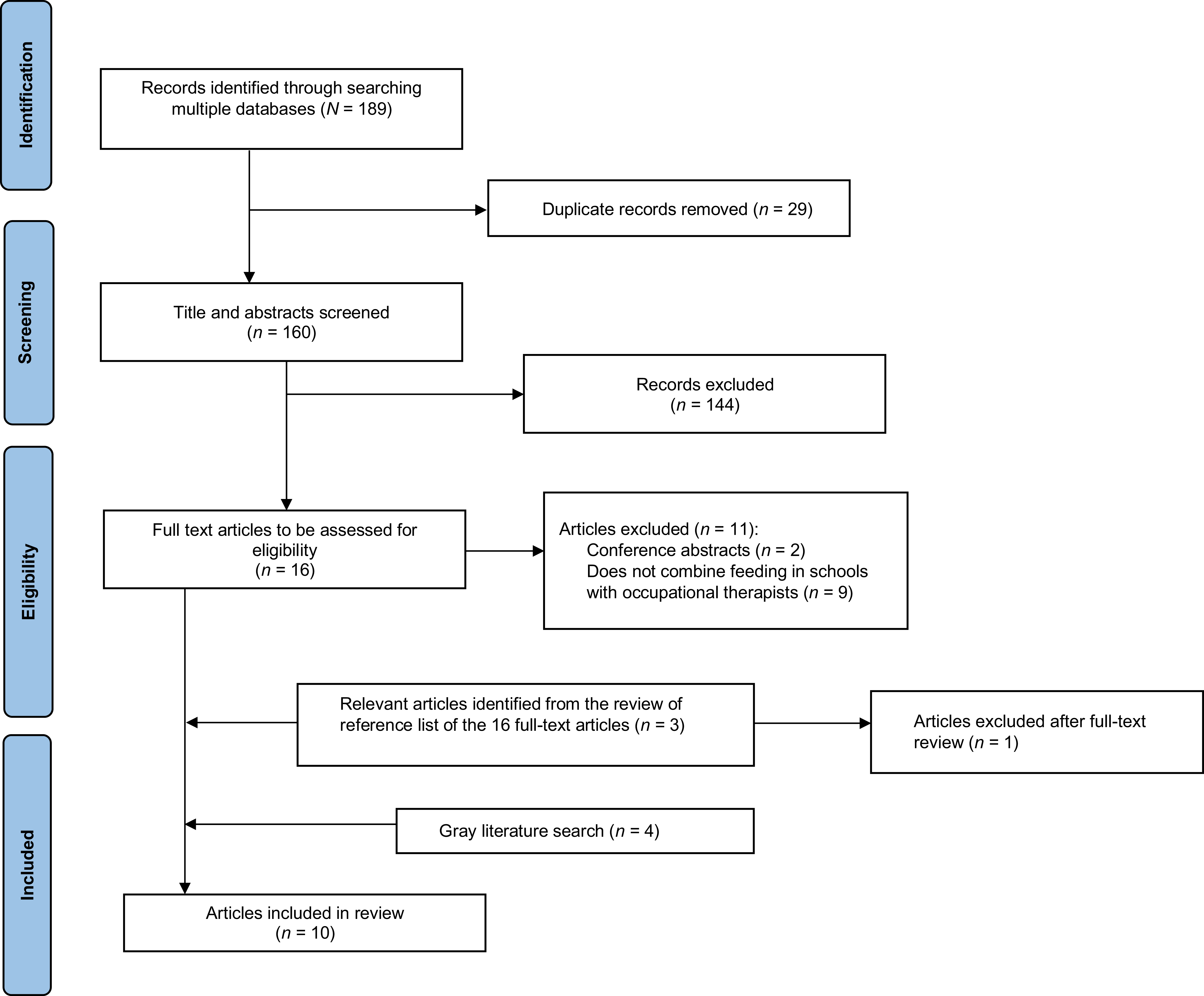
Preferred Reporting Items for Systematic reviews and Meta-Analyses flowchart for the scoping review.
Results
Overview of Studies
A total of 10 articles were included in the two result tables in the Supplemental Material, along with a description for each. Six articles were from peer-reviewed journals (see Table A.1) and 4 were from non-peer-reviewed journals (see Table A.2). We used AOTA’s guideline for systematic reviews to determine the level of evidence for the selected articles (AOTA, 2020a). Four (66.67%) of the 6 peer-reviewed articles were given a Level 5, 1 article (16.67%) was given a Level 4, and 1 article (16.67%) was given a Level 3b. The other 4 studies included in Table A.2 were not given a score because the level of evidence was not applicable to them.
Two (33.33%) of the six peer-reviewed articles involved more than 170 participants each. One of those used a mixed-methods design involving surveys and interviews, and the other was a quantitative survey study. One (16.67%) peer-reviewed article involved a single participant in the form of a case study. Three (50%) peer-reviewed articles did not include participants because they were expert opinion papers. Of the four articles included in the non-peer-reviewed table, two (50%) were blogs, one (25%) was a magazine article, and one (25%) was a periodical.
Most (90%) of the selected articles were conducted in the United States, and 1 article (10%) was a peer-reviewed article conducted in New Zealand. Seven of the 10 articles (70%; 5 peer-reviewed and 2 non-peer-reviewed) were published more than 5 yr ago, and 50% (3 peer-reviewed and 2 non-peer-reviewed) were published more than 10 yr ago. The publishing dates ranged from 1986 to 2022.
Role of Occupational Therapy
Upon reviewing the 10 selected articles, we identified several common themes regarding the role of occupational therapy in feeding in schools. These recurring concepts included (1) working collaboratively, (2) assessment strategies, (3) intervention approaches, and (4) formalized policy. Table A.3 in the Supplemental Material outlines a synopsis of the themes in the 10 selected articles in this scoping review.
Working Collaboratively
Of the 10 selected articles, 90% (6 peer-reviewed and 3 non-peer-reviewed) discussed in some capacity the importance of multidisciplinary collaboration when working as an occupational therapist in schools with students requiring feeding support. Three studies (30%; 1 peer-reviewed and 2 non-peer-reviewed) noted that occupational therapists are ideally situated to coordinate with the medical team. In addition, 7 studies (70%; 4 peer-reviewed and 3 non-peer-reviewed) reported the importance of collaborating with the family and teachers. The studies highlighted the need for consistent communication between stakeholders, the role of teacher training, and the involvement of medical professionals to ensure the safety and effectiveness of interventions. The studies recognized teamwork as essential while acknowledging the unique constraints and opportunities in the educational setting (Breithart, 2020; Clark, 2003; Drobnyk & Rocco, 2011; Helminger & Hartmann, 2023; Lowman et al., 1999; Paul & D’Amico, 2013; Strauss, 1986). Occupational therapists can assume the position of an educator or coach for team members working with students. Sixty percent (4 peer-reviewed and 2 non-peer-reviewed) of the articles discussed the significance of a consulting role for occupational therapists in this area (see Table A.3).
Assessment Strategies
Assessment strategies in this practice area were not frequently detailed in the selected studies. Fifty percent (4 peer-reviewed and 1 non-peer-reviewed) of articles mentioned the use of informal assessments and observations when evaluating students with feeding challenges. Twenty percent (2 peer-reviewed) of articles discussed and provided the name of a standardized assessment used by practitioners. Helminger and Hartmann (2023) reported that the eating and drinking portion of the School Function Assessment was the most frequently used standardized assessment. Notably, 80% of participants reported that a “lack of formalized training and knowledge of current evaluation tools” (Helminger & Hartmann, 2023, p. 10) prohibited them from using standardized assessments to inform their intervention process. Twachtman-Reilly et al. (2008) named the Sensory Profile as a standardized assessment that included components related to eating and oral sensory processing; however, they did not discuss occupational therapy assessment for oral motor feeding challenges. Sixty percent of articles did not discuss specific assessment and evaluation protocol (Table A.3).
Intervention Approaches
The 10 selected articles outlined various feeding intervention techniques that occupational therapists have used in schools. The two most common interventions discussed were a focus on positioning, posture, and strength (90%; 5 peer-reviewed and 4 non-peer-reviewed) and implementing adaptive equipment and proper utensil use (90%; 6 peer-reviewed and 3 non-peer-reviewed). Six (60%; 4 peer-reviewed and 2 non-peer-reviewed) of the articles mentioned a consideration for the sensory component of feeding, for example, addressing textures, temperatures, tastes, and building sensory regulation skills for mealtime. Other strategies included working on fine and gross motor skills (50%; 4 peer-reviewed and 1 non-peer-reviewed) to strengthen independent feeding and building social skills in the context of feeding (50%; 3 peer-reviewed and 2 non-peer-reviewed), because socializing during these times is a significant occupation for students. Forty percent (3 peer-reviewed and 1 non-peer-reviewed) of the articles discussed oral motor planning, oral exercises, and the importance of establishing a feeding routine for students. The use of cues and prompts as an intervention tool was explored in 30% (2 peer-reviewed and 1 non-peer-reviewed) of the articles. Visual, verbal, and physical cues and prompts were used when teaching various feeding skills to students. Of the 10 studies, 4 (40%; 3 peer-reviewed and 1 non-peer-reviewed) reported a preference for assessing and implementing interventions for feeding in a natural setting, such as the school cafeteria in which the feeding occupation took place. Clark (2003) argued that providing feeding support in the school environment allows the clinician to observe the students in their typical environment and gain a comprehensive image on performance and participation during school mealtime. Helminger and Hartmann (2023) discussed the shift in practice trends toward interventions in natural settings rather than clinics. Twachtman-Reilly et al. (2008) and Strauss (1986) described the benefits of having the school team involved in interventions and education. Twachtman-Reilly et al. (2008) further discussed the benefits of taking into account the multitude of sensory inputs that occur in a school lunchroom, such as other children, smells, and sounds. In contrast, Breithart (2020) argued that clinic settings might be preferable because of access to direct parent communication, access to the medical team, coordination of food, easier setup, and difficulty justifying some situations as school-based concerns.
One non-peer-reviewed article (10%) discussed advocating for feeding needs as an intervention for students (Table A.3). The school-based occupational therapy methods of service provision for students with feeding challenges were discussed briefly in 20% (2 peer-reviewed) of the articles; however, there is no evident reasoning for a preferred or effective method (Table A.3). Helminger and Hartmann (2023) and Paul and D’Amico (2013) emphasized the role of occupational therapists in providing interventions through direct services or collaborating with multidisciplinary teams to create intervention plans in the school context.
Formalized Policy
Of the 10 studies, 4 (40%; 2 peer-reviewed and 2 non-peer-reviewed) reported that feeding goals should be included in formal documentation such as IEPs, but the procedure to do so is unclear. Moreover, 2 studies (20%; 1 peer-reviewed and 1 non-peer-reviewed) discussed the ambiguity of occupational therapy’s scope of practice when it comes to addressing feeding in schools (see Table A.3). Both Breithart (2020) and Helminger and Hartmann (2023) discussed that school-based occupational therapists may not feel like they have sufficient training and experience in this area owing to the limited training in feeding-related interventions, which makes it difficult to determine whether certain challenges should be addressed in schools versus clinical settings. Although it may be easier for occupational therapists to address mechanical skills such as utensil use and positioning, the role of handling picky or restrictive eating is less defined. This is an area that takes some skill and practice beyond typical entry-level occupational therapy training (Breithart, 2020; Helminger & Hartmann 2023).
Discussion
The purpose of this scoping review was to summarize the existing knowledge and research regarding occupational therapy feeding practices in schools and discuss relevant research gaps and limitations. It was difficult to draw definitive conclusions because of the large variation in the level of evidence, design, setting, participants, and type of literature. Nevertheless, some consistent findings were noted across the selected articles. Multidisciplinary collaboration was highlighted as a repeated theme throughout. Occupational therapists work as vital members of school teams to ensure that students’ feeding needs are met. As team members, occupational therapists have the capacity to work with teachers, school staff, and parents to facilitate seamless student success in feeding, both in the classroom and at home, through consultations or education. Some notable methods of occupational therapists’ consultation services in the scoping review articles included (1) providing support, strategies, and resources to the teacher regarding feeding (Clark, 2003); (2) off-site consultations with school staff and students (Drobnyk & Rocco, 2011; Strauss, 1986); and (3) coaching parents on mealtime routine (Drobnyk & Rocco, 2011). In addition, occupational therapists were able to form a bridge between the medical team and the education team. Occupational therapists can establish a connection between all the students’ service providers and ensure professionals are working in agreement (Clark, 2003). They are qualified to collaborate with the health care system and can serve as a communicator outside of the medical environment to help clients manage their health in their daily occupations (AOTA, 2020b). Occupational therapists can consult with the medical team and relay information to the education team as well as the family in a manner that ensures understanding for all parties.
It is important to highlight that assessments were not frequently discussed in the selected articles to guide occupational therapists in evaluating feeding in school settings, and there is no agreement on which assessments are most appropriate. There are very few available assessments for feeding that are relevant to school settings, and there is not currently a gold standard. The most common interventions discussed throughout this scoping review were positioning, posture strength, adaptive equipment, and utensil use. The intervention-specific results are very similar to the interventions discussed in the occupational therapy feeding management literature. Occupational therapists have the knowledge and supporting literature regarding the application of feeding management; however, there is an existing knowledge translation gap when practicing in this area in school settings. A critical intervention that occupational therapists in schools implement is advocacy. However, throughout the selected articles, advocacy was rarely discussed with regard to feeding. Occupational therapists have the potential to perform an important advocacy role for students’ feeding needs. They can advocate to parents, teachers, and school staff to make the intake of adequate nutrition more accessible and individualized. This may involve consulting with caregivers and school staff on students’ feeding concerns; raising awareness for feeding accommodations, such as adjustments to the eating environment, meal schedule, or food textures and portion sizes; and integrating specialized feeding therapies, such as oral motor or sensory integration therapy, into the student care and safety plans. This necessary role was missing in the literature.
Implications for Future Direction
Although a small number of roles for school-based occupational therapists working with clients with feeding challenges can be drawn from the results, this scoping review has identified many additional considerations for practice, occupational therapy education, policy, and research. This scoping review has established that occupational therapists are able to participate in the support of clients with feeding challenges. Despite this, occupational therapists in schools reported a lack of training to do so; occupational therapy and school district policies are lacking; and there are no current guidelines for documentation, assessment, and intervention protocols on feeding in schools. Further steps need to be taken to address feeding challenges in a school setting. In this field, practitioners have reported a lack of training and education in and after occupational therapy school, there is a lack of guidance in scope from occupational therapy regulators, and research has identified a need for additional specific training in these occupations (Helminger & Hartmann, 2023). Therefore, the results of this scoping review suggest that a basic understanding of feeding, eating, and swallowing is a necessary component of occupational therapy education, and more extensive content including AOTA guidelines and professional development opportunities specific to feeding in schools must be available for future occupational therapists who wish to practice or specialize in feeding management. One of the largest barriers to practice identified in the selected articles was the lack of policy surrounding feeding management in schools. The results of this scoping review demonstrated that feeding is a necessary component of an IEP. Feeding is educationally relevant because it is essential for a child’s participation in learning activities, supports their overall health and development, and plays a critical role in their well-being. In addition, ongoing communication between professionals regarding feeding goals is crucial to ensure a coordinated approach in supporting the child’s needs in their IEP (Bruns & Thompson, 2014). It is recommended that students’ disabilities should be documented for them to access their accommodations and to ensure they are well supported. Occupational therapists are often vital collaborators in creating an IEP; however, guidelines and policies on how to incorporate feeding into an IEP are lacking. Helminger and Hartmann (2023) detailed how practitioners experienced a lack of confidence and uncertainty when including feeding needs into formalized documentation; they were not aware of district or school board policies or there were not any available. To have feeding goals included in IEPs, there needs to be a change at the system level. For occupational therapists to serve their clients with the best care, there must be increased district and school board policy awareness and development. Despite the lack of clear practice guidelines and literature addressing the scope of practice for feeding challenges in school, this article highlighted that feeding interventions is within the scope of occupational therapy. Therefore, more organizational college standards and guidelines on specific school-related feeding practices need to be developed for school board practitioners seeking direction on how to engage with clients who have feeding challenges.
Limitations
Several limitations to this scoping review should be noted. Because of the limited quantity of research in this area, very few exclusion criteria were used. The results, specifically those for intervention and assessment protocols, were gathered from selected articles with these limited exclusion criteria. The scoping review included peer-reviewed studies with low levels of evidence, gray literature, non-peer-reviewed literature, and many outdated articles. We are confident in the comprehensiveness of our search strategy, including search terms and databases selected. However, it is possible that we missed relevant results because of the exclusion criteria that we set. Books and articles that were not written in the English language were excluded from this scoping review. The articles we selected were primarily from the United States; therefore, results might not be an accurate representation of the role of occupational therapists in feeding management in schools internationally. In addition, the setting of the relevant articles and the language criteria resulted in the scoping review consisting of entirely Westernized articles. This scoping review does not accurately represent the practice of occupational therapists for all populations and in all cultures. The practice of occupational therapy is location-dependent, and assumptions about the role of occupational therapy in specific fields cannot be made across countries. The results of this scoping review may have limited generalizability.
Implications for Future Research
The findings from this scoping review highlight the need to further investigate the role of occupational therapists in feeding management in the school setting. There is very limited peer-reviewed literature published in this area, and evidence on occupational therapy practitioners’ roles is lacking. It is unclear what the best practices are regarding feeding in the school setting, and further research is needed to guide occupational therapists in their practice. More evidence is needed with respect to the most relevant and effective types of direct and indirect services for the practice of feeding in the school setting. In addition, because of the expansion of services from clinic- or hospital-based services to school-based services, there is a preference for interventions in the natural context of the occupation. However, there is insufficient research in this setting, and more is needed to understand best practices.
Future research should investigate the type of assessments, including standardized or nonstandardized, occupational therapists can administer in the schools. It is unclear what the procedures are to assess students’ feeding needs and whether existing feeding assessments are suitable for the school setting. A more defined scope is necessary to enhance assessment best practices. Further research, with higher levels of evidence, is needed in this field to substantiate the results outlined in this article. Occupational therapy is an evidence-based practice. Evidence-based practice refers to the use of the current best evidence when making practice decisions (AOTA, 2017c; World Federation of Occupational Therapists, 2021). When developing practice guidelines, AOTA systematically reviews research by extracting, appraising, and synthesizing the information to generate clinical recommendations (AOTA, n.d.). In a rapidly developing and growing field, strong and reliable evidence that is relevant to today’s practice of occupational therapy is a necessary step in the development of guidelines. A more diverse range of knowledge and research must be collected and completed to obtain more complete and extensive results that are generalizable to a broader range of practitioners.
Implications for Occupational Therapy Practice
This study has the following implications for occupational therapy practice: ▪ The current research on occupational therapy feeding management in schools has low evidence and is outdated and Westernized, and no research has been completed in North America. For progress to occur in this field, more and higher quality research is needed to advance training, education, policies, and guidelines for best practice for practitioners. ▪ Collaboration with the multidisciplinary team is key. Working with physical therapists, speech- language pathologists, dietitians, and other allied health professionals is crucial and allows practitioners to ensure feeding needs are met. Working in collaboration with parents and teachers by supporting, educating, and coaching, as well as providing resources, is also important when addressing feeding concerns in the school setting.
Conclusion
In this scoping review, we synthesized articles discussing the role of occupational therapy in feeding management in the school setting. We chose 10 articles encompassing this role and identified several consistent findings as well as knowledge gaps. The most frequent roles discussed throughout the articles are collaborating with a multidisciplinary team and providing interventions such as supporting proper positioning and adaptive equipment. The existing research is limited, outdated, and often lacking evidence. This area of occupational therapy necessitates more and better research to provide practitioners with a defined scope of practice. We suggest that further research be done on direct service type, occupational therapy educational content and training, guidelines on assessment and interventions, and IEP policy.
Supplemental Material
Supplementary material for Oral Feeding Management in the School Setting: A Scoping Review
Supplementary material, sj-pdf-1-aot-10.5014_ajot.2025.051029.pdf for Oral Feeding Management in the School Setting: A Scoping Review by Talia J. Widrich, Catherine Fournier, Lothika Shanmugarajah and Sandra Fucile in The American Journal of Occupational Therapy
Footnotes
Acknowledgments
Talia J. Widrich, Catherine Fournier, and Lothika Shanmugarajah completed this study as part of their capstone research project in fulfillment of their MScOT degrees.
*
Indicates articles included in the scoping review.
References
Supplementary Material
Please find the following supplemental material available below.
For Open Access articles published under a Creative Commons License, all supplemental material carries the same license as the article it is associated with.
For non-Open Access articles published, all supplemental material carries a non-exclusive license, and permission requests for re-use of supplemental material or any part of supplemental material shall be sent directly to the copyright owner as specified in the copyright notice associated with the article.
