





Abstract
This study explored a new occupational therapy program, OT-Parentship, to help parents of autistic adolescents feel more capable and confident.
Recent studies indicate that approximately 1 in 100 children globally are diagnosed with autism spectrum disorder (ASD; Zeidan et al., 2022). This prevalence has increased over time and varies across sociodemographic populations (WHO, 2023). Autistic youth often experience decreased participation in areas such as social participation, independence in daily tasks, adaptability to change, and initiation of functional activities (McCollum et al., 2016). These experiences are often related to differences in how autistic individuals process sensory information (Myles et al., 2004), cognitive abilities (Chen et al., 2016), social–communicative skills (Wu & Chiang, 2014), and emotional regulation (Leno et al., 2015). Autistic adolescents often experience reduced participation compared with their typically developing peers (Lamash et al., 2020; Poon, 2011). They may also experience other conditions alongside autism, such as motor, neurological, or psychiatric conditions (Menezes et al., 2018).
The unique challenges faced by autistic adolescents often necessitate significant parental involvement to support their development and participation in various life domains (Orentlicher & Case, 2018). Parents play a crucial role in fostering independence and enhancing occupational performance of autistic adolescents (Althoff et al., 2019). However, parents of autistic adolescents face unique caregiving responsibilities and a reduced quality of life (Patel et al., 2022). They experience more parenting stress and tend to use avoidance coping strategies more often than parents of typically developing children (Lai et al., 2015). Parents of autistic adolescents report mental and physical exhaustion, feelings of being overwhelmed (Mount & Dillon, 2014), and increased responsibility and anxiety regarding their adolescent’s achievements compared with caregivers of adolescents with other developmental conditions (Lee et al., 2008).
The significant impact of raising an autistic child on parental well-being underscores the need for interventions that specifically address parents’ needs and challenges. Enhancing parental engagement in interventions designed for autistic children could potentially improve these parents’ quality of life (Musetti et al., 2021). Promoting parental resilience has been identified as a protective factor that enables parents to cope more effectively with caregiving demands while moderating the association between these demands and maternal well-being (Bekhet et al., 2012; Halstead et al., 2018). Resilience reflects a parent’s ability to overcome adversity and thrive in the face of challenges (Van Breda, 2001). It encompasses indicators such as parental competence, reduced stress, acceptance, sense of coherence, optimism, and positive family functioning (Bekhet et al., 2012). Furthermore, resilience has been shown to predict greater positive outcomes in raising an autistic child (Pastor-Cerezuela et al., 2016). Studies suggest that parental resilience is linked to reduced psychological distress and greater adaptability when navigating the unique dynamics of supporting autistic individuals (Ruiz-Robledillo et al., 2017).
However, recent research highlights a gap in interventions that address a broad range of parental outcomes, including mental health such as resilience and autonomy, family dynamics, and overall family well-being (Dieleman et al., 2018; Halstead et al., 2018; MacKenzie & Eack, 2022). Existing interventions primarily emphasize child-focused outcomes, such as reducing behavior problems or improving specific skills, while often neglecting critical parental outcomes such as resilience, daily functioning, and family dynamics (Kuhaneck et al., 2015; MacKenzie & Eack, 2022). Parental resilience, identified as a key factor in reducing psychological distress and improving adaptability among parents of autistic children, remains underexplored in current interventions (Bekhet et al., 2012; Ruiz-Robledillo et al., 2017). Therefore, there is a need for interventions that explicitly recognize and promote resilience as a critical component of comprehensive parental and family support.
Occupation-based interventions that are aligned with principles of self-determination theory (SDT) have demonstrated promise in enhancing parental competence and promoting participation among autistic children. Collaborative approaches, such as coaching parents to support their child’s participation in daily activities, have been particularly effective (Graham et al., 2015; King et al., 2019; Little et al., 2018). Despite their promise, many interventions fail to consistently measure outcomes related to parental mental health and daily functioning, as noted in a systematic review by Kuhaneck et al. (2015).
OT-Parentship directly addresses these gaps by offering a comprehensive and collaborative intervention designed specifically for parents of autistic adolescents. The OT (occupational therapy)-Parentship is a validated (Wachspress et al., 2019) occupation-based intervention program for parents of autistic adolescents. The OT-Parentship protocol (Mazor-Karsenty et al., 2017) uses a comprehensive and collaborative approach, in which therapists and parents work together to address the various factors affecting daily life.
OT-Parentship aims to enhance parental resilience, self-determination, and the occupational performance of both parents and their adolescents (for specific protocol details, see Wachspress et al., 2019, 2024). It offers parents a comprehensive understanding of their child’s individual multidimensional profile, including sensorimotor, cognitive–behavioral, social– communicative, and volitional dimensions affecting daily participation. This comprehensive understanding of the child’s multidimensional profile can enable parents to reframe stressful events and manage them more effectively (Twoy et al., 2007). OT-Parentship builds upon this foundation, providing a structured framework for analyzing the child’s strengths and challenges, creating action plans to promote meaningful participation, and strengthening parents’ coping abilities. The program’s success stems from its comprehensive approach, incorporating collaborative goal-setting and detailed action planning with the therapist, alongside the development of parents’ problem- solving skills, including the ability to adapt therapeutic modes (Taylor, 2008) to different situations and apply them effectively in interactions with their adolescent.
Findings from Wachspress et al. (2024) confirm the feasibility and preliminary efficacy of OT-Parentship as a strength-based, family-centered intervention for parents of autistic adolescents. A qualitative study by Kahlon et al. (2023) investigated parental experiences with the OT-Parentship program, finding that SDT (Ryan & Deci, 2017) effectively explains the program’s components and their impact on treatment outcomes. OT-Parentship directly addresses parents’ SDT central needs for autonomy, relatedness, and competence, thereby enabling them to better support these needs in their autistic adolescents.
The main purpose of this study was to evaluate the effectiveness of OT-Parentship on parents of autistic adolescents. We assessed the protocol’s impact on parent occupational performance, self-determination, and resilience (primary outcomes), as well as on adolescents’ occupational performance (secondary outcomes). By achieving these objectives, we aimed to address the critical need for multidimensional, parent-centered interventions for families of autistic adolescents.
Method
Study Design
We chose a pragmatic randomized controlled trial design to assess the effectiveness of OT-Parentship in a real-world setting, reflecting the diverse needs and circumstances of families raising adolescents with autism. The study used a two-group design, with participant recruitment beginning in March 2021 and concluding with the final follow-up in July 2023. Participants were recruited through convenience sampling via referrals from treating psychiatrists, community-based autism centers, and social media platforms. They were randomly assigned to either OT-Parentship (experimental group) or a psychoeducational video-based intervention (control group). The study was approved by the Helsinki Committee of Meir Medical Center, Clalit Health Services (0119-20-COM1) in 2020 (ClinicalTrials.gov Identifier: NCT05879705).
Participants
Of 64 potential participants, 52 families were randomly assigned to two groups. Thirteen parents dropped out before the intervention started, and 36 parents completed it. A flow diagram (Figure 1) following the Consolidated Standards of Reporting Trials (CONSORT; Schulz et al., 2010) shows the recruitment process, treatment allocation, and assessment. Procedures for inclusion criteria were in two phases. Phase A included parents (individual or couple) of adolescents ages 12–18 yr with an ASD diagnosis according to DSM–5 criteria (with documented range of intelligence 85 or above). Of 36 adolescents, 32 were also diagnosed based on the Autism Diagnostic Observation Schedule (Lord et al., 2012). Parents reported unmet functional needs (e.g., showering independently, managing finances, completing homework, initiating conversations, planning leisure time independently) and provided signed consent to attend all sessions. In Phase B, preintervention assessment required achieving a qualifying score in at least one area indicating a need for clinical intervention: sensory processing (Sensory Profile 2–Parent; Dunn, 2014), executive function (Behavior Rating Inventory of Executive Function–Parent; Gioia et al., 2000), or social–communication skills (Social Skills Improvement System–Parent; Gresham & Elliott, 2008). Exclusion criteria included unstable adolescent neurological or psychiatric co-occurring condition significantly affecting functioning, and parents unable or unavailable to participate in the intervention (based on self-report).
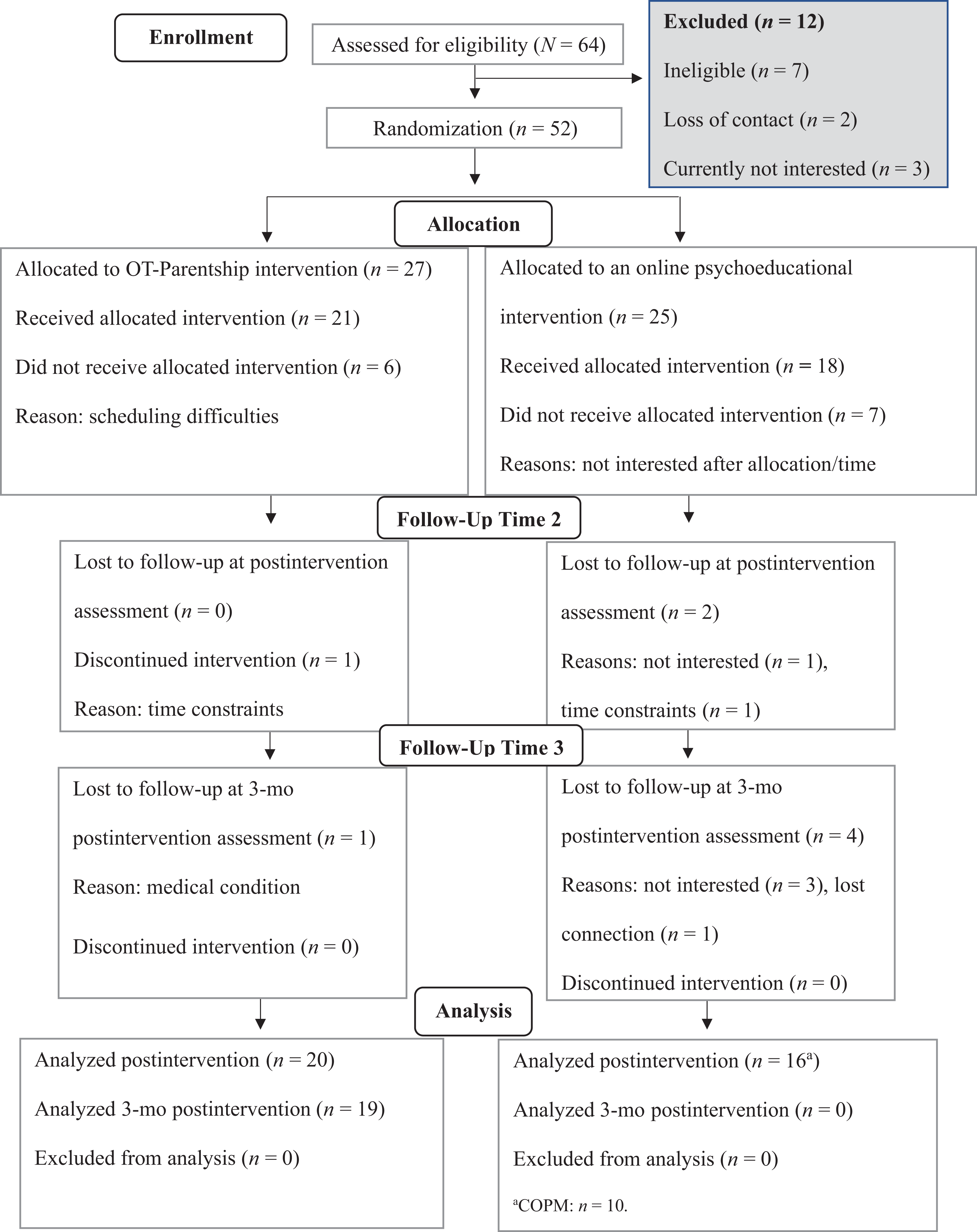
Consolidated Standards of Reporting Trials (CONSORT) flow diagram of the participant selection process.
Sample Size, Randomization, and Participant Allocation
We conducted power analysis using G Power software. On the basis of our feasibility study (Wachspress et al., 2024), which used the Autism: Parenting Questionnaire (APQ; Kim et al., 2004) to assess parental resilience, a minimum sample size of 16 participants per group was required to achieve a significance level of .05, power of .8, and an effect size of at least .65. With an estimated 10% dropout rate, we determined there should be 18 participants per group. The random allocation sequence was generated by Batel Wachspress using WINPEPI software with minimization assignment (Abramson, 2011) to match groups based on adolescent age, gender, and parents’ demographic data (education, socioeconomic, and family status).
Procedure
Eligibility testing for research participation was conducted in two phases, as detailed in the Participants section. Families completed an online questionnaire providing demographic information. Those meeting the inclusion criteria for Phase A proceeded to Phase B. For the study outcomes, participants in both groups were assessed at three time points: preintervention, postintervention, and follow-up 3 mo postintervention. Although some parents participated in the intervention as couples, each parent individually responded to the assessments at each of these three time points.
Interventions
In the OT-Parentship (experimental) group, each parent (or couple) participated in 11 weekly individual 90-min sessions, followed by an additional session 3-mo postintervention. These sessions were conducted either in a designated treatment room at the university or at a local child development center (depending on participant preference and availability). A therapist training course prepared five occupational therapists with over 5 yr of clinical experience to deliver the OT-Parentship protocol (for the complete protocol, refer to Table A.1 in the Supplemental Material, available online with this article at https://research.aota.org/ajot). Following supervision for each family’s intervention, these therapists, along with Wachpress, provided treatment to the experimental group families.
Throughout the sessions, parents and therapists collaboratively explored the adolescent’s multidimensional profile and its daily impact. Parents identified three primary challenges across occupational areas, with a focus on aligning their own goals to support their adolescent’s occupational performance. For instance, if an adolescent’s goal was to manage time effectively for homework, the parent might set a goal to provide structured prompts and establish routines to facilitate this process. This approach emphasized the interdependence between the occupational performance of parents and their adolescents. The parent and therapist continuously analyzed daily life situations related to the adolescent’s barriers and personal profile, as well as parental barriers within the family, with a focus on enhancing parents’ problem-solving skills. During this analysis, the therapist guided parents in understanding how their individual coping strategies and behaviors affected the situation, and they collaboratively identified and implemented tailored strategies to address these challenges. In later sessions, action plans were created, and parents were encouraged to implement them. By the 11th session, parents set an additional “transfer goal” for themselves and their adolescent to work independently for the next 3 mo.
In the psychoeducational video-based (control) group, each family viewed six psychoeducational videos explaining the multidimensional profile of an autistic adolescent in general, along with guidance on interpreting and understanding the child’s personal profile (specific abilities and impairments). These videos were viewed at participants’ convenience in their home environment. During the third video session, parents were asked to identify a challenging occupational domain in dealing with their adolescent and to set a goal for improvement using the Canadian Occupational Performance Measure (COPM; Law et al., 2019). In addition, generic guidance was provided for analyzing daily life events and creating structured problem-solving solutions. Parents were encouraged to independently analyze their own challenges and coping strategies by using the information provided in the video presentations.
Measures
Demographic Questionnaire
This questionnaire included demographic information of parents and adolescents, along with open-ended questions about the adolescent’s strengths and challenges and the parents’ coping methods.
APQ
The APQ is a self-administered questionnaire that assesses parental competence across six domains— knowledge, communication, behavior management, confidence, family functioning, and play—as well as parental stress (Kim et al., 2004). These domains collectively serve as measures of parental resilience in the current study, aligned with resilience indicators mentioned earlier (Bekhet et al., 2012). The APQ is normed on parents of autistic children ages 2 to 47 yr. The Play subscale was removed, as recommended by the scale authors, and was not included in the total score. Higher APQ scores reflect greater perceived parental competence. Factorial validity analysis further supports the APQ, confirming that the seven subscales measure distinct components of parenting and account for 64.6% of the variance (Kim et al., 2004). Internal reliability for the current sample was acceptable, with Cronbach’s α for the total score of .834, aligning with prior studies that reported a total score reliability of .87.
Basic Psychological Need Satisfaction in Relationships
The Basic Psychological Need Satisfaction in Relationships (BPNSR: La Guardia et al., 2000) questionnaire assesses the degree to which an individual experiences the three innate psychological needs central to self-determination theory—autonomy, competence, and relatedness—within specific relationships. Nine items on a 7-point Likert scale (1 = not at all true, 7 = very true) assess each need, with higher scores indicating greater fulfillment. In the original version of the scale, validation studies demonstrated strong construct validity, significantly correlating with measures of relationship satisfaction (r = .74, p < .01) and psychological well-being (r = .68, p < .01; La Guardia et al., 2000). In this study, the BPNSR assesses the parent’s sense of competence, autonomy, and relatedness within the parent–adolescent relationship, reflecting their feelings of efficacy and capability, independence, and sense of belonging in that specific dynamic. In the current sample, reliability was acceptable across subscales, with Cronbach’s α of .818 for autonomy, .893 for competence, and .838 for relatedness.
COPM
The COPM (Law et al., 2019), designed to measure occupational performance, is a fundamental component of overall functioning. It tracks changes in patients’ self-perception regarding occupational performance and satisfaction overtime, specifically in identifying issues with daily participation (Law et al., 2019). In our study, parents assess both their own (primary outcome) and their adolescent’s (secondary outcome) occupational performance and satisfaction levels across one to two functional goals in meaningful contexts. Validation studies have demonstrated strong criterion validity, with COPM scores significantly correlating with measures of functional improvement and client satisfaction in intervention studies (r = .76, p < .01; Law et al., 2005). For the current sample, Cronbach’s α values demonstrated high reliability, ranging from .83 to .87 across all performance and satisfaction measures for parents and adolescents.
Data Analysis
We analyzed quantitative data using IBM SPSS Statistics (Version 28) software. Descriptive statistics were obtained for the demographic characteristics of the two groups. We examined differences in the variables between the experimental and control groups using either chi-square tests or independent-samples t tests. Differences between the mothers and fathers were explored using paired-samples t tests. Given the attrition in the control group at follow-up, we performed two separate repeated-measures analyses of variance (ANOVAs) to assess intervention effects. The first mixed ANOVA was used to test changes pre- and postintervention and compare between groups on all outcome measures (Time × Group). The second ANOVA examined the experimental group across all three time points (preintervention, postintervention, and follow-up), with time as a within-subjects variable. A third ANOVA, conducted for the transfer goal, examined the experimental group’s scores at the postintervention and follow-up time points, with time as a within-subject variable. We used pairwise comparisons with Bonferroni adjustments.
Results
The final study included 20 families in the experimental group and 16 in the control group, with no significant differences observed at baseline between the two groups in demographic and clinical characteristics. The sample included a near-even split of male and female adolescents with ASD, most diagnosed between ages 10 and 15 yr. Adolescents attended various educational settings, including regular classes, special education, and homeschooling. The mean age was 14.1 yr for adolescents and approximately 46 yr for mothers and 48 yr for fathers. Both single parents and couples participated, with a slightly higher proportion of married couples. Most participants reported an average or above-average socioeconomic status (detailed information provided in Table 1). Because no significant differences were found between fathers and mothers across outcome measures, we analyzed results using a single combined score for each couple, calculated by averaging their scores. Table 2 summarizes the means, standard deviations, and results of the first mixed ANOVA for outcome measures for both groups at pre- and postintervention. For further analyses of all outcome measures, see Table A.2 in the Supplemental Material.
Parent and Adolescent Demographic Data and Group Comparisons for All Participants (N = 36)
Note. ADOS = Autism Diagnostic Observation Schedule.
Evaluation of the Time × Group Interaction Effect on Outcome Measures (N = 36)
Note. Values in bold indicate significance of .05. APQ = Autism: Parenting Questionnaire; BPNSR = Basic Psychological Need Satisfaction in Relationships; COPM = Canadian Occupational Performance Measure.
Parental Resilience
A significant Group × Time interaction was found for the APQ total score, F(1, 34) = 6.59, p = .015, indicating that the experimental group experienced greater improvements from pre- to postintervention compared with the control group.
Parent Self-Determination
A significant Group × Time interaction was identified for the BPNSR competence score, F(1, 34) = 6.35, p = .017, demonstrating substantial and consistent improvement in the experimental group from pre- to postintervention compared with the control group. Although no significant Group × Time interaction was observed for the BPNSR autonomy, F(1, 34) = 2.7, p = .11, and relatedness, F(1, 34) = 1.21, p = .28, scores, the experimental group showed a significant improvement trend from pre- to postintervention in autonomy, F(1, 34) = 5.03, p = .032, partial η2 = .13, and relatedness, F(1, 34) = 10.87, p = .002, partial η2 = .24, whereas the control group did not, autonomy, F(1, 34) = 0.04, p = .84, partial η2 = .001, and relatedness, F(1, 34) = 2.18, p = .15, partial η2 = .06.
Parent and Adolescent Occupational Performance
A statistically significant Group × Time interaction was found for the COPM scores of parents—performance, F(1, 28) = 15.01, p < .001, and satisfaction, F(1, 28) = 12.89, p = .0014—and adolescents—performance, F(1, 28) = 12.7, p < .001, and satisfaction, F(1, 28) = 9.29, p = .005. This interaction indicates that the intervention led to greater improvements in both performance and satisfaction of occupational goals for the experimental group compared with the control group.
The second analysis used repeated measures ANOVAs with time (preintervention, postintervention, and follow-up) as a within-subject variable, conducted on the experimental group. The results indicated no significant differences in mean scores for all measures between postintervention and follow-up, indicating maintained results (for details, see Table A.3 in the Supplemental Material).
Regarding the transfer goal, COPM scores for the experimental group showed significant improvement between postintervention and follow-up assessments in the third ANOVA for parents: performance (postintervention, M = 1.9, SD = 1.3, and follow-up, M = 5.6, SD = 2.6), F(1,18) = 45.3, p < .00, and satisfaction (postintervention, M = 1.9, SD = 1.5, and follow-up, M = 5.7, SD = 3), F(1, 18) = 32.9, p < .00. Similar improvements were observed for adolescents: performance (postintervention, M = 1.8, SD = 1, and follow-up, M = 5.2, SD = 3.2), F(1, 18) = 21.7, p < .000, and satisfaction (postintervention, M = 1.8, SD = 1.3, and follow-up, M = 5.4, SD = 3.3), F(1, 18) = 20.87, p < .000.
Discussion
The OT-Parentship intervention had a positive impact on both parents and their autistic adolescents. The intervention enhanced parents’ resilience, self-determination, and ability to address their adolescents’ occupational needs, resulting in improved occupational outcomes for the adolescents that were sustained at follow-up.
The term continuous parental development (CPD) refers to the ongoing process of growth, learning, and adaptation that parents undergo as they raise their children. Parents of autistic adolescents may find their own unique pathways within this ongoing process. This process includes the actions parents take to enhance their parenting skills and overall performance as caregivers. These actions indirectly contribute to their child’s well-being by improving the parent’s ability to support the child’s needs (Lim et al., 2022).
The OT-Parentship intervention provided parents with a comprehensive understanding of their adolescent’s multidimensional profile in a supportive exploratory environment and equipped them with practical tools and strategies to effectively address daily functional challenges. We observed a significant Group × Time interaction for parental resilience in our study, demonstrating that the OT-Parentship intervention effectively strengthened parental resilience and promoted parents’ ability to engage in CPD actions. This underscores the need for interventions that support families of autistic adolescents in their growth and development as caregivers. This finding aligns with Shikarpurya et al. (2023), who found that interventions focusing on skill-building and stress management for parents of autistic adolescents were particularly effective in improving parental well-being and increasing family empowerment.
The OT-Parentship intervention significantly increased parental self-determination, particularly enhancing their sense of competence. This effect is evidenced by a significant Group × Time interaction, aligning with research on self-determination theory (Graham et al., 2015). This finding supports the parent-centric focus of the Parent Occupation and Purposes (POP) framework, which emphasizes the importance of understanding parenting tasks and the underlying factors influencing them (Lim et al., 2022). The POP framework highlights the importance of understanding parenting as an occupation with inherent purposes and demands. OT-Parentship aligns with this framework by empowering parents and providing them with the tools to understand and support their adolescents’ needs. By addressing parents’ basic psychological needs for autonomy, competence, and relatedness, OT-Parentship contributed to the observed increase in self-determination. This study contributes to the theoretical understanding of parental resilience, self-determination, and occupational therapy interventions for families of autistic adolescents. As demonstrated by Dieleman et al. (2018), when parents of adolescents and emerging adults with ASD experience greater need satisfaction, they are more likely to engage in autonomy-supportive parenting behaviors.
The significant Group × Time interaction for COPM scores of both parents and adolescents indicates the unique influence of the OT-Parentship intervention on occupational performance and satisfaction. The experimental group showed greater improvement from pre- to postintervention compared with the control group, aligning with Althoff et al. (2019), who found parent-mediated interventions effective in enhancing children’s participation and skill development across various occupational performance areas. The results highlight how parents’ occupational performance goals, such as enhancing their organizational skills or developing strategies to support daily routines, are inherently tied to their adolescent’s occupational performance. This connection underscores parents’ active role in fostering their adolescent’s independence and participation in meaningful activities. OT-Parentship intervention facilitated this process by equipping parents with strategies to align their goals with the needs of their adolescent, promoting reciprocal progress in both aspects of performance—for parents and adolescents—where advancements in one reinforce the other.
The sustained improvements observed at the 3-mo follow-up suggest the potential for long-term efficacy of OT-Parentship. The significant improvement in transfer goal COPM scores for both parents and adolescents suggests that the intervention equipped them with skills and strategies applicable to new goals and contexts. This finding also aligns with CPD and underscores OT-Parentship’s potential to foster sustained improvements beyond the immediate intervention period. These findings are consistent with Conrad et al.’s (2021) study, which showed that parent-mediated interventions improved adaptive functioning among autistic children. Their review highlighted interventions that focused on parent training and coaching, equipping parents with strategies to address their child’s occupational needs in areas such as social participation, self-care, and communication, and similar to the OT-Parentship intervention, have been shown to contribute to positive outcomes. The OT-Parentship intervention, which focused on empowering parents and enhancing their ability to understand and support their adolescent’s occupational needs, may have contributed to similar positive outcomes, addressing the need highlighted by MacKenzie and Eack (2022) for interventions that effectively enhance a broader range of outcomes for parents of autistic children.
Limitations
The parents who participated responded to advertisements in health facilities and social media platforms, indicating high motivation to engage in the study. The OT-Parentship protocol requires commitment and availability from parents, which makes it potentially unsuitable for all parents. In addition, a high dropout rate in the control group at follow-up prevented direct comparison with the experimental group at that time point. The higher proportion of parental couples in the experimental group might confound the results. Although the experimental group demonstrated significant pre–post improvement in autonomy and relatedness, the absence of a significant Group × Time interaction for these variables may be caused by the study’s limited power to detect smaller between-group differences or the influence of extraneous factors not accounted for in the study design. Future research with a larger and more diverse sample is needed to assess the impact of couple versus single-parent participation and the intervention’s long-term effects, as well as to determine the generalizability of the results to a broader population of parents facing similar challenges.
Implications for Occupational Therapy Practice
This study has the following implications for occupational therapy practice: ▪ The OT-Parentship program stands as an efficient and effective intervention that provides occupational therapists with a structured protocol supported by research evidence for interventions targeting parents of autistic adolescents and emphasizes a collaborative approach that empowers families to actively participate in their own support and growth. ▪ The OT-Parentship program supports parents’ basic psychological needs for self-determination, including autonomy, relatedness, and competence, while also enhancing parental resilience and addressing the occupational performance of both parents and their adolescents.
Conclusion
This study provides compelling evidence for the effectiveness of the OT-Parentship intervention in enhancing parents’ occupational performance, resilience, and self-determination, as well as improving the occupational performance of their autistic adolescent. The sustained improvements at 3-mo follow-up highlight the intervention’s potential for lasting positive changes for families. Future research should explore the long-term effects of OT-Parentship and its applicability to diverse populations.
Supplemental Material
Supplementary material for OT-Parentship Effectiveness on Parental Resilience, Self-Determination, and Occupational Performance of Parents and Their Autistic Adolescents: Pragmatic Randomized Controlled Trial
Supplementary material, sj-pdf-1-aot-10.5014_ajot.2025.051047.pdf for OT-Parentship Effectiveness on Parental Resilience, Self-Determination, and Occupational Performance of Parents and Their Autistic Adolescents: Pragmatic Randomized Controlled Trial by Batel Wachspress, Adina Maeir, Shlomit Tsafrir and Tal Mazor-Karsenty in The American Journal of Occupational Therapy
Footnotes
Acknowledgments
We are grateful to Hadas Goldberg, Leah Livne, Maya Laiwand, Noga Cohen, and Yael Safra for their involvement in the experimental group interventions and their significant contribution to data collection.
References
Supplementary Material
Please find the following supplemental material available below.
For Open Access articles published under a Creative Commons License, all supplemental material carries the same license as the article it is associated with.
For non-Open Access articles published, all supplemental material carries a non-exclusive license, and permission requests for re-use of supplemental material or any part of supplemental material shall be sent directly to the copyright owner as specified in the copyright notice associated with the article.
