





Abstract
This study reviewed evidence on how occupational therapy supports sports participation, including using adaptive tools and education to improve performance and quality of life.
Participation in sports, involving organized, recreational, and competitive physical activities, is widely recognized for its physical, psychological, and social benefits (Eather et al., 2023; Eime et al., 2013; Oja et al., 2024). These benefits include improved physical fitness, enhanced mental health, and strengthened social connections (Eime et al., 2013; Reiner et al., 2013). For individuals engaging in professional and nonprofessional athletic pursuits, sports serve as a meaningful occupation that promotes identity, mastery, and well-being (Costalonga et al., 2020). However, the specific role of occupational therapy in supporting athletes across these contexts remains underexplored.
Sports therapy refers to the application of therapeutic interventions tailored to prevent, manage, and rehabilitate sports-related injuries (Costalonga et al., 2020; Zarro et al., 2022). Sports therapists use sports and exercise principles to optimize performance, preparation, and injury prevention programs; provide immediate care of injuries and basic life support in various environments; and assess, treat, rehabilitate, and, where appropriate, refer for specialist advice and intervention (Gupta, 2022; Kemp et al., 2023; Zarro et al., 2022). High-performance environments in sports refer to settings designed to optimize athletic performance through multidisciplinary support, including coaching, nutrition, psychology, and medical interventions (Eubank et al., 2014). Although these concepts are well established, the integration of occupational therapy within these domains has yet to be clearly defined or systematically reviewed (Costalonga et al., 2020), highlighting a critical gap in literature.
Occupational therapy’s distinct contribution is its holistic approach to promoting participation in meaningful activities, including sports, despite challenges such as injury, disability, or other barriers (American Occupational Therapy Association [AOTA], 2020; Costalonga et al., 2020; Law et al., 1996; Pizzi & Richards, 2017). Moreover, literature suggests that occupational therapy can address not only the physical aspects of performance but also psychosocial factors, such as motivation and resilience, that are important for athletic engagement and recovery (AOTA, 2020; Costalonga et al., 2020; Weiß et al., 2024). However, the extent to which these roles are realized in practice, particularly among athletes, remains unclear. This lack of clarity highlights the need for a scoping review to map the current evidence and identify opportunities for advancing occupational therapy’s role in sports contexts.
Literature on occupational therapy in sports has primarily examined sports as a leisure occupation, with limited synthesis of evidence on occupational therapy’s role in athletics and sports (Mynard et al., 2009; Ratcliff et al., 2002; Rogers et al., 2014). This focus has left gaps in understanding occupational therapy’s contributions to both professional and nonprofessional athletes, as well as its broader applications in sports-related contexts (Costalonga et al., 2020). By addressing these gaps, this scoping review aims to provide a comprehensive overview of how occupational therapy is characterized in competitive and leisure sports contexts and the services it offers to support participation, recovery, and performance.
The objectives of this review are to examine the existing evidence on the roles and interventions of occupational therapy in sports and explore the contexts and populations served by occupational therapy within sports environments. By addressing these aims, this review seeks to bridge the gap in understanding occupational therapy’s role in sports contexts. It aims to highlight occupational therapy’s unique contributions in enhancing participation, recovery, and performance while aligning with the profession’s core values of promoting health, inclusion, and meaningful engagement in life activities.
Method
This scoping review followed Arksey and O’Malley’s (2005) five-stage framework, a foundational methodology for scoping reviews. The stages include (1) identifying the research question; (2) identifying relevant studies; (3) selecting studies; (4) charting the data; and (5) collating, summarizing, and reporting the results. This structured approach allowed a broad exploration of how occupational therapy is characterized and applied in competitive and leisure sports contexts. The review adhered to the Preferred Reporting Items for Systematic reviews and Meta-Analyses extension for Scoping Reviews (PRISMA–ScR) guidelines (Tricco et al., 2018).
Identifying the Research Question
The research questions guiding this scoping review are as follows: How is occupational therapy characterized in leisure and competitive sports contexts? What are the types of occupational therapy interventions and services provided to support participation, recovery, and performance in sports-related settings?
These questions were developed through preliminary discussions and a literature review, highlighting gaps in understanding occupational therapy’s role in sports contexts.
Identifying Relevant Studies
We conducted a comprehensive search of relevant peer-reviewed literature across four databases: CINAHL, EBSCO, PubMed, and SCOPUS. Search terms included occupational therapy, sports, athletics, sports rehabilitation, injury recovery, performance optimization, and sports participation. Boolean operators (AND, OR) were used to ensure comprehensive coverage. Literature searches by all authors were conducted in August 2024. Table A.1 in the Supplemental Material (available online with this article at https://research.aota.org/ajot) provides the detailed search strategy across databases.
Selecting Studies
Inclusion criteria were developed to align with the research objectives. Studies were included if they (1) discussed occupational therapy interventions in the context of sports, including competitive and leisure contexts; (2) described occupational therapy’s role in injury recovery, rehabilitation, or performance optimization; (3) explored sports as a therapeutic occupation; (4) were published between 2000 and 2024 to capture early foundational work and recent developments in the emerging intersection of occupational therapy and sports; and (5) were peer reviewed, published in English, and accessible in full text.
Database filters were applied to limit results to ensure only relevant studies were included for screening. This approach refined the results according to the inclusion criteria established for this review. Studies focusing on other health professions or addressing general physical activity without relating specifically to occupational therapy were excluded. Following the initial database search, articles were imported into Zotero, and duplicates were removed. Titles and abstracts were screened for relevance, and full-text articles were assessed against the inclusion criteria. The screening process involved three independent reviewers, with discrepancies resolved through discussion and consensus. We then used a PRISMA flow diagram to document the study selection process, detailing the number of records identified, screened, excluded, and included in the review.
Charting the Data
We extracted and charted data based on the research questions to categorize study characteristics, population details, interventions, outcomes, and key findings. Study characteristics included author(s), year of publication, country/region, and study design (qualitative, quantitative, or mixed methods). Population details focused on the type of participants (e.g., athletes, para-athletes, rehabilitation patients), contexts (e.g., leisure, competitive, adaptive sports), and specific demographics (e.g., age, gender, type of sport). Interventions were categorized by purpose (e.g., rehabilitation, performance optimization) and modality (e.g., education, client-centered approaches, assistive technology). Outcomes captured psychosocial impacts, performance measures, and quality of life. Key findings addressed the characterization of occupational therapy in sports, intervention impacts, and implications for practice. A detailed evidence table is provided in Table A.2 in the Supplemental Material.
Collating, Summarizing, and Reporting the Results
We conducted basic content analysis (Krippendorff, 2004) to identify patterns and frequencies within the data. This systematic approach allowed the categorization of textual data into predefined categories and themes guided by the research questions.
Frequency analysis summarized study characteristics such as publication year, geographical distribution, population focus, and intervention types. Moreover, we used a systematic coding approach for content analysis (Krippendorff, 2004), which involved defining units of analysis, developing a coding framework, and ensuring reliability through pilot testing and iterative refinements.
A structured coding process was used, with the primary author (Paolo Miguel Pangue Bulan) conducting the initial round and other authors providing feedback for refinement. Then, all authors performed a second round of coding to refine and consolidate the data. After finalizing the codes, we examined patterns and collectively identified themes. Discrepancies were addressed through consensus. We framed the themes to address the research questions. This integrated approach provided a robust synthesis of findings and identified patterns across included studies.
Results
The initial database search identified 241 studies (Figure 1). After deduplication (n = 11), 230 potential studies were eligible for the title and abstract screening. A total of 216 studies did not meet the eligibility criteria and were removed, leaving 14 studies for retrieval. Only 12 studies were retrieved because 1 study was retracted and 1 study had no available full text (the full text was inaccessible through standard academic databases and interlibrary loan services, and efforts to obtain the full text were unsuccessful, limiting the study’s availability for inclusion). Of the 12 studies, 6 met all inclusion criteria for the scoping review. Twelve additional relevant studies were identified by scanning the reference lists of included articles and through a hand search by the authors. Only 7 additional studies met all inclusion criteria. A total of 13 studies were included.
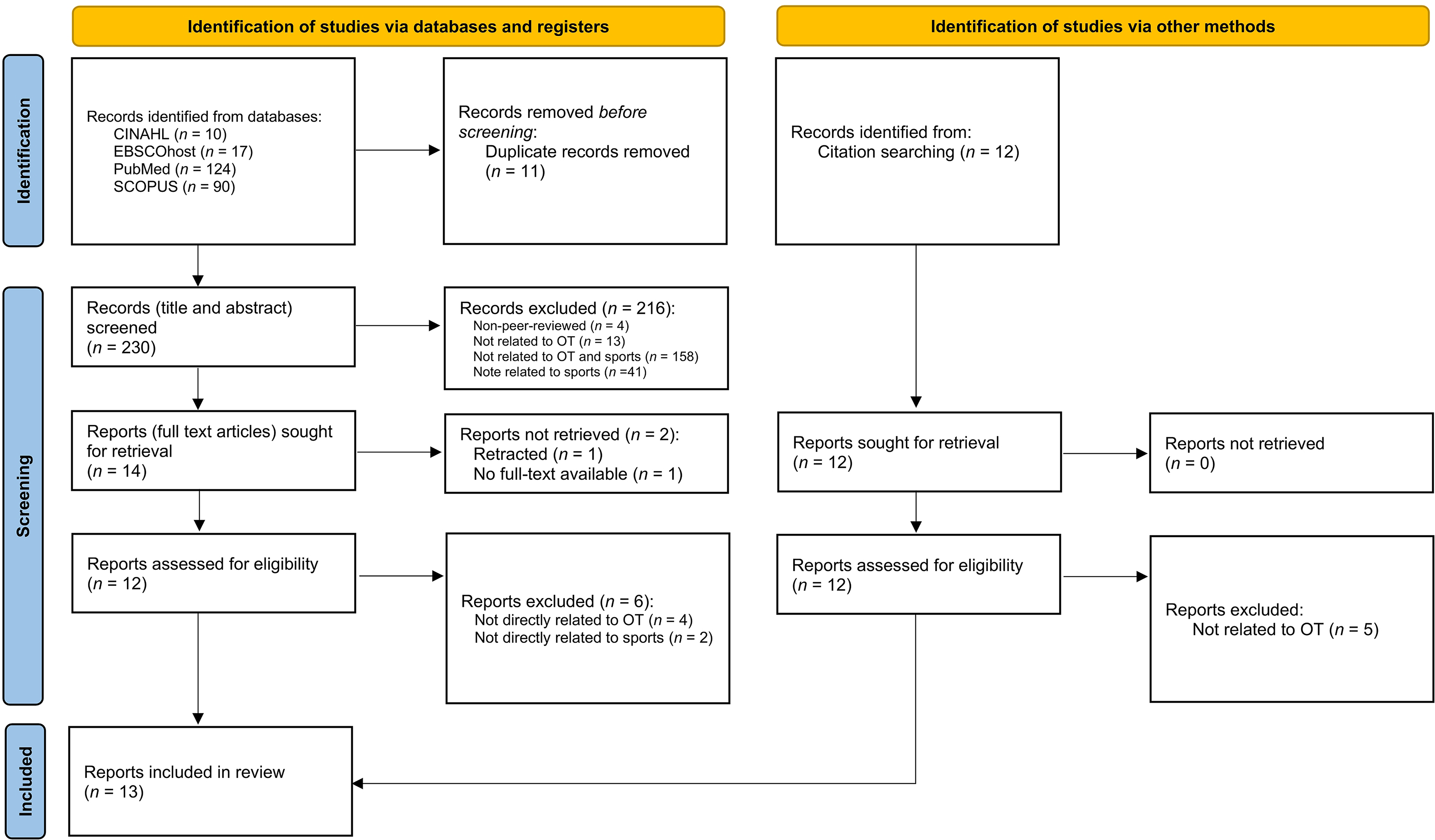
Preferred Reporting Items for Systematic reviews and Meta-Analyses (PRISMA) flow of study selection of occupational therapy (OT) in athletics and sports. Note. Figure format from Page, M. J., Moher, D., Bossuyt, P. M., Boutron, I., Hoffmann, T. C., Mulrow, C. D., … McKenzie, J. E. (2021). PRISMA 2020 explanation and elaboration: Updated guidance and exemplars for reporting systematic reviews. BMJ, 372, n160. https://doi.org/10.1136/bmj.n160
Table 1 shows the summary of the frequency analysis. The scoping review revealed that most studies were published between 2020 and 2024 (61.54%), with smaller contributions from 2000 to 2009 (23.08%) and 2015 to 2019 (15.38%). Geographically, most studies originated from North America (38.46%), with contributions from other regions including Europe and South America. In terms of study design, qualitative approaches accounted for 46.15% of the included studies, followed by quantitative designs (38.46%) and mixed methods (15.38%). Participant groups were primarily composed of competitive athletes (30.77%), para-athletes (23.08%), and rehabilitation-oriented participants (23.08%), with additional representation from socially disadvantaged groups. Education and training (30.77%) was the most frequently used intervention modality, followed by assistive technology (23.08%) and client-centered and participatory approaches (23.08%). Outcomes measured predominantly focused on psychosocial and quality-of-life impacts (30.77%), with additional emphasis on assistive technology, performance, daily living, and mental health and participation outcomes.
Characteristics of Included Articles
Characterization of Occupational Therapy in Sports
Occupational therapy in sports was characterized by its multidimensional role, addressing physical, emotional, and social rehabilitation needs. Occupational therapy practitioners were noted to facilitate holistic recovery by integrating interventions that enabled participation in meaningful occupations, such as competitive and leisure sports. For example, occupational therapy’s role in supporting high school athletes’ return to activities postconcussion was highlighted through cognitive and motor recovery programs (Douglas et al., 2024). The therapeutic potential of sports was described in football programs that helped individuals with psychosis reengage in social roles and routines (Moloney & Rohde, 2017). In adaptive and parasports, occupational therapy was frequently described as a key facilitator of participation, tailoring interventions to meet athletes’ unique needs (Silva & Alves, 2020). Moreover, occupational therapy can enhance the quality of life and family dynamics through structured adaptive sports programs for individuals with cerebral palsy (Groff et al., 2009).
Types of Occupational Therapy Interventions in Sports
Occupational therapy interventions in sports were diverse and tailored to individual needs, often integrating assistive technology, education, and client-centered approaches. Interventions ranged from customized assistive technology for para-athletes to structured rehabilitation programs. For instance, occupational therapy interventions, such as personalized wheelchair adjustments and adaptive gloves, significantly improved safety and performance for wheelchair rugby athletes (Teixeira & Alves, 2021). Peer mentoring and education were common strategies, as occupational therapy facilitated adaptive sports participation by offering psychosocial support and training (Ali & Rider, 2024). In addition, visual rehabilitation protocols enhanced reaction times and visual–motor coordination among collegiate athletes (Feldhacker & Molitor, 2019). Moreover, occupational therapy fostered psychosocial support and teamwork through adaptive sports programs for wheelchair basketball players (Garci & Mandich, 2005).
Impact of Occupational Therapy Interventions in Sports
The reviewed studies consistently reported positive outcomes associated with occupational therapy interventions in sports. Improved quality of life and psychosocial well-being and enhanced athletic performance were recurring results. For instance, participants in community football programs for individuals with mental illness experienced increased social inclusion and physical health improvements (Mynard et al., 2009). Faster recovery times and improved functional mobility were documented among competitive handball players receiving motor rehabilitation (Abdalreda & Elawa, 2023). Across multiple contexts, participation in occupational therapy–supported sports programs promoted stronger senses of identity, belonging, and empowerment (Abdalreda & Elawa, 2023; de Lima & Alves, 2020; Mynard et al., 2009). Moreover, tailored assistive technology enhanced satisfaction and participation for adolescent para-athletes in parasports such as bocce and parabadminton (de Lima & Alves, 2020).
Contexts and Populations
Occupational therapy services were implemented across diverse sports contexts and populations. High school athletes recovering from concussions (Douglas et al., 2024), para-athletes in competitive settings (Silva & Alves, 2020), and individuals with mental health challenges participating in community sports (Pettican et al., 2022) were key focus groups. Studies highlighted occupational therapy’s adaptability in addressing the needs of athletes across competitive, leisure, and rehabilitative sports environments. For instance, occupational roles in adaptive sports were explored, showing how occupational therapy interventions supported athletes in balancing their personal, professional, and sporting roles (Sousa et al., 2021). Sustained participation in sports was also supported by broader social engagement. The involvement of family members emerged as a key factor that positively influenced athletes’ quality of life and motivation to remain active (Groff et al., 2009).
Barriers to Participation in Sports and Access to Occupational Therapy
Athletes in all the reviewed studies reported barriers that limited their participation in sports and access to occupational therapy services. In community-based settings, individuals with mental health conditions experienced stigma, fear of judgment, and a lack of inclusive programming (Moloney & Rohde, 2017; Pettican et al., 2022). In contrast, athletes in parasport or professional contexts faced logistical challenges such as limited access to low-cost assistive technology and specialized occupational therapy services, along with financial strain (de Lima & Alves, 2020; Teixeira & Alves, 2021). These findings demonstrate that barriers vary across settings, with psychosocial exclusion more prominent in community-based programs and resource constraints more evident in high-performance or competitive contexts.
Despite these challenges, occupational therapy practitioners were recognized for their role in promoting participation through individualized interventions, environmental adaptations, and psychosocial support. However, their presence in sports-related settings was limited, and access to occupational therapy remained inconsistent (Pettican et al., 2022; Silva & Alves, 2020). Addressing these setting-specific barriers requires both expanded occupational therapy integration and advocacy for inclusive, resource-equipped environments that support diverse athletes’ needs.
Discussion
This scoping review highlights the multifaceted role of occupational therapy in sports contexts, identifying key interventions and their impact on recovery, participation, and performance. The findings reveal that occupational therapy practitioners address a range of physical, psychosocial, and environmental needs through client-centered approaches, adaptive technologies, and education. Occupational therapy’s contribution spans competitive and leisure sports, with demonstrated benefits in quality of life, psychosocial well-being, and athletic performance. Despite these advances, gaps remain in the literature regarding occupational therapy’s role in diverse sports contexts and populations, particularly nonprofessional athletes and underrepresented groups.
The findings align with prior research emphasizing the holistic nature of occupational therapy in enabling participation in meaningful activities despite physical or psychosocial challenges (Costalonga et al., 2020; Silva & Alves, 2020). For example, studies have consistently reported the effectiveness of adaptive technologies, such as customized equipment for para-athletes, in enhancing performance and safety (de Lima & Alves, 2020; Teixeira & Alves, 2021). Similarly, the role of occupational therapy in fostering social inclusion through sports programs for individuals with mental health challenges supports earlier work highlighting sports’ therapeutic potential in psychosocial rehabilitation (Eime et al., 2013; McMahon et al., 2017; Moloney & Rohde, 2017; Mynard et al., 2009). However, the present review extends this understanding by synthesizing evidence on occupational therapy’s broader contributions, including performance optimization and recovery support for competitive athletes.
A discrepancy identified in the literature was the limited emphasis on culturally specific adaptations and inclusivity in occupational therapy interventions within sports. For example, culturally tailored occupational therapy was demonstrated through the adaptation of assistive technologies to match athletes’ preferences and contextual needs in wheelchair rugby (Teixeira & Alves, 2021). Likewise, community-based football programs for individuals with mental distress were codeveloped to reflect the lived experiences and cultural values of participants, fostering belonging and inclusion (Pettican et al., 2022). These examples illustrate how occupational therapy can deliver context-sensitive, person-centered interventions in diverse sports settings.
Although the benefits of adaptive sports for individuals with disabilities are well documented, barriers such as stigma, resource limitations, and funding constraints persist (Darcy & Dowse, 2013; Pettican et al., 2022; Silva & Alves, 2020). Moreover, few studies have explored how occupational therapy frameworks, such as the person–environment–occupation model, can be integrated into sports-focused interventions (Costalonga et al., 2020; Law et al., 1996). This highlights an ongoing need to address systemic inequities and promote equitable access to occupational therapy services in sports contexts.
The findings of this review highlight the critical role of occupational therapy in advancing health and well-being through sports, emphasizing its potential to bridge physical rehabilitation and psychosocial support (Eime et al., 2013; Oja et al., 2024). Practitioners should consider integrating evidence-based interventions, such as adaptive technologies and psychosocial support programs, to maximize their impact (McMahon et al., 2017; Silva & Alves, 2020). Moreover, occupational therapy can expand its scope by collaborating with multidisciplinary teams in high-performance environments to optimize athlete preparation, recovery, and performance (Costalonga et al., 2020; Eubank et al., 2014).
Future research should prioritize exploring occupational therapy’s role in underrepresented sports contexts, including recreational and grassroots sports. Investigating culturally tailored interventions and their impact on marginalized populations is critical (Darcy & Dowse, 2013; Jenkin et al., 2017). Future studies should include youth athletes, para-athletes, and individuals with mental health conditions, who remain underrepresented in current research. In addition to clinical and performance metrics, outcome measures should include indicators of participation, social inclusion, and quality of life to better capture the holistic impact of occupational therapy interventions. Studies are needed to explore occupational therapy’s role across diverse cultural and socioeconomic contexts and its impact on nonprofessional athletes. Research examining the long-term outcomes of occupational therapy–supported sports interventions would provide valuable insights into their sustainability and effectiveness. Moreover, cost-effectiveness and feasibility studies of occupational therapy interventions in sports could inform policy and funding decisions. The development of standardized outcome measures is necessary to enable rigorous comparisons of intervention efficacy (Costalonga et al., 2020; Petrisor & Bhandari, 2007). Integrating occupational therapy frameworks, such as the model of human occupation or the person–environment–occupation model, would advance theoretical understanding (Costalonga et al., 2020; Law et al., 1996), whereas interdisciplinary approaches could enhance collaboration in optimizing athlete outcomes (Costalonga et al., 2020; Eubank et al., 2014). Finally, the health benefits of sports participation, such as enhanced cardiorespiratory fitness and reduced depressive symptoms (Eime et al., 2013; Oja et al., 2024), highlight the importance of occupational therapy–supported sports programs.
Limitations
Although this scoping review synthesized current evidence, some limitations must be acknowledged. The exclusion of gray literature and non-English publications may have restricted the scope of the findings, potentially overlooking relevant but unpublished studies. Moreover, the reliance on peer-reviewed articles limited insights into innovative or emerging practices in occupational therapy and sports. Another limitation was the absence of a critical appraisal of the included studies. Although not typically required in scoping reviews, future research may benefit from evaluating the quality and strength of evidence to guide more rigorous practice recommendations. Lastly, the heterogeneous nature of the included studies, covering different populations, methodologies, and interventions, may affect the generalizability of the findings.
Implications for Occupational Therapy Practice
Occupational therapists play an important role in supporting athletes in both rehabilitation and ongoing participation. The findings highlight specific ways practice can be strengthened: Support holistic recovery by addressing not only physical rehabilitation but also confidence, identity, and roles that athletes value after injury. Provide tailored interventions and adaptive strategies that enhance safety and sustained participation, especially for para-athletes and those with long-term conditions. Reduce barriers to engagement by advocating for equitable access to equipment, training opportunities, and inclusive sports environments. Incorporate cultural and personal values into therapy plans so that interventions align with athletes’ beliefs, routines, and motivations. Embed prevention into practice by teaching strategies that minimize injury risk and promote long-term well-being in sports participation.
Conclusion
This scoping review highlights the multifaceted contributions of occupational therapy in sports, emphasizing its role in enhancing participation, recovery, and performance through evidence-based interventions such as adaptive technologies and psychosocial support. Key findings emphasize the importance of integrating occupational therapy frameworks, such as the model of human occupation and the person–environment– occupation model, into sports contexts to optimize outcomes. Despite notable advances, research gaps persist, particularly in culturally tailored interventions and underrepresented sports contexts. Addressing these gaps through interdisciplinary collaboration and rigorous studies will strengthen occupational therapy’s transformative role in promoting inclusion, equity, and sustainable health outcomes in sports.
Supplemental Material
Supplementary material for Occupational Therapy in Athletics and Sports: A Scoping Review
Supplementary material, sj-pdf-1-aot-10.5014_ajot.2025.051180.pdf for Occupational Therapy in Athletics and Sports: A Scoping Review by Paolo Miguel Pangue Bulan, Celine Karla Villalino, Martina Simone Y. Gutierrez and Michelle Kyra S. Evardo in The American Journal of Occupational Therapy
Footnotes
Acknowledgments
We thank the College of Occupational Therapy and Physical Therapy at Velez College and the practitioners who provided valuable feedback on this work.
*Indicates articles included in the scoping review.
References
Supplementary Material
Please find the following supplemental material available below.
For Open Access articles published under a Creative Commons License, all supplemental material carries the same license as the article it is associated with.
For non-Open Access articles published, all supplemental material carries a non-exclusive license, and permission requests for re-use of supplemental material or any part of supplemental material shall be sent directly to the copyright owner as specified in the copyright notice associated with the article.
