





Abstract
This review of studies on home-based occupational therapy for older adults found that interventions often targeted activities of daily living, instrumental activities of daily living, and environmental adaptations.
With the globally aging population, there is an urgent need for effective, community-based support systems to maintain health and independence among older adults (Permanyer & Scholl, 2019). Among adults age 70 yr or older, falls and functional decline are major contributors to disability. Although gains in healthy life expectancy have been reported, high rates of disability persist (GBD 2019 Ageing Collaborators, 2022), contributing to an increased prevalence of chronic conditions and a growing demand for long-term care services (Osareme et al., 2024). Consequently, there is a need for integrated care models that address not only medical concerns but also the psychological and social needs of older adults, tailored to regional and community-specific contexts (Lee et al., 2021). Recently, hospital-at-home programs—which provide hospital-level acute care within patients’ homes—have expanded in response to these challenges (Schiff et al., 2022; Sultana et al., 2020). This trend has accelerated in the wake of the COVID-19 pandemic, as health systems seek to reduce hospital stays (Walsh et al., 2025), lower infection risk (Barranco & Ventura, 2020; Lawrence et al., 2023), and manage resources more efficiently (Schiff et al., 2022; Walsh et al., 2025).
Evidence suggests that hospital-at-home programs can reduce health care costs, shorten length of stay, and improve patient satisfaction and outcomes (D. M. Levine et al., 2020). As a result, the volume and medical complexity of clients receiving care at home, including those receiving occupational therapy, are likely to increase, underscoring the importance of high-quality, evidence-informed, multidisciplinary home-based services.
Home care also offers a distinct advantage for occupational therapy, because it allows practitioners to address meaningful occupations within clients’ natural environments. This ecological validity supports individualized, context-specific interventions that can enhance participation and daily functioning. In the United States, recent policy changes have expanded the role of occupational therapists in home care, including the ability to open new therapy cases under Medicare regulations (American Occupational Therapy Association [AOTA], 2021), further reinforcing the profession’s contribution to home-based service delivery.
Home-based occupational therapy is important in rapidly aging societies because it maintains and enhances older adults’ quality of life (QOL) and activities of daily living (ADLs; Imanishi et al., 2017). Occupational therapy highlights the role of environmental factors and social support in rehabilitation by prioritizing activity and participation (Randström et al., 2013). Goal setting and community-based activities, supported by frameworks such as the International Classification of Functioning, Disability, and Health, improve therapeutic outcomes by enhancing social participation and optimizing living space utilization (Kamioka et al., 2020; Wong et al., 2023). These suggest the role of occupational therapy in creating holistic and region-specific care models for aging populations.
Despite various evaluations of the effectiveness of home-based occupational therapy, there are no systematic assessment and intervention methods (Vik & Eide, 2014). Older adults receiving home-based services value participation in daily and leisure activities but express low satisfaction with social activities, underscoring the need for occupational therapy interventions to promote participation in these areas (Zachry et al., 2024). A scoping review reported the importance of occupational therapy in functional recovery and QOL improvement following stroke and identified inconsistency in methodology and quality, thereby leading to the need for further research (Nielsen et al., 2017). Occupation-focused and home-based occupational therapy interventions enhance occupational performance among older adults, although the foundation for such research requires further development. Occupational therapy interventions aimed at supporting social participation and leisure engagement among community-dwelling older adults exhibit certain benefits, highlighting the need for standardized evaluation and intervention approaches (Smallfield & Lucas Molitor, 2018).
A home-based occupational therapy model to enhance activity competence of older adults with chronic disabilities showed qualitative improvements in areas valued by clients, highlighting the necessity for more systematic evaluation and methodological refinement (R. E. Levine & Gitlin, 1993). These findings underscore the need for further research to develop standardized and rigorous assessments and intervention methodologies in home-based occupational therapy. Therefore, in this study, we aimed to systematically explore recent insights and intervention strategies designed to enhance activity and participation among community-dwelling older adults through home-based rehabilitation frameworks.
Method
Study Design
This study was a scoping review. We mapped the key concepts underlying the research area and main sources and types of available evidence (Arksey & O’Malley, 2005). We collected, integrated, and interpreted evidence on occupational therapy interventions aimed at improving activity and participation during home-based rehabilitation. The review process was structured following the methodology proposed by Arksey and O’Malley (2005) and the guidelines outlined in the Preferred Reporting Items for Systematic reviews and Meta-Analyses extension for Scoping Reviews (PRISMA–ScR; Tricco et al., 2018).
Eligibility Criteria
The eligibility criteria were established based on the population, concept, and context framework (Peters et al., 2015): Patient: We included community-dwelling older adults age 65 yr or older receiving home-based rehabilitation, mindful of any comorbid conditions. Concept: We focused on occupational therapy interventions aimed at improving activity and participation. Context: Only research articles in English or Japanese were included, regardless of the country or region.
The language selection was based not only on practical considerations, such as research feasibility and language accessibility, but also on our specific interest in comparing home-based occupational therapy practices in the United States and Japan, which have the largest populations of occupational therapists and distinct home care systems. Articles were included if they reported occupational therapy interventions focused on improving activity and participation, targeted community-dwelling older adults age 65 yr or older receiving home-based rehabilitation, and were published in peer-reviewed journals in English or Japanese. The exclusion criteria included (1) articles that lacked sufficient information on the intervention or outcome measures; (2) studies not within the field of occupational therapy; and (3) publications such as conference proceedings, review literature (e.g., systematic reviews, meta-analyses, narrative reviews), editorials, and book chapters.
Search Strategy
We conducted a comprehensive literature search across the following databases: PubMed, Web of Science, Scopus, Ichushi Web, and J-Stage. The search strategy was designed in accordance with the PRISMA-ScR guidelines (Tricco et al., 2018) to systematically extract studies related to improving activity and participation in community-dwelling older adults receiving home-based rehabilitation. The search was completed on June 10, 2024. The detailed search strategies for each database, including search terms and Boolean operators, are presented in Table A.1 in the Supplemental Material (available online with this article at https://research.aota.org/ajot). Equivalent Japanese search terms were used for searches in Ichushi Web and J-Stage. In addition, we conducted a manual search of the reference lists of included articles to identify any relevant studies not retrieved in the initial database search.
Data Charting Process
After the study selection process, the included articles were reviewed for data charting by Yuki Saito and Yusuke Kikuchi. Where discrepancies were observed, they were resolved through discussion with either Kounosuke Tomori or Tatsunori Sawada, who acted as arbitrators. The studies’ general information and characteristics, and occupational therapy characteristics were collected. The extracted data were entered into Microsoft Excel for Mac (Version 16.93.1) using a descriptive approach. Key details, including authors, publication year, country, study design, sample size, health condition, intervention details, structured interventions, outcome measures, and results, were summarized. Regarding occupational therapy interventions, we analyzed the data by using a conventional content analysis approach, as described by Hsieh and Shannon (2005). Specifically, meaningful units were identified, coded, and categorized into seven intervention categories: (1) those targeting mental and cognitive functions, (2) those targeting physical functions, (3) direct interventions for skills necessary for activity and participation, (4) group-based educational interventions, (5) group-based therapeutic activities, (6) environmental modifications to the physical environment (e.g., home modifications, provision of assistive devices), and (7) environmental modifications to the social environment (e.g., caregiver training; see Table 1).
Overview of Structured Intervention Programs in Reviewed Studies
Note. CAPABLE = Community Aging in Place–Advancing Better Living for Elders; OTIPM = Occupational Therapy Intervention Process Model; COTiD–UK = Community Occupational Therapy in Dementia–United Kingdom; CBR = Community-Based Rehabilitation program; RCT = randomized controlled trial; NRCT= nonrandomized controlled trial.
Similarly, we categorized outcome measures into eight categories based on qualitative research methods: (1) physical functions and abilities, (2) mental health, (3) cognitive function, (4) activities and participation, (5) environmental factors, (6) QOL, (7) condition-specific assessments, and (8) combined or multidimensional assessments. In addition to mapping interventions and outcomes across all included studies, we conducted a supplementary synthesis that compared findings by study design. This was not an a priori objective but was added post hoc to explore potential differences in the level of detail and nature of reported interventions and outcomes between randomized controlled trials (RCTs) and case reports.
Results
Search Results
The database search identified 3,311 studies, and manual search identified 7 additional records. Duplicates (1,334) were removed using the duplicate removal function in EndNote (Version 21.5, Clarivate). The remaining studies were then subjected to a two-stage screening process. In the first stage, screening of titles and abstracts was conducted using Rayyan (Rayyan Systems, Inc.). We identified 184 potentially eligible studies. In the second stage, a full-text review was conducted using Rayyan; 130 studies were excluded because of age of participants, study design, or type of publication. Ultimately, 54 studies were included in the final analysis (see Figure 1).
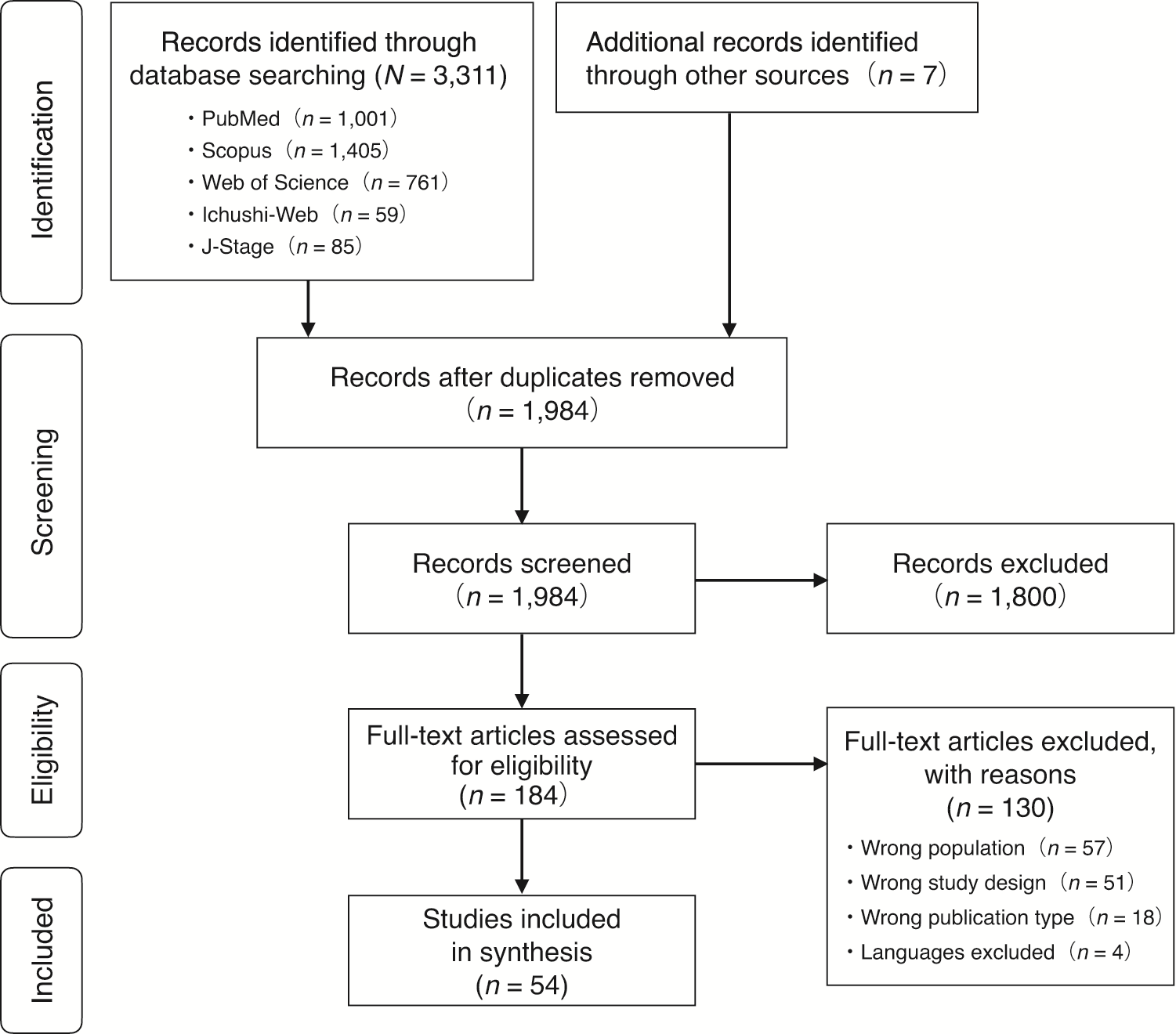
Preferred Reporting Items for Systematic reviews and Meta-Analyses extension for Scoping Reviews (PRISMA–ScR) flow of study selection process of articles included in the review. Note. Figure format from Tricco, A. C., Lillie, E., Zarin, W., O’Brien, K. K., Colquhoun, H., Levac, D., … Straus, S. E. (2018). PRISMA extension for scoping reviews (PRISMA–ScR): Checklist and explanation. Annals of Internal Medicine, 169, 467–473. https://doi.org/10.7326/M18-0850.
Study Characteristics
An increase in publication frequency was observed over the decades. The publication years of the selected studies ranged from 1994 to 2024 (see Figure A.1 in the Supplemental Material). Regarding country representation, most studies were conducted in the United States (n = 17, 31.48%), followed by Japan (n = 12, 22.22%; see Figure A.2 in the Supplemental Material). Among these, one nonrandomized controlled trial (NRCT) and two single-arm intervention studies adopted mixed-method designs including qualitative interviews.
Characteristics of the Participants and Occupational Therapy Interventions
Regarding disabilities observed in the studies, physical disabilities were the most common (n = 27); no disability was specified in 14 studies. Seven studies each involved patients with dementia or healthy individuals. The most performed interventions were ADLs and instrumental ADLs (IADLs; n = 55). Other interventions included environmental adjustments such as home modifications and provision of medical equipment (n = 39), physical function improvement (e.g., muscle strengthening, fall prevention, and energy-saving training, n = 24), caregiver instructions (n = 12), group educational interventions (n = 4), mental and cognitive function interventions (n = 2), and group outings (n = 2; see Table 1).
As summarized in Table A.2, the nature of occupational therapy interventions varied widely. Many studies used individualized training in ADLs or IADLs combined with physical exercises, whereas others incorporated cognitive stimulation, leisure engagement, caregiver education, or environmental modifications. Several studies used structured programs such as CAPABLE (Community Aging in Place—Advancing Better Living for Elders), Reablement, and Lifestyle Redesign, often adapted to fit local cultural or health care contexts (e.g., Kjernsholen et al., 2024; Levasseur et al., 2019; Maeir et al., 2021). Group-based approaches were also reported, including both educational sessions and social outings. Some interventions involved goal-setting tools and emphasized personalized, context-sensitive care strategies, reflecting the diversity of practice in home-based occupational therapy.
Regarding structured programs, the CAPABLE program was the most frequently cited intervention (Breysse et al., 2022; Szanton et al., 2011, 2015, 2016, 2019). CAPABLE is a home-based, interdisciplinary intervention that integrates occupational therapy, nursing, and handyman services to enhance older adults’ ability to live independently by addressing both physical and environmental barriers. Meanwhile, the Reablement program and Lifestyle Redesign were implemented in eight studies (Juang et al., 2018; Kjernsholen et al., 2024; Langeland et al., 2019; Levasseur et al., 2019, 2022; Maeir et al., 2021; Whitehead et al., 2016; Winkel et al., 2015). The Reablement program focuses on short-term, goal-directed interventions to improve functional independence, whereas Lifestyle Redesign is an occupation-based approach that helps individuals modify their daily routines to promote health and well-being. Some of these programs were adapted to fit specific countries or regional contexts.
Other structured intervention methods, each cited in a single study, included routinizing therapy (Nakanishi & Yamaga, 2021), Let’s Go Program (Mulry et al., 2017), Occupational Therapy Intervention Process Model (OTIPM; Fisher et al., 2007), Community Occupational Therapy in Dementia–United Kingdom (COTiD-UK; Wenborn et al., 2021), a community-based rehabilitation program (Park & Lee, 2016), the Caspar Health e-system (Li et al., 2022), and the independent living program (Dugow & Connolly, 2012). Regarding participant characteristics, five studies involved patients with physical disabilities, four had no specific participant restrictions, three focused on healthy individuals, and one targeted patients with dementia.
Among the studies using structured interventions, the research designs were as follows: single-arm interventions, n = 8; RCTs, n = 8; and NCRTs, n = 4. Most interventions were conducted at the participants’ homes. One study was conducted in both homes and nursing homes, and one study was conducted in nursing homes only. Notably, only one study described a remote intervention, whereas all others reported face-to-face interactions.
Of the 54 included studies, 52 (96.3%) reported using one or more outcome measures. This suggests that most studies attempted to evaluate intervention effectiveness. However, 2 studies did not report any outcome tools, indicating a potential area for improvement in research design. Among these 52 studies, a total of 198 instances of outcome measure use were identified, corresponding to 126 unique outcome measures, classified into eight categories (see Table 2). Of these, 43 measures were used exclusively in case reports, and 16 were nonstandardized or had unspecified tools, all of which were found in case report studies.
Categorization and Count of Outcome Measures
Note. COTiD–UK = Community Occupational Therapy in Dementia–United Kingdom.
The most frequently reported measures were those related to activities and participation (48 measures), including the Barthel Index and Nottingham Extended Activity of Daily Living Scale. Among these, 14 were not limited to ADLs or IADLs but targeted broader client-centered activities and participation. These measures also incorporated subjective aspects, such as client values, satisfaction, and perceived performance, and included tools such as the Canadian Occupational Performance Measure (COPM), Activity Card Sort, and the Aid for Decision Making in Occupation Choice (ADOC). Measures related to mental health included various scales, such as the Patient Health Questionnaire–9 and the Geriatric Depression Scale. Similarly, measures assessing cognitive function included tools such as the Mini-Mental State Examination (MMSE) and the Revised Hasegawa Dementia Scale (HDS–R).
Overall, 20 measures were identified for the assessment of physical function, including range of motion (ROM), manual muscle testing, the Short Physical Performance Battery, and Timed Up and Go (TUG). Six measures addressing environmental factors were identified, such as the Zarit Caregiver Burden Scale and Westmead Home Safety Assessment. Seven QOL-related measures were identified, including the Short Form–36 and the European Quality of Life–Visual Analog Scale. Furthermore, 17 condition-specific measures were identified, corresponding to 2 studies on Parkinson’s disease, 9 on Alzheimer’s disease and related dementias, 2 on aphasia, 1 on autism spectrum disorder, and 1 on chronic obstructive pulmonary disease. Finally, multidimensional tools included the modified World Health Organization questionnaire and the COTiD-UK Checklist.
Synthesis of RCT Findings
Of 54 studies, 19 were RCTs examining home-based occupational therapy for older adults, including those with dementia or Parkinson’s disease, with interventions ranging from multidisciplinary programs (e.g., CAPABLE) to home modifications, telerehabilitation, and group or individual sessions. The benefits found were as follows: improvements in ADL and IADL performance (e.g., CAPABLE reduced ADL disability scores by about 30% and mitigated fear of falling; Szanton et al., 2016, 2019); short- to midterm benefits from tailored interventions and home modifications (Gitlin et al., 2006, 2008; Graff et al., 2006; Stark et al., 2018); psychosocial benefits such as reduced depressive symptoms (Juang et al., 2018), improved self-efficacy, pain, and fear of falling (Szanton et al., 2019; Szanton et al., 2011); and greater well-being gains from group-based interventions (Toledano-González et al., 2019). However, there were challenges in long-term maintenance of these benefits (Callahan et al., 2017).
Synthesis of Case Report Findings
Among the 54 studies included in this review, 14 were case reports that described individualized, home-based occupational therapy interventions. These interventions ranged from ADL/IADL training and environmental modifications to caregiver education and psychosocial support (e.g., Kagawa, 2023; Masuo, 2021; Tanaka, 2019). Several reports detailed tailored therapeutic programs, including ROM and balance training, self-directed stretching, woodworking as leisure engagement, and functional mobility training such as stair climbing and bus riding (e.g., Hatabe, 2014; Sakuraba & Izumi, 2022; Tomita et al., 2016). Many cases incorporated strategies to promote social participation and goal setting, often involving family or caregivers in the intervention process (e.g., Chapman & Nelson, 2014; Nomoto et al., 2019). Therapists also emphasized using preserved cognitive abilities, such as procedural memory, to foster habit formation and meaningful activity engagement (e.g., Nakanishi & Yamaga, 2021).
The observed outcomes indicated improvements across multiple domains. ADL performance increased, with gains reflected in measures such as the Barthel Index, FIM®, and COPM (e.g., Kagawa, 2023; Masuo, 2021; Sclarsky & Kumar, 2021). Functional mobility and endurance improved (e.g., TUG, 6-Minute Walk Test), and some cases reported significant enhancements in upper limb use and hand function (e.g., Imai et al., 2020; Sakuraba & Izumi, 2022). Several clients showed increased self-efficacy and reduced fear of falling, contributing to greater independence in daily life (e.g., Chapman & Nelson, 2014; Hatabe, 2014). Psychosocial improvements were also noted, including mood stabilization, improved communication, and enhanced caregiver confidence (e.g., Baba et al., 2013; Sclarsky & Kumar, 2021). In cases involving clients with dementia, interventions led to reduced behavioral and psychological symptoms and increased participation in routine or leisure activities (e.g., Baba et al., 2013; Nakanishi & Yamaga, 2021). Although some clients experienced limited changes in physical capacity, they reported subjective gains in engagement, autonomy, and QOL (e.g., Nomoto et al., 2019; Tanaka, 2019).
Overall, the case reports underscore the potential of home-based occupational therapy to deliver personalized, meaningful, and context-specific interventions that support not only functional recovery but also psychological well-being and social integration. Despite the inherent limitations in generalizability, these detailed accounts highlight the flexibility and responsiveness of occupational therapy in complex home care contexts.
Remote Rehabilitation Interventions
Two studies in this review implemented remote rehabilitation interventions—one RCT (Li et al., 2022) and one case report (Sclarsky & Kumar, 2021). The RCT evaluated a smartphone-based occupational therapy program for older adults after hip fracture surgery. The intervention group showed significant improvements in fall-related self-efficacy and IADL, suggesting the potential of remote rehabilitation as an alternative to in-person care. The case report described a remote occupational therapy intervention for older adults recovering from mild COVID-19. Using the COPM, the therapist targeted prioritized activities such as ADL, meal preparation, and leisure participation, while also addressing caregiver stress and hospitalization prevention. Favorable outcomes were reported. These findings suggest the feasibility and potential of remote rehabilitation in home-based occupational therapy; however, further research is needed to confirm its effectiveness across diverse settings and populations.
Discussion
This scoping review largely achieved its aim of identifying effective contemporary home-based occupational therapy practices that prioritize activity and participation. A wide variety of intervention and evaluation approaches were identified, reflecting the individualized and context-specific nature of home-based occupational therapy. Furthermore, this review included studies published in both English and Japanese, resulting in a predominance of studies from the United States and Japan—the two countries with the highest number of occupational therapists worldwide. Given the differences in health care systems and policy contexts between these countries, such inclusion enhances the global relevance and interpretability of the findings. The inclusion of Japanese-language articles is particularly significant, because it provides access to evidence that may otherwise remain inaccessible to international readers. However, the findings also revealed a lack of consistency across studies in terms of both intervention methods and outcome measures. Notably, several case reports described highly unique and tailored practices that are difficult to capture through standardized or large-scale study designs, highlighting the value of narrative evidence in uncovering innovative approaches.
This scoping review was conducted to map intervention strategies aimed at improving activity and participation among community-dwelling older adults in the context of home-based rehabilitation. Many of the interventions conducted in the 54 selected studies focused on enhancing ADLs or IADLs, and others highlighted the importance of leisure participation, social interaction, environmental adjustments, and the provision of assistive devices. Furthermore, outcome measures including physical function, QOL, depression, cognitive function, self-efficacy, and social participation were identified.
Need for Standardized Outcome Measures and Frameworks
Despite the diverse range of outcome measures used to evaluate activity and participation, a unified framework or standard for selecting and integrating these measures has not yet been established (R. E. Levine & Gitlin, 1993; Smallfield & Lucas Molitor, 2018). Occupational therapists use individualized, multidimensional interventions encompassing functional, activity, and environmental aspects to support clients in improving their activity and participation (Saito et al., 2023). Even when activity and participation remain the primary objectives, it is important to evaluate changes in functional domains that constitute occupational performance. In total, 198 assessment instances representing 126 unique tools were identified in this review, highlighting the diversity of evaluation approaches in home-based occupational therapy. Notably, 16 of these tools were nonstandardized or had unspecified methodologies, and all of them were found in case reports, underscoring the need for more consistent and validated assessment practices in narrative-based evidence.
In home-based occupational therapy, interventions are conducted in the client’s natural living environment, making environmental assessments particularly critical. Evaluating environmental factors is essential for understanding barriers and support within the home influencing occupational performance. However, in this review, only six studies used standardized environment-related outcome measures. Of these, three focused on the physical or digital living environment, such as home safety or internet access, whereas the other three evaluated caregiver-related factors. This limited use of environment-specific tools highlights the need to further develop and integrate comprehensive assessments of environmental factors. Enhancing such assessments may contribute to improving the validity and overall quality of occupational therapy interventions delivered in home settings.
Changes in activity and participation are tied to individual client goals. Occupational therapy evaluations and interventions should not be limited to impairments or bodily structures but should be grounded in meaningful and purposeful activities relevant to individual and societal contexts (Fisher, 2013; Polatajko & Davis, 2012). This necessitates personalized goal setting tailored to unique health and well-being needs of each client. However, we identified only 14 studies that used outcome measures encompassing ADLs, IADLs, and subjective aspects such as client values, satisfaction, and perceived performance.
Goal planning is an effective framework for improving outcomes measured by standardized scales, strengthening client autonomy, and achieving patient-centered outcomes (Levack et al., 2006). Goal setting enhances client motivation (Ogawa et al., 2016), self-efficacy (Coppack et al., 2012), and QOL (Tomori et al., 2015). Case reports in which the ADOC tool was used identified meaningful activities even among older inpatients with aphasia (Saito et al., 2012), dementia (Saito et al., 2013), or attention deficits (Kawaguchi & Saito, 2019). Tools such as the ADOC and COPM, which help in the subjective evaluation of goal importance, performance, and achievement, address the need for assessing activity and participation.
Diversity in Research Designs and Challenges in Evidence Building
We identified different research designs. Although methodological quality was not formally assessed in this review, the diversity in study designs posed challenges for interpreting the consistency and comparability of the reported outcomes. There is an urgent need for multicenter collaborative studies using standardized methodologies. Most studies were conducted in the United States and England; high-quality studies from Asia and other culturally diverse regions are needed.
Quantitative studies are essential for establishing causal relationships and ensuring high internal validity when evaluating the effectiveness of occupational therapy (Birken et al., 2022). However, the practice of occupational therapy is complex, encompassing subjective client experiences, contextual and environmental factors, and individual life histories and social contexts. Recent systematic reviews have highlighted methodological limitations in RCTs on occupational therapy interventions for mental health and dementia, emphasizing the need for higher quality research aligned with international guidelines (Mortenson & Oliffe, 2009). However, we identified only one mixed-methods study and two single-group intervention studies that used semistructured interviews (Johansson & Björklund, 2016; Levasseur et al., 2019; Mulry et al., 2017). Mixed-methods approaches can provide both rigorous patterns of change and contextual insights to enhance understanding of treatment interventions in complex clinical settings. To evaluate studies with diverse methodologies, tools such as the Quality Assessment Tool for Studies with Diverse Designs have been developed, showing good reliability and validity for standardizing qualitative evaluation between qualitative and quantitative research (Sirriyeh et al., 2012). Integrating various methodologies can deepen our understanding of interprofessional collaboration while focusing on issues of reliability and validity (Saraswati & Devi, 2023). Researchers should consider conducting rigorous mixed-methods research, targeting both the effectiveness of the intervention and the contextual factors that influence its implementation and outcomes.
Implications for Systematic Approaches and Remote Interventions
Systematic approaches, such as CAPABLE and Reablement, aimed at enhancing activity and participation, were reported in 19 studies with interventions targeting mental and cognitive functions, physical functions, skills necessary for activity and participation, group-based educational interventions, group-based programs, and environmental modifications. These findings suggest that supporting clients in improving activity and participation in occupational therapy requires multifaceted approaches that integrate these diverse intervention strategies. However, only 7 of these studies were RCTs, highlighting a lack of robust evidence. This observation aligns with previous research findings (Zachry et al., 2024). To standardize the quality of home-based occupational therapy interventions, it is essential to validate these systematic approaches and establish clinical guidelines. Furthermore, research should address the effective use of individual versus group interventions, the differences in outcomes between in-person and remote interventions, and the synergistic effects of multidimensional approaches.
The Rehabilitation Treatment Specification System (RTSS) has been proposed as a promising framework to standardize the specification of rehabilitation interventions (Fasoli et al., 2019; Reynolds, 2023). Although RTSS may offer valuable insights for describing and categorizing interventions in future research, the heterogeneity and descriptive nature of the included studies in this scoping review made it difficult to systematically apply the RTSS framework. Nonetheless, incorporating the RTSS in future systematic or focused reviews may contribute to greater clarity and consistency in reporting rehabilitation interventions in home-based occupational therapy.
Limitations
This review had several limitations. We included only academic articles published in English and Japanese. In addition, the risk of bias in the included studies was not assessed, limiting the ability to discuss the quality of the evidence in detail. Furthermore, the findings are based on the included literature and may not be directly generalizable to other contexts or populations. In particular, case reports may include assessments that are commonly used in clinical practice but are underrepresented in the research literature, whereas studies with formal research designs may preferentially report outcome measures that yielded significant or favorable results. These limitations highlight the need for careful interpretation of findings and consideration of potential reporting bias. In addition, this review did not apply a publication year limit, resulting in the inclusion of studies spanning over three decades. Although this broad timeframe allowed for a comprehensive mapping of interventions, it may have introduced variability because of historical changes in health policies, service delivery systems, and technological developments in home-based care. Future research should consider including studies in multiple languages and incorporating a risk-of-bias assessment to enhance reliability and applicability.
Implications for Occupational Therapy Practice
This study has the following implications for occupational therapy practice: Standardizing outcome measures and goal-setting processes can improve comparability and clinical utility. Stronger research designs, including multicenter RCTs and mixed-methods studies, are needed to expand the evidence base. Multidimensional and hybrid approaches that integrate physical, mental, and environmental strategies should be optimized for home rehabilitation. Remote rehabilitation using digital technologies has potential but requires further validation and long-term evaluation.
Conclusion
This scoping review suggests that home-based occupational therapy interventions aimed at improving activity and participation can positively affect ADL, IADL, QOL, and psychosocial aspects among older adults. It provides information supporting the advancement and quality improvement of occupational therapy in home rehabilitation, contributing to the development of comprehensive models that promote older adults’ independent living and social participation. Future research should focus on developing intervention programs tailored to cultural and individual characteristics, validating their effectiveness, conducting long-term outcome evaluations, examining cost-effectiveness, and exploring the potential of remote rehabilitation. In particular, the case reports included in this review revealed highly individualized and context-sensitive practices that are often not captured through large-scale quantitative designs. Future research should consider how such unique interventions can be systematically described and translated into evidence through approaches such as single-case experimental designs or mixed-methods studies.
Supplemental Material
Supplementary material for Occupational Therapy Intervention for Improvement of Activity and Participation in Home Rehabilitation for Community-Dwelling Older Adults: A Scoping Review
Supplementary material, sj-pdf-1-aot-10.5014_ajot.2025.051190.pdf for Occupational Therapy Intervention for Improvement of Activity and Participation in Home Rehabilitation for Community-Dwelling Older Adults: A Scoping Review by Yuki Saito, Yusuke Kikuchi, Tatsunori Sawada and Kounosuke Tomori in The American Journal of Occupational Therapy
Footnotes
Acknowledgments
We thank all collaborators who made valuable contributions to this study. This scoping review was conducted with support from the Japan Society for the Promotion of Science KAKENHI (Grant 21K11045).
*Indicates articles included in the scoping review.
References
Supplementary Material
Please find the following supplemental material available below.
For Open Access articles published under a Creative Commons License, all supplemental material carries the same license as the article it is associated with.
For non-Open Access articles published, all supplemental material carries a non-exclusive license, and permission requests for re-use of supplemental material or any part of supplemental material shall be sent directly to the copyright owner as specified in the copyright notice associated with the article.
