





Abstract
The American Occupational Therapy Association’s Centennial Vision articulates the need for occupational therapy to be science driven and evidence based in major practice areas. This article provides a review on the state of the occupational therapy research published in the American Journal of Occupational Therapy (AJOT) in the area of productive aging in the past 2 years (2008–2009). The article identifies the types of research published, assesses how well the journal is meeting the Centennial Vision in productive aging research, and discusses implications for utilization of the evidence by occupational therapy practitioners. Although many basic research articles provide a foundation for future intervention development and further define practice roles, the AJOT articles addressing productive aging represent diverse research questions and have produced a body of knowledge that is not easily translated to practice. More effectiveness studies are needed to provide adequate evidence for occupational therapy intervention with older adults.
To commemorate the American Occupational Therapy Association’s (AOTA’s) 100th anniversary, the Board of Directors proposed a Centennial Vision for the profession. The vision states that by the year 2017, occupational therapy will be “a powerful, widely recognized, science-driven, and evidence-based profession with a globally connected and diverse workforce meeting society’s occupational needs” (AOTA, 2007, p. 613). The Centennial Vision was proposed to establish priorities and benchmarks by which progress can be tracked.
The American Journal of Occupational Therapy (AJOT) supports this vision by publishing research that can build occupational therapy’s evidence base. During the strategic planning for tracking progress of this vision, six main practice areas were identified: (1) productive aging; (2) childhood and youth; (3) rehabilitation, disability, and participation; (4) mental health; (5) work and industry; and (6) health and wellness (Corcoran, 2007). By organizing research into these areas, AJOT can synthesize bodies of literature to track research advancements and facilitate practitioners’ use of evidence.
One practice area in which the need for occupational therapy services will be growing is productive aging. By 2030, estimates are that 72 million Americans, or 1 in every 5 people in the United States, will be ≥65 (Day, 1996). Not only will rehabilitation services be in greater demand, a concerted national effort to promote healthy lifestyles and improve Americans’ quality of life will also exist (U.S. Department of Health and Human Services, 2000). Occupational therapists are uniquely qualified to respond to the needs of older adults across the spectrum of ability. However, although opportunities for occupational therapy are plentiful and growing, our discipline needs to be able to draw on evidence to support reimbursement for services.
The trends in publication of geriatric research are improving. From a review across 5 years of prominent occupational therapy journals, Case-Smith and Powell (2008) found that articles on geriatric topics increased from 10% to 14% from 2001 through 2005. Within AJOT in 2008, 19% of all research studies fell into the practice area of productive aging (Gutman, 2008). In this article, I review all geriatric research published in AJOT in the past 2 years (2008–2009) to (1) identify the types of research published, (2) assess how well the journal is meeting the Centennial Vision, and (3) discuss implications for practitioners’ use of the evidence.
Types of Research Articles Published
Articles are classified by type: effectiveness study, systematic or narrative review, efficacy study, basic research, instrument development and testing, and the link between occupational engagement and health. Effectiveness studies are defined as studies in which the primary purpose is to examine whether the intervention provides the intended health benefits to participants (Gutman, 2008). Efficacy studies are defined as those that focus on other elements of interventions, such as cost, safety, time efficiency, or patient satisfaction (Gutman, 2008; Sussman, Valente, Rohrbach, Skara, & Pentz, 2006). Basic research is descriptive, providing knowledge about an experience or phenomenon; however, this research does not necessarily translate into guidance for intervention research (Gutman, 2009). For instance, in occupational therapy, a basic research article may focus on risk factors for a particular health problem without providing directions for developing interventions. Articles involving instrument development and testing focus on testing psychometric properties of measures (e.g., reliability and validity). Some research is classified as linking occupational engagement and health. This type of research is considered a research priority in occupational therapy; it can help translate theory into practice and highlight the unique practice areas of occupational therapy to the public (Gutman, 2008).
In 2008 and 2009, AJOT published 14 research articles classified as productive aging articles (Figure 1). Articles pertaining to productive aging involve research that can inform best practices in aging and include an older adult sample. Each article is classified by type in Table 1 and described in detail in Table 2. Of the 14 articles, 1 (7%) examined the effectiveness of an occupational therapy intervention (Yuen, Huang, Burik, & Smith, 2008). No studies were published about clinical efficacy of interventions, such as patient safety, satisfaction, and time and cost efficiency. Four systematic reviews (29%) examined different driving interventions that were conducted as part of AOTA’s Evidence-Based Practice Project (Arbesman & Pellerito, 2008; Bohr, 2008; Hunt & Arbesman, 2008; Stav, 2008).
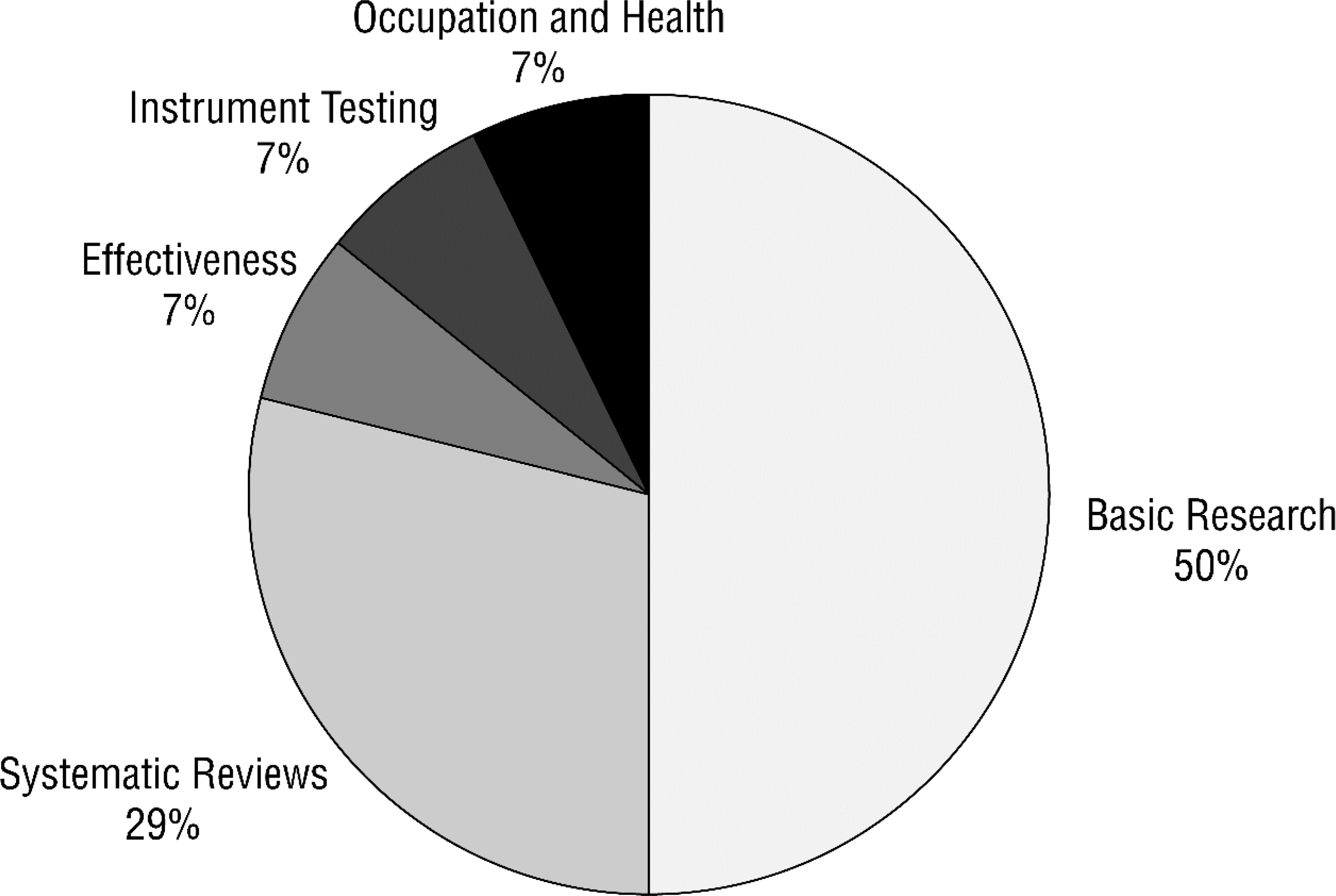
Types of productive aging articles published in the American Journal of Occupational Therapy in 2008–2009.
Productive Aging Articles Published in the American Journal of Occupational Therapy in 2008–2009, by Type and Level of Evidence
Productive Aging Articles Published in AJOT in 2008–2009
Note. OT = occupational therapy; n/a = not applicable; SR = systematic review; ITS = intelligent transportation systems; SD = standard deviation; MS = multiple sclerosis; ADL = activity of daily living; ICC = intraclass correlation coefficient; T1 = Time 1; T2 = Time 2; LTC = long-term care; ESL = English as a second language; MMSE = Mini-Mental State Examination; LSI–A = Life Satisfaction Index–A; SCU = special care unit; QoL = quality of life; CES–D = Center for Epidemiologic Studies Depression Scale; OARS = Older Americans Resources and Services Program; IADL = instrumental activity of daily living; OA = osteoarthritis; WOMAC = Western Ontario and McMaster Universities Osteoarthritis Index.
Of the 14 articles related to productive aging published in AJOT in 2008–2009, 50% were basic research articles (n = 7). These articles examined a clinical phenomenon but did not assess treatment (Classen, Awadzi, & Mkanta, 2008; Finlayson, Garcia, & Cho, 2008; Finlayson, Shevil, & Cho, 2009; Haak, Fange, Horstmann, & Iwarsson, 2008; Mann et al., 2008; Murphy, Smith, & Alexander, 2008; Schmid & Rittman, 2009). However, many of these articles extended the knowledge that can be linked to implications for clinical practice. For example, Finlayson et al. (2009) discussed their findings regarding discrepancies in the perception of cognitive symptoms between people who have multiple sclerosis and their caregivers in terms of how they can affect occupational therapy treatment. In addition, Schmid and Rittman (2009) outlined several clinical issues that could enhance occupational therapy treatment for managing falls and fall risk among people who had a stroke, including caregiver education, medication management, and intervention to reduce fear of falling and associated activity curtailment.
One article (7%) pertained to instrument development and testing (Kay, Bundy, & Clemson, 2009). Kay et al. (2009) examined whether the DriveAware assessment, a five-item self-report questionnaire administered and rated by clinicians, could tap awareness of driving ability. Agreement between a clinician’s rating of awareness before and after on-road testing was examined. Further examination of this questionnaire’s psychometric properties is ongoing; however, Kay et al. discussed future implications for occupational therapy clinicians. Because lack of awareness has been associated with unsafe driving, using a simple scale in place of costly and unsafe on-road tests may provide a great benefit.
Of the 14 articles on productive aging, 13 used quantitative methods (93%). One study had an instrumental case study design that used both qualitative and quantitative methods (Wood et al., 2009), and 1 study was qualitative (Schmid & Rittman, 2009).
How Well Did AJOT Meet the Centennial Vision in 2008 and 2009 in the Area of Productive Aging?
Taken as a whole, this body of research shows that the evidence for occupational therapy’s effectiveness for use in practice to facilitate productive aging is still limited. Most studies were classified as basic research, and although several pertained to specific practice issues and some used groups of older adults with a particular disease or condition (e.g., multiple sclerosis, stroke, osteoarthritis), the articles were difficult to synthesize. The articles in general articulated occupational therapy’s role in existing or emerging practice areas and may reflect where the discipline is at in terms of providing a foundation for future intervention work.
To examine evidence of the effectiveness of occupational therapy, I used the evidence rating system from AOTA’s Evidence-Based Literature Review Project (Lieberman & Sheer, 2002). These levels range from I (highest level of evidence) to V (lowest level of evidence) according to the rigor of the study design, not necessarily the quality of the study. Level I includes systematic reviews and randomized controlled trials; Level II includes two-group nonrandomized trials; Level III includes one-group nonrandomized trials; Level IV includes single-subject designs, descriptive studies, and case series or case reports using objective measures; and Level V includes expert opinion (Lieberman & Sheer, 2002).
The strongest evidence for the use of occupational therapy in productive aging is in the area of driving. The four systematic reviews on aspects of driving interventions are considered Level I evidence and are of high quality. Of the 56 studies used in the systematic review articles, I should note that only 3 studies (5%) came from the occupational therapy literature (Stav, Arbesman, & Lieberman, 2008). Despite the lack of occupational therapy–driven research, each review discussed the relevance of the different aspects of interventions to occupational therapy. Reviews such as these can assist practitioners in disentangling the body of evidence related to a practice area and can educate practitioners about their role. On the basis of the systematic reviews on driving, information gleaned from reviews of interventions related to the person’s driving abilities (Hunt & Arbesman, 2008) and community mobility programs (Stav, 2008) may directly affect the type of occupational therapy treatment provided and may foster future occupational therapy research. Reviews on physical infrastructure (Bohr, 2008) and automobile modifications (Arbesman & Pellerito, 2008) are not within the realm of interventions provided by occupational therapists, but practitioners need to know this information to fully understand what factors affect driving performance and be a knowledgeable consultant to policymakers, engineers, and urban planners.
In 2008 and 2009, AJOT published only one randomized controlled trial related to productive aging (Yuen et al., 2008). The study examined the effectiveness of participating in a volunteer activity (mentoring a student for whom English was a second language) on measures of well-being. Although the design was rigorous (randomized controlled trial), the positive results could possibly have been inflated by comparing the volunteer group with a nonattention control group and including only people who completed the intervention in the analyses. Whether participants benefited from the program because it compensated for loss of a valued role, as hypothesized, or for another reason, such as being an outlet for social interaction, remains to be determined. In addition, because the treatment is not an occupational therapy intervention, the future practice implications are ones in which the occupational therapist is a facilitator of services rather than a direct service provider.
Research Gaps and Future Directions to Meet the Centennial Vision
On the basis of the past 2 years of geriatric research in AJOT, the discipline appears to still be at the beginning stages of knowledge building in productive aging. Many of the basic research articles have discussed occupational therapy’s role in emerging areas of practice. However, research on intervention development and examination of the effectiveness and efficacy of interventions will need to be conducted to establish these roles in multidisciplinary arenas. The continued emphasis on training new occupational therapy researchers will be critical to move beyond basic research and build evidence in these areas.
The systematic reviews on driving not only have served occupational therapy by defining practice roles and by synthesizing current evidence but also have clearly shown gaps in research for which occupational therapy needs to take a leading position. Because the aging U.S. population will necessitate a huge need for these services, occupational therapy needs to mobilize research efforts to examine the effectiveness of driving interventions to stay viable in this area.
Future research on instrument development is also needed to adequately measure outcomes related to occupational performance. In addition, research linking occupational engagement to health will be important to build on to advance occupational therapy as a discipline. These types of theoretically grounded articles can facilitate translation into practice and provide a foundation to examine effectiveness of occupational therapy interventions.
This review provides an overview of effectiveness research published in AJOT in 2008 and 2009. I should mention that occupational therapy effectiveness research has been published in journals outside of AJOT and the profession during this time period (e.g., Di Monaco et al., 2008; Eklund, Sjostrand, & Dahlin-Ivanoff, 2008; Gitlin et al., 2009; Murphy, Strasburg, et al., 2008). Publishing occupational therapy effectiveness research outside of AJOT may reflect pressures to publish in higher impact journals or the need to reach specific, multidisciplinary audiences. Future reviews of productive aging research may need to include multiple journals to examine more broadly how occupational therapy is meeting the Centennial Vision in geriatric research.
In conclusion, occupational therapy will need to build on the productive aging research evidence base in the years ahead to address the growing practice needs of the aging population. The foundation provided in the past 2 years in AJOT is a promising beginning. However, more research is needed to build on these initial studies and provide the evidence that will clearly specify occupational therapy’s role in productive aging and justify service reimbursement.