





Abstract
As our population ages, more older adults are living longer with chronic conditions, using multiple medications, and experiencing multiple comorbidities—all of which can affect safe driving and independence in community mobility. Ensuring participation in society through safe driving or independent use of community mobility is a critical issue for occupational therapists and agents of the aging network. We know that driving cessation is linked to social isolation, depression, and early nursing home admissions and, as such contributes to health care costs and decreased quality of life (Freeman, Gange, Munoz, & West, 2006; Marottoli et al., 1997, 2000). However, occupational therapists, being skilled professionals who assist people to maintain participation in desired occupations and roles, can embrace driver evaluation and rehabilitation as a critical and emerging practice area to ensure that older drivers stay on the road longer and safer (American Occupational Therapy Association, 2005). Doing so will increase awareness of our role in health care and enhance our societal value.
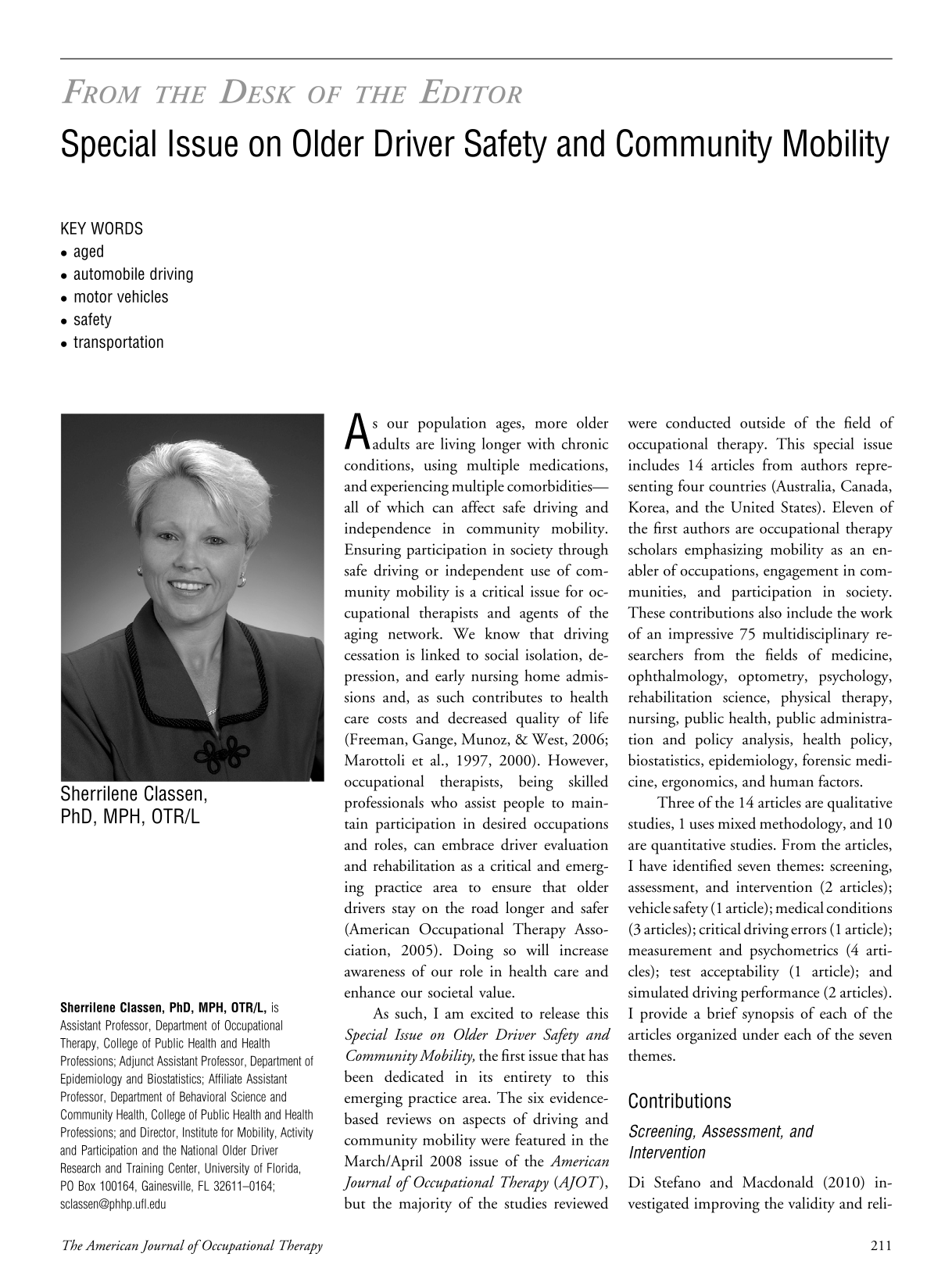
Sherrilene Classen, PhD, MPH, OTR/L

As such, I am excited to release this Special Issue on Older Driver Safety and Community Mobility, the first issue that has been dedicated in its entirety to this emerging practice area. The six evidence-based reviews on aspects of driving and community mobility were featured in the March/April 2008 issue of the American Journal of Occupational Therapy (AJOT), but the majority of the studies reviewed were conducted outside of the field of occupational therapy. This special issue includes 14 articles from authors representing four countries (Australia, Canada, Korea, and the United States). Eleven of the first authors are occupational therapy scholars emphasizing mobility as an enabler of occupations, engagement in communities, and participation in society. These contributions also include the work of an impressive 75 multidisciplinary researchers from the fields of medicine, ophthalmology, optometry, psychology, rehabilitation science, physical therapy, nursing, public health, public administration and policy analysis, health policy, biostatistics, epidemiology, forensic medicine, ergonomics, and human factors.
Three of the 14 articles are qualitative studies, 1 uses mixed methodology, and 10 are quantitative studies. From the articles, I have identified seven themes: screening, assessment, and intervention (2 articles); vehicle safety (1 article); medical conditions (3 articles); critical driving errors (1 article); measurement and psychometrics (4 articles); test acceptability (1 article); and simulated driving performance (2 articles). I provide a brief synopsis of each of the articles organized under each of the seven themes.
Contributions
Screening, Assessment, and Intervention
Di Stefano and Macdonald (2010) investigated improving the validity and reliability of the on-road driver assessment used by 55 specialist occupational therapists in Australia. They deduced that Australian occupational therapy driver assessors are in support of greater standardization of their test routes and procedures to improve assessment reliability and validity. However, the extent to which standardization can be achieved is limited by the variable road traffic environments in which assessments are conducted. Korner-Bitensky, Menon, von Zweck, and Van Benthem (2010) examined the capacity-building needs of 133 occupational therapists related to older driver screening, assessment, and intervention. They found that driving services offered by occupational therapists were primarily related to screening compared with assessment or intervention. The authors surmised that clinicians would benefit from driving-related professional training aimed at enhancing professional capacity in field.
Vehicle Safety
Shaw, Miller Polgar, Vrkljan, and Jacobson (2010) used inductive qualitative inquiry with seniors to obtain their perspectives on their driving experiences, in-vehicle safety feature use, and strategies to prevent injury and manage risks. The authors identified a lack of congruence between the vehicle and safety feature design and seniors’ needs. The authors outlined specific aspects of vehicle design, safety features, and action strategies that support safer use and operation of a vehicle by seniors.
Medical Conditions
Vrkljan and colleagues (2010) used focus groups to explore the information needs of clinicians and consumers related to arthritis and driving. The results revealed that although driving is critical for maintaining independence and community mobility, drivers with arthritis experienced several problems that can affect safe operation of a motor vehicle. Findings from this study will inform the development of the Arthritis and Driving Toolkit with strategies to support safe mobility for people with arthritis.
Hunt, Brown, and Gilman (2010) challenged the current research that suggest drivers with early Alzheimer’s disease may continue to drive for extended periods of time as long as their driving is evaluated or monitored. They examined 207 reports of lost demented drivers over 10 yr. Seventy drivers with Alzheimer’s disease were not found, 32 drivers were found dead, and 116 drivers were found alive. Of those found alive in the vehicle, 35 were injured. Hunt et al. challenged researchers to more clearly understand the consequences of becoming lost while driving and to better understand the reasons for some drivers’ becoming lost whereas others do not.
From the University of Alabama and Brisbane, Australia, Elgin and colleagues (2010) examined the extent to which drivers with hemianopia or quadrantanopia display safe driving skills when evaluated on road compared with drivers with normal visual fields. Although drivers with hemianopia were more likely to receive poorer ratings for all skills evaluated, more than half performed without obvious errors or had only minor errors. The skill most commonly problematic for drivers with hemianopia was lane keeping, whereas drivers with quadrantanopia drove without obvious errors or exhibited only minor errors.
Critical Driving Errors
Certain driving errors are predictive of crashes, but it is unknown whether the type of errors evaluated during on-road assessments is similar to traffic violations associated with crashes. From the University of Florida and Dongguk University, Korea, Classen, Shechtman, Awadzi, Joo, and Lanford (2010) used crash data of 5,345 older drivers to construct a violation-to-error classification. They found that almost half of the drivers sustained crash-related injuries, with female drivers having a higher injury probability than male drivers. Lane maintenance, yielding, and gap acceptance errors predicted crash-related injuries with almost 50% probability and must be viewed as critical driving errors. They suggested injury-prevention strategies to protect the health and well-being of older drivers, especially older women.
Measurement and Psychometric Properties
Shechtman, Awadzi, Classen, Lanford, and Joo (2010) examined the validity of the University of Florida’s on-road driving assessment among 127 older drivers. They identified a cut-point for the driving error score to predict with 91% sensitivity and 87% specificity those who pass/fail an on-road assessment. In addition, they identified that the strongest predictors of failing the on-road test were adjustment to stimuli and lane maintenance errors. They also generated a decision tree for informing clinical decision making among driving evaluators.
Duquette and colleagues (2010) examined the concurrent validity of partial administration of the Cognitive Behavioral Driver’s Inventory (CBDI). They used multicenter data from on-road evaluations in which the CBDI was used on clients with cerebrovascular accident or traumatic brain injury. Only 52% of the road test failures were predicted correctly by the completely administered CBDI; as such, the CBDI should be used as a complement and not a substitution for a road test.
Unsworth, Pallant, Russell, Germano, & Odell (2010) from La Trobe University, Melbourne, Victoria, Australia, are developing the Occupational Therapy Driver Off-Road Assessment battery and reported on the psychometric properties and validity of its subtests with final recommendations on which test to include or exclude.
Classen, Winter, and colleagues (2010) from the University of Florida and Lakehead University, Ontario, Canada, reported on item development and validity testing of a new self-report Safe Driving Behaviors Measure. This instrument is based on three theoretical frameworks, existing driving measures, and focus group feedback and is guided by item response theory. The scale content validity index is 0.84, and the criterion validity is being established by comparing results to on-road testing.
Test Acceptability
From Washington University, Dalchow, Niewoehner, Henderson, and Carr (2010) tested acceptability and confidence among 57 older adults referred for fitness-to-drive evaluations. In general, there was a trend toward higher acceptability of tests adopted from the Neuropsychiatric Assessment Battery and the Washington University Road Test than other off-road measures. Confidence was noted to decrease after administration of the psychometric test battery, yet it increased after the on-road evaluations despite a 47% failure rate.
Simulated Driving Performance
Bédard, Parkkari, Weaver, Riendeau, and Dahlquist (2010) and Mullen, Weaver, Riendeau, Morrison, and Bédard (2010) conducted two simulator studies. First, they examined whether participants who failed to complete a simulated drive because of simulator sickness differed from those who completed the simulation. They found that in healthy senior drivers, simulator sickness does not prevent examination of those who need it most (i.e., those with the poorest on-road driving performance) and that cognitive differences are not associated with dropping out because of simulator sickness. Next, they examined the validity and reproducibility of simulator-based driving evaluations of community-dwelling, healthy adults. They conducted a series of experiments and found statistically significant correlations between clinical tests and simulated driving tests and between on-road and simulated drives, with good reproducibility of simulator assessments. The results suggest that with adequate training occupational therapists could use simulators to facilitate their decision making regarding fitness to drive.
Summary
This special issue features 14 research articles on older driver safety and community mobility research. Plausible clinical practice and research opportunities exist in each of the seven themes. Likewise, contributions to clinical practice were made to most of these seven themes. Table 1 provides a synopsis of research opportunities and contributions.
Summary of Key Findings Extending Research Opportunities or Contributions to Occupational Therapy Research or Clinical Practice, Organized by Seven Themes - 211
Conclusion
The evidence base of occupational therapy pertaining to older driver safety and community mobility is growing. These are particularly exciting times for this emerging practice area; yet, much needs to be done to demonstrate efficient and effective interventions, to secure reimbursement for occupational therapy services in this practice area, and to facilitate policy change. Such change can be fueled only from evidence emerging from our joint practice and research activities. As such, I am extending appreciation to all the scholars who participated in making this special issue a reality and who will continue to research the critical senior mobility issues that we are facing. I am inviting all occupational therapists to embrace, infuse, and extend the practice area of driver safety and independent community mobility to their older (or medically at risk) clients.