Cities have increasingly developed into spaces for consumption. This paper
explores the relationship between patterns of use of urban leisure amenities and
feelings of attachment to the city. A survey among highly educated professionals
and managers (the new middle class, working in the Dutch city of Rotterdam) was
carried out in order to examine both their participation in the domain of urban
leisure and urban residence, and their attachments to the city in general. The
survey shows that among the new middle class subgroupings can be identified,
based on their mobility with regard to leisure and their psychological
attachments to the city. One of them is a group of young single urban
households, who are not only frequent urban consumers, but who also feel
strongly attached to the city as a whole. The findings suggest that in cities
specific processes of symbolic consumption occur which facilitate some extent of
psychological attachment and which appear to tie a subset of the new middle
class to urban places, regardless of place of residence.
The city is mine. I am from here. Each time I go here or there, and I
see this or that, it moves me. (Wentholt 1968: 77). [transl. MvdL]
1.1 During the twentieth century cities have developed into places for
consumption par excellence (Hannigan 1998, Zukin 1998). People buy, stroll and play
in cities, they watch and are looked at, they entertain and are being entertained
(Lofland 1989). The city, moreover, is a special place for consumption. Not only is
the city a kind of container for all kinds of consumption goods and services, it is
also a consumption phenomenon on its own. Consumption in the city is a highly
symbolic and social phenomenon. First, the urban environment and the diversity of
activities which take place there, allow for the non-monetary consumption of urban
experiences (like streetshows, skateramps, the urban hustle, the historic ambiance).
Second, it is also a centre for art exhibitions, concerts and buying exclusive
goods. People take in images and impressions in the presence of, and interaction
with, others.
1.2 For some time now, the city as a domain of consumption has been
subjected to much critical debate. As a result of the commercialization of all kinds
of consumption activities, some authors claim that the city is increasingly void of
‘authentic meaning’ (Mommaas 2002). Others claim that urban centres are increasingly
‘regulated spaces’ in which spontaneous ideas and cultural initiatives are more and
more repressed (Zukin 1991, Gottdiener 1997). Emotional bonds and very personal
relationships with a place develop over time and through repeated interactions,
especially by maintaining social relations with others there (Low & Altman
1992). The development of cities into consumption domains urges the question of
whether the city is still a place people feel psychologically attached to,
especially as selective migration over decades has led to a decline in urban ties
developing through actually living in the Netherlands.
1.3 In this paper the possible relationship between symbolic consumption
and the development of feelings of attachment to the city will be explored, through
culture, spectacle and residence. This is done by focussing on the so-called ‘new
middle class’ of Rotterdam, a category of people who are the main target group of
dS+V, the council's Department of Urban Planning and Housing. In most of the larger
Dutch cities, the new middle class largely lives outside the city, either in the
countryside or in small towns near the city (van der Wouden & de Bruijne 2001).
Rotterdam is a prime example of this and has resulted in the administration trying
to keep new middle class households from moving away. Not only is this new middle
class still considered to be representing bourgeois values like solidarity and a
sense of public responsibility, they are considered to be essential for sustaining a
transformation into a full fledged postindustrial economy in two ways. First, due to
their high levels of economic and cultural capital, the new middle class are thought
to be bearers and drivers of the consumption and culture driven economic sectors. It
is suggested they display an urban consumption oriented lifestyle, both regarding
the art and culture complex, as well as inner city shopping, entertainment and
catering (Featherstone 1990, Shields 1992, O'Connor & Wynne 1995). Second, the
presence of a new middle class is an important condition and pull factor for
knowledge intensive and creative industries (Scott, 1988, Florida 2002).
1.4 The argument in this paper develops along the following lines. After
discussing the new middle class and the city of Rotterdam, I analyse the popularity
of the leisure facilities among the new middle class living in Rotterdam and
conclude that a high proportion is not very mobile with regard to leisure. The
analysis then moves on to those living in the centre of Rotterdam and shows that the
development of the city into a leisure city does not for some (yet) seem to be at
odds with the residential function. Young and single highly qualified workers from
the producer services make up the predominant new middle class section living in
Rotterdam's centre and they are also frequent users of its leisure facilities. Next,
attention shifts to the psychological attachment of the new middle class to the
city. The degrees of attachment frequent leisure consumers, both living inside and
outside the city, suggest they have to the city leads us to hypothesize that the
presence of leisure facilities in cities has a psychological (cognitive and
emotional) dimension, which is related to the presence of others and which
stimulates rather than discourages the development of psychological attachments to
the city.
Urban leisure, housing and the new middle class
2.1 In the debate on urban culture and consumption the new middle class
takes centre stage (Wynne 2002). Some perceive their role as having been decisive
for the postindustrialisation of contemporary cities and the development of consumer
culture. The symbol-intensive character of new middle class occupations would not
only have turned them into the driving force behind the urban transformation from a
production centre into a consumption centre, but, due to their positions in
production and consumption relations, the new middle class is also the main
beneficiary of this transformation. Both the production and reproduction of images
and meanings which have pervaded the city, can be traced back to their claimed
‘postmodern predisposition’ towards a postmodern culture in which high and popular
culture are mingled (Lash & Urry 1987, Featherstone 1990, Bourdieu 1992).
2.2 As a result of this postmodern predisposition, the new middle class
is thought of as a typically urban social stratum, both in academic literature (see
e.g. Featherstone 1990, Sassen 1991) and popular literature (see e.g. novels by Tom
Wolfe or David Lodge). In Bourdieuan terms, the cultural participation of the new
middle class, their ownership of cultural goods, spending power and their particular
lifestyles all are means of distinction, which can be exposed well in the context of
the city. The need for distinction as well as demographic, economic and cultural
changes are believed to shape the demand for urban dwellings by the new middle class
(Ley 1996). For example, economic structural factors, the most important being the
rent-gap of urban dwellings in or near the centre of cities, is one element shaping
the gentrification of dilapidated urban neighbourhoods (Smith 1996). Whilst partly
the result of changing gender roles, but also efficient time-use, many such urban
new middle class households look for an environment offering high quality urban
consumption experiences as close to home as possible (Knulst 1992, Van der Land
1998).
2.3 For members of the urban new middle class, urban symbolic
consumption can thus become a habitual element of life, familiarizing them with
local places, people, customs and special characteristics (Schmidt-Relenberg 1968).
Consumption is both about products and about people, and therefore very much a
social and cultural activity. Social contacts in the domain of urban consumption can
be intense but temporary, and highly expressive but partial and flexible (Bauman
1990, Shields 1992). With regard to the cultural dimension of symbolic consumption,
the exchange of symbols, what is consumed, and even more important, how it is
consumed conveys messages about identity. Elements of symbolic consumption can
include “personal ornaments, modes of social display, aestheticised objects, forms
of entertainment and distraction, or sources of information and self-awareness”
(Scott 1997:323/4). In the urban public realm it is not necessary to know each other
by name to have a feeling of togetherness (Maffesoli 1996). Spaces of consumption
are experiential spaces (Lash & Urry 1987, Schulze 1992), where related
structures of feeling can be found. People can in a way extract a feeling of
togetherness from the presence of others even when these others differ completely
from what one is accustomed to (Hajer & Reijndorp 2002). Such cultural
differences form an essential part of identity construction and symbolic consumption
(Campbell 1987, Bourdieu 1992).
Rotterdam
3.1 The Rotterdam housing stock has traditionally been strongly aimed at
the working class. Urban renewal, during the 1970s and 1980s, in Rotterdam, (which
is the second largest city of the Netherlands with a population of 599.544
inhabitants) has reinforced this situation.
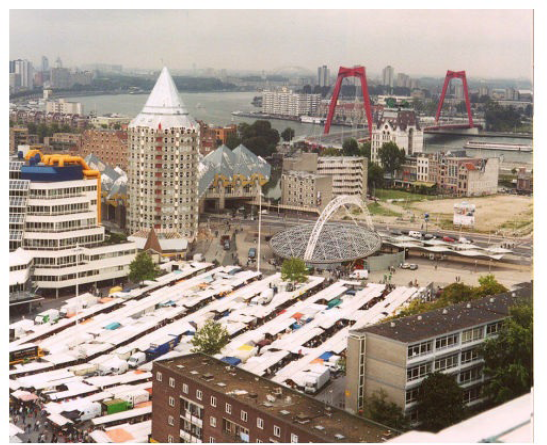
A View of Rotterdam Centre
3.2 There are only a few neighbourhoods, like Hillegersberg, old
Kralingen and Prinsenland, where the composition of the housing stock allows for a
high level of homogeneity with regard to the socio-economic background of residents.
Until the nineteen nineties there has been little building of middle class housing
stock. Middle-class dwellings were mainly built in the suburbs of Rotterdam. The
existence of post-war housing stock means that (as yet) there are limited
possibilities for gentrification in Rotterdam, except for a few small blocks. During
the nineteen nineties new dwellings have been built for middle and higher income
groups (Van ‘t Verlaat & Van der Meer 2002) and, according to the local council,
this share should increase from 51 per cent in 2000 to 77 per cent in 2005 (ibid:
21).
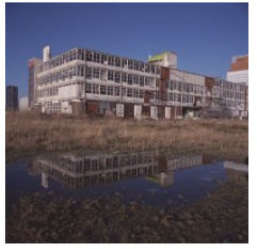
Rotterdam Apartments
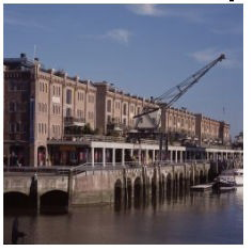
City Centre Loft Apartments
3.3 However, all in all, for many members of the new middle class
Rotterdam is not an attractive city to settle in. This has little to do with the
type of houses which are on offer, but has a lot to do with the lack of safe and
secure residential environments for households in middle and higher income
groups.[1] The
so-called “Woonstadbeleid” [Urban Living Policy] between 1998 and 2002 aimed at
improving the quality of both existing residential areas and new areas for middle
and higher income groups. More importantly, the city council at its inauguration in
2002 announced it would tackle issues of safety and dilapidation in the city much
more fiercely than had previously been the case.
3.4 Rotterdam had previously had a poor reputation with regard to
leisure and entertainment (Vijgen & Van Engelsdorp Gastelaars 1990). However,
much has changed during the past decade. In 2002 the city council issued a brochure
called “Happy business in Rotterdam”, showing details of the recovery of the
cultural economy (Gemeente Rotterdam 2002). The statistics in the brochure show that
not only does Rotterdam attract more visitors, they also stay longer and return more
often. Visitors are relatively young and many of them live in the greater Rotterdam
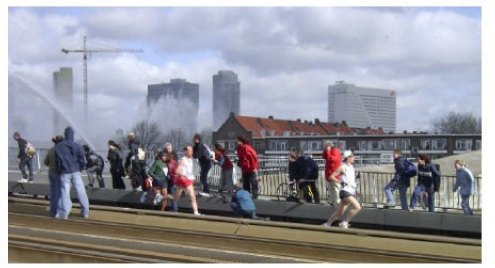
region. Festivals and big events (like e.g. the Rotterdam Marathon) are increasingly
popular. While the centre is still being rebuilt from the Second World War,
festivals and events already provide the city with a dynamism that compares
favourably to other cities. Annual popular events like the Wereldhavenfestival,
Dunya, the Zomercarnaval and the Dance Parade have increasingly made their mark,
just as in the past the respectable Museum Boymans van Beuningen or the Kunsthal
made their mark.
The Dance Parade Rotterdam
3.5 The empirical research on which this paper is based consisted of a
survey among 279 highly qualified professionals and managers in selected economic
sectors (see below). The survey included questions about the urban ties of new
middle class professionals and managers with regard to work, their residential
situation and neighbourhood, leisure patterns, social participation, and their
psychological urban ties, and was followed by in-depth interviews with a selection
of the participants. The occupations of the selected population all are highly
knowledge intensive and in the service sector. Three clusters of service-occupations
were included in the research, which were in some instances overlapping, but which
overall allow for taking a representative sample of new middle class occupations.
They are those in service production occupations, public sector occupations and
occupations of a symbolic-analytical nature, mostly in the cultural sector and
service-sector. These three clusters of occupations were derived from a theoretical
analysis in which macro-historical roots of the new middle class have been traced
(Van der Land 2004). It was concluded that there are three tracks along which the
new middle class developed into its current form. The first is the technocratic
track, which dates back to the industrial revolution and which has produced
technical and professional occupations as well as managerial occupations within
production processes. Much of the work is aimed at directly facilitating and
directing the production of goods and services. The second track concerns the public
welfare system. The growth of the welfare state during the post-war years has
produced all kinds of new occupations, both in the public as well as the semi-public
and private sector. The third track has produced service sector occupations and
incorporates two important developments. Firstly, the rise of the cultural economy
has involved the development of occupations in which cultural knowledge is produced
and distributed. Secondly, the role of knowledge has changed from strongly
utilitarian with regard to the production process into knowledge of a more symbolic
kind.
3.6 Every participant of the survey was working in or very near to
Rotterdam with 45 per cent of them actually living in Rotterdam. The research was
carried out in 1996 and 1997. This was a period of economic prosperity, in which the
conditions to develop strong attachments may be not so conducive, compared to
periods of less prosperity. This is because the degree of freedom to be
geographically mobile was high, compared to the years before and after, and if
people develop local ties during such a period when they can express their
preferences to a high degree, these ties are probably often developed against a
background of relatively free choice.
The popularity of Rotterdam's leisure amenities compared to other cities
First, I explore how the use of leisure amenities in Rotterdam relates to the high
amount of geographical mobility this part of the new middle class is supposed to
show (Lash & Urry 1987). I examine the relative importance of Rotterdam's
leisure facilities compared to other places. To what extent does the new middle
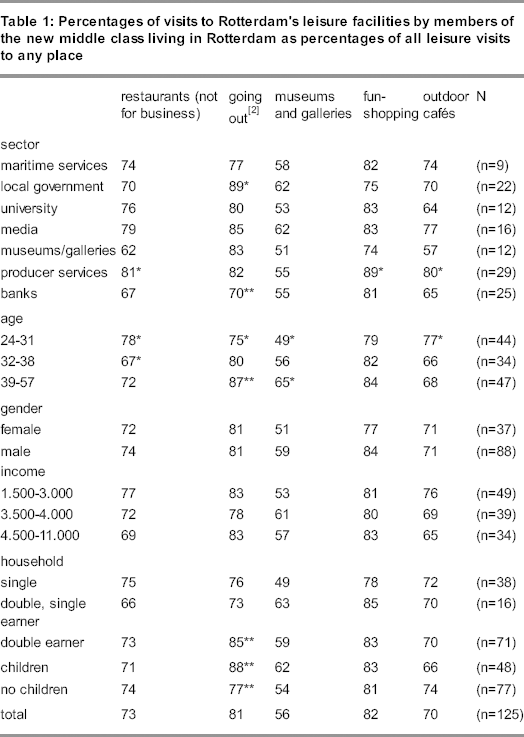
class visit the city of Rotterdam instead of other places? Table 1 shows this popularity as a percentage of
all leisure visits to any other place. If this percentage is relatively low, then it
suggests that Rotterdam holds a less important position in that respect and that
leisure mobility is relatively high. Such a conclusion would fit well into the
popular image of the new middle class as a highly mobile group of people. The
analysis distinguishes between socio-demographic and socio-economic characteristics
and relates these to participation in the leisure city. The analysis has been
restricted to people who actually live in Rotterdam.
Percentages of visits to Rotterdam's leisure facilities by members of the new
middle class living in Rotterdam as percentages of all leisure visits to any
place
Age and income have been grouped into three percentiles as best as
possible.
3.7Table 1 shows that except for
visits to museums and galleries, the percentages of visits to Rotterdam compared to
other places fluctuate around 70 to 80 per cent. Several conclusions can be drawn
from the table. First, it can be concluded that especially for the somewhat older
part of the new middle class, Rotterdam's leisure amenities are relatively popular
compared to those in other places, whereas the somewhat younger population goes
elsewhere more often, but only to visit museums. Second, double income earners are
oriented towards Rotterdam more strongly than other households. The need for a time
efficient lifestyle might explain this. Close to their dwelling are all kinds of
amenities that make the organization of their daily and leisure activities easier.
Third, households with children are less mobile with regard to their leisure
patterns. Fourth, service producers and public service workers are strongly oriented
towards Rotterdam and are less mobile in this respect.
3.8 From this it can be argued that, despite the fact that in popular
media as well as in sociology and cultural studies (cf. Featherstone 1990) the image
of a highly mobile new middle class prevails, this analysis shows that a large part
of Rotterdam's new middle class is in fact not so mobile for leisure. Singles and
producers of services are strongly oriented towards the nearby city (cf. Van der
Land 1998). Age, household and occupational sector seem to be important factors to
explain differences in urban symbolic consumption within the new middle class.
3.9 A comparison between shopping patterns of the new middle class and
the entire Rotterdam adult population reveals that the new middle class exclusively
shops in Rotterdam even more often than the entire population of Rotterdam on
average (in 35 of the 100 cases, whereas the mean for the population is 28 per cent,
COS 1996:35.)
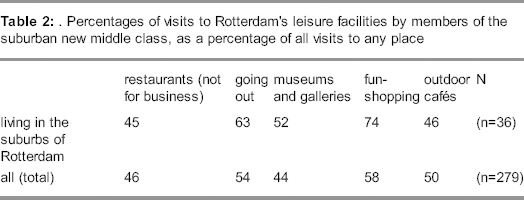
3.10 Moreover, a comparison of the popularity of Rotterdam's leisure
amenities between the suburbanized new middle class and the entire survey-population
shows that differences in visits to Rotterdam are not as great as might be expected
(see Table 2) (cf. Burgers &
Van der Land 1997). The fact that a large part of Rotterdam's new middle class does
not live in the city does not seem to inhibit active and frequent use of leisure
amenities.
Percentages of visits to Rotterdam's leisure facilities by members of the
suburban new middle class, as a percentage of all visits to any place
restaurants (not for business)
going out
museums and galleries
fun-shopping
outdoor cafés
N
living in the suburbs of Rotterdam
45
63
52
74
46
(n=36)
all (total)
46
54
44
58
50
(n=279)
The centre of Rotterdam as a place to live
3.11 The other, partly overlapping, section of the new middle class who
are very important for the functioning of the city centre are those actually living
there. As stated earlier, during the 1990s Rotterdam put great effort into improving
the appeal of the centre to this much sought-after category of residents, both in
the residential and leisure domains. Another way of increasing the appeal of
Rotterdam to new well-to-do inhabitants has been the cultural revitalization that
has been taking place since the early 1990s. Both the policy-programmes
“Attractieve Stad” [Attractive City] and “Rotterdam
Culturele Hoofdstad 2001” [Rotterdam Cultural Capital 2001] have been
means to trying to lure the new middle class to the city. This research has looked
into the characteristics of residents who did choose to live in Rotterdam and their
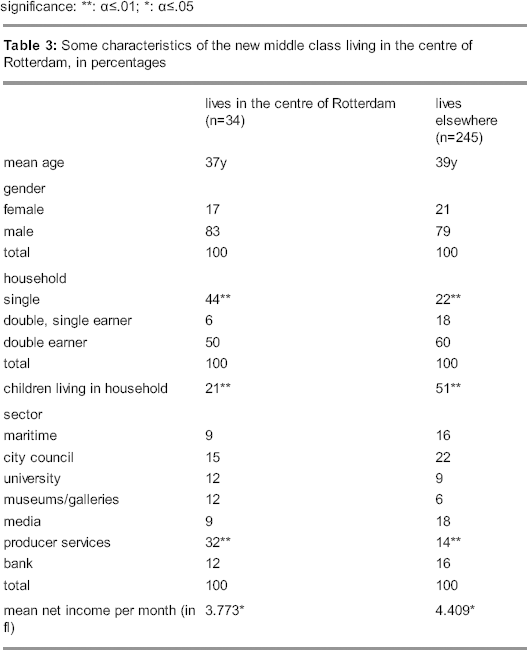
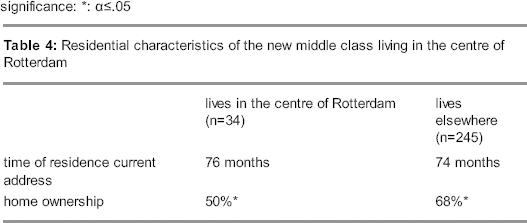
motivations. In total 12 per cent of the sample lived in the centre. Some of their
characteristics are summarized in Tables 3 and 4.
Some characteristics of the new middle class living in the centre of
Rotterdam, in percentages
3.12 The centrally living urban new middle class appears to a large
extent to consist of singles in their thirties, without children, who are
potentially mobile as a result of their lack of home ownership. Many of them work in
the service production sector. Not only do they work in a highly locally based
economic sector (Storper 1997, cf. Van der Land 2004) they are frequent visitors to
the city and their urbanity also shows in their choice of residence. Also there is
an age-effect (the mean age of the survey participants from the producer service
sector was 34, compared to 40 for the rest of the population). However, when we only
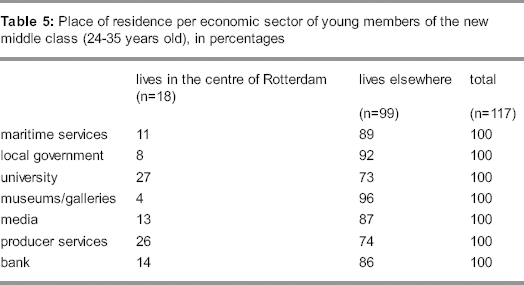
select 24-35 year olds from the whole of the sample, then the producer service
sector, together with the academic sector, still stands out (see Table 5). Sectoral and
occupational factors are both involved, it seems. Furthermore, among the 24-30 year
old inhabitants of the city centre, six out of seven are from the producer service
sector.
Place of residence per economic sector of young members of the new middle
class (24-35 years old), in percentages
lives in the centre of Rotterdam (n=18)
lives elsewhere (n=99)
total (n=117)
maritime services
11
89
100
local government
8
92
100
university
27
73
100
museums/galleries
4
96
100
media
13
87
100
producer services
26
74
100
bank
14
86
100
Next it is important to determine the motivation behind people chosing the city
centre as a place to live. Answers centre around two key motivations. First, the
presence of others plays an important role, both in a negative sense (noise, litter)
and a positive sense (diversity, liveliness). Many of the people in this category
claim they like the dynamic and surprising atmosphere in cities (cf. O'Connor &
Wynne 1995, Zukin 1995): positive aspects of social density in the city centre
dominate. Second, people point to the higher quality of life which can be obtained
through the proximity of the available, though expensive, amenities (like
night-shops, traiteurs, bagelshops, bars, etc). Also, the vicinity of the work-place
is important in this respect (all of them work in Rotterdam). Both the use of
amenities and the journey to work should not take too much time. The potential
quality of life, seems to be affirmed by the behaviour of the centre inhabitants,
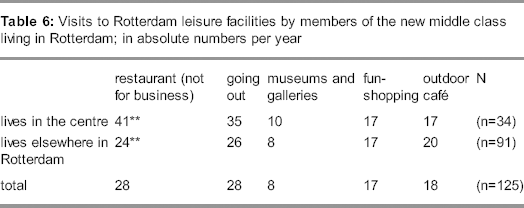
i.e. as far as visits to leisure amenities are concerned. From Table 6 it can be argued that
those who live in the centre of the city make more use of these amenities than the
rest of the new middle class, although only for visits to restaurants the difference
is statistically significant.
Visits to Rotterdam leisure facilities by members of the new middle class
living in Rotterdam; in absolute numbers per year
3.13 Residential motivations appear predominantly very pragmatic. The
results of the survey affirm stereotypes in the Netherlands of ‘Rotterdammers’ being
straightforward and commonsensical. The new middle class has chosen a central
location for practical reasons mainly. A strategic residential location enhances the
quality of life. Everything that is needed - work, art and culture, entertainment,
public transport - all is to hand.
3.14 On these grounds, the Rotterdam urban policy to create more
up-market dwellings in the centre seems to be well founded. The development of the
city into a leisure city does not (yet) seem to be at odds with the residential
function. Moreover, the popularity of leisure in Rotterdam to both local inhabitants
and visitors highlights the importance of the city - compared to new emerging
centres in the urban network. It does not appear that the city centre will whither
in the near future.
Symbolic consumption and mental attachments to the city and the
city-centre
4.1 There is a hint of romanticism behind some of the claims about
negative effects of consumer culture on the urban ties people develop. It supposes
that developing urban attachments would be more common in a time when cities were
not as much the consumption domains as they are today. Young new middle class
households in Rotterdam, who are at the beginning of their housing career,
especially point to the city as their favourite place to live, but they do so often
for practical reasons. Can the simple fact that they have chosen the city for these
reasons also be interpreted as an indication for ‘urban attachment’? And what else
makes them feel they belong? Do they feel attached to the centre? Do they feel they
are ‘Rotterdammers’? Are they proud of the city? Is it their city? An analysis of
these issues will be be presented with regard to inhabitants as well as to visitors
of the urban centre. I start with the centre-inhabitants.
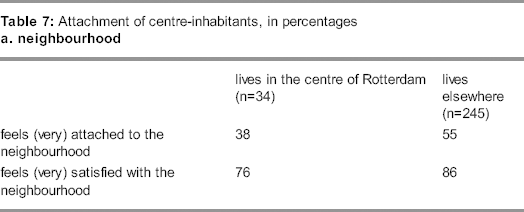
Attachment of centre-inhabitants, in percentages a. neighbourhood
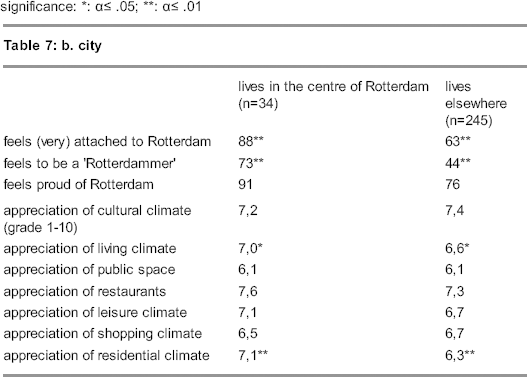
4.2 Looking at Table 7, it appears that the centre-inhabitants feel
strongly attached to the city in general, more so than the rest of the new middle
class living in Rotterdam. Although they feel less attached to their neighbourhood
(i.e. in their case a part of the centre) they do identify with other
‘Rotterdammers’ strongly and many of them feel proud of the city. The residential
aspects of Rotterdam are appreciated less, whereas the living climate in general is
valued relatively highly. It seems as though they perceive Rotterdam less as a place
to live and more as a ‘complete environment’ (“life here is good, but living here is
less good”).
4.3 Often, conflicting interests of centre-inhabitants and visitors of
the leisure city are stated and they show that these two categories experience the
city in different ways. Residents e.g. would think highly of a safe residential
environment, whereas visitors are more keen to see spectacle and entertainment
(Glasson, Godfrey & Goodey 1995). The first category experiences the city as a
daily returning habitat, the second looks for extraordinary special experiences.
However, the centre-inhabitants, and especially the highly qualified young and
single among them, partly seem to be like tourists in their own city (cf. Urry 1990,
Metz 2002). Their pride of the city in general confirms this. When finding out why
they feel proud, they refer to the metropolitan characteristics of Rotterdam:
especially its international harbour and the all modern architecture that is
present. Profiles of residents and visitors partly seem to merge, not only literally
(the new middle class resident and visitor are both in their thirties, single and
without children), but also symbolically, in the sense that symbols representative
of Rotterdam have important meanings for both of them.
4.4 The connection between identification with the city and attachments
through symbolic consumption appears, paradoxically, to be more prominent among the
new middle class from outside Rotterdam. Members of the suburbanized new middle
class who claim to feel ‘Rotterdammer’ appear to go out more than twice as much in
Rotterdam than those who do not (59 times against 24 times per year). The difference
is partly made by ‘born Rotterdammers’, as they go out three times as much as those
who are not born in Rotterdam. Their (leisure) ties with the city involve a high
level of urban attachment, and this is based on the huge difference in levels of
leisure visits to the city between those who say they feel attached to Rotterdam and
those who do not. The latter visit the city 16 times a year, the first do so 45
times on average. Hence it does not even seem necessary to live in Rotterdam to feel
attached to the city. Symbolic consumption functions as a means though which
developing attachments can also occur.
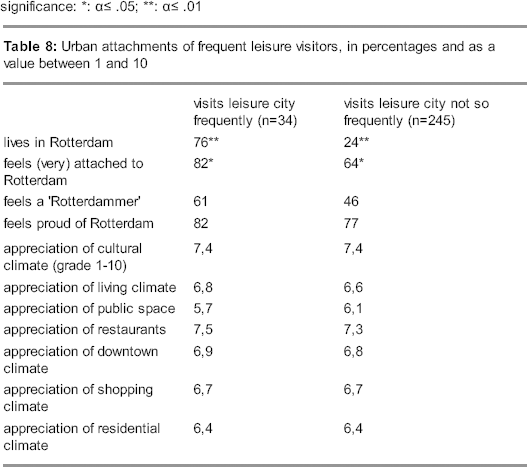
4.5 Next, I analyze the urban attachment of frequent leisure consumers
(see Table 8).
Urban attachments of frequent leisure visitors, in percentages and as a value
between 1 and 10
4.6 Among the frequent leisure consumers, feelings of urban attachment
appear again to be stronger than among those who visit leisure amenities less often.
Although the percentages of people who say they feel attached to Rotterdam, who
identify with ‘Rotterdammers’ and who are proud of the city are lower compared to
the centre-inhabitants, the percentages are still relatively high, especially when
we take into account that almost a quarter of them live outside Rotterdam. Their
appreciation of diverse aspects of Rotterdam is rather average, including their
appreciation of leisure aspects like culture, public space, restaurants, shopping,
and so forth.
4.7 The survey also explored the motivation of residents and visitors as
to why they feel attached to Rotterdam. The centre-residents answered this
particular question with a high level of abstraction, often stating that their
attachment is something that just goes naturally with living somewhere. Most answers
deal with urbanity and image: for example, the city thrives with energy, is dynamic,
has international appeal and offers the latest in art and culture. Others explain
their attachment in more emotional terms: they feel at home or want to identify with
the popular image of a city of hard working people. Only a few people give more
specific answers, like that their friends live there also, that they are involved
through their job or that it is necessary for their work to know the city well, and
that this leads to a certain degree of attachment. The frequent visitors of
Rotterdam's leisure amenities provide similar answers. However, no one explicitly
refers to urban leisure as a means of attachment. A possible correlation between
attachment and symbolic consumption is not that straightforward it seems.
Rotterdam Marathon
Discussion and conclusion
5.1 What kind of involvement is the attachment visitors and residents
point to? Attachment is usually associated with some deeper consciousness of what is
‘good’ about the city, mostly in terms of urban civic culture (cf. Putnam 1993).
Often consumer culture is associated with cursoriness, hedonism and egoism.
Consumption is considered something private: there is no collective gain (Slater
1997). Recently, however, more optimistic voices can be heard. Attachments in the
domain of ‘play’ might also be a more playful, ‘lighter’ kind of attachment, which
develops under conditions of play (Allon 1978), like choice, desire, spontaneity and
fantasy. Leisure often is a very social activity, which might invoke a feeling of
togetherness, possibly enhancing feelings of attachment to the context in which this
takes place (Goffmann 1961, Maffesoli 1996). People can get in contact with local
cultural identity, the local sense of place (Eyles 1985, Shields 1992).
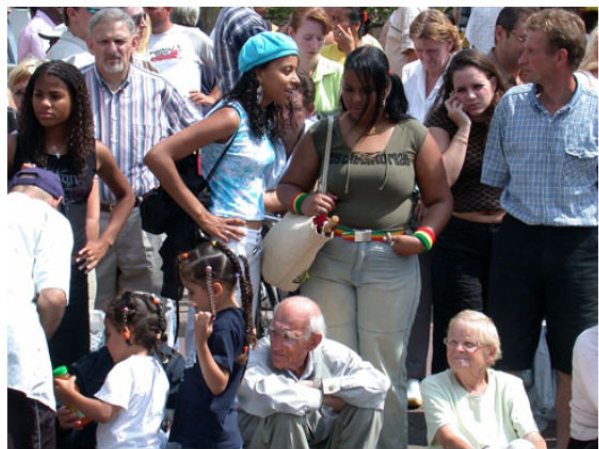
Rotterdam Summer Carnival
5.2 The survey indicates that the attachments of the new middle class
are often of a rather abstract nature. City centre-inhabitants appear to have an
encompassing, but rather crude kind of attachment to their residential environment.
They feel attached to the city as a whole and less with the centre, where they live.
Attachments of visitors also point to the city as a ‘complete’ experience. What they
feel attached to is not specific, to say the least, and is to a certain extent
superficial and of a cursory nature. When they move to another city or when they
visit the city less, their attachment might disappear quickly.
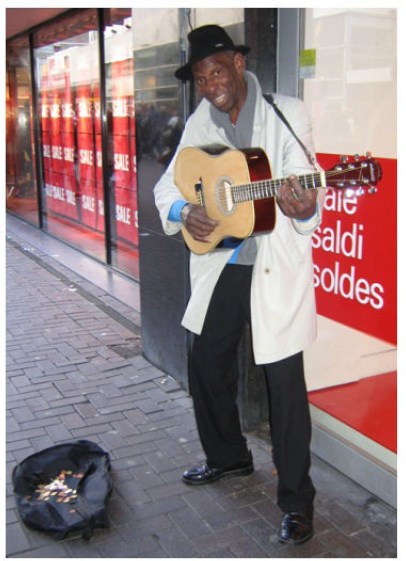
Musician in Rotterdam Centre
5.3 Despite the somewhat pessimistic stance that is often taken in the
debate on the city as a consumption domain, regarding social and cultural effects,
the survey does, however, provides some clues for a possibly more optimistic view.
This idea itself is not new, but consumption has not often been explicitly related
to the issue of developing ties and feelings of attachment.
5.4 Consumption plays an increasingly important role in identity
construction, in the identification with others and in the identity construction of
the self. Consumption is an effective means of distinguishing an individual's
personality intentionally and actively from others. Therefore, the context in which
symbolic consumption takes place (the city and especially the city centre) in a
social, cultural and physical sense is important. Two factors can be identified in
this context, which in their interdependence facilitate the development of
attachment, namely frequency and intensity. Frequency refers to recurring symbolic
consumption. Places, people, noises, products and particular images and landmarks (a
bridge, a square, the decorum of a street parade) emerge and stick because of the
returning visits. Intensity refers, rather paradoxically, to the intense experiences
that can be found in the city. As frequency and intensity increase, the chances that
one can identify with the context in which symbolic consumption takes place also
increase. Although the city is not literally their city by birth or by residence,
people still can identify with it to a great extent. The city is ‘acquired’ so to
speak and made into a city ‘for one's own’.
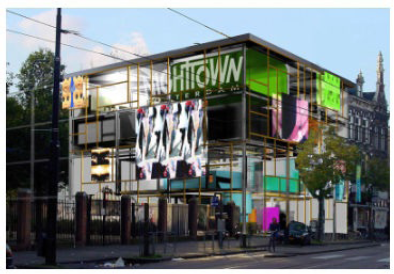
Nighttown: Venue for Popular Music
Rotterdam Romantic Music Day
5.5 This indicates that the presence of leisure facilities in cities,
beside their functional value, also has a psychological (cognitive and emotional)
dimension, which is closely connected to the presence of other social beings. Big
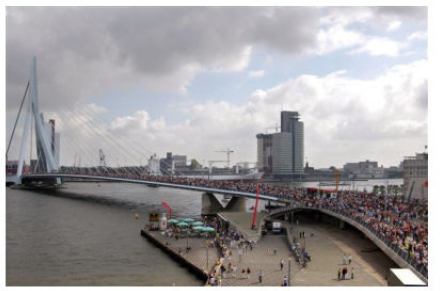
events, like football matches, parades or e.g. the opening of a bridge, or places
where many people gather (like in shopping malls, concert halls or festivals) have a
certain social quality that goes beyond the mere presence of just a lot of people.
Maffesoli and in his footsteps Shields call this quality, after Simmel, ‘sociality’
(Shields 1992). Sociality has become an important part of consumption, because it
seems to offer people ideas on how to change or form identity. It emerges where
people gather with a common goal, share the same phenomena and similar feelings, and
create a sense of togetherness. It invokes a sense of belonging and communion
(Shields, in Maffesoli 1996). In this respect the emotional aspects of sociality,
like identification with local history, local sayings, feelings of pride with what
is achieved in the city, or the presence of symbolic spots can enhance one's
attachment with the city and the city centre.
5.6 Members of the new middle-class living in the centre of Rotterdam
appear to be psychologically attached to the city, as are the frequent visitors of
leisure facilities who do not live in the city at all, but only work there. The
symbolic consumption of the city, its cultural products and the sociality the city
contains, contribute to the way and the extent to which people identify with the
city. Symbolic and emotional aspects of social interactions based on consumption in
other words facilitate the development of attachments to the city. The fact that the
new middle class living in and around Rotterdam is not very mobile with regard to
their leisure patterns, seems to stimulate this identification to develop. As
marriages are increasingly based on emotional grounds and decreasingly on rational
grounds, but are also increasingly ended for emotional reasons, so might these
attachments also turn out to be more fragile than rationally based attachments.
Still, urban attachments of the new middle class might in a sense be cursory and
partial, they are nevertheless real and seem to be intensified by symbolic
consumption, rather than the other way around.
Footnotes
1
Personal conversation with senior civil servant of the Rotterdam Development
Corporation (OntwikkelingsBedrijf Rotterdam).
2
Movie, musical concert, dance performance, club, bar etc.
AltmanI., and LowS. (1992). (eds.)
Place Attachment.Plenum Press,
London.
3.
BourdieuP. (1992). [1984]
Distinction: a Social Critique of the Judgement of Taste.Routledge,
London.
4.
BurgersJ., and van der
LandM. (1997).
Thuis in de Uitstad. [At home in the leisure
city] In A. Reijndorp, V. Kompier and L. de Haas (eds.).Leefstijlen.
Wonen in de 21e Eeuw. [Lifestyles. Living in the 21st century]
NAi,
Rotterdam.
5.
CampbellC. (1987). The
Romantic Ethic and the Spirit of Modern Consumerism.Blackwell,
Oxford.
6.
COS (1996).
Binding aan Rotterdam. Een Verkennend Onderzoek. [Attachment to
Rotterdam. An explorative study]COS,
Rotterdam.
7.
EylesJ. (1985). Senses of
Place.Silverbrook Press,
Warrington.
8.
FeatherstoneJ. M. (1990). The
Paradox of Culture and the Globalization of Diversity.ISOR, Utrecht.
[Phd thesis].
9.
FloridaR. (2002). The Rise
of the Creative Class.Basic Books, New
York.
10.
RotterdamGEMEENTE (2002).
Plezierige Zaken in Rotterdam. Vrije Tijdseconomie in Cijfers 2001.
[Happy business in Rotterdam. Leisure economy in numbers 2001]OntwikkelingsBedrijf Rotterdam,
Rotterdam. [brochure]
11.
GlassonJ., GodfreyK., and GoodeyB. (1995). Towards
Visitor Impact Management; Visitor Impacts, Carrying Capacity and Management
Responses in Europe's Historic Towns and Cities.Aldershot,
Avebury.
12.
GoffmanE. (1961).
Encounters. Two Studies in the Sociology of Interaction.Bobbs-Merrill,
Indianapolis.
13.
GottdienerM. (1997). The
Theming of America: Dreams, Visions, and Commercial Spaces.Harper Collins, New
York.
14.
HajerM., and ReijndorpA. (2002). Op Zoek
naar Nieuw Publiek Domein. Analyse en Strategie. [Looking for new public
domain. Analysis and strategy]NAi Uitgevers,
Rotterdam.
15.
HanniganJ. (1998). Fantasy
City: Pleasure and Profit in the Postmodern Metropolis.Routledge,
London.
16.
KnulstW.P. (1992).
Waarom blijft het cultureel rendement van een stijgend
opleidingsniveau achter bij de verwachtingen? [Why does the cultural revenue
of increasing educational levels not live up to the
expectations?] In DekkerP., and Konings-van der
SnoekM.J. (eds.). Sociale en Culturele
kennis. Hoe Bevalt de Nederlandse Vrouw? en 44 andere Vragen Beantwoord.
[Social and cultural knowlegde]Sociaal en Cultureel Planbureau/VUGA,
Rijswijk/Den Haag.
17.
LashS., and UrryL. (1987). The End of
Organized Capitalism.Polity Press,
Cambridge.
18.
LeyD. (1996). The New
Middle Class and the Remaking of the Central City.Oxford University Press, New
York.
19.
LoflandL.H., (1989)
‘Social life in the public realm: a review.’Journal of Contemporary Ethnography17, 4 (January),
453–482.
20.
MaffesoliM. (1996). The Time
of the Tribes. The Decline of Individualism in Mass Society.Sage,
London.
21.
MetzT. (2002). Pret!
Leisure en Landschap. [Fun! Leisure and landscape]NAi Uitgevers,
Rotterdam.
22.
MommaasH. (2002). De Ruimte
als ‘Event’. Over de Noodzaak van ‘Cultureel Structuurbeleid’.
[Space as ‘event’. On the need for a cultural structure policy]
[Lecture]
23.
O'CONNORJ., and WynneD. (1995). City
Cultures and the ‘New Cultural Intermediaries’.Institute for Popular Culture,
Manchester.
24.
SassenS. (1991). The Global
City: New York, London, Tokyo.Princeton University Press,
Princeton, NJ.
25.
Schmidt-RelenbergN. (1968). Soziologie
und Städtebau. Versuch einer Systematischen Grundlegung.Karl Krämer Verlag,
Stuttgart/Bern.
26.
SchulzeG. (1992). Die
Erlebnisgesellschaft. Kultursoziologie der Gegenwart. [The experience
society. Cultural sociology of the present]Campus Verlag, Frankfurt/New
York.
27.
ScottA.J. (1997)
‘The cultural economy of cities.’International Journal of Urban and Regional Research21(1997), 2,
323–339.
28.
ShieldsR. (ed.) (1992).
Lifestyle Shopping: the Subject of Consumption.Routledge, London/New
York.
29.
SlaterD. (1997). Modernity
and Consumer Culture.Polity Press,
Cambridge.
30.
SmithN. (1996). The New
Frontier. Gentrification and the Revanchist City.Routledge, New
York.
31.
StorperM. (1997). The
Regional World. Territorial Development in a Global Economy.The Guildford Press, New
York etc.
32.
UrryJ. (1990). The
Tourist Gaze. Leisure and Travel in Contemporary Societies.Sage,
London.
33.
VAN DE WOUDEN, R., and Erica de
Bruijne (2001). De stad in de omtrek.
Problemen en perspectieven van de vier grootstedelijke gebieden in de
Randstad. [The contours of the city. Problems and perspectives of the four
metropolitan areas in the Randstad.]Sociaal en Cultureel Planbureau,
Rijswijk.
34.
VAN DER LAND, M.
(1998). ‘Myths of mobility. On the geography of
work and leisure among Rotterdam's new middle class'.
Netherlands Journal of Housing and the Built Environment,
February, 117–135.
35.
VAN DER LAND, M.
(2004). Vluchtige Verbondenheid. Stedelijke Bindingen
van de Rotterdamse Nieuwe Middenklasse. [Cursory connections. Urban ties of
Rotterdam's new middle class.]Amsterdam University Press,
Amsterdam.
36.
Van ‘T VerlaatJ., and van der
MeerJ. (2002). Quality of
life als strategisch beleidsthema. [Quality of life as a strategic policy
issue].OBR/dS+V,
Rotterdam.
37.
VijgenJ., and van Engelsdorp
GastelaarsR. E. (1990).
‘Hoe stedelijk is de Maasstad? Voorzieningen, bewoners en
leefpatronen in Rotterdam en Amsterdam.’ [How urban is the Maasstad?
Amenities, residents and living patterns in Rotterdam and
Amsterdam]K.N.A.G. Geografisch Tijdschrift24, 3,
241–251.
38.
WentholtR. (1969). De
binnenstadsbeleving en Rotterdam. [Inner city experience and
Rotterdam].Ad. Donker,
Rotterdam.
39.
WynneD. (2002). Leisure,
Lifestyle, and the New Middle Class. A Case-Study.Routledge, London/New
York.
40.
ZukinS. (1991). Landscapes
of Power. From Detroit to Disney World.University of California Press,
Berkeley.
41.
ZukinS. (1995). The
Cultures of Cities.Blackwell,
London.
42.
ZukinS. (1998)
‘Urban Lifestyles: diversity and standardisation in spaces of
consumption.’Urban Studies35(1998), 5–6,
825-839.