In recent political debates about physical chastisement, children have been
positioned as ‘potential’ selves and have had their bodies mapped in specific
ways. This article compares these discourses with findings from a study of
parents’ views of proposed legislation on physical discipline. It is argued that
parents’ talk about physical discipline is temporal not only because it is
concerned with the nature of the child's body/self at the time of punishment but
because parents engage with memories from their own childhood and, therefore,
with how childhood selves have been disciplined across social and biographical
time. Drawing on sociological work on the body, memory and childhood, the
article explores two aspects of disciplinary practices - their embodied and
embedded nature – which, to date, have been under researched and under theorised
in debates about physical chastisement.
‘For every man and woman, the control of children is a part of real experience:
for all of us, the basic stuff of our memories’ (Newson and Newson, 1968:
387)
1.1 In recent political debates about physical chastisement, children
have been positioned as future selves and have had their bodies ‘zoned’ in
particular ways. Comparing these discourses with findings from a research study of
parental accounts of disciplinary practices, this article explores how these
dominant temporal and physical mappings fit with parents’ understandings of their
children and their accounts of disciplining them. It is argued that parents’ talk
about physical discipline is temporal not only because it is concerned with the
nature of the child's body/self at the time of punishment but because parents engage
with memories from their own childhood and, therefore, with how childhood selves
have been disciplined across social and biographical time. Drawing on sociological
work on the body, memory and childhood to understand how disciplinary practices are
constructed allows for two under researched aspects of these practices - their
embodied and embedded nature - to be investigated. In what follows, I do this by
exploring how children's bodies have been constructed in political debates about
physical chastisement in the UK and, through drawing on a research study which
looked at how parents themselves think about discipline. I begin by outlining the
methodology of this study in more detail.
Project methodology
2.1 In September 2002, just after a proposed age-related ban on physical
chastisement had failed to become legislation in Scotland, the Scottish Executive –
devolved government in Scotland - published research it had commissioned on parental
practices and beliefs about physical chastisement. The data from this research form
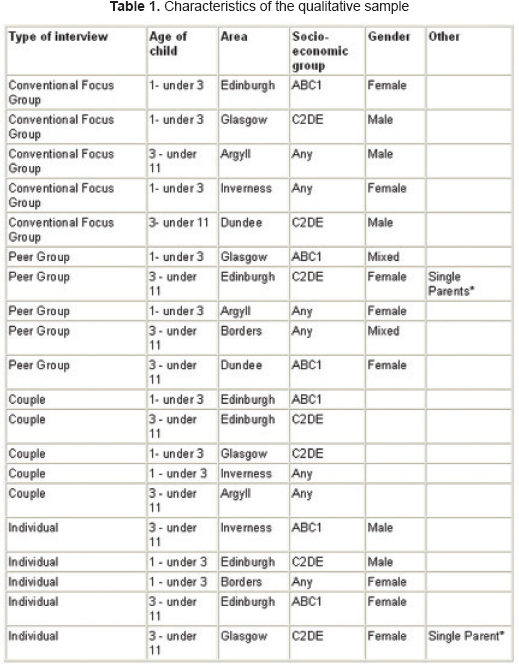
the basis for the present article[1]. The first stage of the research, which preceded the
survey element, consisted of a series of 20 qualitative interviews (involving 85
parents) across Scotland (see table
1).
2.2 These interviews were equally divided between individual depth
interviews; interviews with couples; conventional focus groups; and ‘peer’ focus
groups[2]. The
focus groups consisted of 6 to 8 individuals and all interviews lasted approximately
1 hour. The moderators for the focus groups introduced a series of topics which
offered a rough structure for the discussion. These included general orientation
towards issues of discipline; parents’ own experience of physical discipline as
children; assessment of effectiveness - and impact - of disciplinary practices; and
perception of prevalence of use of different forms of physical chastisement among
peers and society at large. Qualitative methods are based on particular forms of
interaction and data arising from such approaches are, therefore, likely to be
shaped by these interactions (Kitzinger, 1994). The methodological implications of
this might usefully be explored in more detail elsewhere; in this article the focus,
in order to highlight previously neglected embodied aspects of disciplining, is on
those themes which emerged strongly across interview context.
2.3 The aim of the sampling for the qualitative part of the study was
not to generate a sample that was representative in a statistical sense but to
ensure as wide a range of characteristics as possible were represented.
Consequently, the sample was purposive in nature. A short screening questionnaire
was used to recruit participants with particular characteristics, door to door. Key
sampling variables included sex and socio-economic group and the sample was
deliberately structured to include interviews with single parents. In terms of
geographic focus, interviews of each type were carried out in different parts of
Scotland. This ensured not only that rural and urban areas were included but that a
wide geographical area was covered.
2.4 As the proposed ban on smacking was aimed at children aged under
three, the qualitative sample was also segmented by age of child: parents with
children aged under three and those with children aged three to 11 years. However,
in practice, it was not possible to ensure that participants in the former group
only had children aged under three. Further analysis on the
basis of age, gender and class might be worthwhile though, as noted, this sample has
limited scope in this respect.[3] All of the interviews were tape-recorded and transcribed and
the software package QSR-N6 was then used to categorise, search and retrieve text.
Data were analysed within and across cases in relation to emergent themes.
Other than for the interviews with couples, there was no restriction on
whether parents were single parents or not. However, to ensure that
single parents were included, we selected a single
parent as the “lead” member of one of the peer groups and for one of the
individual interviews.
2.5 The second stage of the research was quantitative in nature and took
the form of a nationally-representative survey of 692 parents carried out in
respondents’ homes using Computer Aided Personal Interviewing (CAPI). The sampling
for the survey was based on probability techniques involving the random selection of
sampling points, of addresses within those points and of individuals for interview
at those addresses. A response rate of 55% was achieved. As such, the achieved
sample affords a reasonable basis for generalising to the views of parents in
Scotland as a whole, though a number of caveats should be noted. First, the achieved
sample was relatively small and is not large enough to support detailed sub group
analysis. Second, there was a significant under-representation of fathers in the
final sample (an indication perhaps that issues to do with parenting and discipline
continue to be seen primarily as the responsibility of mothers) and, as a result,
the data were weighted to correct for gender imbalance (using information about
composition of Scottish households from the Scottish Household Survey). While there
was a problem recruiting fathers for the quantitative part of the study, fathers
were represented, in roughly similar numbers to mothers, across the qualitative
study in individual, couple interviews and peer and conventional focus groups.
Finally, the overall response rate among participating households is lower than for
some household surveys but reflects the difficulties of identifying eligible
households and of persuading fathers to take part.
2.6 The focus of the survey was wide ranging and included use of
different forms of physical chastisement with own child in last week; perception of
appropriateness of smacking in different situations for different age of children.
While this article mainly draws on the qualitative data, where useful, reference is
also made to the quantitative data. For example, in exploring parental beliefs about
how to discipline children of different ages.
2.7 Before going on to explore what these data can tell us about how
parents understand their disciplinary practices, I first engage with the question of
how children's bodies have been discursively constructed through political debates
about physical chastisement legislation.
Mapping the child's body
3.1 De Certeau (1984) suggests that the law inscribes all bodies, yet
some bodies clearly find themselves more inscribed than others. Feminist legal
theory has identified how the construction of the legal subject as a ‘rational,
autonomous, isolated, disembodied individual’ (Bridgeman, 2002:100) allows the law
not only to regulate, but to produce, particular female bodies.
These are bodies which the law conflates with ‘emotionality, irrationality, the
material and natural’ (Keywood, 2000: 499) and then fragments, reducing women to
‘bits of their bodies’ (Smart, 1989; 95).
3.2 Theorists have also begun to consider how legal discourses produce
particular constructions of childhood and, relatedly, of children's bodies
(McGillivray, 1997). Some constructions, for example most obviously in relation to
child protection, position children as potential or actual victims, while others
situate children as citizens, focusing either on their responsibilities (for
example, the age of criminal responsibility, see Freeman, 1997) or, more rarely, on
their rights, for example, in recent debates about the rights of the child to
confidential contraception[4]. Therefore, while not applying uniformly to the law, in
relation to some areas, the law, influenced by developmental psychology, can be
thought of as positioning the child's body as a ‘body with potential’ (Bridgeman,
2002). The child, then becomes understood in terms of ‘lack’ - not yet physically
mature and not yet competent - with the result that the law concerns itself with
‘the future embodied by the child and without reference to his or her present
experience’ (Bridgeman, 2002: 100). In this context, Alderson (1994) points out, if
children are understood to not yet be ‘real selves’, then it becomes possible to
argue that ‘there cannot be any real invasion, or integrity to violate’ (1994:
47).
3.3 This focus on the productive nature of discourse draws on Foucault's
understanding of the subject as constituted through the particular relationship
between power and knowledge. Political and legal discourses are one means through
which child subjects have become constituted and then monitored (Brownlie, 2001). To
this extent, the body of the child can be ‘disciplined’ both in the sense that it
becomes subject to surveillance as a result of knowledges emanating from sites such
as parliaments or courts but also in the sense that it can become subject to the
hierarchical and coercive power of adults. To some extent, the Foucauldian focus on
disciplinary power in relation to children has led to an under estimation of the
degree to which children remain subject to more traditional or - to use Foucault's
term - sovereign forms of power. This reluctance to acknowledge the physical power
adults and, in particular, parents, continue to have over children is not, however,
restricted to Foucault's analysis: it is also apparent in other theoretical
perspectives which focus on the democratisation of family life (Giddens, 1991). In
this article, by looking at political discourses and parental accounts about
chastising children, the interplay between disciplinary power and sovereign power in
relation to physical chastisement is explored.[5]
3.4 What then do discourses about physical chastisement tell us about
the disciplining of the child's body? While, as can be seen from the references
above, the literature in this area often refers broadly to legal discourses, in
fact, such discourses cover a range of practices, including both domestic and
international legislation and case law. In what follows, therefore, while I make
references to some of these practices, I focus on one particular aspect of legal
discourses about physical chastisement in the UK – specifically, political debate
about proposed legislation in this area.
‘Instruments of punishment’, ‘body parts’ and the ‘time future’: the physical
chastisement of children
3.5 Legislation relating to physical chastisement has, as
McGillivray puts it, allowed the child's body to be
‘zoned and re-zoned in a maze of lines drawn around injury, reasonableness,
gender, community standards, correctability, instruments of punishment and
body parts’ (McGillivray, 1997: 210).
As with legislation in relation to children's health (Bridgeman and Monk, 2000),
these discourses fragment the child's body and, by focusing on the body
primarily as a physical entity, perpetuate the Cartesian dualism between body
and mind. In law, the focus of physical chastisement, McGillivray suggests, has
been on body parts: children's hands – because of what the ‘bad hand’ has done -
or buttocks because of the ‘cushioning of fat and muscle’ (1997: 224). Although
reference is made to the emotional impact of physical chastisement,
international law suggests this tends to relate to more extreme disciplinary
behaviours[6]
rather than to the shame, embarrassment and anger that might accompany
‘everyday’ disciplinary practices (see footnote 5). Such zoning or body mapping,
McGillivray suggests, is not found in assault law in relation to adults.
3.6 The justification for this difference in how the law thinks
about children and adults, she argues, is the ‘tutorial’ motive: the idea that
parents have a responsibility to guide children towards appropriate adult
behaviour and that physical chastisement is one tool for achieving this. The
law, at least in the UK, is also clear, however, that it is parents, not
teachers, who have the right to express this tutorial motive through physical
chastisement. To this extent, we need to be aware of how the body of the
chastiser, as much as the body of the child, comes to be inscribed by the
law.
3.7 The law in relation to physical chastisement is concerned, then,
in Mayall's (1998) terms, with the ‘time future’ not the ‘time present’ of
children. The focus on lasting or permanent injury or harm as the legal standard
for denying reasonable chastisement also points to children being understood in
terms of their future subjectivity as an adult, rather than in terms of their
having ‘personal integrity’ in the present: children as ‘becoming’ rather than
‘being’ (Brownlie, 2001; Mason, 2005).
3.8 Far from being ‘a transcendental notion’, how we think of harm
changes with time and across cultures (Smart, 1999:393). Interpreting harm in
relation to physical chastisement has also been a dynamic process; and, as well
as legislation and case law, recent political debates on such legislation in
Scotland, and the rest of the UK, can be read as part of this process. In 2003,
the Criminal Justice (Scotland) Act came into force. Among other things, the Act
amended the current law on the use of physical chastisement in Scotland. Since
1860, the law in Scotland - as in England and Wales - has allowed parents (or
those acting on their behalf) to claim they were using ‘reasonable chastisement’
if charged with assault for physically punishing their child.[7] This new act allows
for the continued use of physical chastisement - ‘justifiable assault’ - for
all ages of children[8] but now explicitly bans the use of
implements to discipline children, the shaking of children and blows to
children's heads.
3.9 In the case of Scotland, the initial idea was that there should
be of an age-related ban. This focused on the ‘developmental time’ (White, 1998)
of children - on the idea that children below a certain age could ‘surely not
yet understand ideas of guilt and punishment’ - though there was uncertainty
about what this age was (Justice 2 Committee, 2002).[9] In the end, Scottish politicians
moved away from such temporal and developmental uncertainties back to the
familiar and more material territory of ‘body parts’ and ‘instruments of
punishment’, and voted for a ban on the use of implements, on smacking children
around the head and on shaking children.
3.10 Similarly, in England and Wales, after years of resisting
change to the law on parental physical chastisement, the government allowed the
issue to be raised as part of the proposed Children's Bill (Toynbee, 2004). The
legislative changes for England and Wales, which came into effect in January
2005, focus on (re) defining reasonableness, mainly in terms of the impact of
physical chastisement on the child's physical body – how ‘transient’ this impact
is and whether or not a mark (for example, bruising, swelling, cut, scratch) is
left on the child's body.[10] In relation to the possible emotional impact, however
there is, again, little acknowledgement of the possible effect on the everyday
emotional relationship between parents and children. In other words ‘psychiatric
injury’ would be considered beyond transient but ‘mere
[emphasis added] emotions such as fear, distress or panic’ (Lord Goldsmith, HL
deb., 2004, col. 563) would not.
3.11 During the debating stage of the bill in the House of Lords,
some dissenting voices raised the moral issue of whether children should be hit
at all. Others, however, focused their anxieties on this issue of how to read
harm from the physical body. Lord Gresford, for example, pointed out that some
children will bruise more easily than others or ‘may be hit in an area where
bruising does not occur, but the pain is the same’ (HL deb., 2004, col.531).
Similar points were made in relation to the colour of children's skin - ‘it
takes a great deal of that type of smacking for the bruises to show on a black
child’ (Baroness Howells of St Davids, HL deb., 2004, col. 537) - and the fact
that injuries may be internal and, therefore, not visible.
3.12 These anxieties, however, serve to emphasise the extent to
which more holistic understandings of the harm/pain caused by physical
chastisement - and the child's experience of this - are missing from political
discourses about physical chastisement legislation and point to a continuing
tendency to think about children's bodies in dualistic and fragmented terms and
about children as potential ‘real selves’.
3.13 To what extent, though, do parents share these understandings?
As O'Malley (2004) has recently argued, how governing technologies are planned
is not always how they are implemented. In this final section, through drawing
on data from the Scottish study, parents’ understandings are explored in more
detail.
4.1 This section engages further with the temporal and embodied themes
that were identified above as infusing recent political discourses about physical
chastisement in the UK. In the first part, drawing on the Scottish 2002 data, I
explore parents’ zoning work in relation to their children's bodies; and, in the
second, I discuss how parents describe themselves as ‘punishing adults’ on the one
hand, and as ‘punished children’ on the other. Here, as well as drawing on the
Scottish data, I also draw on findings from other research studies. This allows for
the voices of children who have experienced physical chastisement in the present and
the voices of parents from the 1960s and 1970s - when many of the parents in our
Scottish study would have been children – to be heard alongside the accounts of the
Scottish parents. Finally, in the third part of this section, I draw on sociological
work on memory as a further aid in reading parents’ talk about parenting and
disciplining
Mapping their children's bodies through ‘developmental time’
4.2 Before exploring if, and how, parental accounts of disciplining
children's bodies are similar to those found in political discourses noted
earlier, it is worth asking how aware parents are of such discourses in the
first place. In the 2002 Scottish study, there was a high level of awareness
that the legal status of physical chastisement was under review, but also a
great deal of confusion about the current and proposed legislation.[11] Despite this,
parents did understand that the legislation was concerned with parts of
children's bodies and with the age of those bodies. The following exchange is
typical of parents’ responses, across socio-economic groups, on this theme.
*Interviewer: what is the current law on smacking?
*It is not under three's. You're not allowed to smack under three's. Or is it
over three's?
*I don't think you're allowed to smack them at all.
*You're not allowed to touch their head. I know that. But I would never touch
the head anyway. [Female Focus group, Edinburgh,
ABC1][12]
4.3 Unlike traditional accounts of parental punishment (Hazel
et al, 2003), parents in the 2002 study are not comfortable
talking about inflicting pain on their children - ‘It is just a “stop that” it
should not really hurt ‘ [Edinburgh couple, ABC1]. The focus of
adult-child interaction, Mayall (1998) suggests, is a concern with civilising
and regulating children's unruly selves. While she locates this regulative role
as falling heavily on schools, our data suggest this maybe to underestimate the
extent of the responsibility parents feel to control their children's bodies. In
the 2002 study, the qualitative data makes clear that parents see the
responsibility, and the right, to discipline resting with them. For example,
even among those parents who are most strongly committed to the use of smacking,
69% say they would definitely not allow another parent they know well to smack
their child.
4.4 Parents’ zoning of their children's bodies in relation to
physical chastisement, therefore, is based on a concern to gain control of these
transgressive bodies/selves without causing physical pain or marking the
external body of the child (Hazel et al‘s, 2003[13]). For these parents,
‘safe’ parts of the body - that is those parts that can be hit without causing
harm – are the fleshier parts; unsafe parts are children's heads.
Yes the bum, the more fleshy parts. The sort of hand I have done that, and
the thigh I did that tonight. But you don't do the head or anything like
that. [Female peer group, Edinburgh, C2DE]
4.5 Parental talk about ‘instruments of punishment’ is also linked
to a concern about marking or causing harm to the child's body and to the issue
of what constitutes abuse/violence. The quantitative and qualitative data from
the 2002 study makes clear that using implements to discipline chimes much more
closely with most parents’ views of what constitutes abuse (Hazel et
al, 2003).
It's just violence, I think. Getting something to hit and beat someone with,
as opposed to a smack. [Female peer group, Dundee,
ABC1]
4.6 Beliefs about what constitutes ‘violence’ and ‘abuse’ are, in
turn, shaped by understandings about age. Hitting children's bottoms, for
example, is not acceptable for older children. The concern in the following
extract is with the age of the child – ‘he was a schoolboy’ - and, possibly with
the sexual connotation – ‘if she had done it on top of his trousers’.
I've seen somebody taking a wee boy's pants down in Boots and that was
embarrassing and I was just quite angry at the mother, and I thought, you
had no business doing that to him. He was a schoolboy. […] If she had done
it on the top of his trousers, I probably wouldn't have bothered, but that
to me, was assaulting him [Female peer group, Dundee,
ABC1].
4.7 It is clear from this extract that when talking about older
children – the actual age varies from parent to parent - parents allow for the
possibility that physical chastisement may be humiliating. This is stated
explicitly in another focus group discussion.
When they're older. You don't want to publicly humiliate them in front of
loads of people. It's just not on. Because that kind of thing sticks in your
mind. It's different when they're tiny. [Female peer group,
Edinburgh, C2DE]
4.8 The possibility of emotional harm, therefore,
is admitted for older ‘nearer completion’ children. These
children are recognised as having/being a ‘body incarnate’. Drawing on
Frankenburg's (1990) work, Christensen understands the ‘body incarnate’ to be
‘the body, as experience, in action, involved with the environment as well as
interactions with others’ (Christensen, 2000:47). She compares this to the
‘somatic body’ - ‘an objectification of the body beyond subjective experience’
(2000:45).
4.9 In relation to parents of very young children, the absence of a
more holistic approach to understanding the pain of physical chastisement in the
Scottish data may, in part, be to do with their view of these children as
pre-rational and implicitly, therefore, as only responsive to physical stimuli –
to ‘something that's quick and sharp’ [Male, Inverness, ABC1].
It is, then, the older child's greater cognitive understanding that turns
smacking into assault:
When they're young and you smack them, they don't think you're being violent
to them […] When they get older, they know what's going on. Bairns don't
know what violence is. [Male, mixed peer group,
Borders]
4.10 This focus on the significance of age is backed up by the
quantitative data from the Scottish study, which points to there being
relatively little support among parents for smacking either very young or older
children. Indeed, most parents saw smacking as useful only within a relatively
narrow age band.[14]
Some of the reasons given for not smacking an older child are reflected in the
qualitative data for the study analysed above, including the idea that older
children would understand the meaning of violence and, therefore, interpret a
smack differently.
4.11 The above discussion based on analysis from the 2002 study
suggests that parents do ‘zone’ or ‘map’ children's bodies in similar ways to
political discourses. Their focus on the age of the children they are
disciplining, however, seems to point to an awareness of ‘developmental time’ –
something briefly engaged with, but then rejected by, the Scottish legislators.
Parents’ understandings, though, seem to depend not simply on age but on how
they perceive the emotional and cognitive capacities of children – hence the
variability, for example, in parental determination of above what age smacking
should be seen as inappropriate – this ranged in the 2002 study from 4 to 5
years up to 7 to 8 years (Anderson et al, 2002:40). To this
extent, while parents do still draw a broad distinction between ‘younger’ and
‘older’ children, the variation in the meanings they attach to different ages,
suggests a more complicated understanding than the idea of the ‘potential self’.
The parental practice of not uniformly and straightforwardly reading off
children's capabilities from their age – as well as politicians’ and ‘psy’
experts’ uncertainty about how to think about this issue - echoes recent wider
calls for a debate about how we should, in practice, measure children's
competencies (Lansdown, 2004).
4.12 There is, however, another temporal dimension to parental talk
about physical chastisement; and this is the tendency of parents, even when not
being asked to make these connections, to move between their own experiences of
being chastised as children and their current disciplinary practices.[15] As with parents’
talk about zoning, these, too, are embodied accounts. While the significant
methodological problems in analysing these connections need to be kept in mind,
the prominence of such memories for parents of both sexes and across
socio-economic groups, suggests it is worth exploring them further.
The punished body and the punishing body: remembering discipline
4.13 Although, when asked to think about physical chastisement,
parents in the Scottish study engaged in the zoning work identified by
McGillivray (1997), their accounts of actually using physical
chastisement are thinly embodied. Parents, for example, tend, for the most part,
to talk about ‘taps’ and ‘light smacks’. When, however, parents describe their
experiences of being disciplined as children, their accounts are more embodied,
both physically and emotionally.
That's the only thing that sticks in my memory: being scared of him coming
home from work and the belt coming off [Male, Mixed peer group,
Borders].
I can remember getting leathered when I was wee. The stinging backside and
all that [Edinburgh female, ABC1].
4.14 Also prevalent across all socio-economic groups are parental
memories of the fear parents felt when threatened with being
disciplined:
Mind you I can't remember being hit by either of my parents but the fear was
there. “You wait until your dad comes in”. [Edinburgh couple,
C2DE]
These memories are also interesting because they emphasise the extent to which
parents remember family life as structured by parental (mostly paternal)
authority (Jamieson and Toynbee, 1990). I return to this issue of the
construction of parental memories later.
4.15 The point being made here is not that all parents in this
Scottish research give strongly embodied accounts of having been disciplined as
children, but that such accounts emerge only when adults
situate themselves as ‘punished children’ rather than as ‘punishing adults’. How
do we understand this? It is possible that these parental memories are based on
parents’ experiences as older children. We saw in the last
section, in relation to their own children, that parents appear to be more
likely to allow for the body incarnate in relation to the older child. Parents’
embodied accounts of being punished, therefore, may also be the memories of
older incarnate bodies.
4.16 The difference between how parents talk about their
disciplinary behaviours and those of their parents could, however, also point to
a shift in actual parenting practices. Most parents indicated, in the
qualitative interviews, that they felt physical discipline is used less
frequently - and in less severe ways now - than in the past. In the extract
below, a parent from the study describes a memory of how she was disciplined as
a child and uses this memory to emphasise how she herself parents differently.
To the extent that parents manage their parental identity through the narratives
they tell about parenting, memories of how they were parented are a part of
these.
I got belted. Yes, I remember I was fourteen at the time, I'll never forget
this, and I went along to my friends, and you know when you get in with a
bad crowd […]. My dad was standing at the side of the door and my mum was
waiting for me straight on. So I didn't see my dad and I got knocked from
one end of the hall to the other and I never ever done that again. But that
isn't the way I treat my kids. I talk to my kids [Glasgow
female, single parent, C2DE].
4.17 Parents, then, consciously seek to distance their own parenting
from these harsher methods and this is reflected in their use of language. The
terms in which they describe disciplinary practices in the past - ‘walloped’,
‘belted’, ‘hammered’ or ‘leathered’ – are not used at all in relation to their
current practices. This discursive shift, as with parents’ accounts of how their
parenting differs from those of their parents, can be read in different ways: as
reflecting a narrowing of how physical chastisement is actually practised; or as
evidence of parents’ need to present socially-acceptable accounts of their own
parenting. This is a significant methodological point for any study on parenting
because of an almost in-built societal expectation of parents that they will
always act in their children's best interests (Ribbens McCarthy et
al, 2000).
4.18 Although - because of differences in recall periods - it is not
possible to make a direct comparison between parents’ experiences as children
and the forms of chastisement they use with their own children[16], the survey results
from the Scottish study lend some support to the impression gained from the
qualitative data that there has been a decline in the use and severity of
physical punishments over time.[17] Over and above the problems with recall, however, it
is possible that in responding to survey questions[18] too, parents are perhaps less
forthcoming about their use of harsher measures than about their own parents’
use of these. As noted, this may reflect their awareness of the changing social
context in which accounts of using severe physical chastisement are now less
acceptable.
4.19 Having looked at how parents contrast their experience of being
disciplined with their own parenting, it is interesting to ask why, if the acts
of physical chastisement parents recall administering are so physically
inconsequential, do parents also describe strong feelings of guilt after using
physical discipline? Some mothers queried if this was a gendered response – ‘Do
you not think its part of being a mum? You like beating yourself up about
everything you do though?’ (Female peer group, Dundee, ABC1).
Findings from this 2002 study, however, suggest this ambivalence is prevalent
across all socio-economic groups and for both male and females.
It gives them a short, sharp shock and it brings them to their senses but it
doesn't do me any good because I feel guilty for days after it
[Female, Mixed peer group, Borders].
It makes me feel really guilty. I'm quite a big lad eh? I've got quite a big
pair of hands so if I was to smack them, I would knock them next door so I'm
always saying to my wife to do it but she never does! [Male, Mixed
peer group. Borders]
4.20 How are we to read this apparent lack of fit between the ‘taps’
parents administer and the intensity of their emotional reaction to using
physical chastisement? Again, it is possible that the acts are, in fact, more
physical than parents are willing to admit to; or, alternatively, as many
parents do describe experiencing intense emotions of anger and frustration
leading up to their use of physical chastisement (Anderson et
al, 2002), it could be that it is the loss of emotional control
parents are reacting to. At the same time, these feelings of guilt may also
reflect parental awareness of a social climate where there is now a greater
focus on children's rights (Brownlie, 2006). Yet, although outright opposition
by parents to the use of physical chastisement because it infringes the rights
of the child was not completely missing from the data, it was very
rare.[19] This
relative absence of a children's rights discourse by parents is complicated and
needs to be understood. While the significance of the gap between parents’
perception of children having increased rights and children's actual rights in
law – which have remained consistent – is explored elsewhere (Brownlie, 2006),
it can, in brief, be linked to parents’ perception that there has been a decline
in parental rights while the responsibilities they face as parents have
increased. Alongside the relative absence of a focus by parents on children's
rights or parental rights per se, therefore, are parents’
concerns with parental rights as responsibilities. We return to these issues of
how to understand parental ambivalence, and the significance of the social
context in which memories take place, later in the article.
4.21 So far in this section we have engaged with the problem of how
to interpret parental accounts of their parenting practices and those of their
parents. This analysis acts as a reminder that recalling the past is an
epistemological and methodological issue (Mills, 2000). Given this, it is
interesting to look beyond the Scottish study - though not with the aim of
making straightforward comparisons – to two other research studies with parents
from the 1960s and 1970s (Newson and Newson, 1968; 1976) and at recent research
study with children about their views of physical chastisement (Willow and
Hyder, 1998).
Voices from other generations: parents’ and children's accounts from other
research studies
5.1 Newson and Newson's Nottingham studies of parents of four-year olds
and seven- year olds, in 1968 and 1976[20] respectively, lend support to what the parents in our
Scottish study remember of their childhood. Parents in these older studies, for
example, describe using implements (canes, belts, spoons) on a frequent basis;
smacking very young children; smacking so as to leave a mark; and smacking around
children's faces and on their bare skin. In terms of the shifting social context, it
is as significant to note the open way in which parents in these other studies
describe these behaviours in research interviews, as it is to read that they took
place.
5.2 Willow and Hyder's 1998 study[21] of physical chastisement, on the other
hand, allows for the perspective of those children on the receiving end of physical
chastisement today. These, like the Scottish parents’ accounts of being punished as
children, are embodied stories where children clearly describe smacking as ‘hitting’
which ‘hurts’:
It feels like someone banged you with a hammer’ (5 year old girl)
It's like when you're in the sky and you are falling to the ground and you just
hurt yourself’ (7 year old boy)
(cited in Willow and Hyder, 1998: 46).
5.3 Willow and Hyder found that when children talked about their
experience of physical chastisement, they described pain that is not related to a
part of the body but to the whole experience of being hit: to return to
Christensen's (2000) distinctions, they describe the body incarnate. The physical
descriptions above, from Willow and Hyder's study, therefore, may tell us as much
about children's emotional pain as their physical pain: the physical pain of
chastisement for these children causes emotional hurt, and the emotional pain is
experienced physically (Leder, 1984). Children's accounts, therefore, are stories
where dualisms are overcome and ‘mindful bodies’ are to the fore (Scheper-Hughes and
Lock, 1987). This is encapsulated in the title of Willow and Hyder's research report
taken from the description of the experience of physical chastisement by one
five-year-old girl from their study– ‘it hurts you inside’. In contrast to recent
legislation in England and Wales, children's descriptions of feeling angry and upset
‘inside’ point to pain not as something that can be measured by the redness of skin
but as ‘rooted in the lived body’ (Williams and Bendelow, 1998: 210).
5.4 Mayall argues that mothers, through their everyday caring work, are
well aware of the links between the physical, emotional and the cognitive (1998:
141) but makes no mention of physical discipline in the home. Yet, in their
relatively unembodied accounts of disciplining children, mothers and fathers in our
Scottish study appear to rupture the holistic approach to civilising and regulating
children described by Mayall. It could be, however, that the emotional intensity of
parents’ responses to using smacking, discussed earlier, is in part rooted in an
awareness at some level – perhaps grounded in their own memories of childhood - of
children as physical, emotional and cognitive beings. In other words, in a
recognition that children do experience physical chastisement as ‘mindful
bodies’.
5.5 There are, then, at least three ways of understanding the
differences in the accounts given by the children in Willow and Hyder's study and
the parents in our Scottish study. First, as argued above, children who experience
physical chastisement, unlike the adults who administer it, are adopting a holistic
approach to what constitutes pain/ harm. Second, we may be picking up again on the
significance of age. One of the main differences between our Scottish study and
Willow and Hyder's study is the age of the children: while Willow and Hyder (1998)
are referring to 5 to 7 year olds, when the parents in the Scottish study are
talking about the impact of physical discipline on their children, they are often
referring to under-threes – an age group regarded by these parents as pre-rational.
By contrast, as noted, when the Scottish parents offer embodied accounts of being
disciplined as children, they are often drawing on memories of themselves as older
children. Third, parents in Scotland, as we have seen, may be denying to themselves
or the researcher how painful (emotionally and/or physically) their use of
discipline actually is. In part, this may be because of an awareness, identified
earlier, of the moral imperatives acting on parents (Ribbens McCarthy et
al, 2000) and, relatedly, because of the changing social acceptability
of sharing accounts of using harsh physical chastisement.
5.6 The above analysis points to the significance for parents of
memories of being disciplined and the embodied nature of these memories. At the same
time, it also highlights the complexity of understanding such memories and their
impact on beliefs and behaviours. Through exploring these themes and drawing on
voices from other research studies in the past and in the present, the significance
of social time - that is, the social context of parenting (and disciplining) now and
in the past - begins to emerge. By way of conclusion, then, we ask what sociological
work on memory can add to our understanding of the temporal dimensions of
discipline?
Embedding physical chastisement
5.7 Oakley (1994), referring to Schachter's (1947) work, suggests that
our memories of childhood are shaped by how we learn as adults to think of
childhood. Schachter's point is that an adult's ‘way of experiencing’ is different
from that of a child: ‘the person who remembers is the present person, a person who
has changed considerably, whose interests, needs, fears, capacity for experience and
emotion have changed’ (1947: 4). It is also the case, however, that we understand
the present, both individually and collectively, in terms of the past (Connerton,
1989:2). Parental selves, like all other selves, are ‘temporal processes’ (Flaherty
and Fine, 2001): moving backwards and forwards between past, present and future
(Mead, 1932). This is reflected in the parents’ beliefs from the 2002 Scottish study
that parenting is something you learn through doing and from having been
parented:
From my memories of what my mum was like with me, I think I'm like that with my
wee one [….]. And I think a lot of that is just the way you are brought up. It's
just the way you are without thinking. It just comes naturally to you
[Edinburgh female ABC1].
It is also reflected in the sense parents from the Scotland study have that parenting
impacts on the ‘time future’ of their children- on how their children ‘turn
out’.
5.8 How and what parents remember, however, is not just about individual
fears and emotions. It is also shaped by social context, both in terms of the social
networks we belong to, and in so far as individual memories are ‘ruled and ordered
by socially structured norms and patterns’ (Misztal, 2003: 5). Families are a part
of the social context in which memories are embedded: it is through them that
memories are passed on/down. It is likely, therefore, that some of what parents in
the Scotland study remember is shaped by their own parents’ recollections. At the
same time, research interactions with others from their generation also shaped the
memories these parents shared. While there is not space to explore the idea of
generation in detail, I use the term here to imply something more than an age
cohort: the idea that through collective memory a group of people can come to have a
‘cultural identity’ (Edmunds and Turner, 2002). This can lead to individuals
identifying with a generational culture to which they are not chronologically
connected. Parents in this study may share a sense of cultural identity through
having experienced the same events – for example, the banning of physical
chastisement in Scottish schools in the 1980s - but at the same time they may also
identify with their parents’ generation, in part because they have memories from
their childhood but also because they share other experiences with this generation
including, for example, a sense of an era before children's rights.
5.9 In terms of social norms and patterns, parents in the Scotland study
believe that, for their generation, the social context of parenting has changed and,
with it, the nature of parent-child relations (Anderson et al,
2002). In particular, as suggested earlier, parents believe that children now have
more rights than they had as children; and that this generation of parents has less
authority, yet more responsibilities, than their parents’ generation had. They
describe a past that was more ordered, compared to the lack of respect in the
present.
I think the way society has changed is that you have a lot less respect than you
used to have, going back to my day [Male, mixed peer group, Glasgow,
ABC1]
5.10 This belief in the loss of a more respectful, ordered past is part
of a shared cultural understanding in post-traditional societies (Giddens, 1994;
Scott, 2000). It is a worldview which, as Loader and Mulcahy (2003) describe it,
‘looks forward to a past’ (p.312). The experience of parents in the Scottish study
of the present social context – one where they understand themselves not to have the
authority/control/respect that their parents enjoyed - is mediated through the
social memory of a more respectful time. This can be heard in those
parental accounts where parents compare the fear they felt towards their own parents
with the lack of attention their children pay to them. The following extract from a
focus group also illustrates how memories come to be jointly constructed between
people of the same generation and emphasises again the gendered nature of these:
they are, for the most part recalling lost paternal authority. While there is not
the space to explore this here, the gendered nature of parental memories of
discipline is an area that could be fruitfully explored further
*You didn't know your dad, did you? You didn't just jump on him.
*You had to respect him, you know what I mean. It was […] I'm not saying it
wasn't an earned respect, but it was […] you know, you must respect him. He is
your father.
*He was an unknown person, aye?
Yeah. It was different relationships, aye.
Whereas, my husband will say the same things as my father. “Sit there, don't
move”, and she just doesn't pay a blind bit of attention. [Female peer
group, Dundee, ABC1]
5.11 The Scottish study suggests the current generation of parents have
invested in this particular social memory of the past being a more respectful time
but it is not clear if this investment will continue indefinitely and if it does
not, what will take its place for the next generation of parents. At the same time,
it is worth noting that what parents in the Scottish study are also remembering here
is not just a particular historical time but the time of childhood:
typically for all generations, a more structured, regulated time of life than
adulthood.
5.12 The relationship between individual and social memories of
discipline can be heard in these Scottish data through parents’ talk about the
banning of physical chastisement in schools. Memories of this are prominent in the
research accounts - ‘It was the belt in my day’ [Inverness couple,
C2DE] - and form part of the construction of a more respectful past –
‘the respect went when they took the belt away’ [Edinburgh female,
ABC1].
5.13 As Loader and Mulcahy's found, however, the parents in the Scottish
study who mourn the loss of authority, at the same time ‘embody’ the ‘altered world’
(2003:93) brought about by this loss. These parents recognise, for example, that
their own parents’ disciplinary practices do not quite ‘fit’ with the current social
context, hence their uncertainty – ‘It certainly worked for us but, whether you'd
want it for your own kids’ [Dundee male, C2DE] - and the references
in their accounts to a ‘modern approach’ to disciplining:
*INT: If you think it worked for you, why are you doing it differently?
*Well, it's sort of the modern approach to it. Like anything, things change with
the generation. [Edinburgh, male, C2DE]
5.14 For a few parents this is a way of managing a tension between, on
the one hand – perhaps out of loyalty to own parents– the suggestion that smacking
did them no harm, and, on the other hand, their wish not to use similar techniques
with their own children. Quantitative data from the Scottish study, however, also
points to considerable parental ambivalence – the construction of smacking as last
resort – rather than any positive commitment to smacking. This may explain why the
more unapologetic construction of smacking as never having done me any harm is
largely absent from the qualitative data.
5.15 As much as parents’ memories are embedded in particular social
contexts, what this article also argues is that theirs are also embodied memories.
For the parents in this study, the importance of bodies for remembering is
highlighted by the relevance emotions have for remembering: it is through emotions
that the past is felt in the lived body. This was evidenced earlier in the article,
in parents’ emotive memories of disciplinary incidents that stood out from their
past. Remembering the past is an interpretive process, therefore, and one which
involves drawing on meanings in the current social context but also our individual
embodied experiences (Misztal, 2003: 77). It is these latter experiences that
guarantee that, even though memories are socially mediated, they are, as Misztal
argues, and as we have seen in these parents’ accounts, never completely
standardised.
Concluding thoughts
6.1 Through an analysis of political discourses and of parental
accounts, this article brings together two previously neglected – and interconnected
– themes: the embodied and temporal nature of physical chastisement. These themes
were apparent across political discourses and parental accounts but with slightly
different emphases. Specifically, while both highlighted the physical ‘zoning’ of
children's bodies, political discourses about physical chastisement, drew on the
notion of the child as a potential self, while parents have a more nuanced concern
about the evolving capabilities of the children they are disciplining. In Scotland,
as we have seen, there was a brief attempt - albeit through the planned introduction
of a crude age cut-off point - to try to incorporate into the law on physical
chastisement a more differentiated understanding of children. This was subsequently
abandoned – notably not because of a belief that all children, whatever their age,
have a right not to be physically disciplined but because of the fear of a parental
backlash in relation to ‘criminalisation’ (Brownlie, 2006) - and politicians and
legislators once more retreated to concerns about ‘instruments of punishment’ and
‘body parts’.
6.2 Parents also engaged with these temporal and embodied themes through
talk about how they were disciplined as children. Given that identities – including
our identities as parents – are, in part, made up of memories (Jedlowski, 2001),
this is, perhaps, not too surprising. While acknowledging the methodological and
epistemological problems of ‘recalling the past’, sociological approaches to memory
were drawn on to argue that the current social context – including ideas about
parenting and the use of physical discipline – shape how the past is read; yet, at
the same time, the past continues to shape the present. It is parents’ engagement
with this ‘paradox of memory’ (Jedlowski, 2001) which means that subtler processes
are probably at work here than McGillivray's suggestion that the punished child and
the punishing adult ‘replace’ one another in other generations (1997: 195). In
particular, when talking about physical chastisement, individual parents are
describing not only their own practices within particular families and in relation
to children of specific ages, but also how they engage with understandings of what
it means to belong to the social category ‘parent’ or ‘child’ both now and in the
past. To paraphrase Mayall (2002): to understand disciplinary practices is to
understand generational processes happening at a number of levels: between
individual parents and children; between parents and children as social groups;
between people born at different points in history; and in relation to laws handed
down (Mayall, 2002: 35). While it adds to the already difficult task of recalling
the past, the focus in this article on the embodied nature of physical discipline
reminds us that although in legal and political discourses it is the mindful body of
the ‘reasonable parent’ rather than the child that is often to the fore, across
these different levels, ‘mindful bodies’ are both doing the disciplining
and being disciplined.
Footnotes
1
The author, Simon Anderson and Lorraine Murray, then of TNS Social Research,
carried out this research (Anderson et al, 2002).
2
Conventional focus groups are made up of individuals who are not known to each
other in advance of the group, whereas in the peer group interviews we recruited
a parent and then asked them to recruit a close friend or relative with children
of the same age. The advantage of this latter approach is that there is an
existing level of trust within the group and it is anticipated that
participants’ awareness of each other's lives would act as a check on
misrepresentation of views or behaviours.
3
Interestingly, although the qualitative sample is differentiated by sex and
class, differences based on these factors were not significant in either the
quantitative or qualitative data. For example, women were only marginally more
likely than men to have used most disciplinary behaviours – reflecting, no
doubt, their greater role in child care - and there were surprisingly few
differences between the forms of chastisement favoured by mothers and fathers.
The exceptions here included smacking or slapping a child's face or head or
cuffing a child's ear (10% of men compared with 3% of women). The tendency to
use physical chastisement did not vary greatly by whether the child was a boy or
a girl. In relation to class, parents in class C2DE were somewhat more likely to
smack - 45% in the past year compared with 34% of ABC1 parents. What is most
notable, however, is that temporal issues and particular understandings about
children's bodies emerged across the sample. In order to emphasis this point,
therefore, data extracts are differentiated by sex and class.
4
On the 23/1/06, a judicial review rejected a challenge to the Department of
Health's guidance for providing confidential abortion services and advice for
girls under 16 see: <>
5
Towards this end, in the 2002 study which this article draws on, parents were
asked about their use of a whole range of disciplinary techniques – physical and
non physical. In particular, they were asked about a spectrum of physical
behaviours including smacking a child's bottom, arm, leg or face; grabbing,
pushing or handling a child roughly; shaking a child or hitting them with an
object. Non physical chastisement referred to in the study included refusing to
talk to a child, calling a child names, threatening to have child sent away or
telling another parent about the child's behaviour.
6
Article 3 of the European Convention of Human Rights, for example, refers to the
need to avoid ‘degrading treatment’ and Article 19(1) of the UN Convention on
the Rights of the Child refers to the need to protect children from ‘mental
violence’.
7
See Section 12 of the Children and Young Persons (Scotland) Act 1937 and Scottish
Law Commission (1992).
8
Clause 51(1) of the Criminal Justice (Scotland) Act 2003
9
Expert witness evidence presented to the Justice Committee in Scotland, for
example, noted that while banning smacking for under threes ‘makes sense
practically because it is easier to apply alternatives with children under
three’ at the same time, the witness in question – a child psychologist - noted
‘I am not aware of any research that shows a clear cut-off point—that shows, for
example, that a child could not understand something at two years and nine
months but could understand it at three.’ Scottish Parliament Justice 2
Committee May 2002 Accessed at <>
10
‘Ban on smacking comes into force’ 15/1/05 (online) <> (accessed
20/1/05)
11
When asked about the current law in Scotland, half of all
parents believed that smacking is currently illegal, either for younger children
or children in general.
12
This notation refers to location of interview, socio-economic group, interview
format and whether the interview was with women, men or a mixed group. The
‘Borders’ groups were mixed in both gender and socio-economic terms.
13
In identifying what counts as acceptable physical chastisement for parents, Hazel
et al (2003) mention age, but choose to focus on two other
factors: risk of harm and the purpose of using discipline.
14
Of the 80% who thought there was an age below which children should not be
smacked, 23% thought the age should be three and the main reason for this was
the belief that a child under this age would not understand why they were being
smacked. 76% of those who thought one should not smack a child above a certain
age suggested age eight or above.
15
For a similar pattern, see submissions to the Scottish Parliament about the
proposed age-related ban (Justice 2 Committee 8th report, 2002).
16
Similarly, it is difficult to draw conclusions about the relationship between
having been smacked as a child and deciding to use smacking as a parent. While
there is evidence from the qualitative data that some parents decide not to use
physical chastisement exactly because they were physically disciplined as
children, the survey results suggest that of those whose own parents had never
used physical chastisement, 33% had done so in the past year with their own
child, compared to 53% of parents who had experienced physical chastisement
themselves. Again, however, we should be wary, of over-reading such data as the
former group may also share with their parents a higher level of educational
attainment, higher income and better social support – all of which can shape how
children are parented (Anderson et al, 2002).
17
For example, a quarter (26%) of respondents said that they had been hit around
the face or head but only 6% of parents said they had used this form of physical
chastisement with their own children.
18
It is worth noting, however, that Computer Assisted Self Interviewing (CASI) and
interview strategies such as normalisation were used to encourage honest
responses.
19
This is reflected in the quantitative data which confirms the widespread use of
physical chastisement: 77% (8 out of 10 parents) of children aged between 3 and
5 had used some form of physical chastisement in the last year.
20
See Newson and Newson (1963) for outline of methodology
21
Hyder and Willow's sample was of seventy-six 5 to 7 year olds across 6 schools
and 2 play schemes.
References
1.
AldersonP.
(1994) ‘Researching children's right to
integrity’ in
MayallB.
(editor) Children's Childhoods Observed and ExperiencedLondon: Falmer
Press
2.
AndersonS.,
BrownlieJ.,
and MurrayL.
(2002) Disciplining Children: Research with Children in
ScotlandEdinburgh: Central Research Unit,
Scottish Executive
3.
BrownlieJ.
(2001) ‘The “Being-Risky” Child: Governing
Childhood and Sexual Risk’Sociology Vol. 35, No. 2:
519–537
BridgemanJ.
(2002) ‘The child's body’ in
EvansM., and
LeeE.
(editors) Real Bodies. A Sociological IntroductionBasingstoke:
Palgrave
6.
BridgemanJ.,
and MonkD.
(2000) Feminist Perspectives on Child LawLondon: Cavendish
Publishing
7.
ChristensenP.
(2000) ‘Childhood and the cultural construction
of vulnerable bodies’ in
ProutA.
(editor) The Body, Childhood and SocietyBasingstoke: Macmillan
Press
8.
ConnertonP.
(1989) How Societies RememberCambridge: Cambridge University
Press
9.
De
CerteauM.
(1984) The Practice of Everyday Life.Berkeley: University of
California Press
10.
EdmundsJ.,
and TurnerB.
(2002) Generations, Culture and SocietyBuckingham: Open University
Press
11.
FlahertyM.G.,
and FineG.A.
(2001). ‘Present, past and future. Conjugating
G.H. Mead's perspectives on time’Time and Society, Vol. 10, No.
2/3, pp.
147–161
12.
FrankenbergR.
(1990). Review article: ‘Disease, literature and
the body in the era of AIDS - a preliminary exploration’,
Sociology of Health and Illness, Vol. 12,
No. 3, pp. 351–60.
13.
FreemanM.
(1997) ‘The James Bulger Tragedy: Childish
innocence and the construction of guilt’ in
McGillivrayA.
(editor) Governing ChildhoodAldershot:
Ashgate
14.
GiddensA.
(1991) Modernity and Self IdentityCambridge: Polity
Press
15.
GiddensA.
(1994) ‘Living in a Post-traditional
Society’, in
BeckU.,
GiddensA.,
LashS.
(editors) Reflexive Modernisation: Politics, Tradition and Aesthetics in
the Modern Social OrderCambridge:
Polity
16.
HazelN,
GhateD.,
CrieghtonS.,
FieldJ.,
FinchS.
(2003) ‘Violence against children. Thresholds of
acceptance for physical punishment in a normative study of parents, children
and discipline’, in
StankoE.
(editor) The Meanings of ViolenceLondon:
Routledge86–113.
JamiesonL.,
and ToynbeeC.
(1990) ‘Shifting patterns of parental
control in
CorrH., and
JamiesonL.
(editors) Politics of Everyday LifeLondon:
Macmillan
19.
JedlowskiP.
(2001). ‘Memory and sociology. Themes and
Issues’Time and Society, Vol. 10, No.
1, pp. 29–44.
20.
JUSTICE 2 COMMITTEE 8th
report (2002). Stage 1 Report on the Criminal
Justice (Scotland) Bill Volume 1Scottish Parliament
21.
KeywoodK.
(2000). ‘My body and other stories: Anorexia
Nervosa and the legal politics of embodiment’Social and Legal Studies, Vol. 9, No.
4, pp.
495–513.
22.
KitzingerJ.
(1994). ‘The methodology of focus groups: the
importance of interaction between research participants’Sociology of Health and Illness, Vol. 16, No.
1, pp.
103–121.
23.
LansdownG.
(2004). The Evolving Capacities of Children.
Implications for the Exercise of RightsUNICEF. Accessed at <http://www.scslat.org/pdf/109eng.doc>
24.
LederD.
(1984) ‘A tale of two bodies: the Cartesian
corpse and the lived body’, in
WeltonD.
(editor) Body and Flesh. A Philosophical
Reader
25.
LoaderI.,
and MulcahyA.
(2003) Policing and The Condition of England: Memory,
Politics and CultureOxford: Oxford University
Press
26.
MasonJ.
(2005) ‘Child protection policy and the
construction of childhood’ In
MasonJ., and
FattoreT.
(Eds) Children Taken Seriously in Theory, Policy and PracticeLondon: Jessica
Kingsley
27.
MayallB.
(1998) ‘Children, emotion and daily life at home
and school’, In
BendelowG.,
and WilliamsS. (Eds)
Emotions in Social Life. Critical Themes and Contemporary
PerspectivesLondon:
Routledge
28.
MayallB.
(2002) Towards a Sociology for Childhood. Thinking from
Children's Lives.Milton Keynes: Open University
Press
29.
McgillivrayA.
(1997). ‘He'll learn it on his body:
Disciplining childhood in Canadian Law’The International Journal of Children's Rights, Vol.
5, pp.
193–242.
30.
MeadG.H.
(1932) The Philosophy of the PresentChicago: Chicago University
Press
31.
MillsM.
(2000). ‘Providing space for time. The Impact of
temporality on life course research’Time and Society, Vol. 9, No.
1, pp. 91–127.
32.
MisztalB.A.
(2003) Theories of Social RememberingMaidenhead: OU
Press
33.
NewsonJ.,
and NewsonE.
(1963) Infant Care in an Urban CommunityLondon: George Allen and Unwin
Ltd
34.
NewsonJ, and
NewsonE.
(1968) Four Year Olds in an Urban CommunityLondon: George Allen and Unwin
Ltd
35.
NewsonJ.,
and NewsonE.
(1976) Seven Year Olds in the Home EnvironmentLondon: George Allen and Unwin
Ltd
36.
OakleyA.
(1994) ‘Women and children first and last:
parallels and differences between women and children's
studies’, in
MayallB.
(editor) Children's Childhoods Observed and ExperiencedLondon: Falmer
Press
37.
O'MALLEYP.
(2004) Risk, Uncertainty and GovernmentLondon:
Glasshouse
38.
Ribbens
MccarthyJ.,
EdwardsR.,
GilliesV.
(2000). ‘Moral tales of the child and the adult:
narratives of contemporary family lives under changing
circumstances’Sociology, Vol. 34, No. 4, pp.
785–803.
39.
SCOTTISH LAW COMMISSION
(1992) Report on Family Law Scot. Law Com.
No.135. Edinburgh:
HMSO
40.
SchachterE.G.
(1947). ‘On memory and childhood
amnesia’Psychiatry, Vol. 10, pp.
1–26.
41.
Scheper-HughesN.,
and LockM.
(1987). ‘The mindful body: a prolegomenon to
future work in medical anthropology’Medical Anthropology Quarterly, Vol. 1, No.
1, pp. 6–41.
42.
ScottJ.
(2000). ‘Is it a different world to when you
were growing up?’ Generational effects on social representations and child
rearing values’British Journal of Sociology, Vol. 51, No.
2, pp.
355–376.
43.
SmartC.
(1989) Feminism and the Power of LawLondon:
Routledge
44.
SmartC.
(1999). ‘A history of ambivalence and conflict
in the discursive construction of the ‘child victim’ of sexual
abuse’Social and Legal Studies, Vol. 8, No.
3, pp.
391–409.







 >
>