






Abstract
Almost twenty years ago, the French anthropologist Claude Fischler wrote: ‘To identify a food, one has to “think” it, to understand its place in the world and therefore understand the world.’ For several decades I have been carrying out research among peasant cultivators on the East African coast (since 1965) and among the middle classes in Chennai (formerly Madras), South India (since 1974). During those periods, there have been marked changes in food consumption patterns in both areas. Recent research on local views of modernities in Tanzania suggests that food is an important way for people to conceptualise some of the dis-orders which have arisen as a result of current neo-liberal policies. In Chennai, on the other hand, my most recent research suggests that the consumption of ‘modern’ food is welcomed by the middle classes, especially by younger people, as being associated with global cosmopolitanism. In both areas, however, as might be expected, much depends on context and positionality and thus multiple and sometimes competing voices can be heard. In this paper, I examine local responses to changing food consumption patterns in order to understand local knowledge of food and the world.
Introduction
‘The old order changeth, yielding place to new’ (Tennyson)
Part 1. Historical Background
a) Mafia Island, Tanzania, 1965-2004 [4]
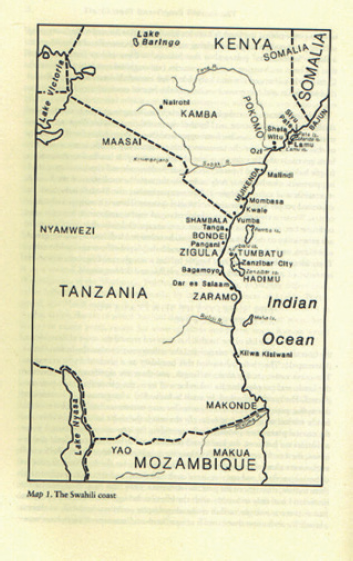
Map of East Africa
It was first colonised by Arabs during the Omani Sultanate of Zanzibar in the 19th century, and its southern half became largely a plantation economy growing coconuts with slave labour. Indigenous people were left mainly with the northern half of the island, which was less suitable for coconuts, and grew subsistence crops such as millet, as well as keeping cattle. When Germany took over Tanganyika at the end of the 19th century, Mafia was exchanged for another parcel of land close to Uganda, and so became a part of German East Africa or Tanganyika. The Germans pushed the cultivation of coconuts into the northern areas of the island, and there was a big change in the settlement patterns of the northern villages, as their inhabitants moved nearer to the coast to take advantage of the sandy soil to plant the coconut trees required (fifty trees for each able-bodied male on pain of beating for failure to comply).
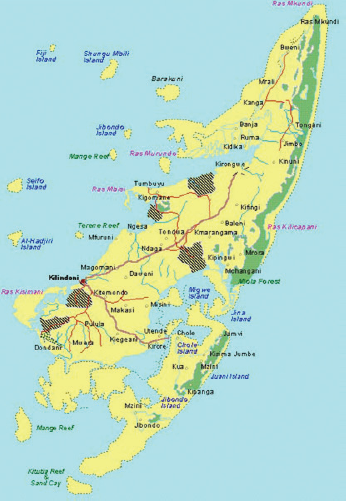
Mafia Island
b) Middle-class Households in Chennai (Madras), South India
young people – foods such as pizzas are presented as ‘modern’ and pizza parlours as places where teenagers can gather to meet their friends
mothers – certain foods are ‘good for children’ and will increase their growth or their intelligence because they are fortified with iron and/or vitamins
the middle-classes in general – these foods are well packaged and therefore deemed ‘hygienic’, unlike unpackaged and unprocessed food which may be ‘dirty’ or ‘adulterated’
Part 2. Conceptions of order and disorder: the local response to changes in food
a) Mafia Island
People today don't have enough strength because they don't eat as well [as they used to do]. The food they eat comes from all over the place, some of it's alright, but some of it isn't….
Q. So is the food which is grown here better?
A. Yes, first of all it's heavy (kizito), the other [kind of food] is very light (kinyepesi). A person has to fill their stomach, but these days people don't feel satisfied! You need two kilos of rice for five children and one and a half kilos of flour daily. Furthermore often people don't eat from their morning tea until night time.
Q. So what constitutes good food?
A. I eat cassava just to fill my stomach But the food that you really need is rice and beans. Bananas don't stay in the stomach (hazikai tumboni) and [just] to fill my stomach I eat porridge made of maize flour (unga/ugali).
Q. What about the food people eat nowadays?
A. The [imported] food has its problems – it's been around for years before it gets sold. It like medicine – you shouldn't use it after its due date [has expired]. So can it be real food?
b) Chennai/Madras City
a) Food that is imported
Q. How do people feel about so many foreign companies and multinationals coming in?
Housewife. It is no big deal. No-one goes to a shop and wonders whether something is Indian-made or foreign-made. You just pick it up [and buy it]. It doesn't matter….
Teenage Boy. People here want what people in Europe have. Previously they didn't have information about what was being sold in the US and Europe. Now they do. So why shouldn't we have a part of it? Why shouldn't we have a taste of it? That's the main thing.
Q. Are there any food issues which worry you?
Wife. No, only that we eat good and clean food.
Q. What about foreign foods which have come in - is that a good thing?
Wife. Yes, if I see it is foreign I always buy it! It must be good, [since] the standards [there] are high.
Husband (jokingly) The other side of the river is always greener!
b) Food that is hygienic
Everything in the store is packaged - nothing should appear to be touched by the fingers. We even do some of our own packaging.
Perhaps inevitably, the search for hygiene had extended to water and bottled water was by this time heavily promoted and widely available:
Q. Do you sell bottled water?
A. Yes, lots of it, the usage is increasing, because as soon as someone has an upset stomach that is what the doctors recommend.
Q. But I understand that bottled water is very expensive, it costs more than milk, doesn't it?
A. (They look at each other). It's true, it is very expensive and actually it isn't always purer than any other.
But many, especially older people, also regretted the innovations: ‘Nothing tastes like fresh home cooking’, ‘Aerated drinks are bad for health’.
Q. What foods are bad?
Housewife: Pepsi, Coke, I don't like those aerated drinks - and they have something in them, what is it? Caffeine? Yes that's right. But they insist on buying them, just yesterday I had a fight with him (son) about it. So I do buy the large bottles for the house.
I don't know if my son is going to find a girl [wife] who will be willing to cook for him in the way that I did. All the girls [women] these days are working and want convenience foods.
PC. What do you think about all these new western foods coming in?
Middle-aged woman: It is both good and bad: good that we have new things, bad that we are being exploited. Collaboration [with foreign companies] is good if we Indians hold a majority of the shares.
PC: Do you eat out?
A. Yes, we are members of the [mixed-sex residents'] club in the neighbouring suburb [which has a restaurant] and go there frequently. One of the reasons is that my husband and children like to eat chicken or fish occasionally, whereas in the house they are pure vegetarians. Also they like to have a change - different kinds of food such as Chinese (‘not cooked by Chinese, but Indian Chinese’) which are served there.
We will arrange [a] Brahmin cook on [a] monthly basis and [deliver] order[ed] meals also
Iyangar's catering…tasty, homely north and south Indian meals, home delivery, party functions orders taken.
In the latter case, the very name of the enterprise, Iyangar, which is one of the two kinds of Tamil Brahmins, signals its caste status, although its clients might well come from other caste backgrounds.
Club member. A. I know a woman who uses this daily. She is a doctor and so is her husband, the children eat at her mother's house every day, but her food comes in a tiffin-carrier at 2 p.m. so she comes back for lunch, which is ready, and whatever is left over she takes for dinner.
PC So what is that system called?
A. It's just catering, house catering.
Club member B. When we did not have a servant for two or three months we used that system. They will come and deliver; in some places you have to go and fetch it.
Click on the following links to see photo slideshows:
Conclusion – so who benefits?
Footnotes
1
Fieldwork in Tanzania has been funded by a variety of sources: the ESRC, The Worshipful Company of Goldsmiths, the University of London, the Nuffield Foundation and the Leverhulme Trust.
2
Fieldwork in Madras-Chennai has been funded by the ESRC, and the Leverhulme and Nuffield Foundations.
3
In this respect, their argument is now new. In the introduction to his book on the effects of the entry of McDonalds into SE Asia, Watson (1997) argues that people do not accept changes in food habits passively – they ‘domesticate’ new foods like those sold by McDonalds.
4
In this section I consider only the situation on Mafia; for an account of Tanzania more generally, see Bryceson 1990.
5
Under both the German and British colonial regimes, District Officers were responsible for keeping the District Book, which had information on population, customs, flora, fauna, agriculture and many other topics. The District Books are now housed in the National Archives in Dar es Salaam.
6
see Bryceson 1980, 1990 for Tanzania as a whole
7
Swadeshi – literally ‘own country’ – promulgated the view that Indians could and should be self-sufficient and should produce their own needs rather than relying on imports.
8
PL 480 (Public Law) in the US allowed for the export of American wheat (of which there was a considerable surplus) to selected recipients in return for payment in rupees, instead of dollars. The ensuing rupee money was used to support much research by US scholars in India.
9
All Tamilians have a ‘native place’ even if they do not own land, where their ancestors came from and where their family deity's temple is still located. Tamilian notions of the body include the idea that substance is derived at least in part from food and water ingested (Daniel 1984). One couple whom I interviewed in 1998 stated that they recently bought some land outside Madras in order to get rice from it, telling me ‘It is rain-fed (in Tamil ‘sky dependent’) land, but there is a good well for irrigation’.
10
The work of Finkelstein (1989) and Martens and Warde (1987) offers a comparison with the growth in eating out in the West.
11
A similar situation is discussed in Watson's 1997 collection on the impact of the entry of McDonalds into South-east Asia
12
Compare Mukhopadhyay 2004 for a similar view from Calcutta
13
There have been regular reports in the British press. See for example Paul Brown ‘Coca-Cola in India accused of leaving farms parched and land poisoned (Guardian 25th July 2003), John Vidal ‘Coke on Trial as Indian villagers accuse plant of sucking them dry’ Guardian November 19th 2003, Ari Paul ‘Drawing a line with Coke’ in Red Pepper March 2006, or Nick Mathiason ‘Coke ‘drinks India dry” in The Observer March 19th 2006.
14
Although they may be unhappy at being left alone by their children, they admit that they themselves encouraged their migration in the first place, as they wished to see them doing well in the world.
15
Notably in the writing of Vandana Shiva (e.g. 1989), Akhil Gupta (1998) and J. Scott (1990). See also the recent special edition of the Economic and Political Weekly on suicides among Indian farmers (e.g. Vaiyanathan 2006).