Bourdieu's theory of cultural reproduction has been interpreted in various ways,
and several authors have criticised an overly narrow interpretation of cultural
capital as simply consisting of ‘beaux arts’ participation. For researchers,
this raises the challenge of developing a broader interpretation of cultural
capital which is still specific enough to be operationalised. This paper
discusses the ways in which parents may transmit educational advantage to their
children through cultural rather than economic means, and the forms of knowledge
and skill which may be considered as ‘cultural capital’. An operationalisation
of cultural knowledge is discussed, and empirical evidence is presented on
differences in levels of cultural knowledge between the children of graduates
and non-graduates.
Introduction
1.1 Bourdieu's theory of cultural reproduction seeks to explain the link
between social class of origin and social class of destination in terms of the
impact of cultural capital on educational attainment. Bourdieu's theory has been
interpreted in various ways. Several authors have criticised an overly narrow
interpretation of cultural capital as simply consisting of ‘beaux arts’
participation, and have suggested that cultural capital should be seen as including
certain forms of skill and knowledge which are rewarded in the education system
(Crook, 1997, Ganzeboom, 1982, De Graaf et al., 2000, Sullivan, 2001, Lareau and
Weininger, 2003, Farkas, 2003).
1.2 For researchers, this raises the challenge of developing a broader
interpretation of cultural capital which is still specific enough to be
operationalised. If ‘cultural capital’ simply denotes skills which are rewarded
within the education system, and cannot be distinguished from ‘academic ability’,
then the argument that cultural capital leads to academic success could easily be
seen as circular. Thus, it is crucial to discuss which forms of knowledge and skill
can be seen as representing ‘cultural capital’, and to be specific about the
mechanisms through which parents may promote academic success in their children.
1.3 Furthermore, we need to consider whether, or to what extent,
schools’ rewarding of cultural capital implies that the curriculum and assessment
criteria are ‘arbitrary’, and are rigged to favour the middle class. The role of the
curriculum and assessment practices in perpetuating class inequalities in
educational attainment has been widely discussed, yet empirical evidence on these
questions has been lacking.
1.4 There are many forms of knowledge and skill (as well as other
characteristics) which are rewarded by the education system, and many mechanisms
through which parents may promote these characteristics in their children. This
poses an enormous challenge for researchers who wish to examine these processes
empirically.
1.5 Despite the substantial literature on cultural reproduction and
education, several key questions remain relatively under-researched:
What is the link between social class, cultural knowledge and attainment?
What are the means – including but not limited to cultural participation –
through which highly educated parents produce cultural capital and ‘ability’
in their children?
To what extent does the nature of the curriculum, and assessment criteria and
practices produce social class inequalities in academic outcomes?
1.6 This paper explores the implications of these questions for
researchers interested in social class inequalities in education. It discusses the
various ways in which parents may transmit educational advantage to their children,
and unpacks the forms of knowledge and skill which may be considered as cultural
capital. Focussing on the question of the link between class, cultural knowledge and
attainment, I illustrate a step towards a wider approach to the empirical
investigation of cultural capital, by presenting an operationalisation of one form
of cultural knowledge – a knowledge of the wider culture of the arts, science and
politics. More broadly, I suggest that the process of operationalising theoretical
concepts provides a discipline which is as important to theoretical development as
it is to empirical work.
1.7 Thus, the purpose of this paper is to disentangle some of the key
strands in the theory of cultural reproduction, and to clarify its central concepts,
with an eye to operationalisation, and the development of theory through empirical
research.
Cultural Capital, Status-seeking, Information Processing and Language
2.1 It is well established that some forms of cultural participation are
linked to educational attainment. Highly educated adults are more likely to
participate in cultural activities, and children's cultural participation is linked
to their success in gaining educational credentials. But there are competing views
as to the reason for the link between cultural participation and educational
attainment. Ganzeboom (1982) distinguishes between two key strands in the literature
on cultural reproduction, the ‘status-seeking theory’ of cultural consumption, and
the ‘theory of information processing’.
2.2 The status-seeking theory is based on the view that individuals
conform to social norms associated with their status, and that participation in high
culture is linked to high status. On this view, highly exclusive cultural activities
communicate status more effectively than less exclusive cultural activities, and
public cultural consumption communicates status more effectively than private
cultural consumption. So, a trip to the theatre denotes status more strongly than
reading a book.
2.3 On the ‘information processing’ theory, cultural stimuli are sources
of complex information, and people have different levels of ability to process
information, and different levels of familiarity with any given cultural field. An
individual's enjoyment of cultural participation is determined at least in part by
their ability to understand it. Ganzeboom (1982) interprets his finding of a high
level of association between cultural knowledge and cultural participation as
evidence for the view that high levels of knowledge and skill allow people to
understand and enjoy cultural stimuli, therefore making cultural participation more
likely. However, it is plausible that cultural participation also promotes the
development of cultural knowledge, which in turn allows greater cultural
appreciation, making further cultural participation more likely.
2.4 Of course, these two accounts of the link between education and
cultural participation are not mutually exclusive. It is quite plausible both that
cultural participation is more enjoyable for those with certain types of knowledge
and skill (for example, reading is not very enjoyable for people who find it
difficult), and that cultural participation communicates a certain social status.
Indeed, one could argue that cultural participation communicates status precisely
because it is generally linked to a set of knowledge and skills.
2.5 Furthermore, we can distinguish the question of whether cultural
participation communicates social status in a particular society from the question
of whether the communication of status is what links cultural participation to
educational attainment. Bourdieu (1984) describes the use of cultural tastes as a
marker of social status in France. Chan and Goldthorpe (2003; 2004) argue that forms
of cultural consumption such as the type of newspaper readership and music listened
to serve to communicate social status in England. Conversely, Lamont (1992) argues
that cultural participation and tastes are not an important marker of status for her
sample of upper-middle class men in the US. But, whether or not cultural
participation is an important marker of status in a society, the question remains
whether cultural participation is an important determinant of educational
outcomes.
2.6 Some empirical work in the field of cultural capital and educational
attainment has been implicitly based on the ‘status-seeking’ theory, in that it is
assumed that cultural capital implied participation in public and highly exclusive
activities, such as theatre and gallery attendance (Lamb, 1989, Katsillis and
Rubinson, 1990). Other authors have examined the link between young people's
cultural participation and educational attainment in greater detail, unpacking the
concept of cultural capital in order to assess which types of cultural participation
are linked to educational outcomes (Crook 1997; De Graaf, De Graaf, and Kraaykamp
2000; DiMaggio 1982; Sullivan 2001).
2.7 Crook (1997) and De Graaf (2000) break cultural participation down
into two categories ‘beaux arts’ and reading. Public and highly exclusive forms of
cultural participation, such as art gallery, theatre and concert attendance, are
categorised as ‘beaux arts’. These activities are seen as the most effective for
communicating status. In contrast, reading is a solitary activity, and is relatively
common. Reading is linked to ‘information processing’ and cultural knowledge. Both
Crook and De Graaf find that reading is strongly associated with academic success
whereas beaux arts participation is not, and infer from this that the effect of
cultural capital is due to the ‘educative resources’ such as analytic and cognitive
skills which are developed by reading, rather than to the communication of status
through participation in formal culture. However, this inference may be questioned,
since one could argue that participation in ‘beaux arts’ may contribute to the
development of skills and knowledge, or that students’ reading behaviour is as
likely to communicate status, and prejudice teachers in their favour, as is
participation in ‘beaux arts’ activities.
2.8 The cultural activities designated as ‘beaux arts’ are all public
forms of cultural participation – i.e. they take place in public spaces such as art
galleries and theatres, rather than in the home. But does the public nature of this
type of cultural participation mean that it is more effective than private forms of
cultural participation, such as reading, in communicating status? (An immediate
problem with this distinction is that reading is often done in public – on public
transport for example). People attending concerts, theatres, galleries and museums
are unlikely to be noticed in their public acts of cultural consumption. The concept
of ‘being seen’ at the theatre, for example, may have applied once, but seems very
dated now. We are more likely to make others aware of our cultural participation by
talking about it after the event than by having it witnessed at the time. And it is
just as easy to mention a book you have read as a play you have seen. People who
attend book groups make reading into a public, group activity, rather than a
private, solitary activity. Similarly, social networking websites allow people to
share their cultural tastes in a very overt and straightforward way. So, what
matters is surely not whether a particular cultural activity takes place in a public
space, but whether it can be made public, and therefore used to communicate status.
In the context of schooling, children's cultural tastes and activities may only be
discussed in certain lessons (e.g. English), so may not be something that most
teachers are strongly aware of – although they will no doubt be well aware of the
children's manner, vocabulary, styles of expression, etc. – the whole raft of
cultural signals with are generally bundled together by Bourdieuians as
‘habitus’.
2.9 Both young people's reading behaviour and TV viewing habits
(watching relatively ‘highbrow’ programmes) are significantly associated with
examination results (controlling for parents’ social class and educational level)
(Sullivan 2001). Neither public cultural consumption (art gallery, theatre and
concert attendance) nor private ‘highbrow’ music participation (playing an
instrument, listening to classical or jazz music) are linked to educational
attainment in this way. This suggests that the important distinction is not between
public and private cultural participation, but between language based and
non-language based cultural forms. Literature uses words to transmit content. The
reader absorbs not just the content, but also vocabulary and styles of expression.
The same can be said of television. Visual and musical forms, do not transmit
information as such, and do not develop linguistic fluency, which is a fundamental
skill which is rewarded within the school. And Ganzeboom's description of cultural
stimuli as sources of complex information seems less apt when applied to the visual
arts or music than to literature. A painting or a piece of music is not often a
source of information as such (unless we mean ‘information’ about itself).
Transmitting information about the wider world is the distinctive role of media
based on the written or spoken word. Without these information media (books and
other written material, TV, internet, film, radio), the individual would be confined
to a small world of limited information provided by their family, teachers and
social circle. These media provide the individual with unlimited information. The
ability to filter and process this type of information is a crucial academic skill,
as is the ability to manipulate language.
Cultural Knowledge and Ability
3.1 A recent paper by Lareau and Weininger (2003) argues that most
studies of cultural reproduction reflect a ‘dominant interpretation’ of the concept
of cultural capital, in which “researchers assume that the effects of
cultural capital must be partitioned from those of properly educational
“skills”, “ability”, or “achievement”. (p.568). This description
reflects those studies which are based on the ‘status seeking’ theory of cultural
reproduction, but does not reflect the literature described above, which explicitly
describes cultural capital in terms of educational skills, abilities and knowledge,
described in such terms as ‘information-processing’, ‘cognitive abilities’ and
‘educative resources’. Lareau and Weininger's division of research into examples of
‘dominant’ and ‘alternative’ interpretations appears to be largely based on the
methods used rather than the theoretical assumptions underpinning the research
(quantitative studies are all classified as reflecting the dominant interpretation).
Nevertheless, the point that academic ability and cultural capital cannot be readily
partitioned from one another is an important one, and raises some interesting
questions.
3.2 It seems reasonable to designate those forms of knowledge and skill
that are transmitted within the home and rewarded within the school as ‘cultural
capital’, yet the breadth of this definition is potentially problematic. If we
simply label academic ‘ability’ as ‘cultural capital’, then the claim that social
class differentials in academic attainment are due to social class differentials in
cultural capital could be seen as circular - although not entirely so, as academic
outcomes are not entirely determined by tested academic ability. The claim would of
course be entirely circular if we labelled all skills, behaviours and
characteristics rewarded by the school as ‘academic ability’. So it is important to
discuss what is meant by academic ability, and what we mean by cultural reproduction
of academic ability and academic attainment.
3.3 It is clear that parents with high levels of academic ability,
broadly defined, transmit this to their children in various ways. Academic ability
can be defined as any form of intellectual skill or knowledge which is rewarded in
academic assessments within schools and other educational institutions. Of course,
considerations other than a student's intellectual performance can affect the grades
or other rewards given by the school. Academic ability is seen as distinct from
these other characteristics and behaviours which may be rewarded in the school, such
as ‘appropriate’ behaviour in class. It will be useful to break down the concept of
‘academic ability’, since there are various skills rewarded by the school, and the
role of parents’ cultural resources in transmitting ‘ability’ may not be the same
for all forms of academic ability.
Forms of Academic Ability
Language:
3.4 Bourdieu could hardly place greater stress on the importance
of linguistic sophistication.
“Obvious in the literary disciplines but more subtle in the
sciences, the ability to manipulate academic language remains the
principal factor in success in examinations” (Bourdieu et
al., 1994 p.21)
3.5 Bourdieu may exaggerate the importance of the manipulation
of academic language in science examinations, but it is undeniable that
students who have a grasp of formal language, rather than being restricted
to informal language, are at an enormous advantage in the education system.
This recalls Bernstein's (1973) distinction between the ‘restricted code’
which is accessible to both the working and the middle class, and which is
characterised by a low level of vocabulary and limited syntactic variety,
and the ‘elaborated code’ which belongs to the educated classes, and which
has a flexibility which facilitates the expression of analytical and
abstract ideas and arguments.
Information Processing:
3.6 The ability to collect and interpret relevant information on
a given question is distinct from, but strongly related to, language
skills.
Knowledge:
3.7 The knowledge which is rewarded within the school includes
command the knowledge transmitted within the school, but also, a broader
cultural knowledge which is not necessarily transmitted within the school –
an awareness of the wider ‘dominant culture’, in terms of literature, music,
politics, art, science, etc.
3.8 Successful students also have a grasp of the ‘rules of the
game’ regarding what is rewarded within academic assessments. Bourdieu
suggests that the more vague these criteria are, and the less explicit they
are made, the more disadvantaged students who are not from the ‘cultured
classes’ will be.
“Students from the cultured classes are those best prepared…to
adapt themselves to a system of diffuse, implicit
requirements…”(Bourdieu and Passeron, 1979) p.75.
Problem solving and logical reasoning:
3.9 Problem solving and logical reasoning are often seen as
‘real’ or ‘pure’ intelligence, and as reflecting genetic endowment, as
opposed to knowledge and linguistic fluency, which are generally regarded as
being learned. In fact, there is no test that will solely capture genetic
differences without picking up environmental ones, and typical IQ tests
measure school-like learning to some degree (Fischer, Hout, Jankowski,
Lucas, Swidler, and Voss 1996). Reasoning skills (both verbal and
mathematical), can be distinguished in principle from language and
knowledge, but in practice, all tests require a degree of linguistic
competence, and a knowledge of the ‘rules of the game’ in terms of the
requirements of the assessment. In addition, logical reasoning is in itself
a learned skill.
3.10 One could add many more categories and sub-categories of
ability - ‘creativity’ for example, and talent in particular fields such as
music or sports. However, I have limited this categorisation to the core
abilities that are strongly rewarded within ‘academic’ school subjects.
Cultural Reproduction
4.1 The cultural reproduction of academic attainment may be
distinguished from economic and social reproduction. Social capital refers to
‘the set of resources that inhere in family relations and in community
social organisation and that are useful for the cognitive or social development
of a child or young person’ (Coleman, 1994)(p. 300). This includes the
attention given to the child within the home, as well as networks and norms within
the school and in the wider community. One should not ignore the role of material
resources, which can have an impact on educational outcomes in several ways.
Well-off parents have access to better schools, and additional tuition for their
children. They can afford to invest more in their children's post-compulsory
(further and higher) education. Educational resources such as a computer, a room of
one's own for study, etc. are costly. Financial resources can also have indirect
impacts on the quality of children's environments, for example, poverty leads to
stress which may affect parenting (Whitty, 2002, Duncan and Brooks-Gunn, 1997,
Mortimore and Whitty, 2000). Nevertheless, financial differences alone cannot
account for the impact that parental social class and educational level have on
children's educational outcomes (Mayer, 1997).
4.2 The transmission of educational attainment via cultural capital
takes many forms, and is not restricted to participation in cultural consumption. It
is important for researchers to distinguish between these different mechanisms, in
order to analyse their impact on educational outcomes.
4.1 Means of Cultural Transmission
4.3Cultural participation: For Bourdieu, cultural participation is
crucial to the reproduction of educational and occupational advantage.
Empirically, participation in beaux arts or public cultural activities is not
strongly associated with educational attainment, but reading behaviour appears
important. It is likely that reading behaviour both reflects a child's reading
ability and further develops this ability.
4.4Active transmission of skills and knowledge: Parents
deliberately teach their children, reading to them in the early years, and,
later on, coaching them in school subjects. Not all parents are equally aware
that these forms of help are expected by the school. In addition, parents’
ability to help effectively will be partly determined by their own academic
abilities.
4.5Passive transmission of skills and knowledge: Children
inevitably pick up styles of speech and vocabulary, though talking to their
parents, and hearing their parents talk to each other and to others in their
social circle. Hearing parents discuss particular topics will also expose them
to ideas, information, and forms of argument. These forms of passive cultural
transmission are likely to be crucial in a child's development of language and
cultural knowledge, yet have been given less empirical attention than has been
given to active transmission through activities such as reading to children.
4.6 To the extent that the active and passive transmission of skills
and knowledge from parents to children are important, we should expect a very
strong correlation between parents’ and their children's tested skills and
knowledge. In particular, given that language is transmitted in the home, and
some children are exposed to a much larger range of vocabulary at home than in
the school, we should expect a strong link between parents’ and children's
vocabularies.
4.7Attitudes, beliefs and behaviours: Parents instil attitudes
regarding work and education. It is often suggested that middle-class parents
instil their children with a particularly strong work-ethic (Saunders 1995).
Parents may instil a sense of efficacy in the child – encouraging them to view
themselves as academically able. Such attitudes and beliefs may be transmitted
actively (through conscious efforts to promote them) or passively (as children
pick up the beliefs and habits of their parents more or less unconsciously).
Attitudes, beliefs and dispositions are often termed ‘habitus’. However, this
concept of a ‘system of dispositions’(Bourdieu 1977) p.495 is vague, and does
not encourage researchers to be specific in identifying particular attitudes and
beliefs which they believe to be important. Assumptions are often made regarding
class differences in attitudes and beliefs, in the absence of empirical
evidence, so this is an area which demands further research.
4.8Social styles: Schools do not exclusively reward ‘academic
ability’, but can also reward certain social styles and behaviours, including
students’ and their parents’ styles of interaction with the school (Farkas et
al., 1990, Lareau and Horvat, 1999, Lareau, 2000, Lareau and Weininger, 2003).
It is not clear to what extent parental styles of interaction with the school
may actually affect outcomes for students. Regarding students’ styles and
behaviours within school, Farkas et. al. (1990) find that work habits have an
impact on tested coursework mastery, but work habits also have a large,
independent impact on grades awarded by teachers, independent of coursework
mastery. Thus, work habits are rewarded twice. In this study of US students,
ethnic, gender and income effects on high-school grades were largely explained
by work habits and coursework mastery[1].
4.9 This list is not exhaustive, but aims to capture some of the
main ways in which ‘cultural capital’ affects children's educational chances.
All these mechanisms may also have direct effects on individuals’ occupational
chances.
4.10 It is difficult to develop measures which can tap into these
processes, and the measures we develop will never be perfect. It might be
tempting to despair of this project, and, in particular, to reject quantitative
investigations of cultural reproduction altogether, on the grounds that
quantitative measures will only ever give us crude proxies for subtle cultural
processes. Qualitative studies can provide us with a wealth of rich detail
regarding these cultural processes, and the interactions between students’,
parents and teachers in particular local settings. However, the question of
whether cultural capital (however defined) has any impact on educational
outcomes is essentially a quantitative one. In addition, the process of
operationalising theoretical concepts such as cultural capital is very useful in
that it demands that we are clear and specific in defining these concepts.
‘Arbitrariness’, the Curriculum and Assessment
5.1 In his discussion of the ‘cultural arbitrary’, Bourdieu describes
the way that working-class attempts to appropriate higher class culture can be
treated with disdain by university teachers in France. The implication here is that
the purpose of certain academic values is to exclude certain
students from academic success. So, for example, hard work is denigrated, and there
is ‘…a tendency to prefer eloquence to truth, style to content.’(Bourdieu 1967)
p335. Bourdieu focuses on the arts and humanities departments of élite French
universities, and finds evidence of diffuse and arbitrary standards (Bourdieu 1974).
However, the extent to which these standards apply in secondary schools, and what
impact they may have on socially structured inequalities in educational outcomes, is
less clear. Also unclear is the extent to which Bourdieu is simply critiquing
particular elitist values in education, and the extent to which he is putting
forward a relativistic argument regarding 1. the basis for knowledge, 2. the basis
for the curriculum, 3. the basis for assessment criteria.
5.2 The sociological insight that academic curricula and what counts as
knowledge are social constructs, which are culturally and historically contingent,
is of course far from new (Karabel and Halsey 1977). Weber's essay on the Chinese
Literati points out the way in which dominant groups are able to define the
particular cultural knowledge that is necessary in order to be considered as part of
the ‘cultivated’ elite ‘…the pedagogy of cultivation…attempts to
educate a cultivated type of man, whose nature depends on the decisive
stratum's respective ideal of cultivation’. (Weber 1974) (P427).
5.3 Bourdieu's arguments regarding the arbitrariness of knowledge have
overlaps with the ‘new sociology of education’ of the 1970s, which proposed that
what counts as knowledge should be the central question to be addressed by
sociologists of education. This movement took a more explicit position regarding
knowledge than did Bourdieu, comparing the “dogmas of rationality and science” to
the “feudal, clerical and market dogmas of earler cultures” (Young 1971). The new
sociology of education was concerned primarily with critique rather than empirical
work, and was criticised for raising philosophical rather than sociological
questions (Pring 1972). It was also attacked from a Marxist perspective, on the
grounds that “…its relativist position with relation to knowledge…provides a
new ideological means of denying to the working class access to knowledge,
culture and science” (Simon 1976)(p. 273). Young has recently
acknowledged the force of this criticism, stating that it does disadvantaged
children no favours to structure the curriculum around their knowledge, rather than
allowing them to move beyond it[2]. Young has further acknowledged that this movement failed
to provide positive proposals regarding the curriculum (Young 1999).
5.4 Clearly, the acknowledgement that academic ability is not a ‘culture
free’ concept does not imply that the education system simply creates educational
inequalities by arbitrarily rewarding middle-class characteristics. We need to draw
a distinction between academic criteria which are elitist in the sense of being
exclusive for exclusivity's sake, and those which are universally valuable, but not
equally accessible to all classes.
5.5 As Gramsci (1971) points out, there are many reasons why the child
of a ‘traditionally intellectual’ family aquires learning more easily than the child
of a working class family, but this should not be taken to imply that the difficulty
of study is simply based on some kind of ‘trick’. Whatever abilities the education
system decided to reward, the privileged classes would be advantaged in developing
those abilities in their children. In a class society, regardless of the academic
standards applied, upper and middle class families would have greater resources at
their disposal to achieve those standards. But this does not imply that all the
abilities rewarded are arbitrary. At the most basic, literacy and numeracy are
clearly skills which people need to function in contemporary society. The ability to
gather and process information, and to reason logically are also of obvious value to
all classes in society. The fact that the education system rewards such abilities is
therefore not arbitrary. Any education system which failed to promote these
abilities clearly would have failed.
5.6 Enormous increases (up to 25 points) in average IQ have occurred
internationally in the course of one generation (Flynn 1987). Some of the largest
test score increases have occurred in tests of ‘fluid intelligence’ or
‘decontextualised problem solving’. Interestingly, Flynn notes that
‘Culturally reduced content has maximised culturally influenced
performance’ (1987:188). Efforts have been made to strip IQ tests of
obvious cultural biases (so that answering questions is not dependent on specific
cultural information, such as knowing what a regatta is, or familiarity with the
rules of chess). But it seems likely that the huge increase in scores on abstract
problem solving is linked to the fact that we live in a culture where abstract
problem solving is increasingly highly valued. In the sense that different cultures
value different abilities and skills to varying extents, no test of intelligence can
ever be completely ‘culture free’.
5.7 Kingston (2001) suggests that the criteria used in academic
assessments in the US are not arbitrary because they are linked to economic
productivity. Whereas Tawney speaks of “the disinterested desire of
knowledge for its own sake, the belief in the free exercise of reason without
regard to material results and because reason is divine…” (Tawney
1914). While economic productivity is clearly important, it should not be seen as
the only valid educational goal. Social and intellectual goals are also important
The promotion of critical thought, for example, may not be seen as economically
necessary (at least not for the whole population). It may even be seen as
unrealistic to expect the school system to promote critical analysis, as this is in
conflict with the preservation of the existing social order (Simon 1994). Yet one
can argue that critical thought is precisely what education should be about, if we
do not want to live in a society where too many people are too easily fooled –
whether by government propaganda or media scares. (For example, widespread belief in
a link between the MMR and autism can be seen as an indictment of British science
education). Similarly, one can argue that education should promote cultural
engagement, regardless of whether this makes people more (or less) economically
productive. Highly educated people have been shown to be ‘cultural omnivores’
(Bryson 1996; Longhurst and Savage 1996; Peterson 1997; Peterson and Kern 1996),
while people with lower levels of education draw from a narrower cultural palate.
Gayo-Cal et. al. (2006) find that the cultural tastes of the educated middle-class
are defined by likes rather than dislikes, while dislikes and avoidances of a large
range of cultural forms characterise the most poorly educated group. The most
culturally disengaged group disliked established high culture, but had ‘…no
alternative positive preferences to suggest some substitute vibrant popular
cultural life’ (p.219). The promotion of curiosity and cultural breadth
can be seen as worthwhile in its own right, regardless of whether it is linked to
economic productivity. So, there will always be disagreement regarding the proper
aims of the education system and how they should best be pursued. One person's clear
example of an arbitrary value will be seen as a universal value by others. Perhaps
the most we can expect is that these values should be open for debate.
5.8 The extent to which academic assessments are based on arbitrary
criteria has not been given as much attention as the related but distinct question
of teacher bias in awarding grades. There is every reason to expect that the level
of arbitrariness, as well as the level of ambiguity in assessment criteria, will
vary cross-nationally, and according to the academic subject, and the stage of the
education system in question. Arbitrariness and ambiguity may be expected to go
hand-in-hand to some extent, as the process of setting out explicit, non-ambiguous
assessment criteria, which will be externally enforced, means that assessment
criteria are open to external scrutiny and criticism. The external enforcement of
assessment criteria makes it more likely that the official assessment criteria match
the real assessment criteria. Whereas individual teachers are likely to vary in the
criteria according to which they judge coursework, external examiners have to work
to common standards. In addition, assessments by individual teachers who know their
students leave scope for direct bias. Of course, even in systems where teachers do
not determine students’ final grades, grades given throughout schooling can serve to
encourage or discourage students, and therefore indirectly affect the final outcome.
Nevertheless, we may expect to see important differences between education systems
which are primarily driven by external examinations (such as the current British
school system) and those which are primarily driven by internal assessments (such as
the US system).
5.9If we acknowledge that it is not possible to make a neat separation
between cultural capital and ability, then we also have to acknowledge that is not
possible or desirable for educational assessments to avoid rewarding cultural
capital. Even if the education system fully achieved the aims of communicating clear
assessment criteria to students, and ensuring that assessments do not reward
irrelevant student characteristics, it must be acknowledged that inequalities in
educational outcomes would remain, given the greater resources the privileged
classes can marshal in order to promote ‘ability’ or ‘merit’ in their children,
regardless of how ability and merit are defined. Theoretical contributions to this
discussion from Bourdieu and others have left very much open the empirical question
of the extent to which class inequalities may be driven by a particular curriculum
which favours the privileged classes, and could be reduced by some other sort of
curriculum. But it seems clear that class inequalities in any meaningful educational
outcome will not be reduced by attempting to remove all cultural forms which are
associated with the privileged classes from the curriculum.
Operationalising Cultural Knowledge
6.1 Operationalisation is the process of pinning down a theoretical
concept in such a way that it becomes measurable. This is obviously a necessary
process for empirical researchers who wish to engage with theory. But often
researchers are constrained by the variables available in a particular dataset, and
therefore may not consider what measures would be best suited to their purposes if
they were not subject to such constraints. At worst, this can result in crude
proxies for theoretical concepts being used in a fairly unreflexive way. The fact
that sociologists usually begin with a set of items that have been included in an
existing survey, rather than starting with a concept and trying to develop a scale
to measure this concept, is due to the importance that is placed on analysing
large-scale representative samples of the population (Heath and Martin 1997). This
is understandable, but unfortunate, because the process of operationalisation
introduces strictures which are helpful to the refinement and development of theory,
as well as to the development of empirical work. I.e. In order to operationalise a
concept, the researcher is forced to impose a degree of clarity and precision on the
concept itself. The study of cultural reproduction could particularly benefit from
this, as there is always a danger that the concepts used by Bourdieu are amenable to
becoming catch-alls, which are too flexible and all encompassing to rule anything
out or to tell us anything interesting. This section illustrates the usefulness of
the process of operationalisation using the example of a scale measuring cultural
knowledge.
6.2 Many surveys contain tests of reading and writing skills, and of
problem-solving ability/ reasoning skills. However, the area of cultural knowledge
has been neglected. There is a canon of information which any ‘educated’ person is
expected to have. Clearly what this information is is culturally specific, and will
vary cross-nationally. If a person of high social status and/or high educational
attainment gives away ignorance of this sort of information, this may well encourage
others to re-evaluate this person's status as an ‘educated’ or ‘intelligent’ person.
Conversely, a person who is of low occupational status and who is lacking formal
educational credentials can communicate their status as ‘cultured’ and ‘intelligent’
by demonstrating a grasp of the dominant culture.
6.3 I have developed an operationalisation which is intended to give an
indication of an individual's knowledge of the dominant culture. (More information
on the study is contained in appendix 1). This test is intended to assess the type
of knowledge which is expected of the ‘educated’ or ‘cultured’ person. The test
reflects the broader cultural knowledge which is not necessarily transmitted by the
school. The aim is to gauge the individual's general awareness of this wider
culture, rather than their ability to actually ‘do’ any particular subject.
6.3 The test of cultural knowledge consists of asking pupils to
categorise 25 famous cultural figures according to whether these figures are most
strongly associated with politics, music, novels art or science. The form of the
test items is shown in appendix 2. Thus, to answer the questions correctly,
respondents only needed a very basic awareness of what each figure was known for.
The figures were chosen to reflect both past and contemporary culture, and items
were pitched at different levels of difficulty in order to give a scale that could
differentiate well between individuals in the sample according to their level of
cultural knowledge. So, some figures were intended to be identifiable by practically
anyone, while others were intended to be more difficult.
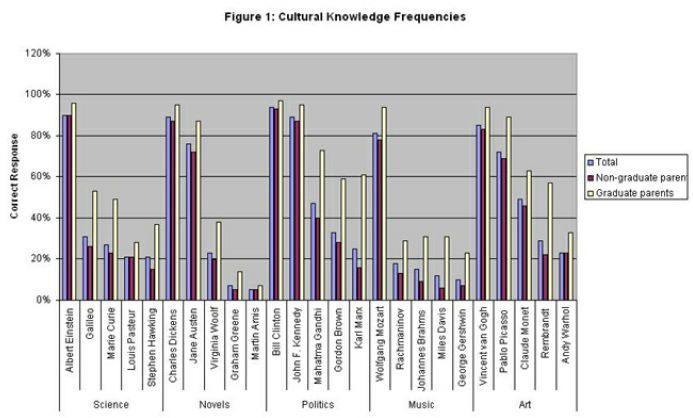
shows the level of correct responses to the cultural knowledge test, broken
down according to the educational level of the parents (graduate or
non-graduate).
6.4 While the sample is not nationally representative in all relevant
respects, the students in the sample are reasonably representative in terms of their
academic attainments. 41% of the sample gained 5 or more GCSE passes at grade C or
above, compared to 46% of the English population of the relevant age group in
1997/8.
6.5 The children of graduate parents gained a higher proportion of
correct responses than the children of non-graduates for each item on the test.
However, the gap between the children of graduates and no-graduates tended to be
least in those cases where a figure was either almost universally known, or hardly
known at all.
6.6 The level of knowledge of scientists was generally quite low, and
only Einstein could be identified as a scientist by a majority of respondents. But
the fact that one in ten respondents apparently did not know that Einstein was a
scientist still seems a little shocking, as most people would probably take it for
granted that this is something that ‘everyone knows’. The children of graduates were
more than twice as likely as the children of non-graduates to correctly identify
Galileo and Marie Curie.
6.7 The modern novelists were far less well known than the pre-20th
Century examples, Dickens and Austen. This reflects the strength of Dickens’ and
Austen's place in mainstream British culture, as they are staples of both cinema and
television adaptation. The contemporary novelist Martin Amis was the least known
figure in the study. Graham Greene is only slightly more known than Amis, despite
being an important novelist, several of whose books have been adapted for film and
TV in the past. But this is not reflected in current TV schedules or any very recent
films, and this may account for the lack of awareness of this author on the part of
the respondents.
6.8 Bill Clinton was the best known figure in the survey, with 94%
correctly identifying him. John F. Kennedy was also well known, probably due to an
eponymous film that had been at the cinema shortly before the questionnaire was
administered. Only a quarter of respondents could correctly identify Karl Marx, and
the children of graduates were nearly 4 times as likely to do so as the children of
non-graduates.
6.9 Among musicians and composers, only Mozart was correctly identified
by a majority. Miles Davis and George Gershwin were even less well known than any of
the figures associated with classical music. The example of Gershwin illustrates the
fact that ‘popular culture’ for one generation can gain obscurity and exclusivity
for later generations. The children of graduate parents were 3.5 times more likely
than the children of non-graduates to correctly identify Gershwin. However, the gap
was even wider for Miles Davis. Pupils with graduate parents were over 5 times more
likely than pupils with non-graduate parents to correctly identify him. This
reflects the status of jazz music as being outside the mainstream, and therefore not
receiving a large amount of air-time on TV or radio.
6.10 Van Gogh and Picasso were both correctly identified by a large
majority of respondents. The least known artist was Andy Warhol, who was correctly
identified by less than a quarter of respondents, despite his association with
popular culture. Of course, ‘popular’ culture can be exclusive, and ‘highbrow’
culture can be mainstream. Those elements of high culture which are so
well-established that they are promoted within the media, and become universally
accepted as good or at least ‘good for you’ inevitably lose their exclusivity.
6.11 The broad cultural knowledge examined here, in common with
linguistic fluency, is most strongly transmitted within the home rather than the
school, and yet is inevitably rewarded within the school.
“By doing away with giving explicitly to everyone what it implicitly
demands of everyone, the educational system demands of everyone alike that
it has what it does not give. This consists mainly of linguistic and
cultural competence and that relationship of familiarity with culture which
can only be produced by family upbringing when it transmits the dominant
culture.”(Bourdieu and Passeron, 1990) p. 494.
6.12 So, while explicit teaching of the dominant culture is often seen
as politically regressive, it would be naïve to think that removing this information
from the curriculum creates a level playing-field – in fact, the absence of the
dominant culture from the curriculum ensures that this culture is the sole property
of those who have inherited it within the home.
6.13 In a model of educational attainment[3] at age 16 (Sullivan, 2001), students’
cultural knowledge and vocabulary scores entirely mediated the effects of both
cultural participation and of parents’ social class and educational level. This
suggests that the development of these skills, abilities and knowledge is a
fundamental mechanism of cultural reproduction.
Conclusions
7.1 Education is a crucial mechanism of social reproduction, linking
class origins to class destinations. The professional classes are more successful
than other, less highly educated, sections of the middle class in transmitting their
occupational status to their children (Savage, Barlow, Dickens, and Fielding 1992;
Savage and Egerton 1997). There has been continued interest in the way in which
(sections of) the middle and upper classes use their cultural resources to promote
educational attainment in their children.
7.2 Much research has focused on the link between cultural consumption
and educational attainment. Ganzeboom draws a distinction between private cultural
consumption, which he links to information procession, and public cultural
participation, which he links to the communication of status. However, I have argued
that the important distinction is not between ‘public’ and ‘private’ cultural
consumption, but between verbal or literary forms which use words to transmit
content, and visual or musical forms which are not based on words. Word-based
culture is linked to academic ability, both because the skills required to enjoy
this type of culture are academic skills which are rewarded within the education
system, and because the consumption of word-based culture develops important
academic abilities, such as linguistic fluency and broad cultural knowledge. While
both word-based and non word-based culture can be used to communicate status, only
word-based culture is linked to academic ability.
7.3 Parents with high levels of cultural capital promote the development
of academic ability in their children in many ways, and participation in cultural
activities is just one of these. Most importantly, children pick up vocabulary,
styles of expression, ideas, information, and forms of argument from hearing their
parents talk. Parents also actively teach their children reading and other skills,
and pass on attitudes and beliefs. The role of these mechanisms of cultural
reproduction has been under-researched compared to the role of cultural
participation. This is an important direction for future research. Several studies
have examined the link between cultural consumption and educational outcomes in
detail, and this approach should now be applied to the examination of other
mechanisms of cultural reproduction.
7.4 The fact that cultural capital is rewarded within the education
system should not necessarily be taken as evidence for the ‘arbitrariness’ of
academic judgements. Bourdieu's discussion of arbitrary values in education is
largely confined to the arts and humanities departments of French universities, and
the role of ‘the cultural arbitrary’ within schooling, and within different academic
disciplines in different societies, has not been given much attention. The impact
that unclear assessment criteria may have on class inequalities in educational
outcomes has not been examined empirically, though the question of teacher-bias in
academic assessments has been given more attention. Nevertheless, even when
non-arbitrary values are assessed externally according to clear criteria, enormous
class inequalities in attainment remain. This further supports a focus on the
ability of the privileged classes to promote ‘ability’ in their children.
7.5 Forms of cultural capital such as a high level of linguistic
fluency, broad cultural knowledge, and a knowledge of the ‘rules of the game’ of
academic assessments are an important part of what we mean by ‘academic ability’.
Even problem solving skills are linked to cultural capital, partly because high
level linguistic skills facilitate the development of problem-solving skills. These
academic abilities can be distinguished from other styles and behaviours which may
be rewarded within the education system, such as interacting with teachers in an
approved way.
7.6 The acknowledgement that, in rewarding ‘ability’ schools are also
rewarding cultural capital presents researchers with the challenge of
operationalising both the mechanisms through which parents transmit cultural
capital, and the forms of cultural capital which are rewarded in educational
assessments. This paper has presented an operationalisation of cultural knowledge,
in terms of familiarity with the arts, science and politics. Children from
non-graduate homes had strikingly low levels of knowledge of what many ‘educated’
people sometimes unthinkingly assume is a generally shared culture. For example,
only 16% of the children of non-graduates could identify Karl Marx as being
associated with politics.
7.7 This operationalisation of cultural knowledge is intended as an
illustration of the way in which researchers can tap into a wider range of forms of
cultural capital. It also illustrates the way in which the process of
operationalisation can help to impose clarity on initially nebulous concepts.
Clearly there is an enormous amount of work yet to be done in the field of cultural
reproduction, and this paper has indicated some promising future avenues for
research in this area.
Footnotes
Data
Pupils were surveyed in their final year of compulsory schooling (i.e. year 11
students, about 16 years old) in England, in1998. The sample contained four
schools, all of which were Comprehensive. This is not a representative sample of
the year 11 population. While a large, representative sample would have been
ideal, the sample was inevitably restricted, as I was a Ph.D. student collecting
data independently. The corresponding advantage to this was the freedom of
designing the questionnaire and including rich measures of cultural capital.
A questionnaire was administered for self-completion by pupils. Pupils were not
allowed to confer while completing the questionnaire. Pupils and schools were,
of course, assured of the confidentiality of their responses.
Out of a potential sample of 557 pupils, 465 questionnaires were adequately
completed, giving a response rate of 83.5%. The majority of the non-response was
due to absenteeism. Parents’ educational credentials were determined from
pupils’ responses. Mother's or father's qualifications were selected according
to which was higher. Parents’ qualifications are missing in 122 cases.
Pupils were surveyed on a broad range of possible components of cultural
capital.
Cultural Knowledge Questions
1
‘Non-cognitive’ characteristics such as efficacy and industriousness are also
rewarded in the labour market, BOWLES, S., GINTIS, H., and OSBOURNE, M. (2001).
“Incentive-Enhancing Preferences: Personality, Behaviour and Earnings.”
American Economic Review 92 (2).
2
Debate between Michael Young and Mike Apple, Institute of Education, University
of London, 2007.
3
In the General Certificate of Secondary Education examination.
References
1.
BernsteinB.
(1973). Class, Codes and Control,
Paladin,
London.
2.
BourdieuP.
(1967). Systems of Education and Systems of
ThoughtInternational Social Science Journal,
19(3),
338–358.
3.
BourdieuP.
(1974). The School as a Conservative Force:
Scholastic and Cultural Inequalities In Contemporary
Research in the Sociology of Education (Ed, Eggleston, J.)
Methuen,
London.
4.
BourdieuP.
(1977). Cultural Reproduction and Social
Reproduction In Power and Ideology in
Education (Eds, Karabel, J. and Halsey, A. H.)
OUP,
Oxford.
5.
BourdieuP.
(1984). Distinction: A social critique of the judgement
of taste, Routledge and Kegan
Paul, London.
6.
BourdieuP.,
and PasseronJ.-C.
(1979). The Inheritors,
CUP,
Cambridge.
7.
BourdieuP.,
and PasseronJ.-C.
(1990). Reproduction in Education, Society and
Culture, Sage,
London.
8.
BourdieuP.,
PasseronJ.-C.,
and Saint-MartinM.
(1994). Academic Discourse,
Polity Press,
Cambridge.
9.
BowlesS.,
GintisH., and
OsbourneM.
(2001). Incentive-Enhancing Preferences:
Personality, Behaviour and EarningsAmerican Economic Review,
92(2).
10.
BrysonB.
(1996). “Anything but Heavy Metal”: Symbolic
Exclusion and Musical DislikesAmerican Sociological Review,
61(5),
881–896.
11.
ChanT.
W., and
GoldthorpeJ.
H. (2003). Social Status and
Newspaper ReadershipSociology Working Papers, University of
Oxford.
12.
ChanT.
W., and
GoldthorpeJ.
H. (2004). Social Stratification
and Cultural Consumption: Music in England Sociology Working
Papers, University of Oxford.
13.
ColemanJ. S.
(1994). Foundations of Social Theory,
Belknap Press, Cambridge,
Mass.
14.
CrookC. J.
(1997). Cultural Practices and Socioeconomic
Attainment: The Australian Experience, Greenwood
Press, Westport,
Connecticut.
15.
De
GraafN. D.,
De GraafP.
M., and
KraaykampG.
(2000). Parental Cultural Capital and
Educational Attainment in the Netherlands: A Refinement of the Cultural
Capital PerspectiveSociology of Education, 7392–111.
16.
DuncanG. J.,
and Brooks-GunnJ.
(Eds.) (1997). Consequences of Growing Up Poor,
Russell Sage, New
York.
17.
FarkasG.
(2003). Cognitive Skills and Noncognitive Traits
and Behaviours in Stratification ProcessesAnnual Review of Sociology, 29541–62.
18.
FarkasG.,
GrobeR. P.,
SheehanD.,
and ShuanY.
(1990). Cultural Resources and School Success:
Gender, Ethnicity and Poverty Groups within an Urban School
DistrictAmerican Sociological Review, 55127–42.
19.
FischerC.
S.,
HoutM.,
JankowskiM.
S., LucasS.
R.,
SwidlerA.,
and VossK. P. N. J.,
Princeton University Press. (1996). Inequality by Design:
Cracking the Bell-Curve Myth, Princeton University
Press, Princeton New
Jersey.
20.
FlynnJ. R.
(1987). Massive IQ Gains in 14 Nations: What IQ
Tests Really MeasurePsychological Bulletin, 101(2),
171–91.
21.
GanzeboomH.
(1982). Explaining Differential Participation in
High-Cultural Activities - A Confrontation of Information-Processing and
Status-Seeking Theories In Theoretical Models and
Empirical Analyses: Contributions to the Explanation of Individual Actions
and Collective Phenomena (Ed, Raub, W.) E.S.
Publications, Utrecht, pp.
186–205.
22.
KatsillisJ.,
and RubinsonR.
(1990). Cultural Capital, Student Achievement
and Educational Reproduction: The Case of GreeceAmerican Sociological Review,
55(2),
270–279.
23.
KingstonP.
W. (2001). The Unfulfilled
Promise of Cultural Capital TheorySociology of Education, 74(Extra Issue),
88–99.
24.
LambS.
(1989). Cultural Consumption and the Educational
Plans of Australian Secondary School StudentsSociology of Education, 62(2),
95–108.
25.
LamontM.
(1992). Money, Morals and Manners: The culture of the
French and American upper-middleclass, University
of Chicago Press.
26.
LareauA.
(2000). Social class and the daily lives of
children: A study from the United StatesChildhood, 7(7),
155–171.
27.
LareauA.,
and HorvatE. M.
(1999). Moments of social inclusion and
exclusion: Race, class and cultural-capital in family-school
relationshipsSociology of Education, 72(1),
37–53.
28.
LareauA.,
and WeiningerE. B.
(2003). Cultural capital in education research:
A critical assessmentTheory and Society, 32567–606.
29.
LonghurstB.,
and SavageM.
(1996). Social Class, Consumption and the
Influence of Bourdieu: Some Critical Issues In
Consumption Matters (Eds, Edgell, S., Hetherington, K. and
Warde, A.) Blackwells,
Oxford, pp.
274–301.
30.
MayerS. E.
(1997). What Money Can't Buy: Family Income and
Children's Life Chances, Harvard University
Press, Cambridge
MA.
31.
MortimoreP.,
and WhittyG.
(2000). Can school improvement overcome the effects of
disadvantage? Revised edition, Institute of
Education,
London.
32.
PetersonR.
A. (1997). The rise and
fall of highbrow snobbery as a status markerPoetics, 2575–92.
33.
PetersonR.
A., and
KernR.
(1996). Changing Highbrow Taste: From Snob to
OmnivoreAmerican Sociological Review, 61900–907.
34.
SaundersP.
(1995). Might Britain be a
Meritocracy?Sociology,
29(1).
35.
SavageM.,
BarlowJ.,
DickensA.,
and FieldingT.
(1992). Property, Bureaucracy and Culture,
Routledge,
London.
36.
SavageM.,
and EgertonM.
(1997). Social Mobility, Individual Ability and
the Inheritance of Class InequalitySociology, 31(4),
645–72.
37.
SullivanA.
(2001). Cultural Capital and Educational
AttainmentSociology, 35(4),
893–912.
38.
WhittyG.
(2002). Making sense of education policy,
Paul Chapman,
London.