This paper explores ‘expert’ constructions of public concerns about food within a
sociological framework. Concerns about potential risks in food have become
controversial social and political issues in Britain in recent years. This paper
reflects on these wider debates, and on sociological work on food, ‘risk’ and
science, which provide the backdrop for qualitative research studying ‘expert’
and ‘lay’ understandings of food risks. The first phase of this exploratory
research consisted of a series of ‘key informant’ interviews with a range of
‘experts’ in the arena of food. The interview data serve to ‘map out’ the key
issues in current debates about food. However, they also enable insight into the
ways different involved ‘experts’ construct accounts of public concerns about
food. From the data, several key issues and themes relating to ‘expert’ views of
public understandings and concerns about food emerged. These included, a
‘rolling issue’ of food concerns, public questioning of the origins and
integrity of food, increased involvement of ‘external people’ in food, the
extent of public understandings of microbiological food safety; public
understandings of risk in the BSE crisis, and public knowledge and acceptance of
genetically-modified food. These data set the scene for further research
directly exploring the views of food consumers. The issues and themes from the
‘expert’ accounts are being followed-up by the author through research in
progress, which seeks to uncover the range of rich, intuitive understandings of
food risks held by a diverse range of people who make up ‘the public’.
1.1 The aim of this paper is to explore ‘expert’ constructions of public
concerns about food within a sociological framework. The paper will reflect on
recent social, political and academic debates about food, ‘risk’ and science, and
draw on data from qualitative research in progress. The first phase of this
exploratory research consisted of a series of ‘key informant’ interviews with a
range of ‘experts’ in the arena of food. These individuals were drawn from groups
with the power to inform and shape social and political debate about food in Britain
today. The purpose of these interviews was to define and map out the key issues in
current debates about food. However, importantly, the data also enable insight into
the ways different ‘experts’ construct accounts of public concerns about food.
Rather than providing an ‘objective’, transparent picture of the ‘reality’ of public
concerns, these views serve as socially-constructed accounts of the way that
involved ‘experts’ see the causes of public concern about food. These data also set
the scene for further research directly exploring the views of food consumers.
Indeed, the themes emerging from these data are being followed-up by research in
progress exploring the understandings of a range of groups of ‘lay’ consumers.
Before examining some key issues and themes emerging from the accounts provided by
the food ‘experts’, the scene needs to be set. Why should sociologists study public
concerns about food?
Setting the Scene
2.1 There has been much social and political debate about the potential
hazards in food in recent years. Public debates about food safety since the 1980s,
arguably fuelled by the media, have been concerned with various ‘food scares’ (e.g.
salmonella, listeria, E.Coli O157 and BSE). Most recently, public
concern about food has focused upon the implications for human health and the
environment of the genetic manipulation of crops and foodstuffs. Food policy has
focused on food quality, safety and hygiene, and a major policy response to the
‘scares’ of the 1980s was the Food Safety Act (UK Government, 1990). The most recent
political response has been the development of a Food Standards Agency (UK
Government, 1998). The proclaimed purpose of this agency is to protect public health
by regulating and monitoring the quality and safety of British food products. The
government hopes that this agency will help to restore public confidence in the
safety of food.
2.2 Yet, public concern about food appears to continue. Articles on food
poisoning and poor standards of hygiene in the food industry continue to appear in
the popular press, for example, ‘The Guardian’ newspaper's series ‘What's Wrong With
Our Food’ (‘The Guardian’, Feb 8th-10th, 1999). Most recently, public concern has
centred on genetically-modified (GM) crops and foods, and terms such as
‘Frankenstein Foods’ (‘Daily Mail’, Thurs. Jan 28th, 1999, p.19) and ‘Mutant Crops’
(‘The Express’, Thurs. Feb. 18, 1999, p.1) have become popular. Debates have focused
not only on the safety of such products for human health, but on the environmental,
social and ethical implications of biotechnology. Currently there seem to be firmly
entrenched positions, with exponents from industry and science, and opponents from
environmental and food campaigning groups, taking deeply polarised positions on each
side of the debate.
2.3 Thus, a range of concerns about various aspects of food have emerged
in Britain in the last few decades, and the complex social and political aspects of
the everyday, apparently mundane, world of food and eating have become increasingly
apparent. Indeed, as Smith (1991) has argued, “food has become a political
issue”.
The Sociology of Food
3.1 In recent years, a surge of academic interest in food has mirrored
these wider social and political concerns. Social anthopologists have long studied
the cultural significance of food and eating practices (Richards, 1932;
Levi-Strauss, 1966). Researchers working within a psychological framework have made
a highly significant contribution to the study of public attitudes to food,
particularly focusing on perceptions of the risks and hazards associated with uses
of biotechnology in food production (Frewer et al, 1994; Frewer et al, 1996).
3.2 However, sociologists have only relatively recently recognised food
as a legitimate and important domain of study, not only belonging to the realms of
science and medicine. Some of the earliest sociological work on food is that of
Murcott (1982; 1983). The Economic and Social Research Council's (ESRC) ‘The
Nation's Diet’ programme (1992-1997) illustrates growing sociological concern with
social aspects of food choice, the results of which are reported in Murcott's (1998)
edited collection. Sociological interest in food and eating is also reflected in key
texts such as Mennell et al (1992), Lupton (1996) and Beardsworth and Keil (1997).
Therefore, sociologists are increasingly recognising that public understandings of
food, health, and food safety, are a legitimate and important area for study (Lupton
and Chapman, 1995; Keane 1997; Macintyre et al, 1998). In the light of apparent
ongoing public anxiety about the development of genetically-modified crops and
foodstuffs, some researchers have begun to examine public attitudes to this
technology. A significant example of such research is that of Grove-White et al
(1997).
A Sociological Perspective on Risk and the Public Understanding of
Science
4.1 Sociological approaches to ‘risk’ can also contribute to an analysis
of public concerns about food, as many of the debates about food hazards have been
concerned with the risks that foods present to public health, and in the case of
gentically-modified foods, to the environment and wider society. ‘Risk’ is a concept
which has been much theorised within sociology (Beck, 1992). Underpinning
sociological research is the premise that risk is socially-constructed and
collectively perceived (Gabe, 1995). Risk is seen as subjective and social: “the
perception of risk is a social process” (Douglas and Wildavsky, 1982, p.6). This
sociological perspective, with its emphasis on the value of interpretative
methodology and qualitative methods for uncovering the varying meanings of ‘risk’,
informs and shapes the analysis of food concerns reported in this paper.
4.2 Close parallels to this work on risk exist in sociological studies
of the public understanding of science, which also have relevance for this research
on ‘expert’ constructions of food concerns. Sociologists have criticised the
scientific approach which suggests a ‘deficit view’ (Millar and Wynne, 1988) of
public understanding of science, and have pointed to the rich, intuitive, subjective
knowledge and ‘lay expertise’ about science and risk among the public (Otway, 1992;
Irwin and Wynne, 1996). They have also questioned the assumed superior status of
‘expert’ scientific knowledge, arguing for the social basis of all knowledge, and
the inherent uncertain and incomplete nature of science (Wynne, 1992). Following
this perspective, the partial, negotiated and socially-constructed nature of the
‘expert’ accounts provided in this paper are recognised.
4.3 Therefore, it is within wider social and political debates about
food, and a broad sociological framework on food, risk and public understanding of
science that the research reported in this paper falls. Having set the scene, a
sociological analysis of ‘expert’ views of public concerns about food will now be
outlined, drawing on interview data from ‘key informants’ in the arena of food. Some
broad themes and early analytical thoughts drawn from these interviews will be
mapped out to illustrate public concerns about food as constructed by a range of
‘experts’.
The ‘Key Informants’
5.1 The sample was designed to allow access to a range of ‘expert’
opinions on food issues, and thus individuals were drawn from a variety of
organisations involved in shaping social and political debate about food. A broad
definition of the term ‘expert’ was used, including both those traditionally seen as
experts, e.g. scientists, and those not traditionally seen as such, e.g. pressure
group campaigners. A range of ‘interests’ were represented, including those who
might be seen as ‘pro’, ‘anti’ or ‘independent’ in relation to scientific or
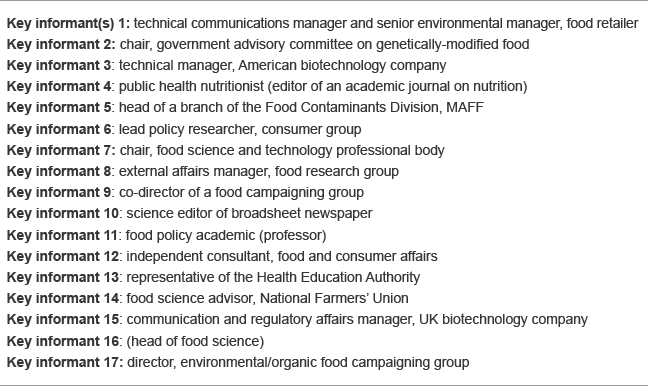
industry developments. Therefore, the final sample included seventeen key informants
who served as representatives of government/statutory bodies, the food and
biotechnology industry, nutrition and food science professionals, and various
non-governmental organisations, including consumer and campaigning groups, and the
media (see figure 1).
Key informants
The Interviews
6.1 The interviews were carried out between November 1998 and January
1999. Each interview lasted between 45 minutes and 2 hours, and covered a general
introduction to the ‘world of food’, followed by more in-depth discussion relating
to topic areas such as microbiological food safety, BSE, and genetically-modified
food. Within these topic areas, several broad issues were covered, which included
the communication of information to the public, public understandings of these food
issues, and key policy developments. To summarise the analysis of the data, the
interview transcripts were read individually several times, and coded for the key
issues and emerging themes. They were then compared to draw together the common and
diverging perspectives across the range of informants.
6.2 This paper will focus on ‘expert’ views of public understanding and
concern about food, particularly in relation to microbiological safety, BSE and GM
food. Differing perspectives as to the nature and extent of public knowledge will be
presented, and attention given to the varying social and professional backgrounds of
these ‘expert’ views.
Public Concerns about Food: Some ‘Expert’ Views: A ‘Rolling Issue’ of Food
Concerns
7.1 The key informants highlighted what they saw as a range of public
concerns about food in recent years, and there was great consensus among informants
from a variety of backgrounds as to the nature of these concerns. Many felt that
these different food matters were not discrete but inter-connected, comprising a
‘rolling issue’, beginning with public anxieties about food additives in the early
1980s and culminating with current concerns about genetically-modified food:
The first example was the famous ‘E for additives’ story…The second trend is
safety…we had…food poisoning outbreaks, and the last and the ultimate case of
this is BSE…The next one…that is very live, current and active, is genetic
manipulation, and this scenario is still very much unfolding (food
producer)
It's been one thing after another…I don't see it as discrete issues of food
safety. I see it as a rolling issue (food policy academic)
7.2 Several informants pointed to the key role of these various food
‘scares’ in recent years, which in their view have initiated a ‘sea change’ in
public attitudes to food and increased consumers’ questioning of the quality and
safety of food in this country:
there's been a number of scares…(and) people began to think to themselves, “Is
our food safe to eat?” (National Farmers Union)
there has been a sea change in public attitudes towards food safety and food
quality collectively as a result of the food scares…the public are asking a
series of questions that they were never asking before. “Where has my food come
from?” “How did they produce it?” “Did they look after food safety and quality
aspects?” (organic food pressure group)
7.3 However, in contrast, a minority of the informants suggested that
while the various food ‘scares’ might have initially increased public concern about
food, the continued attention to food hazards, particularly in the media, has
contributed to a growing complacency and ‘food scare fatigue’ among the public:
we seem to have a complacency now about food scares in the UK…I think the public
have got food scare fatigue…the media likes to make it their headlines, but the
public are much too sanguine about it now (independent consultant on
food and consumer affairs)
there's been so many of these little mini food scares, that in an odd way it's
kind of desensitised people. I think they find them amusing to read, but
ultimately I think they don't believe them (newspaper science
editor)
‘What have ‘they’ done to our food?’: questioning the origins and ‘integrity’ of
food.
8.1 As part of the perceived collective shift in public attitudes to
food identified by many of the informants, a key aspect highlighted by several was
growing public suspicion about the origins or ‘integrity’ of food. This was seen to
have developed from concerns about issues such as salmonella and BSE, and most
recently exemplified in worries about genetic modification.
people want to know questions about where is it from, where has it been
produced…I think there's just an enormous curiosity about all aspects of food
from that point of view, it's origins, it's integrity, that we just didn't have
before BSE, before salmonella and listeria… Certainly genetic modification, that
goes back to the integrity of the food (food retailer)
8.2 For several of these informants from varying backgrounds,
underpinning this perceived increase in public questioning of the sources of food
was unease about fundamental changes in the nature of food production. They felt
that there is a growing realisation by consumers of their diminishing control over
food and the means by which it is produced:
the debate about additives articulated for the first time about food safety a
rumbling unease about changes in the nature of food production…(and) about what
have “they” done to our food…What has been happening in the last twenty years is
a realisation that they don't control their food…they don't know much about what
it is (food policy academic)
8.3 Therefore, these ‘experts’ constructed consumers’ greater
sensitivity about food in recent years as being a result of increased separation
from the ‘reality’ of food production. In their view, people have become divorced
from how food is grown and reared. Many identified broader societal and lifestyle
changes, particularly increased urbanisation, as the cause of this separation, which
they felt has led to decreased public knowledge about the methods by which food is
produced:
We're not a rural nation, we're very very urbanised.. that has helped to provide
a bigger gulf between people's cosy expectations…what we think we want the
countryside to look like and how it should produce our food, to how reality is
(food retailer)
most people don't really know much about how food is made, how farms run…We've
become divorced from the countryside, where our food comes from
(National Farmers Union)
Increased involvement of ‘external people’ in food: who can you trust?
9.1 Paralleling the perceived separation of consumers from food
production, several informants from a range of backgrounds highlighted what they saw
as the increased involvement of other ‘external’ people (industry and science) in
the provision of food. Industry was seen to have taken over the majority of food
production, resulting in less ‘natural’ food and a reduction of public knowledge
about what is involved in making food. Thus, these informants felt that consumers
have become increasingly dependent on outside ‘experts’ for their food:
people are becoming more and more detached from the way that food is produced…to
some extent it's due to a greater involvement of industry in packaging and
processing and changing the form we get our food in…I think that has generally
given people less and less knowledge of what is involved in their food…People
have become more reliant on external people (American biotechnology
company)
9.2 Bound-up with this increased involvement of ‘others’ in the
provision of food, a concurrent yet conflicting development identified by many
informants was the perceived decline of public trust in ‘experts’ to adequately
inform consumers about their food and protect them from food safety problems. For
some, this was seen to be an outcome of the various food ‘scares’. Public trust in
government, the food industry, and science was felt to have been undermined and
damaged by a series of problems related to food safety and food technology:
public trust has been severely challenged and threatened, and members of the
public have been appalled and shocked to realise that civil servants within
government (and) their political masters can't be trusted to deal with the
information that they're given, that they're too interested in their own ends
(food retailer)
there's a lack of trust, public trust, in the way the systems protect people
(independent consultant on food and consumer affairs)
9.3 Furthermore, several informants felt that the handling of one food
issue colours and shapes public perceptions of ‘expert’ claims about other food
concerns. For example, the declining trust in scientists as a result of the BSE
crisis was perceived to have spilled over into a lack of public trust in scientists’
resassurances about the safety of genetically-modified foods:
people now think that they can't trust scientists, because BSE was a major
disaster…The public's view is that we scientists are not capable of giving good
and sensible advice, and therefore if we say that there might be a risk, they
should assume there will be, and that's very difficult to overcome
(government advisory committee on GM food)
9.4 However, while public trust in traditional authority figures like
the government and scientists was seen to have declined, many informants felt that
the ‘whistle-blowers’ in these food safety ‘scares’, such as food campaigning
groups, have maintained public confidence and credibility. Some informants felt this
to be because of a public perception that, unlike the government and industry, these
groups have no ‘hidden agendas’ regarding food:
the public seem to trust campaigning groups more than anything…they're inevitably
going to be seen as the whistle-blower…People don't feel campaign groups have a
hidden agenda…the supermarkets must have a commercial agenda, the government
with BSE…was seen as protecting the (farming/industry) lobby.. (whereas) the
agenda for campaign groups is to highlight what we want to know, so there isn't
any hidden agenda in the public's mind (food retailer)
Microbiological Food Safety: Poor Public Understanding?
10.1 Several informants discussed public understandings and concerns
about microbiological safety (e.g. salmonella, listeria) in particular, and many of
them pointed to what they saw as a general decline in public knowledge about food
safety and hygiene. Practices that were known and passed on by previous generations
were seen to have been eroded because of the movement away from a rural society and
developments in technology such as food refrigeration:
we've grown away from an understanding at the rural level…understanding the
spoilage and storage characteristics of not having a fridge…of cooking your meat
until it's totally and thoroughly cooked…that were simply passed down from
generation to generation…they've really all gone because of changes in lifestyle
and changes in eating habits (food research group)
10.2 Informants who were food scientists and technologists in particular
held this view relating to poor public understanding of food safety. In their view,
consumer concerns arise from a basic misconception about the nature of food itself
as potentially ‘dangerous.. biological material’. These informants pointed to the
need for better education of consumers in food hygiene practices:
the knowledge of food hygiene and the practice of food hygiene by people in
general is nothing like it ought to be (food science/technology
organisation).
eating food is intrinsically dangerous. Food is biological material, it's not
stable against microbial attack…Our forebears knew this very well…(but people)
began to lose that intrinsic knowledge…(it has) sort of dropped out of the
educational awareness of a lot of people. So, the industry now is having to go
back and say “We need to go back and teach people about the basic rules of food
hygiene” (food producer)
10.3 However other informants, especially those from campaigning groups,
were highly critical of a ‘blame the victim’ approach to public understandings and
concerns about food safety. They argued that a focus on consumer hygiene and the
emphasis on poor public knowledge masks key structural problems inherent in the food
chain:
people are well aware…that one in two chickens carries salmonella, or whatever
the figures are…It very quickly becomes apparent that it isn't the individual's
fault, and most people make that connection, that they're being sold rubbish
(food pressure group)
there are problems of food safety and they are structural, they are to do with
changes in the nature of production, they are to do with incompetencies in the
food supply chain (food policy academic)
10.4 Therefore, these informants pointed to what they perceived as a
growing public awareness of the role of modern intensive farming and food production
methods in causing food safety problems. Concurrent with this, they pointed to an
increase in public demand for organically-produced food, which they felt was
perceived by the public to be inherently ‘safer’:
Organic food…there's a perception that it's safer, that there's less pesticide
residues, that it's better for you (organic food pressure
group)
BSE: did the public understand the risks?
11.1 In relation to the BSE crisis, many of the informants talked about
the issue of ‘risk’, expressing a range of opinions as to the ability of the public
to understand such information. For some, the whole risk issue was seen to be so
complex that not even ‘world experts’, let alone the public, are able to fully
understand it. One informant openly acknowledged her own difficulties in
comprehending the complexities of risk in relation to BSE, and thus the arbitary and
fluid nature of the boundaries between public and ‘expert’ knowledge emerged:
it has been impossible for the public to get a good handle on the whole
beef-on-the-bone business…Before, the risk was zero, but now we're being told
that it's one in however many million, and we don't have the structures, or the
tools, or the intellectual capacity to really assess what that means for us…It's
an incredibly complex area…Even some of the world experts grapple with the same
problems (independent consultant on food and consumer
affairs)
11.2 However other informants, particularly those from a campaigning
background, felt that the public had obtained a fairly good understanding of risks
in the BSE crisis. One informant felt that the traditional scientific risk
assessment approach using ‘levels of risk’ was not appropriate in the case of BSE.
Public understanding and concern was seen not to be ‘out of proportion’ to the
severity of the problem. Rather, in his view, people had grasped the ‘big picture’
about BSE, showing a ‘more sophisticated’ range of understandings of the complexity
of the issues involved:
You can say about BSE only 29 people have died, therefore it's no risk. (But) I
think the public was absolutely right to be deeply angry…I think there was a
much more sophisticated range of positions…Using the levels of risk approach,
you could say “Well it was only 29 deaths, who cares? It is peanuts compared to
coronary heart disease, a hundred and sixty thousand a year…you've got it out of
proportion”. No they haven't…The public saw the big picture.. It was pretty good
understanding (food policy academic)
11.3 From a similar perspective, a pressure group representative also
gave credit to public understandings about BSE. This informant felt that the public
were able to understand and accept the idea of qualified risk which took into
account the limits of scientific knowledge about BSE. However, the public were seen
to have been given simplified and ‘politically unqualified’ information because of
the agendas of politicians and the meat industry during the BSE episode:
people are able to comprehend the idea of a qualified risk.. that says “As far as
we know” or “The number of cases has been” or “We estimate the risk to
be”…People can understand that information and it certainly doesn't need to be
simplified by politicians unless they have another agenda. In the case of BSE,
there was another agenda, to do with the preservation of the meat trade, which
did shape the way that statements got changed from scientifically qualified ones
to politically unqualified ones (food pressure group)
11.4 For several of the informants from a range of backgrounds, a key
issue relating to public concerns about BSE was the extent to which consumers had
been enabled to make an ‘informed choice’ about the risks of eating beef. In their
view, many members of the public had opposed the government's ban on
beef-on-the-bone because of a sense of disempowerment to make a free choice about
the risks. For these informants, consumers’ views approximated to ideas about a
‘Nanny State’, and they felt that most people would have preferred to have been
informed of the ‘risks’, and then left to make their own choice about eating
beef:
When the beef-on-the-bone ban came in, a number of people said, “Why wasn't I
given the choice?.. Let me know what the risks are, but I will choose what to
eat. Who are you to decide what I eat?” (food retailer)
Suddenly people realised this was going too far, thay wanted a choice, and they
thought the risk was so infinitessimal, in their view, that perhaps it wasn't
necessary” (National Farmers’ Union).
(During) the beef-on-the-bone incident.. the government said “We're doing this
for the good of the British people”, (but) most people said “This is ludicrous,
the risk of getting BSE from this is very low, so why are we doing this”
(newspaper science editor).
11.5 Therefore, for several informants from a range of backgrounds, BSE
respresented a ‘watershed’ in public attitudes to food safety, risk and food
‘experts’.
BSE, is the last time that the consumer will allow a deligated body, be it
government or industry, to tell them reliably that things are safe…Consumers
views have been damaged by the inability of these professionals…to defend it
against all risk…I think that really represents a watershed in the way that
consumers in the UK, their attitudes to risk and safety occurs (food
producer)
Genetically-modified food: public understanding and acceptance
12.1 In relation to recent developments of genetically-modified crops
and foods, the majority of the informants from varying backgrounds identified what
they felt was a fundamental lack of knowledge among the public about the technology.
For several informants, this perceived public ignorance was related to a basic lack
of knowledge of science. This general absence of scientific education among the
public was seen to lead to difficulty in comprehending the concepts of biotechnology
and the inability to assess the risks in genetically-modified foods:
there is an enormous level of ignorance about what can and cannot be done (in
genetic modification) (independent consultant on food and consumer
affairs)
most members of the population are extremely ignorant about science…They don't
know anything about biology…Biotechnology.. is quite a difficult concept…People
are uncertain about what's really involved (National Farmers
Union)
the public doesn't understand the risk in GMOs, and naturally say, “If I don't
understand it, I don't want anything to do with it. Stop. Wait until I
understand and catch up, and then we'll assess what we can and can't do
(food producer)
12.2 Therefore, many of the informants highlighted what they saw as a
fundamental relationship between knowledge of the technology and acceptance of its
application in crop and food production. They felt that it is this lack of public
understanding which has led to caution and opposition among the public about GM
food. For those informants who were scientists, the solution to this public
opposition was greater public education about biotechnology. However, some
acknowledged the complexity of the relationship between knowledge and acceptance by
highlighting that a certain amount of education leads to greater public concern, and
only a great deal of knowledge resolves people's anxieties about biotechnology:
(The public) know very little (about biotechnology).. and therefore they are
nervous.. Perhaps lack of knowledge is a process that generates caution
(National Farmers Union)
the understanding is limited…Industry is hoping that a little bit of education
will help, (but) when you tell people a little they get more worried, when you
tell them quite a lot they get more worried. It's only when they know a great
deal that they can begin to have a more balanced approach (government
advisory committee on GM food)
12.3 Thus, for many of the informants, public understandings of
biotechnology consisted mainly of greater awareness but not deep understanding. They
felt that public concern and suspicion about GM food is based on ‘snippets of
information’. In particular, many of the informants expressed the view that consumer
concerns were based on a fundamental wariness of an ‘unnatural’, ‘weird’ technology,
which was seen to scare people:
I think there's higher awareness, but I'm not sure that there's much deep
understanding out there (newspaper science editor)
(There is) deep suspicion about GM food…they have snippets of information…and by
and large they don't like what they see…It's the weirdness of it all…the
abilities to cross species gives a whole new realm of tampering to those who
produce our food…These are the scary things, and these are the things that worry
people (food pressure group)
people feel it is unnatural to messing about with genes, so they feel wary about
it even if they can't necessarily explain why they feel wary about it
(consumer group)
12.4 However, for other informants, both from the biotechnology industry
and ‘independent’ organisations, the public were seen as ‘victims’ of
mis-information. In their view, rather than lacking the ability to understand
biotechnology, people are only able to make judgements about the acceptability of GM
food based on the information they are given, which they felt to be often
innaccurate:
the public are very much smarter than they're credited for.. (They) make very
sound and rational decisions, but it's based on the information they've been
given…I think they're just victims of the information they've given….which is
deliberately designed to mis-lead them (American biotechnology
company)
there's a lot of myths and scaremongering going around, which doesn't do anyone
any good (independent consultant on food and consumer
affairs)
12.5 For the informants from pressure and consumer groups, public
understandings and concerns about genetically-modified foods were seen to be related
to worries about the processes of testing, regulation and approval of the crops and
products. Specifically, the public were seen to be anxious regarding the long-term
consequences and implications of the techology:
people are concerned about the way that (GM foods) are approved…they are
concerned about not knowing what the long term consequences are going to be and
that you're messing with something that you don't really know about
(consumer group)
the things that worry people (are) that there is tampering going on without
sufficient testing (food pressure group)
12.6 However, for an industry representative, this public concern was
unfounded because it was seen to be rooted in a lack of understanding of the extent
and nature of regulation of biotechnology:
People don't realise how much, and what kind of regulation there is
(American biotechnology company)
12.7 Overall, the broad picture of public understandings about
biotechnology and genetically-modified foods given by the informants was that of a
fundamental need for greater knowledge and understanding of the issues by all of
society, due to the inevitability and pace of change of the technology:
as a society we need to come up to speed with understanding and grappling with
these issues…We can't stop biotechnology, that would be like trying to stop ice
from melting in the sun.. The rate of change.. is something that as a society we
are really being confronted with for genetic modification (food
retailer)
Concluding thoughts: a sociological and personal perspective on food
concerns
13.1 This paper has presented a range of ‘expert’ views of public
concerns about food. Several key issues and themes have been outlined, namely a
‘rolling issue’ of food concerns, public questioning of the origins of food,
increased involvement of external people in food production, the extent of public
knowledge of microbiological safety, public understanding of the risks of BSE, and
public knowledge and acceptance of genetically-modified (GM) foods. The accounts
provided by these ‘experts’ have shown consensus about certain key issues. For
example, the majority of informants expressed the view that recent public concerns
about GM foods have emerged from, and are closely intertwined with, other anxieties
about food and the methods of food production, e.g. chemical additives,
microbiological safety and BSE. However, varying opinions as to the nature and
extent of public understandings about these issues were expressed. Following a
sociological perspective on the status of ‘expert’ knowledge, the partial,
negotiated, and socially-constructed nature of these accounts must be recognised.
Yet, they raise important issues which set the scene for further sociological
investigation directly examining consumers’ views. The ‘expert’ constructions of
public concerns about food presented in this paper also carry wider implications for
the sociological study of food, ‘risk’ and science.
13.2 The ‘expert’ accounts concur with sociological perspectives on food
which point its complex social and political aspects. These ‘experts’, particularly
those from food and environmental campaigning perspectives, viewed public concerns
about food as being far more rich and diverse than worries about health risks. On
the basis of their accounts, it appears that public understandings of issues such as
microbiological safety, BSE and GM food may carry with them many wider questions
relating to the nature of society, the environment, the food chain, science and
technology, industry, politics, and the complex relationships between these.
13.3 This research also carries implications for the sociological study
of risk. According to these ‘experts’, the communication of risk in the BSE crisis
was perceived by the public to be influenced and shaped by political, farming and
industry ‘agendas’. Some informants, particularly the scientists, talked about risk
in technical terms, therefore viewing public (and indeed ‘expert’) understandings of
BSE risks as limited. However, others, particularly those from a campaigning
perspective, saw risk as a much broader social and political concept, and credited
the public as seeing the ‘big picture’. These differing accounts bear reflection in
the light of a sociological perspective which conceives of risk as both
subjectively-perceived and socially-constructed.
13.4 The ‘expert’ views presented here also have implications for the
sociology of scientific knowledge. The majority of the informants from a scientific
background presented the traditional scientific position of poor public knowledge of
microbiological safety, BSE and GM food. However, this was contested by those from
consumer and campaigning groups. The merits of these differing pictures of public
understanding need to be examined further through research directly exploring
consumers’ views. Such research, currently in progress by the author, may challenge
the ‘deficit’ view of public knowledge, and uncover the range of rich, intuitive
understandings possessed by a diverse range of people who make up ‘the public’.
13.5 Finally, this sociological analysis of food concerns perhaps
carries personal implications. As two informants in the research succinctly phrased
it, “We are all experts on food”, “food is the stuff of life, we all have to eat”.
The famous maxim declares “You are what you eat”. Yet, if these ‘expert’ views of
ongoing public concerns about food, its origins, and the methods of production are
to be taken seriously, then the phrase “You are what ‘they’ give you to eat” perhaps
becomes more appropriate. If this is the case, food concerns are surely worth not
only sociological investigation, but careful personal reflection.
References
1.
BEARDSWORTHA.,
and KEILT.
(1997) Sociology on the Menu,
Routledge,
London.
2.
BECKU.
(1992) Risk Society,
Sage,
London.
3.
DAILY MAIL,
(1999) ‘Gene Switch Foods Could Open Door to
Superbugs’,Thurs. January 28th, p. 19.
4.
DOUGLASM.,
and WILDAVSKYA.
(1982) Risk and Culture,
University of California Press,
London. p. 6
5.
FREWERL.,
SHEPHERDR.,
and SPARKSP.
(1994) ‘Biotechnology and Food Production:
Knowledge and Perceived Risk’, British Food
Journal, 96,
26–33.
6.
FREWERL.,
HOWARDC., and
SHEPHERDR.
(1996) ‘Public Concerns in the United Kingdom
about General and Specific Applications of Genetic
Engineering’, Science, Technology and Human
Values, 22,
98–124.
7.
GABEJ.
(1995) (ed) Medicine, Health and Risk,
Blackwell,
London.
8.
GROVE-WHITER.,
MacNAGHTENP.,
MAYERS., and
WYNNEB.
(1997) Uncertain World: Genetically Modified Organisms,
Food and Public Attitudes in Britain,
Lancaster:
CSEC.
9.
IRWINA., and
WYNNEB.
(1996) ‘Introduction’, In
IrwinA.,
WynneB.,
Misunderstanding Science? The Public Reconstruction of Science and
Technology, Cambridge University
Press,
Cambridge.
10.
KEANEA.
(1997) ‘Too Hard to Swallow? The Palatability of
Healthy Eating Advice’, In
CaplanP. (ed)
Food, Health and Identity,
Routledge,
London.
LUPTOND.
(1996) Food, the Body and the Self,
Sage,
London.
13.
LUPTOND.,
and CHAPMANS.
(1995) ‘“A Healthy Lifestyle Might Be the Death
of You”: Discourses on Diet, Cholesterol Control and Heart Disease in the
Press and Among the Lay Public’,Sociology of Health and Illness,
17(4)
477–494.
14.
MACINTYRES.,
REILLYJ.,
MILLERD., and
ELDRIDGEJ.
(1998) ‘Food Choice, Food Scares, and Health:
The Role of the Media’ In
MurcottA.
(ed) The Nation's Diet: The Social Science of Food Choice,
Longman,
London.
15.
MENNELLS.,
MURCOTTA.,
and Van OTTERLOOA.H.
(1992) Sociology of Food: Eating, Diet and
Culture, Sage,
London.
16.
MILLARR.,
and WYNNEB.
(1988) ‘Public Understanding of Science: From
Contents to Processes’, International Journal of
Science Education, 10(4)
388–398.
17.
MURCOTTA.
(1982) ‘On the Social Significance of the
‘Cooked Meal’ in South Wales’, Social Science
Information, 21(4-5)
677–695.
18.
MURCOTTA.
(ed) (1983) The Sociology of Food and Eating,
Gower Publishing.Co.Ltd:
England.
19.
MURCOTTA.
(ed) (1998) The Nation's Diet: The Social Science of Food
Choice, Longman,
London.
20.
OTWAYH.
(1992) Public Wisdom, Expert Fallability: Toward
a Contextual Theory of Risk, In
KrimskyS.,
GoldingD.
(eds) Social Theories of Risk, Praeger
Pub.: Westport
CT.
21.
RICHARDSA.
(1932) Hunger and Work in a Savage Tribe,
Routledge,
London.
22.
SMITHM.J.
(1991) ‘From Policy Community to Issue Network:
Salmonella in Eggs and the New Politics of Food’,
Public Administration, 69, Summer,
235–255.
23.
THE EXPRESS,
(1999) ‘We Can't Control Mutant
Crops’,Thurs. Feb.18, p. 1.
24.
THE GUARDIAN,
(1999) ‘Up to One in Five Chickens or Turkeys
Contaminated’,Mon. Feb. 8th, p. 7. THE GUARDIAN (1999)
‘Nightmare Shift at the Chicken Gulag’, Tues. Feb. 9th, p.4. THE GUARDIAN (1999)
‘Wounds Still Raw as Legacy of Deadly Food Bug Haunts Stricken Community’, Wed.
Feb. 10th, p.6.
25.
UK GOVERNMENT,
(1990) Food Safety Act,
HMSO,
London.
26.
UK GOVERNMENT,
(1998) The Food Standards Agency: A Force for
Change, HMSO:
London.
27.
WYNNEB.
(1992) ‘Misunderstood Misunderstanding: The
Social Basis of Expert Credibility’, Public
Understanding of Science, 1(3)
271–294.