The aim of this article is to describe the Class Race and Gender (CRG) Research
Programme. The CRG research programme aims to explore the development of
consciousness in South Africa, to understand how we come to be the black and
white, rural and urban, rich and poor and men and women who make up our
stratified and differentiated society and to identify and assess the impact of
changes over time. This complex problem is being investigated through a study of
class, race and gender identity formation in the first generation of children
entering the new, compulsory education system. This article specifically tries
to document the research process; its methodology and the instruments which were
used and developed in order to engage with the issues under investigation. The
article also tries to explain the rationale informing the choice of the sample
and methods and describes how these research methods were implemented. Research
with people is always interactive and reflexive, even if the researchers do not
concern themselves with what the research might contribute to respondents. Yet,
in questions there are ideas and information which people think about and learn
from. Research is or can be a learning process for respondents. For respondents
(and researchers) there is a continual tension between the limits of research
(finding out) and the possibilities of intervention (acting out).
Introduction
1.1 The aim of this article is to describe the Class Race and Gender
(CRG) Research Programme, more specifically to document the research process; its
methodology and the instruments which were used and developed in order to engage
with the issues under investigation. The article also tries to explain the rationale
informing the choice of the sample and methods and describes how these research
methods were implemented.
1.2 The CRG Research Programme is an interdisciplinary research project
bringing together specialists from Sociology, Psychology and Dietetics and is based
at the Community Agency of Social Enquiry (CASE), Pietermaritzburg and the
University of Natal, Pietermaritzburg. The aim of the programme is to explore the
development of consciousness in South Africa, to understand how we come to be the
black and white, rural and urban, rich and poor and men and women who make up our
stratified and differentiated society and to identify and assess the impact of
changes over time. This complex problem is being investigated through a study of
class, race and gender identity formation in the first generation of children
entering the new, compulsory education system.
1.3 The research team is led by Prof. T. Marcus, together with two other
principal investigators Prof. E Maunder (Department of Dietetics and Community
Health) and Ms B Killian (Department of Psychology). Prof Ben Parker and Mr Volker
Wedekund (Department of Education) participated in the conceptual process, but were
forced to withdraw from the programme due to pressure of work. The team also
included three doctoral, four masters, one honours and several post-graduate diploma
students working in the fields of gender, race, transport, locality and place, self
esteem and anthropometric indicators.
Study Design
2.1 The concept of the study is to follow grade one entrants as they
progress through the ten years of compulsory schooling, beginning with the 1997
intake. Empirical investigations are to be done with them in grade one, grade four,
grade seven and grade nine which is the final year of compulsory schooling. In
addition, each field work episode will study pupils who are in their sentinel
grades. Thus, it is intended that pupils in all four grades are studied every time
new empirical work is carried out, and the timing of new empirical work is
determined by expected or actual passage of the new entrants into the next sentinel
grade. While there is likely to be overlap between grades four and seven, the only
intentional follow through will be conducted with the 1997 grade one cohort.
2.2 Given constraints in both human and financial resources, and to
ensure that the programme remains manageable, the study does not extend back into
the children's homes nor does it engage with the teachers and curricula which make
up the schooling environments.
2.3 The study is sited at ten schools - five primary and five high
schools - within a radius of 45 kilometres of Pietermaritzburg. The schools were
selected because of their locations; both with respect to their physical places and
the communities and people they have historically served. The choice of schools was
also determined by the central focus of the study, namely the children who were in
grade one in 1997 and who would remain in the primary education system as presently
structured during at least three of the four research episodes of the programme. The
choice of high schools was more difficult, especially in the urban context.
Generally, they were selected for their proximity to the selected primary school and
as a likely feeder. All the schools, with the exception of one high school (Epworth
High), are co-educational. A pair of schools; primary and a high are private
(Epworth Primary and Epworth High); a pair are historically white, urban schools
(Carter High and Northern Park); a pair are historically black, urban schools
(Georgetown High and Sanzwili Primary); a pair have historically served black
children living within the white-owned commercial farming sector (Jabula High and
Lidgetton Primary) and a pair of schools have historically served rural communities
living within the former Bantustans (Mtholangqondo and Henley).
2.4 The research is sited in the schools, although it is not a study of
the education system per se. The schools were not selected for their
representativeness in the KwaZulu-Natal Province but rather, they are seen as
locales which reflected both in combination and particularity; urban\rural, public
and private schooling thus bringing together regularly over years a range of
children from different backgrounds. The schools facilitate access to a cross
section of school-going children.
2.5 Data was captured using the Paradox programme and a relational data
base was set up. The time frame of actual capture used three people from July 1997
to February 1998, which amounts to 4500 person hours. This time was used to clean,
code and re-code the data. Each respondent was ascribed a unique identifier which
assists in the process of linking the different information they provide us
with.
The Study Population
Grades:
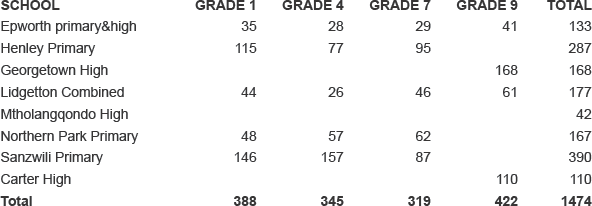
3.1 This study involves approximately 1474 respondents, 388 of whom
are the primary cohort of grade one scholars. In the first episode of field work
carried out over the four months March to June, 1997 a further 345 respondents
were in grade four, 319 were in grade 7 and 422 in grade 9.
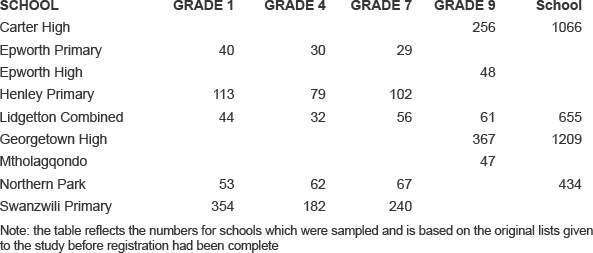
3.2 Although initially a smaller sized sample had been envisaged, it
became increasingly apparent that in order to meet the comparative objectives of
the study and to do so in a way which would satisfy quantitative research
requirements, the size of the overall sample had to be increased. Part of the
reason for this lay in the wide range in size of the schools
[1]
and therefore, the
number of pupils in each grade at each school. In the end, all pupils in grades
one, four, seven and nine at all participating schools became part of the study
sample, with the exception of three -the primary and secondary urban,
historically black schools (Sanzwili, Georgetown and Lidgetton Primary) and the
urban, historically white high school (Carter High). At these, the number of
pupils in each grade were sufficiently large to draw a sample.
3.3 However, the final size of the sample was modified due to
parental or respondent unwillingness to participate in the programme,
absenteeism on the days when field work was done and incomplete
questionnaires.
3.4 The final number of respondents for the study per grade in each
school was:
Gender:
3.5 The gender composition of the sample is fairly evenly divided
between the sexes, although the overall balance tends to favour girls and young
women (53% female and 47% male), albeit only slightly in grades one and seven
(50.5:40.5 and 52:48 females to males respectively) but more markedly in grades
four and nine (54:46 and 55.5:44.5 females to males respectively).
[2]
Race:
3.6 Overall, this is largely a study of black (African) and white
school-going children, a racial composition determined by the schools selected
for the study. Six of the schools are exclusively black (Henley Primary,
Georgetown High, Mtholangqondo, Lidgetton Primary, Jabula High, Sanswili) while
four of the schools (Epworth Primary, Epworth High, Carter High, Northern Park)
have a minority of black scholars, most of whom are African. The programme was
not able to include schools historically set up to service Coloured and Indian
children because of a lack of resources. 77 % of the respondents are black
(African) and 18% are white, 2% are coloured and 3% Indian. In the primary
cohort; grade one - 82% of the sample are Black, 10% are White, 4 % Indian and
3% Coloured. In grade four; 80% of the sample are Black, 15% are White, 3%
Indian and 2% Coloured. In grade seven; 77% were Black 20% were White and 3%
were Indian. In grade nine 68% were Black, 26% were white, 2% were Indian and 4%
were Coloured.
Location:
4.1 In terms of locational distribution, 22% attend rural schools within
the former Bantustans. 12% of the respondents attend at farm schools, located in the
historically white owned commercial farming sector. 38% of respondents attend at
public urban, historically black schools located in the black townships, formerly
segregated from the white run municipalities. 19% of respondents attend public urban
schools which were exclusively white until 1991 and 9% attend private schools -
which although predominantly white had opened access to black school-goers about a
decade sooner than the state.
Age:
4.2 Part of the motivation for selecting children by grade was to
demarcate groups of scholars within relatively narrowly defined age bands of
three or four years. As it turns out, the spread of ages across each grade is
wider, with evident racial, sexual and locality characteristics.
4.3 The overall study population spans the age range 6 - 27. In
grade one, 23% of the sample are seven years old. 23% are in grade four where
the average age is 11, 22% are in grade seven where the average age is 14 and
29% are in grade nine, where the average age is 16. However, it needs to be
noted that within each grade there is a proportion of respondents who are over
the age norm. For the most part, the reason for respondents being over age can
be attributed to repeat years. Overall, 64 % of respondents said that they had
never failed, 27% report failing once and 9% have failed twice or more. Some are
likely to have started late and others may have dropped in and out of schooling
as circumstances outside the schooling context dictated.
4.4 Since it is inappropriate to presume age from grade, the data is
analysed by age. As the chart shows, 39% of respondents are 6-10 years old, 14%
are 11-12 years old, 32% are 13-15 years old, 12% are 16-18 years old and 3%
(n=47) are 19 years old.
4.5 Three observations can be drawn from the study population..
Firstly, while the study's assumption that grade one is the first contact
children have with the formal education system, the ages of between 8% and 16%
of respondents suggest that for approximately one tenth of the children
interviewed in 1997, their first contact is a repeated contact. This needs
further investigation.
4.6 Secondly, while White, Indian and Coloured children are most
likely to move through the education system more or less in compliance with the
age norms, the passage of black children through the system is
characteristically much more bumpy and uncertain. This is an important aspect
which we will have to address in our future investigations.
4.7 Thirdly, for black school going children, the peer environment
of the majority of younger grade members is influenced, if not shaped by a group
of older girls and boys who share their school day. This has potentially
pervasive consequences for gender identity formation and is an issue which
warrants further research.
Research Methodology
Conceptualization
5.1 Consciousness is at the interface between structure and agency.
Eye (1978) captures this positioning of consciousness in asserting that it
cannot be separated from the objective world; it is caught up in this world at
the very moment that it takes possession of it. He (ibid) goes on to explain
that consciousness is neither completely objective nor exclusively subjective,
but rather is ambiguous in form. As such, developing an approach to explore
social identity across disciplines poses enormous theoretical and methodological
challenges. The team engaged in discipline specific literature reviews as well
as intensive debate about appropriate ways of approaching the research both in
terms of theory and methods.
5.2 A preliminary scan of the literature in South Africa reveals
that there is a general paucity of research into social identity or
consciousness in children and teenagers. The discipline which has developed
theories and tools for these age sets is psychology, although mostly around the
areas not of our concern, except for social identity theory in social psychology
which provides a useful starting point.
5.3 For the purposes of the study, whilst there was and continues to
be theoretical exchange across disciplines and perspectives, the programme did
not seek theoretical consensus nor did we anticipate only one outcome. Rather, a
lower order agreement around critical issues was preferred; which could be
informative across disciplines and within different theoretical frameworks. This
approach made co-operation practical and applied. At the same time it created
the expectation and possibility for synergy -where outputs would not only be
bound by the limits of each discipline or particular theories/hypotheses.
5.4 Working from the assumption that understanding consciousness
needs research into both structure and agency. Middens (1977) view is that the
social world is constituted as meaningful by the meanings ascribed to it by
humans in the course of their interactions with it while at the same time these
interactions act to constitute and reconstitute the actors as well. It is within
this context that the team decided that our efforts needed to focus in on the
children's comprehension, experiences and sense of place in their worlds. This
decision meant that in developing research questions and instruments we often
had to resist approaches which would take the study into their homes,
communities or the education system.
5.5 In order to delimit the concepts of class, race and gender, the
team identified themes or areas which we considered to be useful and important
signifiers of each concept and through which it would be possible to explore
social identity. In no particular order, they were poverty, work, food eating
habits and well being, gender and sexual identity, racial identity, self-esteem,
prejudices and preferences, hierarchy and values, and sense of place &
space. These were then developed in a range of instruments as concrete questions
or problems.
5.6 The CRG Research Programme combined survey, experimental and
interpretative research methods in order to generate a complex set of data which
would capture the complexities of life across a wide range of children whose
ages and experiences are very diverse. The possibilities of using qualitative
research techniques were substantially constrained by financial, scale, time,
and data capture limitations. Nevertheless, and although much of the data was
captured through quantitative techniques, it was also possible to experimentally
modify qualitative methods.
5.7 Fifteen instruments were developed to collect anthropometric and
dietary, psychological and sociological information. These were driven from
discipline specific hypotheses and practices, although appropriately, there is
overlap.
Anthropometric:
5.8 A group of three instruments focus on anthropometric, diet and
habitual physical activity. The first is an anthropometric data record which
measures the height, weight and arm, waist and hip circumferences of each of the
respondents.. The second is a 24 hour dietary recall worksheet\exercise where
respondents are asked to recall and record everything they ate or drank the
previous day. The purpose of the exercise is to capture food types as well as
the regularity of food intake. No attempt was made to establish quantities
largely because of the difficulty of getting reliable responses. The third
instrument is an observation sheet which captures the habitual physical activity
levels and preferences of respondents, as observed by teachers. Given the brief
presence of the research team in each of the schools, this exercise had to draw
on the teachers’ accumulated knowledge and observations of learners. All three
instruments are standardized and fairly routine procedures. While the physical
information serves to create a more complete picture of respondents health and
well being, the information gathered in the dietary recall exercise is expected
to yield social and cultural insights.
Social and Psychological:
5.9 Another cluster of three instruments are driven by social and
individual psychological concerns.
[3]
The first is a Social Status Technique derived from
Central's Self-Anchoring Striving Scale where respondents are asked to place
other individuals hierarchically. Rather than doing this pictorially with
drawings, as the exercise had originally been developed, ladders were built and
stylized figures were created and respondents were asked to place them
physically on the ladder in response to questions asked. Two sets of six figures
were created, each consisting of male and female “dolls” for white, black
(African) and Indian people. One set of figures depicts economically better-off
learners; the other, learners who are economically poor.
5.10 The exercise does not involve a forced choice as more than one
figure can be placed on any step. The Social Status Technique is a measure of
preference, social stratification and personal identification built around a set
of “who” questions. Given a choice of six stylized figures, children are asked
10 questions - who has the best food, who is the happiest with their life, who
does best at school, who gets sick the most, who walks the most, who should sort
out a problem, who will get the best job, who will become an important person in
the world, who has the most friends and who is most like the respondent. Their
responses are then scored. This exercise was implemented using the split-half
technique, with half the respondents using one set of figures and the other half
the other set of figures. To overcome interviewer bias, they used both sets of
stylized figures alternately.
Self Esteem:
5.11 A further two instruments which focus on individual self-esteem
are used in order to get a sense of how respondents value themselves and
perceive themselves in relation to others. The Self Scale and the Culture Free
Self-Esteem Inventory (CFSEI), as standardized, internationally validated
instruments, are used, unmodified. The sub-scales of the CFSEI give data on
social, academic and parental-relationship issues.
General and Sociological:
5.12 The next set of eight instruments are sociological - albeit,
with evident general application for the whole programme. There are four
questionnaires which explore experiences and attitudes. The first covers
demographic and locational information about the respondent asking. questions
about kin and household, dwelling type space and place, amenities and services,
religion and literacy, domestic work, and residential and geographical
mobility.
5.13 The second questionnaire explores poverty and work, asking
questions about food routines and hunger, clothes, attendance at school,
educational aspirations and possible obstacles to achieving these, pocket and
spending money, and the differences between rich and poor people as well as
economic activity and the type of work of parents and respondent, employment
aspirations and perceptions of the importance of work.
5.14 The third questionnaire focuses on gender and sexuality, asking
questions about the similarities and differences between boys and girls, their
own play and leisure time preferences, gendered expectations about activities
now and in the future, marriage and sexual preferences, pregnancy, contraception
and sexually transmitted diseases and gendered responsibilities in regard to
these, name calling and abuse and sense of self
5.15 And the fourth questionnaire asks about race and colour,
covering self-categorization, prejudices and preferences, colour and its impact
on present achievements and future aspirations, inter-racial contact, name
calling and bullying, and sense of self.
5.16 The fifth instrument is a 12 hour activity recall, where with
very limited markers, respondents are asked to remember and record what they did
from the time the bell rang at the end of the previous school day until the time
the school bell rang the following morning. The purpose of this exercise is to
get an insight into after-school routines, what children and adolescents do and
the social differences these activities may represent. As with the dietary
recall, no attempt is made to quantify activities in time.
5.17 The next exercise - “mapping the main meal”- is an experimental
activity developed to get a sense of the respondent's place in his or her family
or household. Modifying techniques developed in Participatory Rural Appraisal,
respondents are asked to plot their previous main meal - in which room they sat,
where they sat, who they ate with, who prepared the food, who served it and in
what order, who got more or less food and why, whether they helped somebody else
eat and why, whether there was a prayer or blessing, whether people talked,
watched TV, read or listened to the radio during meal time, their sense of what
the main meal means to them, etc. Their responses are then described and
analysed in relation socio-economic and demographic information.
5.18 The last two instruments are qualitative and are intentionally
broad. In a “A Joke and Three Expressions I have Heard” respondents are asked to
write down any joke that they have heard told about other people. Similarly, in
recording three expressions or sayings they have heard, respondents are asked to
reflect those that are used to describe other people. The purpose of this
exercise is to get a sense of prejudice and difference and to examine the social
differences in how these are presented.
5.19 The final exercise in this group is an essay, the subject of
which is “A Memorable Experience”. Respondents are asked to write down a good or
bad experience and to write about a mark or impression that has endured. The
main aim is to get participants in the research programme to voice their
experience, to locate it in a social context and to relate it to the way they
come to be the people they are.
5.20 The last exercise, administered at the end of the process, is a
Feedback sheet. Self evident in its purpose, this instrument is designed as an
open-ended reflection by participants in the research process. It is innovative,
in as much as it is built into the design of the programme and all respondents
are asked to use it.
5.21 Together, these instruments yielded a wealth of data, however,
in working through the feedback sheets several important questions about process
have come to the fore. An important issue which the study has raised is the
issue of using multiple surveys. In capturing the data for each survey it was
found that each survey had different totals due to either spoilt or incomplete
questionnaires. It is therefore difficult to establish what the total population
really is because the totals for different questionnaires do not correspond.
Operationalising the Study
6.1 The biggest conceptual hurdle the study had to overcome was to
operationalise the research; to find a way to schedule all 14 instruments within a
time frame that a) would successfully accomplish the task; b) would be acceptable to
the schools; and c) would do so in a manner which was as unobtrusive as possible.
The solutions we found were several.
6.2 Fieldwork was divided into two waves. The first wave of field work
centred on capturing anthropometric information. A team of up to 17 diploma students
drawn from the Department of Dietetics and Community Health at the University of
Natal, Pietermaritzburg under the supervision of Prof. Maunder weighed and measured
all respondents over one or two days at each school.
6.3 At the tale end of the first wave, the second wave of field work
began collecting data for the remaining 14 instruments. This entailed assembling a
team of between 20 and 30 fieldworkers, comprising combination of under-graduate and
graduate students, HSRC trained field workers, unemployed matriculants and
graduates, a few lecturers, a field work manager, Bev Killian and myself.
6.4 It was concentrated intensively within each school for between two
and seven school days. Within the time-frame of often a week or less, in each
school, work was divided by grade so that school work was interrupted for no more
than two days for each grade, for the most part. This was viewed very positively by
the schools since they were concerned about taking learners out of their
routines.
6.5 To get through the large number of instruments in the time
allocated, 8 exercises
[4]
were identified as being suitable for self-administration - but in groups and under
supervision. The Feedback sheet was self administered during class time under the
supervision of teachers although without the research team presence Aside from the
anthropometric data record, the remaining five - the four questionnaires and Social
Status Technique Ladder - were administered in face-to-face interviews. This
approach was applied to all the grades except grade one, with some modification, as
it was found to be more useful to absorb Meal Mapping into the face-to-face
interviews schedule.
6.6 For face-to-face interviews, each field worker was assigned two or
three respondents for the day with whom they worked through all the instruments.
They alternated respondents as they completed each exercise. And each exercise
lasted for between twenty and thirty minutes. An initial attempt to group administer
with grade ones, albeit modified into smaller clusters involving field workers
assigned to two or three respondents, proved to be time consuming and unfruitful. In
the end, all exercises conducted with grade ones were done in face to face
interviews. The grade ones did not do three instruments - A Joke, Essay or
Feedback.
6.7 These procedures had also to be modified to accommodate colour and
gender concerns. Thus, where male respondents were being interviewed by female field
workers, the questionnaire on gender and sexuality was administered by a male field
worker. Similarly and in so far as it was possible, White and Indian field workers
were paired with non-African respondents.
6.8 Fieldwork ran almost uninterrupted for over three months. The
hospitality of the schools and good weather, especially where classroom space is a
scarce resource, made a long work detail much easier. There were particular
difficulties at the urban black schools. The timetable had to be rearranged because
of local security conditions at one school. Then, the subsequently rescheduled
programme coincided with the proposed COSATU national strike, which was postponed
but still took hours of school time to renegotiate. In addition, a water crisis in
the area saw the school we were working at closed for a day as teachers went to
protest at the local authority offices. Prolonged work at these schools disrupted
the schedules we had set up with the next schools, it added to the costs of the
field work and wore down the field work team.
Feedback
7.1 Many research programmes are not designed with loops to feedback to
respondents. While sometimes this is not practicable, where it is possible it
provides a very real opportunity for the research to be reflexive and assist the
researcher to learn about both process and content.
7.2 The CRG Research Programme has built in several opportunities to
interact with respondents and their host schools over the research. The study is
designed to report both general and school-specific findings back to each of the
respective schools. From the Feedback, it is clear that this will have to be to both
staff and learners. Where requested, the Programme will also run a workshop in each
school on how to do research. It has proposed a cultural exchange between the farm
school and the private school around the theme “Who I am - Who I want to be”, which
will be realized if they wish to take it up.
7.3 The Feedback sheets provided the opportunity for each individual to
correspond personally with the research programme, with the exception of one school
where teachers took it upon themselves to write “the answers” on the board for the
children to copy, which they did!
Conclusion
8.1 By way of conclusion, the key issues raised in the Feedback sheets
will be raised.
8.2 The response to the programme is overwhelmingly positive. The
respondents enjoyed participating in it for a range of reasons - they saw it as fun,
exciting, different from what they had ever done, and for some a chance to miss
school. Most strikingly, they found it a learning experience, an opportunity to
reflect on their own circumstances, how they see themselves and how they relate to
other people. They also particularly liked being asked to talk about themselves, to
express their views and to be heard. Research with people is always interactive and
reflexive, even if the researchers do not concern themselves with what the research
might contribute to respondents. Yet, in questions there are ideas and information
which people think about and learn from. Research is or can be a learning process
for respondents.
8.3 While most found the research process enjoyable and pleasant, there
was a repeatedly expressed concern about the research's purpose, what it was being
done for and if it would have any impact on their circumstances. In sharing details
about personal experiences and needs, it is not surprising that respondents
anticipate that once articulated, they will be heard and even that somebody will do
something about them. For respondents (and researchers) there is a continual tension
between the limits of research (finding out) and the possibilities of intervention
(acting out). To state that the research will provide a better understanding of the
issues being explored, that it will put the critical issues into the public debate
and onto the policy table, is not a very satisfactory reply to a child or adult who
has told you that they often go to sleep without eating or they have to miss school
because they have no money for transport. But it is really all that the researcher
can say and do.
8.4 In terms of the issues being explored; many commented on one or
another aspect which they described as difficult, uncomfortable, embarrassing,
stupid or strange. One reading of such responses would be that it reflects badly on
the research, that some aspects were unintelligible to the respondents. In some
instances this may well have been the case. Some respondents could not understand
why they were weighed or measured, for example. Similarly, some questions might have
fallen into this category, for example, those that asked about eating patterns and
preferences.
8.5 However, these concerns could and should be read differently. They
reflect on the social circumstances of different segments of our society. While some
respondents found it stupid to ask about toilets and the space they occupy within
their homes, -don't we all have flush toilets, our own bedrooms and our own beds? -
others found questions about consumables or holidays stupid - you know we don't have
cars, electricity or fridges and never go on holiday, why ask?
8.6 Similarly with issues that are sensitive. Sex, sexuality and
inter-personal relations is an issue “known” to be sensitive - something that is
embarrassing, personal and difficult to talk about. Some felt it to be private,
personal and not to be talked about. But it was not seen this way by all
respondents. Many, in fact, said they welcomed the opportunity to talk and find out
about these issues and what is appropriate behaviour.
8.7 Food, what people ate and eating routines is known to be sensitive
with respect to puberty and obesity. But, from our respondents it is clearly also a
sensitive issue culturally, where it signifies difference or if you are very poor
and you are food short. Race, for some, is sensitive, reflecting our racially
complex context where race is a significant indicator of identity and where racial
stereo-types are being challenged. Others found asking about family life and
parental care to be sensitive.
8.8 Depending on where you are socially placed, issues are or can be
sensitive. But does this mean that such questions should not be posed? 1 doubt,
rather it suggests that care has to be taken with how they are posed and respondents
have to be respected and treated with care. Which in the end is about process. Many
of the respondents commented about the ease with which they could communicate with
field workers, the fact that they were made to feel comfortable and that the
research was conducted in an entirely unthreatening way. Moreover, they felt
reassured that they were could refuse to answer a question if they so chose