The relationship between ethnic communities who share a common national space is
often affected by factors above civil society, such as inter-state relations,
political and economic alliances, and geopolitical interests. The relevance of
ethnic minorities’ identity and behaviour to the international political
environment becomes clear whenever an ethnic minority occupies territory of
geopolitical and/or geo-economic importance to countries with conflicting
interests in the area - we will call such a minority, ‘strategic minority’.
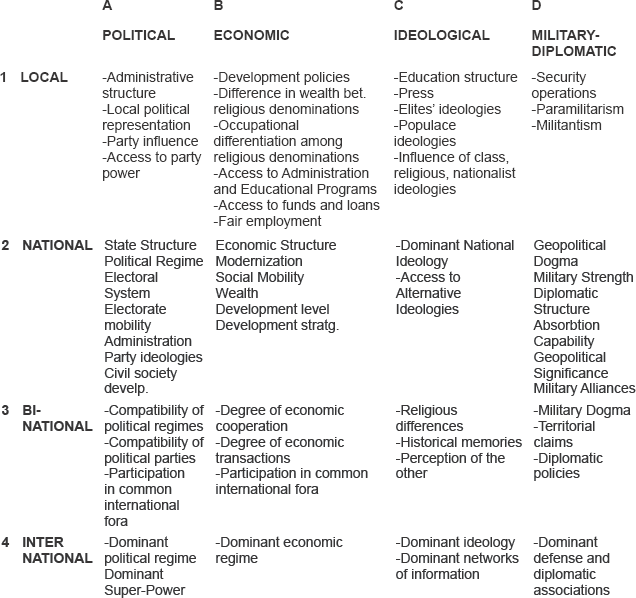
Using a model of ‘network compatibility’ we could delineate the mechanisms and
factors which affect the social outlook of a given minority.
To highlight the paramount importance of national and international relations in
shaping ethnic minorities’ identity and behaviour the paper examines and
compares two strategic minorities situated at the fringes of Europe: The
Northern Irish Catholic minority and the Muslim minority in Western Thrace,
North Eastern Greece. Using as our analytic tool the theory of ‘networks of
social power’ we tentatively conclude that the formation as well as the current
identity, status, and behaviour of the two minorities cannot be fully understood
unless we examine the role of the two sets of neighboring countries (G. Britain
- Ireland, and Greece - Turkey), as well as the two major Western political
powers, i.e., the European Union, and the United States, in the two contested
regions.
1.1 The formation of a social group, such as an ethnic minority, its
organisation and behaviour, depend upon a multiple of social arrangements. These
arrangements could be analytically understood as sui generis or
ad hoc networks of people striving to maintain or improve their
social condition. Since these goals are achieved by controlling human and natural
resources, social activities could be understood and analysed in power terms. Though
power in general is attained by controlling the social and natural environment,
there are four particular kinds of power, that is political, economic, ideological,
and military ones which are attained by controlling four particular kinds of
resources controlled by network of social actors.[1]
1.2 In detail, the political network of power aims at
the control of a given territory and its inhabitants; the economic
network aims at the control of economic praxis (control of
production, transportation, distribution, and consumption of resources); third, the
ideological network aims at the control of thought, symbols,
and aesthetics; and fourth, the military, and its accomplish,
diplomacy, aims to achieve power over matters of life and
death. These networks could be analysed not just in four horizontal ‘layers’ but
also in three vertical levels: The local, national, and international levels.
1.3 Furthermore, any organisation embodies two aspects of power, the
collective and the distributive. The collective aspect of power refers to the
ability of the social group as a whole to advance its mastery over nature as well as
over other social groups. The distributive aspect of power refers to the ability of
a few to profit more than the rest of the group. Thus, we could argue that, any
ethnic group, and any ethnic movement, gives rise to two kinds of power. Firstly, a
fictitious, or real, primordialism, under the form of identity, advances the
collective power of the group. Cooperation makes available
resources non-existed before the ethnic group put its action together. Secondly,
hierarchical structures and division of labor advances the
distributive power, that is the differential and privileged
access to power the leadership of the ethnic organisation, or movement, enjoys.
1.4 In relation to ethnic groups, two points network analysis makes are
of particular importance. First, people who control crucial “junctions” of the flow
or resources in all four networks become elite actors able to affect the life chance
of other, less strategically situated network participants. It follows that the more
these networks overlap with one another in particular locations, the fewer the
elites which control the available resources will be and in general the power
arrangements will be more rigid than in areas where the four networks of power are
diffused into the wider flow of resources. Second, qualitative similar networks
facilitate kin bonds. The more overlapping the four networks in particular
locations, the tighter the social group will be in kinship ties appearing as an
‘ethnic group’. Thus, a possible overlapping of power networks in the case of
minorities-majorities promotes compact group behaviour that facilitates cleavages,
inter-ethnic competition, discrimination, and potentially, conflict.
1.5 The above points situate the modern ethnic minorities in the endless
pursuit of power every social organisation is involved in. Without denying other
aspects of ethnicity, it suggests that the unique tools (political, economic,
ideological, and diplomatic/military), modernity has offered to nations, are
available to ethnic minorities as well, minorities which could feel that existing
national boundaries and national ideologies curtail their own access to power they
deserve. The same logic situates ethnic groups into the wider context of global
networks of power. The fact that the social networks of power do not cease at
national borders is crucial to comprehend ethnic minorities’ behaviour. Ethnic
groups are heavily affected by the international scene, that being ideological
trends, economic regimes, political leagues, diplomatic affiliations, military
alliances, or geopolitical interests. Thus, the factors that affect a minority's
behaviour are triggered by considerations, which are not exhausted on matters of
individual rights and group self-determination, but, potentially, involve other
kinds of interests external to the minority itself.
1.6 For ethnic relations, the crucial factor in determining the
relationship of the ethnic majority to the ethnic minority is compatibility and,
subsequently, degree of diffusion among the networks of power. In other words, the
less compatible the social networks appear to be in all local, national, and
international levels, the more exclusive and vivid the differences will be between
ethnic groups. The argument network analysis suggests is that quality of the
relations between ethnic groups is dictated by whether incompatibility is situated
at the local, national, or international levels.
Strategic Minorities
2.1 Certainly, all ethnic minorities are affected by the above factors,
yet, there is a particular kind of ethnic minorities that are crucially situated at
the nexus of the international economic, political, ideological, and the
military-diplomatic networks of power. We wish to call them “strategic minorities”
in that they concentrate the attention, and their predicament affects not just
themselves, or the nation-state they are part of, but a wider range of all four
global power networks.
2.2 Most of the recognised minorities cannot be called strategic. The
indigenous populations of the New World, and many of the Old one, constitute an
internal issue, in some cases a problem, an annoyance to the status quo rather than
an international issue (see Arab and Eastern European minorities in W. Europe).
Nevertheless, there are few minorities, particularly so in Europe, Caucasus, and the
Middle East whose power-value exceeds their numbers while their status greatly
affects national borderlines and the international status quo. Mostly they are
pre-modern minorities, that is, agrarian populations heavily concentrated in
particular areas, spatially located in the countryside, linked to land-ownership,
and with a strong feeling of primordial attachment to “their land”. Primordial
feelings of blood-and-soil greatly facilitate political messages for secession and
self-determination.
2.3 The Chechens in Caucasus, the Bosnian Muslims in the Balkans, the
Kurds in Anatolia, the Catholics of Northern Ireland, and the Greek Muslims in
Western Thrace are examples of strategic minorities. Geopolitically and
geoeconomically their value is high. Tsetsnia is strategically situated in the
oil-reservoir region of Caucasus. The Kurdish region is situated at the crossroad
linking oil-producing Middle East with oil-consuming Europe. The Muslim Greeks are
overwhelmingly concentrated in Western Thrace, a strategic communication route
between Europe and Asia, East Europe and Near East, adjacent to Turkey and part of
the route Caucasian petroleum will take to reach Europe. Lastly, Northern Ireland
Catholics are situated in the heart of the West. Discrimination and irredentism in
the region challenges the western model of civility, human rights, and prosperity,
and has concentrated significant economic and political resources from both European
Union and the US for its solution.
2.4 Nevertheless, while the above four examples of strategic minorities
exhibit high levels of cultural homogeneity vis-á-vis the dominant ethnic
majorities, and wish for political autonomy, they do not exhibit similar patterns of
behaviour. The Chechens have been involved in a successful war against Russia and
have achieved autonomy; the Kurds are also involved in guerrilla warfare against
Turkey and Iraq yet they are deeply divided thus minimising their chance of success;
in Northern Ireland a political ‘solution’ has just broken the vicious thirty year
old guerrilla and counter-guerrilla campaign shifting the struggle from the streets
of Belfast and Derry to the Stormont chambers; the Muslims in western Thrace have
recently developed a campaign for political autonomy with the aid of the Turkish
state. How could we understand such a diversity of behaviour, and such a variance in
the rate of success of their targets?
2.5 In this essay we intent to provide a comparative perspective based
on network analysis for the understanding of the behaviour of two strategic
minorities: The Catholic population in Northern Ireland, and the Muslim Greeks of
Western Thrace. Though not similar in form and behaviour, they do share a few unique
features:
Both minorities are pre-industrial with strong claims to the land they
occupy;
officially, both minorities are religious minorities, though large sections
of them identify themselves in national terms (Irish - Turks);
both minorities, at least large sections of them, perceive neighboring states
as their homelands (Republic of Ireland and Turkey);
both minorities comprise a large portion of the total populations of the two
regions: the Catholics comprise 45% of the total population of N. Ireland,
while the Muslims 35% of the total W. Thracian population;
both minorities have been subjects of discrimination;
both the Republic of Ireland and Turkey claim the lands where the minorities
live (N. Ireland and W. Thrace);
both N. Ireland and W. Thrace are parts of the European Union;
the two sets of “rival” states belong to common major western alliances: The
Republic of Ireland and the UK to the European Union, while Greece and
Turkey to NATO.
2.6 In spite the above similarities, the Catholic and Muslim minorities
show different levels of militantism. While Northern Ireland has experienced a
bloody civil conflict since the late 1960s with the development of paramilitary
groups on both sides, and the heavy British military presence, W. Thrace enjoys an
uneasy peace, although few political analysts believe it will last for ever under
the current status quo. In the next pages we will endeavor to understand such an
apparent difference in behaviour with the aid of the suggested model.
2.7 In the case of strategic minorities such as the N. Ireland
Catholics, and the Greek Muslims in W. Thrace, and for analytical purposes, we could
scrutinize power in four different settings: The local, the national, the
bi-national, and the international. Though qualitatively the same, the four settings
allow us to examine the particular sources that affect the overall conditions and
behaviour of the two minorities. Mostly, they can inform us of the qualitative
differences that exist among ethnic minorities, differences embedded in the
differential input of elements of the four networks of power in the four
settings.
A
B
C
D
POLITICAL
ECONOMIC
IDEOLOGICAL
MILITARY-DIPLOMATIC
1
LOCAL
Administrative structure
Local political representation
Party influence
Access to party power
Development policies
Difference in wealth bet. religious denominations
Occupational differentiation among religious
denominations
Access to Administration and Educational Programs
Access to funds and loans
Fair employment
Education structure
Press
Elites' ideologies
Populace ideologies
Influence of class, religious, nationalist
ideologies
Security operations
Paramilitarism
Militantism
2
NATIONAL
State Structure
Political Regime
Electoral System
Electorate mobility
Administration
Party ideologies
Civil society develp.
Economic Structure
Modernization
Social Mobility
Wealth
Development level
Development stratg.
Dominant National Ideology
Access to Alternative Ideologies
Geopolitical Dogma
Military Strength
Diplomatic Structure
Absorbtion Capability
Geopolitical Significance
Military Alliances
3
BI-NATIONAL
Compatibility of political regimes
Compatibility of political parties
Participation in common international fora
Degree of economic cooperation
Degree of economic transactions
Participation in common international fora
Religious differences
Historical memories
Perception of the other
Military Dogma
Territorial claims
Diplomatic policies
4
INTER NATIONAL
Dominant political regime
Dominant Super-Power
-Dominant economic regime
Dominant ideology
Dominant networks of information
-Dominant defense and diplomatic associations
2.8 In the following pages we will present as briefly as possibly the
history of Northern Ireland and Western Thrace. Then, applying the above typology to
the otherwise chaotic, unconnected, ethnic histories of N. Ireland and W. Thrace, it
will be shown that the two cases are not just compatible, but they succumb to the
same social prerogative: The organisational outflanking, or the appropriation of the
opponent's resources.
A Short History of N. Ireland and W. Thrace
3.1 Northern Ireland was founded in 1922 under the Government of Ireland
Act signed between the UK and the newly recognized Irish government. The partition
of the island of Ireland aimed at securing the British status of the Protestant
minority in the north where they formed a local majority. It also gave Britain a
base on an island which was, at this time, of strategic importance to the security
of the UK as a whole. The Government of Ireland Act established two separate
jurisdictions: a Northern Ireland government on the Westminster model based at
Stormont, and an Irish Free State under Dominion status.
3.2 Between 1922-1972 in Northern Ireland, the Ulster Unionist party
enjoyed a comfortably absolute Protestant majority, maintaining what was essentially
a one-party state. The demoralised Roman Catholic minority (35%), forced into this
state against their will, were virtually excluded from any effective role in
government.
3.3 Protestant/Unionist supremacy in Ulster was challenged in the late
1960's with the emergence of a Civil Rights movement influenced by events in the
United States of America. A campaign for civil rights developed characterised by
civil disobedience and demonstrations. Liberal elements of the Unionist party who
would have went some way to accommodate the demands of the civil rights movement
were ousted and repressive measures were taken to combat civil disobedience and
public demonstrations. Large-scale civil disorder in 1969 prompted a British
deployment of troops in Ulster. After troops opened fire on civil rights marchers in
Derry in January 1972 the Stormont administration was abolished and Britain ruled
the province of Ulster directly from Westminster.
3.4 The increasing violence of the late 1960's also prompted the
re-emergence of loyalist and nationalist paramilitary groups. In response to attacks
on the Catholic community by the security forces and loyalist groups the IRA grew in
strength in the early 1970's. The IRA and British army rapidly became embroiled in a
guerrilla war and for the next two decades a counter-insurgency conflict was fought
in Ulster - punctuated by episodes of sectarian atrocity.
3.5 Most recently, determined efforts have been made by both sovereign
states, the British and Irish, supported by a sympathetic US administration, to
bring the conflict to a close. These efforts resulted in an IRA cease-fire and the
Good Friday Agreement which outlined plans for an inclusive government in Northern
Ireland. To date, however, that government does not function, NI is still governed
from Westminster, and the peace process has bogged down in negotiations over whether
or not the IRA should surrender weapons. The decommissioning issue, as it is
generally known, is widely regarded as a red-herring, used by Unionists who are
unable to address the issue of sharing power with Nationalists.
3.6 Western Thrace was also formed the same time as Northern Ireland: In
1923 with the Treaty of Lossane between Greece and Turkey which determined border
lines and the fate of minorities ‘left behind’. Accordingly, 100,000 ‘Greeks’ were
left in Turkey, and an equal number of ‘Muslims’ remained in Greek W. Thrace; 45%
Turks, 36% Pomaks, and 18% Roms. Furthermore, the Muslim minority was guaranteed an
Islamic system of economic and educational structures, under the religious authority
of the Muftis.
3.7 The conflict of Greece and Turkey over Cyprus that followed the end
of WWII had grievous consequences for the two minorities. The Greek element in
Turkey was virtually obliterated in a series of progroms between 1955 and 1968
(200,00 in 1923, 3,000 today) while the Turkish-speaking Muslims of Western Thrace
(87,000 in W. Thrace in 1923, 100,000 today) made of Turkish ethnic origin (45%),
Pomaks (36%), and Roms (18%) were treated as second-class citizens by state
administration. This, coupled with the educational autonomy of the Muslim schools,
resulted in alienating the Muslim population which consequently was attracted and
became fully controlled by the Turkish state adopting in the process a Turkish
identity.[2]
Recently, recognising past ‘mistakes’ and under European pressure, the Greek
administration has initiated a series of administrative, economic and cultural
measures to incorporate the minority into mainstream Greek social life and alleviate
the living standards of Western Thrace (the poorest region of the EU), as a
whole.
Making Sense of History
4.1 The greatest challenge of macro-sociology is to create theoretical
models which could incorporate historical cases (de facto unique historical events)
without these models becoming reduced to tautology. The above theoretical framework
tries to achieve such a goal: To frame theoretically the cases of Northern Ireland
the western Thrace. In the following pages we will apply the model of power networks
to the above cases.
Local Level: Political Power Network
5.1 Northern Ireland was until 1974 a politically semi-autonomous region
of the United Kingdom while Western Thrace, as any other Greek region, was, until
recently, controlled by the central state authorities in Athens. Structurally, this
might look as a significant difference between the two regions. Yet, in terms of
network analysis, these differences are minimal, since both governments (the local
in Northern Ireland and the central government in Greece) followed pro-majority
policies.
5.2 Discriminatory policies did not change with Direct Rule that was
introduced in Northern Ireland in 1974 as British policy remained pro-Unionist. A
major reason was that after Direct Rule unionist MPs remained loyal to the
Conservative Westminster governments as long as Westminster remained loyal to the
Unionist cause - a major reason John Major's governments hesitated to take drastic
measures to solve the dead-lock in Northern Irish politics. It is significant that
Northern Ireland is often referred to in government circles in Britain as the
‘Province.’ This colonialist mentalite is a reflection of political reality: the
province is ruled from Westminster. Local politicians have a large measure of
control over the domestic matters of local government but above that level the
‘Province’ is effectively run by the Northern Ireland Civil Service establishment
whose powers far outweigh those of their counterparts in the UK. Politics follows
the sectarian pattern with few exceptions. Class politics are undermined by
sectarianism and class based parties are of little or no significance in Northern
Ireland.
5.3 The Muslim minorities in Western Thrace are concentrated in distinct
rural locations. The primary (municipal) and secondary (prefectural) levels of
administration are only decentralised (1998) with the partial incorporation of the
Muslim elites. During the pre-1998 time period, the Muslims in Western Thrace were
controlled ‘by neglect’. Though no large scale anti-Muslim policy took place (e.g.,
progroms, mass deportations, prosecutions, detainment), the Greek administration did
next to nothing to alleviate the poor living standards of the Muslim population,
either economically, or politically. Furthermore, as it has been admitted by the
Christian perfecturer of Komotini himself, the Muslim minority has had indeed
suffered from discrimination. Discrimination consisted of unwillingness of the Greek
state to provided Muslim farmers with agricultural loans, close scrutiny of their
political activities and relations with the local Turkish embassy, withdrawal of the
civil rights of individuals who affiliated with ultra-nationalist organisations in
Turkey, and in some cases, prosecution of those who spoke of a Turkish, rather than
Muslim minority. If the unofficial unionist dictum in Northern Ireland was ‘keep
them low’, in Western Thrace was ‘let them stay low’. The limited autonomy the
region, as all other Greek regions, enjoyed until 1998, did not allow for local
initiatives. The Muslim as well as the Christian population enjoyed little autonomy
of decision making and policy implementation. Yet, the central political
administration was in Christian hands and political parties were national,
Christian, parties. Thus, while Christians could find representation through formal
political channels, the Muslims could not. Yet, the fact that there are no local
political parties means that sectarian political networks are comparatively week.
This had a positive side effect: Unlike the Northern Irish case, local Western
Thracian politics did not add to divisiveness of the two communities.
5.4 Interesting enough, the status quo of local political representation
changed in both regions at almost the same time-period. In Northern Ireland in 1999,
and in Greece, in 1998. Starting with the former case, the Good Friday Agreement
opened the door to Northern Irish political semi-autonomy. This means that, if the
last crisis over IRA decommissioning is solved, local Nationalist and Unionist
parties will consolidate their control over local political resources such as
education, health, and housing. The Assembly will therefore share power in a sense
with the locally elected borough, district and city councils. Though the British
government will retain control of the security forces, Chris Patten's accepted
reforms would transform RUC to a bi-communal integrated police force. The latter
will erode the power of the Protestant Orange Order, which has a considerable
influence on RUC staff.
5.5 In 1998 the Greek government initiated the autonomy of municipal and
regional political life. Political representatives at these levels are elected and
have the ability to initiate plans of cultural and economic development with the
bureaucratic aid of the central government. Specifically for W. Thrace, acts of
discrimination tend to wither away under a more pro-active stand of the Greek
government towards the Muslim minority. Article 19 of the Civil Code has been
withdrawn under pressure from Greece's European partners (May 1998), and the fact
that the Greek perfecturer has been re-elected with the overwhelming support of the
Muslim vote suggests that his campaign to check discrimination policies during his
previous service on the post were successful. Nevertheless, there is evidence that
the Christian majority and the Muslim minority remain isolated and suspect of each
other. The Christians continue to perceive the Muslims as a “fifth phalanx” bound to
cooperate with the Turkish embassy towards turning Western Thrace to an autonomous
province bound to unite with Turkey in some future time. The majority of Muslim
minority perceives Western Thrace as Turkish given to Greece in an act of good will
with the provision to guard the well being of its Turkish inhabitants. In all,
Christians and Muslims are involved in minimal contact, with the possible exception
of administrative structures where network diffusion has been partially achieved.
Segregation is extended in economic, ideological, and cultural matters. For example,
the final game of the Muslim football league is plaid in Istanbul and the event is
celebrated in Turkey as a national holiday.
Economic Power Network
6.1 1.B. Northern Ireland is economically dependent on subventions from
the metropolitan government. Northern Ireland does contribute through taxation to
the British Exchequer but the subvention far exceeds the returns in tax revenues.
Moreover over one third of employment is in the public sector. Discriminatory
employment policies have led to cleavages between Protestants and Catholics in the
labour force especially in the working, and low-middle classes. This cleavage is
precipitated by the spatial concentration of population in Catholic and Protestant
areas. High unemployment rates reinforce this ‘ghettoisation’ as workers do not
interact in the living space. Mutually exclusive ideologies are thereby also
reinforced among the labour classes especially since they are denied the opportunity
of testing traditional beliefs by interaction in the workplace. EU financial
projects for Peace and Reconciliation do not seem to serve their purpose to unite
the two communities though they have boosted the local economy.
6.2 A similar vicious circle of unemployment, ethnic cleavage, and
underdevelopment is to be found in Western Thrace, which is the poorest region of
Greece. Though it is unclear if this is solely the result of ethnic divisions, the
local population, both Christian and Muslim, exhibit the lowest average income in
Greece with the Christians doing only marginally better than the Muslims. Until
recently discriminatory employment policies were in place as well as restrictions of
economic transactions and development imposed on the Muslim population, though it
remains unclear if they have been imposed by the central government or by the local
authorities. In any case these have been recently made ineffective. Furthermore,
under the auspices of EU, Greece has developed a comprehensive plan to attract
national and foreign capital through EU projects. Among them, the construction of
the Egnatia Highway (horizontally crossing the full width of N. Greece) and the
Burgas-Alexandroupolis[3] pipeline are considered as the most important projects. In
general, the economic development of the region is trusted to solve most of the
inter-communal problems, by moving Muslims away from Turkish influence and
integrating them to the national economic system.
Ideological Power Network
7.1 1.C. Divisions between Catholics and Protestants are reinforced,
some would say perpetuated, by a denominational education system. Primary and
Secondary schools are controlled by the various churches. This is especially true of
the Roman Catholic Church which maintains its own schools with government support.
Sports are also divided between British and Gaelic games. The Gaelic Athletic
Association promotes Gaelic football and hurling and has been viewed by the security
forces as a subversive organisation. Rule 21 of the Association's charter forbids
membership by members of the security forces. In fact, membership of the GAA was
often viewed, quite wrongly, in security circles as an indication of extreme
Nationalist politics. There is little doubt nonetheless that GAA promotes a
distinctively Irish as opposed to English ethos. English games such as rugby or
cricket tend to be much more popular among Protestants. Even soccer, played on both
sides of the community divide, tends to be supported along sectarian lines with
teams perceived as either Catholic or Protestant much in the manner of Celtic v
Rangers in Scotland. We have noted above the mutually exclusive nature of working
class ideology. The basic tenets of this conflictual view of the world is shared at
the level of social elites.
7.2 An equally strong cultural cleavage is to be found in Western
Thrace. Religion, language, and above all segregate educational systems conserve and
precipitate these deep divisions. Educational segregation is due to the Treaty of
Lossane (1923)according to which the education of the Muslim youth is under the
control of the Muftia (Muslim religious authorities). Thus,
Christian and Muslim youth, similarly to Protestant and Catholic ones, remain
unaware of each other. The strong polarization of identities between Christians
Muslims is precipitated through sectarian press, TV channels, and religious
festivals and rituals. The Turkish state has been instrumental in building a Turkish
identity, by funding local minority press, educational facilities to the minority's
youth, and home satellite facilities for every Muslim household in the region
propagating Turkish irredentism. Furthermore, the area has been infiltrated by Greek
and Turkish ultra-nationalists whose extent of influence remains unknown. In spite
the fact that the local Christian Church and the Muslim Muftia and Turkish embassy
follow an overall hard, nationalist line, there are signs that a substantial
proportion of both populations remains moderate. The fact that the majority of the
Muslim minority chose overwhelmingly vote for a Christian prefect, rather than
abstain from the voting process, is a sign of pragmatism and anti-sectarianism.
Military/Diplomatic Power Network
8.1 1.D. Northern Ireland is characterised by high levels of violence.
Paramilitary groups play a very important social role in the community. Nationalist
rejection of the police means that the only recourse to law and order is often
through local paramilitaries. A high profile paramilitary presence is a feature of
working class Catholic and Protestant enclaves. There is evidence of socialisation
into violence as a means of political action. It has been argued (Bell xxxx) that
violence is a cultural trait that has evolved from a particular sub-culture. It is
transmitted from generation to generation in the same manner as other cultural
traits and the young are socialised to behave in this way. There are youth sections
in all the main paramilitary groups and in loyalist areas in particular
participation in marches and rituals is viewed almost as a civic duty. Moreover,
such is the power of these communal ideologies that they tend to override other
sub-cultures or subsume youth culture. Security forces, police and army, also have
high, and very visible, profiles. Armoured vehicles, helicopters and armed men are a
daily feature of life. The panoply of war and civil conflict is therefore
normalised.
8.2 Western Thrace on the other hand is characterised by absence of
institutionalised and organised violence. Levels of overt conflict remain low
concentrated on in ordinate demonstrations and scattered police measures against
nationalist minority leaders. The Greek fringe ultra-nationalist group “Golden Down”
and the popular Turkish “Gray Wolves” are involved into a campaign of verbal
propaganda though acts of violence are few and between. Instead, members of the
Muslim elite become increasingly involved in promoting the Muslim case and exposing
the Muslim problems to international fora, such as the European Union, Helsinki
Watch, etc. The Turkish embassy in Komotini City is instrumental in organising the
efforts of the Muslim elite while the Turkish state itself has repeatedly protested
to the same organisations for the institutional maltreatment of the minority by the
Greek authorities. Furthermore, a possible venue for the absorbion of the Turkish
male youth into Greek culture, the compulsory army service, had long been proved
counter-productive since Muslim conscripts were not allowed to carry guns, but
instead they were allocated secondary and unarmed services. This practice has only
recently changed (1998) with the added provision of promoting young Muslims to the
ranks of NCO. Yet, the results of such a radical change in army policy are not yet
clear.
Preliminary Conclusions
9.1 There is little doubt that the power networks in Northern Ireland
and Western Thrace are primarily sectarian. The sectarian quality of networks allows
little, if any, space to alternative concentration of resources. Any inflow of
resources from Athens or London are bound to be absorbed by organisations already in
existence, that is, sectarian organisations. Furthermore, sectarianism is due to
expand as long as inhabitants of the two regions identify themselves in culturally
exclusive terms, that is, as long as the ideological networks remain incompatible.
Both governments rely heavily on economic development to solve sectarianism though
available evidence suggests that such a strategy promotes absence of violence rather
than genuine reconciliation. Absence of violence in Western Thrace, the only clear
cut difference between the two regions, could be explained in two ways. First, it is
the nature of class composition. The ‘troubles’ in Northern Ireland and the
subsequent violence was triggered by a frustrated new Catholic middle class whose
aspirations were blocked by the ruling Protestant elite. The fact that the Muslim
population lacks a substantial middle class functions as a buffer against unpleasant
comparisons with the Christian equivalent. Furthermore, the fact that the Christian
population is not remarkably better off, keeps ‘comparative deprivation’ low. The
second, and probably most important reason is the attitude of the neighboring states
toward the minorities. The Republic of Ireland followed an ambivalent policy towards
Northern Ireland, and left the local catholic minority in a stage of perpetual
insecurity. Subsequently the Catholic population was ‘forced’ to take the initiative
itself. In contrast, the Turkish state made it clear from the beginning that it
considers itself the defender of the Muslim minority.
National Level: Political Power Network
10.1 2.A. Great Britain is a parliamentary democracy characterised by
class divisiveness and elitist politics. Recently, British politics have moved
towards a more European model of Social Democracy with little to choose between the
major parties of Labour, Conservative or Social Democrats. Further radical
alterations in the nature of the British political system seem inevitable as both
external and internal pressures are brought to bear on the present system:
devolution, the preferred option, now means that Scotland and Wales have their own
regional councils or parliament; internally in England, regionalisation and
devolutionist policies are in train. EU policies in this regard are also a major
motivator of change. In sum, the older structures coped quite well with the
management of an English dominated British super-state but cannot manage the
emergence of regionalist or nationalist economies under the umbrella of the European
Union. This in turn has significant implications for the position of Northern
Ireland within the union. For one thing, an important point to make here is that the
control exercised by NI politicians at local level rapidly dissipates at national
level. Power is centralised at Westminster. Northern Irish politicians have a
usually limited input here. However, as we have seen above, there are occasions,
when minority governments are attempting to remain in power, when Northern Irish
Unionist politicians can hold the balance of power allowing them an influence which
far outweighs their numbers. This is a state of affairs which the metropolitan
government cannot allow to persist, all the more so as the importance of the regions
increases. One cannot foresee how the tiny ‘Province’ of NI, in which, to quote a
former Secretary of State, Britain has no ‘selfish political, strategic or economic
interest,’ will be given any opportunity to create problems for an emergent
Britannia Nova.
10.2 The regime of Greece is Parliamentary-Democratic and in line with
the other members of the European Union. The electoral system does not allow parties
of less than 3% of the vote to elect representatives in the national parliament.
Thus, the Muslim vote is diffused in political (conservative, social-democratic,
socialist) rather than religious lines; the three Muslim MPs belong to three
main-stream political parties a fact that curtails any potential united, Muslim, or
Turkish, front. Until recently the political structures were overwhelmingly
centralised yet, during the last four years the PASOK government has taken
significant steps in decentralising administrative regions and municipalities.
Decentralisation will allow the Muslim minority to develop political structures
semi-autonomous from Athens. Three members of the minority have become majors of
significant parts of Western Thrace. The new positions of power gained during the
recent elections (25 October 1998) will allow the minority a more organised and
united front vis-á-vis state policies though the level of radicalism remains very
mild.
Economic Power Network
11.1 2.B. The British economy is advanced capitalist with ample
financial resources. It can absorb the cost of terrorist attacks both in Northern
Ireland and England. However, IRA bombing campaigns in the City threatened to
drastically undermine invisible earnings and therefore adversely impact on the UK
balance of payments. This may, in part, have played some role in the development of
the peace process. Bluntly, the cost of Northern Ireland threatened to become
unbearable. Since the end of the Cold War, however, Britain no longer has a
strategic interest in Northern Ireland. Southern Ireland, although officially
neutral, is a member of the WEU, and has already taken steps to modernise its armed
forces.
11.2 Greece is a full member of the European Union, and GATT. Increasing
modernization of the economy aims at the full incorporation to the EU economic
system by the year 2001. Furthermore, Greece is characterised by high social
mobility which positively affects the Muslim minority as well. EU funding is the
fuel for the strategic development of Western Thrace. Unemployment in the area is
high (20%) affecting equally the Christian majority and the Muslim minority. Yet,
emigration from the region under the prospect of finding jobs elsewhere has been
followed only by members of the Christian majority. The Muslim minority, supported
by funds provided by the Turkish embassy in Komotini remains firmly embedded in the
region.
Ideological Power Network
12.1 2.C. The dominant ideology of the British ruling class nationalist
within the parameters of the context of four different cultural polities: England,
Scotland, Wales and Northern Ireland. Amongst the working class and tabloid media a
more strident, often xenophobic, jingoism is sometimes expressed. Overall, however,
the ideological emphasis is liberalism and the protection of civil liberties
MORE.
12.2 Greek state ideology is mildly nationalist with pacifist overtones.
Yet, ethnic nationalism, fueled by the Greek Orthodox Church still predominates.
There are sincere efforts to replace it by civil nationalism, promoted by
left-to-center political and ideological elites, albeit with limited success for the
moment. The Orthodox Church in the region, supported by rightist politicians, has
adopted a nationalist ideology directed indiscriminately against Muslim and Turkish
interests. Yet, unilateral party support for European integration has given impetus
to the development of individual rights and full incorporation to the Western moral
system. Thus, we can detect two trends regarding the ideology the Greek elite
embraces: A dominant one oriented towards W. European standards supported by the
vast majority of the political elite and press, and a peripheral one, supported by
the Church and a few rightist politicians, oriented towards traditional nationalist
values. It is the latter trend which still creates alienation among the Muslim
minority.
Military/Diplomatic Power Network
13.1 2.D. The British State retains advanced defense and security
capabilities. Yet, by attempting to defeat the IRA using counter-insurgency methods
it succeeded in alienating large sections of the Catholic minority who were often
the victims of violence on the part of the security forces. Bloody Sunday is but one
example. The RUC are perceived by Nationalists as a partisan and sectarian force.
Britain has until recently managed to capitalise on the pro-British inclination of
the US State Department to shape American intervention to British principles. The
so-called ‘Special Relationship’ between Britain and the US, developed since WWII,
has recently come under pressure but remains a plank of US foreign policy. Britain,
a member of NATO and a supporter of US geo-political policies remains a close ally
of the US. Though a liberal European state, Britain can maintain repressive measures
for use in N. Ireland due to its ability to absorb the cost of Irish nationalism and
terrorism, economically, ideologically, and politically. Its major weapon is the
ability of its cohesive elite to strategically control the otherwise diffused
British power networks.
13.2 Greece is fully integrated to the Western defense system being a
member of NATO, the Western European Union, and the Organisation for the Security
and Cooperation in Europe. The Greek army is relatively strong since it has been
involved into an arms race with Turkey for the last fifty years. Its dogma
recognises Turkey as its sole adversary, and five years ago signed a defense pact
with Cyprus to counter the presence of the Turkish army on the island. Greek
diplomacy is overwhelmingly oriented towards combating Turkey's interests in all
possible fora. Greece has repeatedly used its privilege as a member of the European
Union to block Turkish efforts to develop close links with E.U. (European Structural
Funds for Turkey are blocked for the last seven years), and the Greek lobby in the
U.S. has been repeatedly used to neutralise pro-Turkish American policies (e.g.,
U.S. armament embargo against Turkey 1975-78; blocking American Perry frigates for
Turkey 1996-7). Yet, Greece's diplomatic struggle against Turkey is of limited
value, since both the U.S. and the EU. countries recognise Turkey as a major market
and military ally in the area. Thus, it is only ‘natural’ as Brzezinski has argued
recently, that Greece rather than Turkey becomes the receiver of western pressure to
make concessions towards the adversary power (Brzezinski, 1997).
Preliminary Conclusions
14.1 It is interesting to notice that comprehensive policies in a
contested region do not necessarily lead to satisfactory results. The British State
has been much more stable in all aspects of social life than Greece. This has
resulted in a more coherent and comprehensive policy towards Northern Ireland than
the policies Greece has followed in Western Thrace. We would expect that such a
policy would be much more successful than the re-active, spasmodic, and patchy,
policies Greece used to combat Turkish infiltration or intervention in Western
Thrace. On the other hand, even a comprehensive strategy developed by a united on
the subject British political elite did not allow Britain to combat sectarianism in
Northern Ireland. The reason why comprehensive British policies were equally
unsuccessful to patchy Greek policies lies in the relationship the two countries
have with their neighboring countries: The Republic of Ireland and Turkey.
Bi-national level: Political Power Network
15.1 3.A. The Republic of Ireland and the UK were until their common
entry to EEC (1973) highly incompatible regimes. While The republic, under the de
Valera regime became an inward looking, ultra-conservative, Catholic country, with a
constitutional claim to Northern Ireland, the British state remained liberal,
cosmopolitan, and religiously tolerant. This incompatibility started to wither away
with the opening up of the Republic to European mainstream political culture. This
osmosis was reinforced by common political and economic interests. Today, both
states have similar political structures, due to prevailing liberal regimes and
European Union representation.
15.2 Politically the Republic of Ireland has followed the post-war
European norm of parties converging from left and right to form a social democratic
core ideology. Both the main parties Fianna Fail and Fine Gael are products of the
Civil War period but today they are virtually indistinguishable in social and
economic policies. Far left, far Right or militant Catholic organisations or
programs receive little support in the Irish Republic. The parties of the left and
right, the Progressive Democrats or Labour and are also social democratic. The
legacy of the Civil War fought after the War of Independence has imbued the state,
and its citizenry, with an abhorrence of extremes. Yet, the two states were divided
over the fait of Northern Ireland. Articles 2 and 3 of the Irish Constitution were
explicitly claiming the territory on behalf of the Republic, while Britain was
committed to preserve the Union for as long as the local majority wished to remain
part of the U. K. It has been stated that Northern Ireland was a problem for both
governments due to be solved for the benefit of both parties. Budgetary commitments
in security terms are high for both governments. Politically, the Northern Ireland
situation is of a destabilising influence in the Republic not merely because of the
geographic proximity but due to historical factors. For Britain, Northern Ireland
was always a source of embarrassment and some times of friction with the US, its
main diplomatically. Yet, we have to ask why was Northern Ireland a ‘common
problem’, asking for a ‘common solution'? The answer lies precisely in the
compatibility of political regimes, common political culture, and participation in
common international fora (e.g. EU). It was compatibility of their political
networks which allowed the two governments to agree on a common strategy to solve a
“common problem” (see Anglo-Irish Agreement). Otherwise, the two states would
continue to see each other in adversarial terms since they would be unable to find a
common ground for a minimum agreement.
15.3 In contrast to the British-Irish similarities, the political
regimes of Greece and Turkey are woefully incompatible. Turkey constitutes a
secular, though, authoritarian and militarist regime shaped upon Kemalist statist
lines, where political freedom is limited. As the Susurluk scandal reveals, the
political elite is involved in terrorist operations, drug trafficking, and other
criminal activities. The Army is the ultimate source of power in matters of
government, and foreign policy. The cultural heterogeneity of Turkey, divided by a
variety of religious and ethnic groups,[4] demands a strong a centralised state to combat centripetal
forces.[5] This has
resulted in a deep political crisis which invites military intervention at all
levels of political life and a strict curtailing of political expression thus making
Turkey a country with one of the worst records of human rights violations in the
world (see Amnesty International Report, 1997).
Economic Power Network
16.1 3.B. As we have noted above the economy of the Irish Republic is
still highly dependent on trade with their immediate neighbor. The Irish economy
heavily depends on exports to and imports from Britain. Similarly, British companies
retain a high level of investment in the Irish economy. Both economies have mutual
interests as regards EU policies. The Common Agricultural Policy affects both for
instance and MEPs from both states campaign for issues of joint interest. In sum,
there has been historically, and still are, high levels of economic cooperation and
economic interdependence. EU initiatives in the cross border region are premised on
and demand practical implementation of inter-governmental cooperation.
16.2 As in the case of political networks, the economic policies of the
two states are incompatible as well with a minimum of economic exchange taking place
between the two countries. Turkey follows a massive development policy (10% p.a.)
which has led to the uncontrollable rise of inflation of 80% p.a. It has created a
massive income gap between the labour, civil servants, and lower middle class on the
one hand, and the upper administrative, managerial, and army officers classes on the
other. Furthermore, one of the major economic actors in Turkey is the Army itself
able to secure economic resources for itself without having to cope with the
resources’ redistribution that usually take place in civil societies. The result is
the widening of the gap between poor and rich, and the atrophy of the middle classes
that could lead Turkey to western models of social development. For the moment, the
middle classes appear too small, and organisationally outflanked, to effectively
challenge the privileges of the Army. The “special relations” regime with the EU
will further increase the prosperity gap between rich and poor. Recently, the
Turkish government passed a law that prohibits Turkish firms to close deals with
Greece unless the High Council approves their plan.
Ideological Power Network
17.1 3.C. Ireland and Britain have a long and stormy history of
colonization and strife. Yet, at the level of the elites the Irish and British
official histories do not view each other with hostility. The dominant
historiographical theme of ‘official’ Irish history since the 1940's at least has
been to down play the differences between the two nations. This theme has been
reinforced by the experience of the ‘Troubles’ over the last thirty years. There is
a clear demarcation of what happened in the past and the current conditions. We
could claim, though without hard evidence, that the Irish establishment has been
culturally absorbed by British customs and behaviour thus making contact easier
rather than not. Common language, a parallel history of civil service, arts, and a
constant flow of Irish immigrants to Britain has contributed enormously to similar
dominant ideologies.
17.2 Following the incompatibility of structures and alien political and
economic networks, Greek and Turkish national ideologies are mutually hostile.
First, there is a strong animosity between the Greek and Turkish identities, which
are basically, build on victories against each other. There is a covert popular wish
on both sides for recapturing “enslaved” lands though in Greece the major political
parties condemn such aspirations. It is supported by a few Church, immigrants, and
popular press networks. Second, and more important, the official ideologies of the
states are incompatible, While the Greek intelligentsia is firmly westernised and
thus liberal, the Turkish intelligentsia, at least the one that is allowed to speak
freely, is staunchly nationalist and promotes irredentism, Pan-Turkism, and
territorial expansion in the Aegean sea and Iraq.[6]
Military/Diplomatic Power Network
18.1 3.D. The Irish Army is made of a light Brigade trained for
international Peace Services under the UN authority. Though Articles 2 and 3 of the
Irish Constitution claims jurisdiction over Northern Ireland Britain does not feel
threatened in any way by the Irish Army. British overwhelming military superiority,
as well as the Irish rejection of violence for the re-unification of the island has
facilitated an overwhelmingly diplomatic route for the solution of the bi-national
problem void of militarist-macho overtones.
18.2 The amicable British-Irish relations are reversed in the case of
Greece and Turkey. Here, the abysmal differences in the previous power networks
continue with Greek and Turkish geopolitical and geo-economic interests clashing in
the Aegean, Cyprus, and Caucasus regions. The major issue between the two states is
Cyprus, which remains divided since 1974 after an ill fated pro-junta Greek-Cypriot
coup-de-etat which was followed by a Turkish invasion and occupation of the northern
part of the island. Yet, Cyprus constitutes the consequence rather than the cause of
troubles between the two countries. Turkey is a ‘traditionally modern’, centralised
and nationalist, state, and a major geopolitical ‘axis’ and ‘player’ in the region
with hegemonic pretensions tolerated by the US.[7] On the other hand Greece constitutes a
‘late-modern’ state oriented towards economic development, full integration to W.
European political, economic, and moral institutions, looking at the Balkans and the
Caucasus region as its main objectives of economic expansion. Such incompatibility
is bound to create conflicting interests and ‘hot spots’ between the two countries.
Thus, Turkey feels ‘suffocated’ by the Greek presence in the Aegean and Cyprus, and
has recently challenged the Greek sovereignty of hundreds of Aegean rocks and islets
(some of them inhabited) creating a ‘second front’ against Greece. The third front
is W. Thrace, certain to erupt sooner or later.[8]
Preliminary Conclusions
19.1 The structural compatibility, and thus ability for diffusion,
between the social networks of the two sets of countries appear to be crucial in
managing local ethnic conflicts; overt such as in N. Ireland, or latent, such as in
W. Thrace. There are two reasons which facilitate such reapportionment. First, the
warring local ethnic elites derive much of their credibility from their loyalty to
their perceived home state. Second, states can mobilise resources immensely more
powerful than the resources local ethnic elites can mobilise from their region. Both
reasons work for the outflanking of local elites who could potentially like to
develop a course independent of state policies and agreements. Yet, for two states
to come together and agree on a common policy, and moreover, to carry this policy
successfully, a positively inclined international environment is necessary. The key
player in international relations today is the US.
International Level: Political Power Network
20.1 4.A. The international political regime is dominated by the US-led
United Nations, and less so by the European Union. This is an international
environment that resists any outbreak of violence that could potentially destabilize
the core of Pax Americana. Instead, encouragement is given to
compromise and democratic politics with a series of interventions, which guarantee
American interests. The US has been instrumental in pushing forward the Anglo-Irish
agreement and in negotiating the Peace Agreement since it is equally attracted to
the Irish-catholic side via the Irish-American lobby, and the British-Protestant
side as a long and loyal friend of Britain in international politics. The Clinton
administration was successful in mainly three fronts: First, it de-legitimised any
local party's intention to abstain from direct talks. Second, it de-radicalised Sinn
Fein politics by accepting Jerry Adams and the upper echelon of his party as full
participants in the peace process before the end of hostilities. Third, through
ex-Congresman Mitchell, the US guaranteed the active neutrality and credibility of
the central negotiator.
20.2 Additionally, the European Union has shown interest in the N. Irish
conflict for similar reasons. It is clear the Brussels did not discount the
destabilising potential of the Irish conflict in the EU. The Basques are but one
example of a minority one section of which, ETA, sought to emulate the guerrilla
tactics of the IRA to gain independence from Spain. Since the IRA cease-fire and the
Good Friday Agreement, however, Gerry Adams has visited his erstwhile brothers in
arms and ETA has embarked on a policy of political negotiation with the Spanish
authorities. European influence on British policy towards Ireland should not be
discounted as a major element in the decision to resolve the conflict.
20.3 On the other hand, the US and EU administrations are continually
unsuccessful in bringing to an end the Greek-Turkish hostility. Since Greece and
Turkey are not committed to solving their ‘common problems’ in ways similar to the
Irish and British governments, the US is unwilling to alienate either Greece or
Turkey who both constitute loyal American allies in South Eastern Europe. This
inability is exacerbated by the recent alliance of the Turkish and the Jewish
American lobbies that from now on will counter the strong Greek-American lobby in
Washington. In other words, the conflicting Greek (anti-Turkish, pro-Arab) vs.
Turkish (anti-Greek, anti-Syrian) and Israeli (anti-Arab) interests will be
reflected in diplomatic circles in Washington DC.
20.4 Furthermore, while Greece is a full EU member and Turkey is not,
the major European powers are unwilling to alienate an important regional player
such as Turkey. Nevertheless, it is true that Greece has succeeded in keeping Turkey
at bay in many respects (e.g., blocking Turkey's status as a ‘candidate country’ and
the Third Protocol for Economic Cooperation) because of its full membership.
Economic Power Network
21.1 4.B. After the collapse of the USSR capitalism reigns undisputed.
Free trade zones and the globalisation of economy have become synonymous to the New
Order regime. The enemies of free markets are open hostilities and no-go areas. The
economic interests of states and enterprises demand security and peace at any cost
to access the area of future investment. Northern Ireland's troubles constitute a
thorn to the side of globalisation since the region, literally in the heart of the
Western world, remains under-developed. Absence of conflict regarding economic
interests in N. Ireland facilitated both the Irish and British rapprochement as well
as the smooth introduction of US as the grant broker. On the contrary, Greek and
Turkish economic interests clash over the Aegean sea and its oil reservoirs, the
Balkan hinterland, and the Caucasus and Middle Asia oil deposits.[9] It is not an accident that
Mesut Yilmaz, the Turkish PM has recently announced that no Turkish firm is allowed
to co-operate with Greek enterprises unless it has an explicit permission to do
so.[10]
Ideological Power Network
22.1 4.C. In the past, a major factor in turning Ireland into an area of
perpetual conflict was the Reformation (16th century). Protestant England could not
afford an independent Catholic Ireland in alliance with the catholic Spain or
France. Today, religion is not a matter of dispute among Western European states.
Instead, the dominant ideology of the times is liberalism, which guarantees
promotion of compromise, inclusion, and accommodation in matters of ethnic dispute.
Politics of compromise is further supported by the current Western emphasis on civil
rather than ethnic nationalism. Northern Ireland political parties are, in
principle, anti-sectarian, and endorse secularism and civil society. In principle
then, they are obliged to endorse democratic principles and ‘forced’ to accept the
primacy of equality over ideological, political or religious, distinctions.
22.2 W. Thrace is situated in a region where civic nationalism is weak.
Even though Greece is formally committed in promoting civic over ethnic nationalism,
the prospect of civic nationalism in Greece is week as long as conflicts and claims
in the region are fueled by ethnic nationalism, ‘enslaved brothers’ and ‘enslaved
lands’ (see Kosovo, Bosnia, Moldavia, Cyprus). Thus, the international moral order,
essentially late-modern, which promotes individual rights, freedom of speech,
multi-culturalism, and the disintegration of national borders, could hardly find
fertile ground in W. Thrace. The prospect becomes bleaker if we consider the
anachronistic educational foundations of the Muslim minority (controlled by a
religious institution) which pushes further apart the cognitive frameworks of the
Christian majority.
Military/Diplomatic Power Network
23.1 4.D. In the international arena the dominant military organisation
is NATO. It guarantees the stability in the region while promoting the interests of
the US. The fact that Northern Ireland is situated in the hart of NATO territory
guarantees the undisputed geopolitical character of the region. There are no rival
states or blocks of states who would exploit regional differences to promote their
own interests. A united front of the NATO member states facilitates the full control
of the local actors by the U.S. as well as the E.U.
23.2 On the Greek-Turkish front, NATO's role is paramount in limiting
aggression between Greece and Turkey, and checking the possibility of a “hot
incident” or all-our war between the two neighbors. Yet, it recognises the crucial
role of Turkey as the watchman of the troubled Caucasus and Middle East
regions.[11] The
acknowledgment of the important role Turkey has in promoting western interests is
accompanied by the acceptance of Turkey as a regional power with its own national
interests, even if these interests aim against another western state such as Greece.
Thus, W. Thrace is bound to remain a locality depended on the more important
regional conflict between Greece and Turkey which no international political
organisation is able to solve for the moment.
Preliminary Conclusions
24.1 The hegemony of the US in all aspects of international life
suggests that any problem which fails to find solutions on local, national, or
bi-national levels, will eventually be arbitrated by the US apparatus which by
definition will try to offer a solution on lines that favor US interests. The US
strategic interest in N. Ireland is primarily diplomatic prestige and secondarily
the infiltration of the region by American enterprises. It was able to significantly
and positively affect the negotiations from the moment the Republic of Ireland and
Britain managed to develop a common strategy which outmaneuvered the deep divisions
of the province.
24.2 The US has not been able to bring together Greece and Turkey since
the two countries are deeply divided by political, economic, ideological, and
diplomatic differences which will not be bridged in the foreseeable future. Since US
interests are served by both countries America will continue to be the fireman of
the Aegean, merely preventing open hostilities between its two allies.
Conclusions
25.1 We have examined two regions of Europe contested by ethnic groups,
Northern Ireland and Western Thrace, by using network analysis. This analysis
suggests that the most difficult problem to solve, yet, the most easy to overcome is
the ethnic conflict itself. The reason is that the social action of a strategic
minority is usually informed by social factors external to the region itself. This
does not mean that the elites of the ethnic minorities are passive actors, mere
pawns of states and international affairs. On the contrary, they have their own
goals and strategies. Yet, they are local actors with resources inadequate to
crucially affect the overall fate of the ethnic group they represent. Thus, they
have to operate in frameworks imposed by ‘higher order’ social actors, that is,
state actors. We should focus on their actions and state interests if we wish to
comprehend the fate of ethnic relations.
25.2 It is clear that the major differences between the Northern Ireland
and Western Thrace minority issues are the intensity of ethnic discrimination, by
far more intense in Northern Ireland, and, even more important, the relationship
between the two sets of contesting countries. While in past times the Northern Irish
problem was informed by geo-political worries and national economic interests on the
one hand, and local animosity on the other, now it is above all a problem internal
to the region. The problem can be identified as the mutually exclusive sets of local
power networks. The pressures that have been imposed on the local actors by the
British, Irish, and American states, as well as the strong pacifist tones of the
Press, have succeeded in outmaneuvering the resources of the two fighting factions.
Thus, the Peace Agreement is underpinned by EU, British and American funds to
reconstruct the political, educational, and economic infrastructures of Northern
Ireland.
25.3 In spite the Good Friday Agreement, and ample funding, the three
states involved in the agreement have not succeeded in penetrating or breaking
factional borders - they have not been able to make them compatible and diffuse
them. ADD They remain intact since they are overwhelmingly local and locally
informed, such as local athletic organisations, press, local councils, the
Protestant composition of the security forces, and the Protestant persona of the
public space. Yet, the fact that the Good Friday Agreement is a reality, and that
the paramilitary organisations have declared a permanent cease-fire are evidence of
the significance of factors above the civil society, above the immediate actors, in
affecting ethnic groups’ status and action. Thus, much of the violent conflict was
resolved soon after the Republic of Ireland and Britain agreed on the future of the
province and the US brought in its diplomatic experience and prestige. Today, the N.
Irish problem has been concentrated on the decommissioning of weapons by the IRA,
and the re-formation of the RUC, which are bound to happen sooner rather than
latter.
25.4 In the case of W. Thrace the problematic status of the Muslim
minority as well as its uneasy relations with the Christian majority and the Greek
authorities mainly reflects the problematic relation, and the clash of interests and
incompatible power networks of Greece and Turkey. Western Thrace exhibits the same
quality of mutually exclusive local networks of power as Northern Ireland. Yet,
these sectarian networks are far from being developed locally by local elites, such
as in the case of Northern Ireland. Due to the centralised political structures in
Greece, discrimination, suspicion, and animosity were the product of past
reactionary measures of the national and local Greek authorities, and the Turkish
embassy in Komotini City. Thus, while the Muslim networks of power have more
resources than their Catholic counter-part with direct funding and support from
Turkey, they are less flexible since they are not controlled by a multiplicity of
political, economic, and ideological elites such as in the Northern Ireland case but
instead they are overwhelmingly controlled by a state whose interests are primarily
the redrawing of the Greek-Turkish borders at the expense of Greece.
25.5 In all, the Western Thracian ethnic divisions though they are not
created, they are reinforced by national and bi-national social networks of power
which inhibit reconciliation in Western Thrace. The ethnic divisions in the region
are locally created and re-produced primarily by the educational structures. Thus,
the minority's educational structures of the Muslim minority are woefully antedated
and incompatible with the national Greek educational system, and the only real
alternative to Muslim children is the Turkish-nationalist educational system which
is equally incompatible to the Greek one. Muslim religion, customs, and festivals,
as well as the Turkish language create a sense of otherness immediately colored by
unpleasant past experiences, inter-state rivalry, etc. These local differences are
organisationally institutionalised by some Greek elites operating locally and the
Turkish embassy directly connecting them to the Greek-Turkish rivalry, which are
again reproduced to institutions of international character (e.g., EU and US
policies in Caucasus, NATO's policies in Eastern Mediterranean and Middle East,
etc.).
25.6 The conclusions we derive from a tentative examination of the two
cases are bound to be pessimistic. Firstly, there are too many loose ends in the
game for the control of strategic minorities in general, and the control of N.
Ireland and W. Thrace in particular, to effectively eradicate sectarianism.
Secondly, even if bi-national or international actors wish to solve the ethnic
problem, we still face the local network of power, which is bound to remain divided
due to almost immutable ideological differences, ethnic, or religious these might
be. In Northern Ireland the paramount question, if the region belongs to the
Republic of Ireland or the United Kingdom, is still unanswered. Even if Greece and
Turkey solve their bi-national problems W. Thrace will still be inhabited by Muslims
and Christians informed by quite different cultures and historic memories. In terms
of network analysis it means that the degree of diffusion is limited by the quality
of the items which networks are made of. Thus, ‘national identity’ is bound to be
connected with a ‘national state’, as ‘religion’ is bound to be connected with a
‘moral system’. This means that in the age of national states the most we can wish
for is to refer ethnic relations away from military arenas to political for a as in
the case of Quebec nationalism. This is not the only possible solution. More radical
approaches would seek to transcend the ‘ideological’, or ‘political item’ itself by
creating new ideals, thus, altering the dynamics of the ideological and political
networks altogether. Thus, the creation of a new Imperium Romanum, a European state,
could disarm ethnic imagery stripping it from the desire of national states. Could
the European Union become such a body politic? Could we accept such an
alternative?
Footnotes
1
Mann, 1986.
2
Paresoglou, 1995.
3
Burgas is a Bulgarian coastal city; Alexandroupolis is a W. Thrace coastal city.
The plan calls for the transportation of Russian oil to Burgas by sea, and then
its transportation to Alexandroupolis by pipe-line, to relax the Bosporous
straits from ecologically dangerous oil tanker shipments.
4
Andrews, 1989.
5
The President of the Turkish Republic Suleiman Demirel has stated that: ‘…if we
apply democracy in the fashion demanded by the Europeans, then we will be
desolved, and this will never happen’ (Cumhuriyet, 3 June 1995).
6
Blank, 1993.
7
Brzezinski, 1997.
8
Constas, 1991.
9
Brzezinski, ibid.
10
Eleutherotypia, 12 October 1998.
11
Borovali, 1990; Fuller, 1993.
References
1.
ANDREWSP.A.
(ed.) (1989) Ethnic Groups in the Republic of
Turkey.Wiesbaden: Dr Ludwig
Reihertverlag.
2.
BLANKS.
(1993) Turkey's strategic position at the crossroads of
world affairs, (SSI studies on post-Cold War Nato issues).Carlisle, Pa. US: Army War
College.
3.
BOROVALIA.O.
(1990) ‘Turkey and the Persian Golf: A regional
Power in Srategic Perspectives’,The Iranian Journal of International Affairs, Spring 1990, pp.
40–58.
4.
BRZEZINSKIZ.
(1998) The Grand Chessboard - American Primacy and its
Geostrategic Imperatives.Harper Collins.
5.
CONSTASD.
(ed.). (1991) The Greek-Turkish Conflict in the
1990s.London: Mcmillan
Press.
6.
FULLERG.
(1993) Turkey's new Geopolitics, from the Balkans to
Western China.San Francisco - Oxford: Rand
Corporation.
7.
MANNM.
(1986) Sources of Social Power (v.1).Cambridge: Cambridge University
Press.
8.
PARESOGLOUA.1995. “Muslims of Greek Thrace”, in
VeremisTh.
(ed.), Balkans - From Biopolarity to the New Era.Athens: Gnosis
Publishers.