This article concentrates on youth transitions into the labour market in one EU
member state, Greece. The aim is to explore ways in which the Greek state has
responded to the problem of youth unemployment, looking at policies (passive and
active) introduced to address this. It reveals that state policies and social
norms deeply embedded in the Greek culture, rather than encouraging acquisition
of ‘full-citizenship’ and financial independence, restrict young people's
chances for independence from the family. As is the case in other southern
European countries, in Greece, the family and informal clientelistic networks of
relatives and friends have acted as the primary source of economic and social
support for young people. We argue that four co-centric circles circumscribe the
type of citizenship available to a young person and have implications for young
people's acquisition of full citizenship and financial independence: (a) the
family, (b) friends and acquaintances, (c) changes in the labour market and (d)
opportunities offered to the young unemployed through passive (benefits, social
assistance) and active (vocational training) labour market policies available.
With regard to young peoples’ ability tobecome financially independent, these
either exercise a centrifugal force, encouraging dependency upon others
(especially parents and close friends) for care, guidance and support, or a
centripetal force, encouraging them to assume full rights and responsibilities
of adulthood.
1.1 The economic recessions and restructuring that have taken place in
the European and global labour markets since the 1970s, brought about job losses,
poverty and social exclusion (Brown and Crompton 1994). As youth unemployment
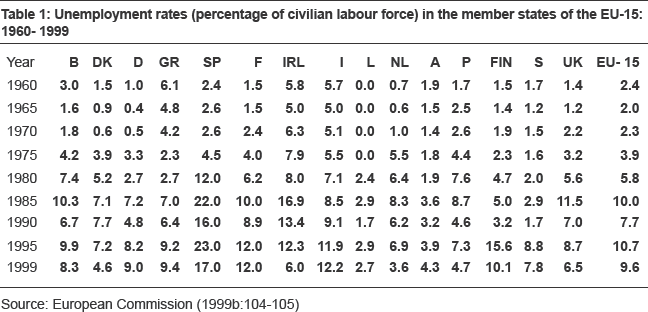
dramatically increased in some[1] north-western European countries, such as UK, France, Belgium,
Finland, and from the 1980s onwards, in southern Europe (see Table 1), youth transitions into the labour market
became more difficult, complex and prolonged than in the past.
1.2 There have been a variety and contrasting explanations on the causes
of high youth unemployment rates in the European context (for example, in the case
of UK, Rees and Atkinson 1982; Lynch 1984; Jackson 1985; Hart 1988; Antal 1990;
Deakin 1995; Orszag and Snower 1997). Two broad types of explanation can be
identified: those based on the characteristics and attitudes of young people (job
search explanations[2];
blame the victim approach[3]; voluntary unemployment approach[4]); and those that locate the problem in
the changing socio-economic context from the 1970s onwards, as a reflection of
economic recession and restructuring that have been taking place in Europe and
internationally during the last three decades.
1.3 The psychological, economic and societal consequences of youth
unemployment have been extensively studied (Furnham 1994; Petersen and Mortimer
1994; Jackson 1985; Allen and Waton 1986; Green et al 1997). Such studies have shown
that young people experience either ‘extended’ or ‘fractured’ transitions (Wallace
1987; Allatt and Yeadle 1992; Fend 1994; Coles 1995; Williamson 1997a).
‘Extended transitions refer to the fact that the attainment of employment,
leaving home and setting up new households in the 1990s is much more likely to
take place at a later age than in previous decades … [and that] young people are
economically dependent upon their families for longer periods of time …
Fractured transitions refer to situations in which young people move from one
status position, without managing to attain a secure, stable or positive outcome
in another. So, for instance, young people may leave education but not obtain a
job … At their worst, fractured transitions result in long-term and chronic
unemployment, dislocation and estrangement from families, and homelessness’
(Coles 1995:30- 31).
1.4 This article concentrates on youth transitions into the labour
market in one EU member state, Greece. The aim is not to record the diversity of
experiences of Greek young unemployed (eg: school drop outs, single-mothers,
disabled etc)[5], but to
explore ways in which the Greek state has responded to the problem of youth
unemployment in general, looking at policies (passive and active) introduced to
address this. It reveals that state policies and social norms deeply embedded in the
Greek culture, rather than encouraging acquisition of ‘full-citizenship’ and
financial independence, restrict young people's chances for independence from the
family. As is the case in other southern European countries, in Greece, the family
and informal clientelistic networks of relatives and friends have acted as the
primary source of economic and social support for young people. We argue that four
co-centric circles circumscribe the type of citizenship available to a young person
and have implications for young people's acquisition of full citizenship and
financial independence: (a) the family, (b) friends and acquaintances, (c) changes
in the labour market and (d) opportunities offered to the young unemployed through
passive (benefits, social assistance) and active (vocational training) labour market
policies available. With regard to young peoples’ ability to become financially
independent, these either exercise a centrifugal force, encouraging
dependency upon others (especially parents and close friends) for care, guidance and
support, or a centripetal force, encouraging them to assume full
rights and responsibilities of adulthood.
Conceptualising ‘Youth’ and ‘Youth Citizenship’
2.1 Concepts such as ‘youth’ and ‘youth citizenship’ are socially
constructed. Their definition changes over time and must be understood within a
particular historical and cultural context (Jones and Wallace 1992:3). In the
literature one can only find a general agreement that ‘youth’ is an intermediate
stage between childhood and adulthood, a transitory stage before reaching adulthood
and full integration into society (Jones and Wallace, 1992:3). Such a definition, of
course, begs the question as to what we mean by childhood and adulthood, and where
the demarcation line between the two is. Statisticians and policy makers have used a
chronological age as a bench mark, eg: those aged fifteen to twenty- five, the lower
age band representing the minimum school leaving age (Blakely, 1990:15). Although
this type of definition is useful for statistical purposes, it has been criticised
for being arbitrary (Coleman 1992; Coles 1995; Harris 1989:37; Jones and Wallace
1992). ‘Terms such as “adolescence” or “adulthood” are related to life course events
and social relationships, and are relatively loosely associated with physical age …
Youth in particular, is a process of definition and re-definition enacted between
young people and their families, their peers and the institutions of the wider
society’ (Jones and Wallace, 1992:4).
2.2 Coles (1995:8) identifies three ‘main transitions of youth’: First,
the transition from full- time education and training to a full-time job in the
labour market (school-to-work transition). Second, the transition from family of
origin to family of destination (the domestic transition). Third, the transition
from residence with parents to living away from them (housing transition). These
three main youth transitions are shaped by a variety of factors, such as the labour
market and economic changes at both national and international levels. Moreover,
state policies (economic and social) contain opportunity structures (in terms of
education, training and welfare), that shape youth transitions and thus prescribe a
variety of choices for young people. These vary not only between countries but also
within one country. ‘The full rights and responsibilities of adulthood are given
gradually, and at different ages in different countries, while parents and legal
guardians are expected and required to help young people make their transition to
full adult status’ (Coles 1995:6). In this way, young people are granted a ‘hybrid’
status of ‘both semi- dependency and semi-independency’
(ibid:7).
2.3 With regard to law, in some countries, the law does not provide a
clear cut definition of ‘youth’. In Greece, for example, some rights and
responsibilities are granted earlier than others. For example, the legal right to
engage in employment is given at the age of 14, the right to leave school and the
right to marry (with the parents’ consent) at 16, whereas the rights to vote and to
drive a car are delayed until the age of 18. These examples illustrate that even in
one country, there is no clear end to the status of childhood and no clear age at
which young people are given full adult rights and responsibilities. Moreover, many
rights and responsibilities are dependent not only upon chronological age but are
also status contingent. For example in Greece, young people are entitled to free
medical treatment and special prices on public transport, while in education.
According to Coleman (1992:21), this uncertainty of status fact has considerable
effects, as it ‘often serves to place young people in positions where they have very
little power and where damaging stereotypes can flourish easily’.
2.4 Moreover, young people are often seen as sucked into an underclass,
at the bottom of the social heap[6]. For some, the alleged formation of the youth underclass
‘constitutes an ideological smokescreen which … diverts attention from government
culpability, presenting “public issues” of policy failure as “personal issues” of
degeneracy and moral turpitude’ (Craine 1997:130). Others (Baldwin, Coles and
Mitchell, 1997) have stressed that it homogenises the experiences of young people
and fails to take into consideration the multiple processes of exclusion and the
diversity/difference of the groups and individuals being affected. Yet others
(Roberts, 1997), have tried to combine culturalist and structural accounts and
identify the youth underclass in terms of its social-structural factors (economic
exclusion) as well as in terms of cultural factors (shared values, activities,
cultural outlooks). According to Roberts (1997:43-44), young people in Britain have
survived unemployment through receiving ‘financial, social and emotional’ support
from their families. However, he acknowledges that young people whose parents are
unemployed and come from single-parent households experience higher risk of
long-term unemployment; this combined with lifestyle factors separate them from the
employed and their culture often acts as an additional impediment to their
absorption into the working population (ibid:55).
2.5 What is it about the social conditions of youth in Greece that lead
them to be or not to be considered as key members of an alleged underclass? As we
shall show below, young people in Greece experience social, economic and political
conditions different to those encountered by their west-European counterparts.
Family life, education, state welfare system in Greece have all shaped the social
situation of youth in such a way that despite the rapid decline of employment
opportunities in the formal labour market, school leavers still manage to survive.
Supportive family networks and clientelistic networks open the doors to better
education and employment futures, which in turn provide the resources that enable
them to carve out successful paths. Of course not all ‘survive’. Young people whose
parents are unemployed or come from single-parent households are especially
disadvantaged, experience higher risk of long-term unemployment compared to their
peers. However, although the experiences of young unemployed differ, it is important
to understand the structural processes that operate and examine what kind of career
paths they circumscribe. Finally one has to be aware of the limitations and dangers
of adopting the American or British notion of the underclass in understanding the
position of young Greek people; in the case of Greece, for example, familialism and
patronage function as a safety valve which, by en large, protects young people from
joining the ranks of the underclass.
The Case of Greece
3.1 Like other Southern European member states, youth transitions in the
Greek labour market seem to have been moving towards the same directions as their
north-western counterparts. The youth unemployment rate in Greece started to
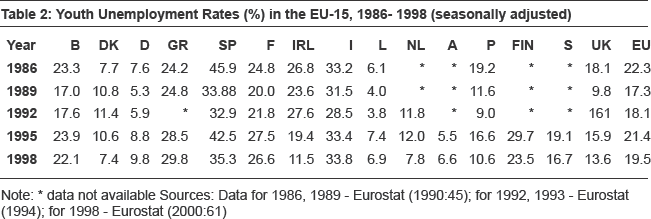
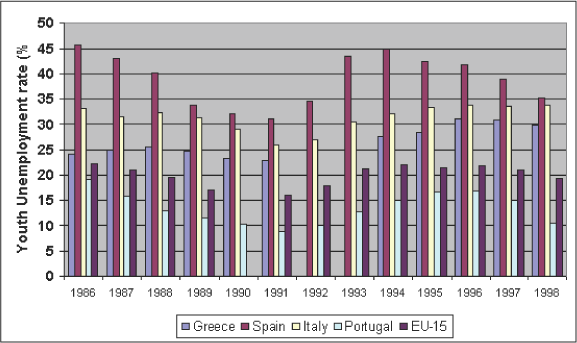
dramatically increase in the late 1980s[7]. In the early 1990s it reached one of the highest levels
among EU member states - (see Table
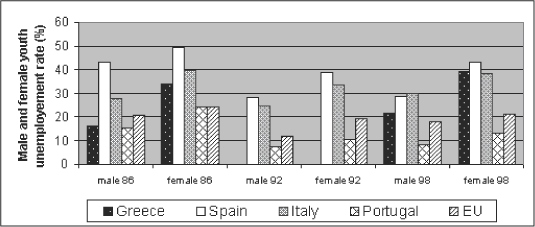
2 and Graph 1). In 1998, for example, the rate was 29.8% and it was the
third higher after Spain (35.3%), Italy (33.8%). Young women are particularly
vulnerable; in the period 1986-1998, the unemployment rate for young women was
double to that of young men (see Graph 2) in most EU countries. Moreover, long term
unemployment rates are particularly high for young people (younger than 25), that is
13.6% in 1995 compared to 3.9% and 1.1% for those aged 25-54 and 55 plus,
respectively (OECD 1995 cited in Demekas and Kontolemis 1997a:94).
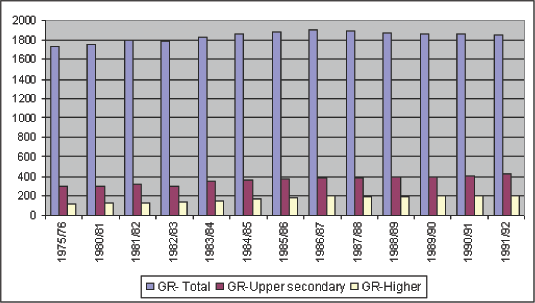
3.2 The expansion of education and training and the increasing number of
young people remaining in upper secondary and higher education beyond the age of 16
(see Graph 3), have meant that fewer and fewer go straight into employment after
leaving school. Despite this, educational attainment can no longer guarantee a
smooth transition into the labour market[8]. The high level of youth unemployment in Greece among
individuals with a high human capital and higher educational qualifications [33,4%
in 1991(Demekas and Kontolemis 1997a:90)], demonstrates that educational attainment
that traditionally (eg: in the 1960s and 1970s) secured a job and upward social
mobility has lost its value. It also suggests that young people are reluctant in
lowering their expectations and accepting a job not on a par with their
qualifications and skills and aspirations for upward social mobility. Such
aspirations are shared by the family which is willing to support young people over
long periods of time, ‘mehri to pedi na bri tin doulia pou tou teriazi’
‘until the child finds a suitable job’.
3.3 Unlike North-Western member sates of the EU, the psychological,
economic and societal consequences of youth unemployment in Greece and the responses
of young people to these changes remain largely unstudied. It is only recently that
the problem has attracted some attention and this is related to the EU's initiatives
to gather information on vocational training and guidance available to young people
across Europe (Rajan 1990; Lazos 1995; Mingione and Contiero UNDATED;
Zanni-Teliopoulou 1995; CEDEFOP 1992a; CEDEFOP 1992b; CEDEFOP 1995; CEDEFOP 1997).
Such studies indicate that similar to young people in other member states of the EU,
young people in Greece experience either ‘extended’ or
‘fractured’ transitions. Attainment of employment, leaving home
and setting up new households is much more likely to take place at a later age than
in previous decades. Some experience what one can call the ‘revolving door
entrapment’ of training schemes, unemployment or employment in the
Greek parallel economy and yet more training schemes. So, in Greece one can observe
Craine's (1997:137) patterns of ‘post-school’ progression: ‘traditional[9]‘, ‘protracted[10]‘ and ‘cyclical[11]‘. However, the phenomenon
of ‘anti- employment careers’ does not seem to be as widespread as in Craine's
case-study, where there is a high correlation between long-term unemployment and
youth crime (Craine 1997:149). In addition, single motherhood is not an option for
the young Greek women; this can be attributed to the lack of state support for young
lone mothers and the ‘honour and shame’ value system which makes lone parenthood a
not socially acceptable choice (see Lazaridis 1995).
3.4 Before discussing the peculiarities of the measures introduced to
deal with youth unemployment, we need to briefly look at the development of the
socio-economic and political structures as these influence considerably the nature
of the welfare state, the direction of youth transitions and young people's
acquisition of social citizenship.
Socio-Economico-Political Structures and the Greek Welfare State: a Schematic
Overview
4.1 Although it has been argued that the Greek welfare state has
elements of the ‘corporatist/continental’ welfare regime (see Katrougalos 1996),
this ideal type cannot capture and explain its peculiarities. Here, we will adopt
Ferrera's (1996) point of view that Southern European welfare states share common
elements - in particular a ‘dualism’ of social protection, statism/clientelism and
familialism - which distinguishes them both from the ‘continental’ and the ‘liberal’
welfare states of the north-western countries of the EU. They belong, following
Ferrera (1996), to the ‘Southern European model of welfare[12]‘.
4.2 The Greek welfare state has developed under different circumstances
and has followed a different trajectory to that followed by its north-western
counterparts[13]
(Maloutas and Economou 1988; Petmezidou 1991 and 1996; Symeonidou 1995; Stathopoulos
1996:137-139). In the 1950s and 1960s, and till the late 1970s the country
experienced rapid economic growth, ‘averaging 8% per year’ (Katrougalos 1996:48),
which was, to a certain extent, the outcome of structural changes in the economy,
reflecting a late industrialisation, followed by a rapid shift to post-Fordism
without passing through a stage of intense industrialisation. Nowadays, the tertiary
sector is the larger sector, employing 46% of all persons in employment. 21% of the
labour force is still employed in agriculture (compared to 8% in Italy, 10% in Spain
and 12% in Portugal [Petmesidou 1996:328]), while the secondary sector remains
underdeveloped, in that ‘less than one fifth of those in employment, work in
manufacturing…Within the tertiary sector most of the employment, is concentrated…in…
trade (both wholesale and retail), restaurants and hotels, and miscellaneous
services (mostly public employment)’ (Karantinos et al 1992:22-23).
4.3 Among the four south European countries, Greece has the highest rate
of self-employed (47% of the labour force) compared to 29% in Italy, 26% in Spain
and 27% in Portugal (Petmezidou 1996:328-329). While small family-based enterprises
have flourished, ‘the proportion of salaried and waged workers remaining the lowest
in the Community’ (Karantinos et al 1992:107). Another characteristic of the Greek
labour market is high involvement in the informal sector and multi-occupation. In
1990, for example, 58% of salary and wage earners held on a regular basis a second
job to make up for real wage losses (Karantinos et al 1992: 18).
4.4 The state has been the main means for the creation and appropriation
of income, wealth and revenue; it functions as an employer of the first resort,
often in a parasitic way. This, ‘together with the widespread ideology that
everything is a matter of politics, has often led “to the open use of political
means by the contending parties for getting access to benefits” and resources’
(Petmezidou 1996:329). One could give various examples of discretionary
appropriation of resources and benefits which can then be distributed within one's
family. These include ‘…informal economic activities tolerated by the state, the
abuse of invalidity benefits, or even “discretionary” granting of other types of
social benefits and subsidies on a particularistic-clientelistic basis’ (Petmezidou
1996:330). Thus, the mode of functioning of the state in Greece (and in other
southern European countries) is distinct from that of their European counterparts,
‘with significant allocative and distributive implications’ (Ferrera 1996:25). Most
typically, however, welfare manipulation takes the form of political clientelism
(Ferrera 1996:25). Usually votes were given to a particular party for the
recruitment of one's family member in the civil service or for gaining discretionary
access to benefits and other resources[14]. This practice has, since WWII, been widespread and still
remains to a considerable degree a common and accepted practice for securing a job
in the civil service. So ‘who’ you know is more important that ‘what’ you
know[15].
‘Closely linked with this statist/clientelistic mode of welfare provision is the
role of family/household as a key unit in redistribution… the family/household
constitutes a strategic unit of decision-making regarding the employment
opportunities and welfare of its members. Family strategies combine formal and
informal economic activities, private and public employment, and efforts to
improve their members’ access to clientelistic clusters and discretionary
benefits’ (Petmezidou 1996:330).
4.5 Young people whose families and kin fail to ensure a
‘traditional’ post-school transition (Craine 1997:137) by
securing a position in the civil service for them, end up experiencing a more
‘protracted’ transition (ibid) by taking up
irregular activities which are rarely vocational oriented, or even if they are,
these fall short of young people's expectations and hence, are likely to move from
periods of sub-employment (unstable work) to periods of unemployment. The family
often constitutes the primary source of support for the young unemployed and acts as
a safety valve against what Craine (1997:138) calls a ‘cyclical’
post-school transition and eventual slide into labour market withdrawal and
rejection and turning into, what Williamson (1997b) calls a ‘Status
Zer0’ youth[16], for whom the underclass may become a social reality. In
addition, Greece is a country with high levels of cohabitation of young people with
their families. The transition from residence with parents to living away from home
occurs at a relatively later stage of one's life, and coincides with getting married
and starting a new family. The family, in other words, plays a crucial role in the
provision of welfare services. This, in turn, strongly affects the youth labour
market in that, as we argue below, a coherent and systematic youth employment policy
was until recently, non-existent in Greece (see below). In addition, Greece is a
country with high levels of cohabitation of young people with their families. The
transition from residence with parents to living away from home occurs at a
relatively later stage of one's life, and coincides with getting married and
starting a new family.
4.6 The socio-economic and political structures mentioned above, have
hardly favoured the development of a universalist culture and universal social
citizenship. This makes vulnerable groups more at risk, since a well organised
employment policy targeting the young is lacking.
Passive Measures for the Young Unemployed
5.1 In Greece, there is no national non-contributory minimum income
scheme for individuals and families with insufficient resources[17] (European Commission
1999a: 458). ‘Thus, a person who is neither old nor an individual with special
needs, but has neither a job nor contributory entitlements nor source of income, is
not entitled to any support from the state, as evidence of low income and of living
in poverty are not in themselves enough to entitle one to any support from the
state’ (Ferrera 1996: 20). There is available an unemployment benefit scheme for
first time job seekers aged between 20 and 29 years and for some repatriate groups
(European Commission 1999a: 412, 518).
5.2 Young people who have not worked are not entitled to receive
unemployment benefit. The only benefit given to those aged between 20 and 29 is of
short duration (five months only) and rather modest (Law 1545/1985), that is
approximately one fifth of the minimum salary Eligible are those that have been
registered as unemployed within three months after having completed either their
20th year of age or their military service or obtained a degree, or quitted their
studies; the benefit is granted after having remained for a year unemployed or
having earned less that 80 wages within a year (interview with OAED). Because the
benefits available are meagre, arguments of a youth underclass relying on welfare
and exhibiting a ‘welfare dependency’ are of no analytical value in the Greek
context.
5.3 The gap in social protection by the public sector is filled by other
sectors, namely the family and kin - parents have the obligation to support their
children until they get full-employment - as well as other particularistic networks,
the informal sector and the Greek Orthodox church (Leontidou 1993; Symeonidou 1995;
Cavounidis 1996; Karantinos et al 1992:32-40; Katrougalos 1996:56; Chtouris 1992).
These circumscribe different opportunities and risks for Greek youth inclusion in
comparison with their peers in north-western Europe.
Active Labour Market Policies
6.1 A coherent and systematic policy is lacking in Greece. The low
unemployment rates of the 1970s and 1980s (see Table 1) provide a partial explanation. Although
‘spending on labour market programmes has increased rapidly [in the 1980s] between
1985 and 1987 public expenditure on such programmes increased by 63% in nominal
terms’ (Karantinos et al 1992:27; Stathopoulos 1996) - this still remains the lowest
in the EU, ‘absorbing 0.39% of the GDP in 1992’ (Katrougalos 1996:54). As regards
active employment measures such as vocational training and subsidised employment,
these are rather rudimentary when compared with other EU countries, such as Portugal
(0,33%, 0,07%), Denmark (0,47%, 0,43%), Germany (0,42, 0.34%), France (0,44%, 0.26%)
and Ireland (0.48%, 0.43%), amounting to only 0.16% and 0.08% respectively of the
GDP in the early 1990s (OECD 1995, cited in Petmezidou 1996:341).
6.2 The active labour market policies (training, subsidised employment)
in operation since the late 1980s are mainly funded from the European Social Fund
(ESF)[18]. These
mainly aim at providing vocational training to young people with no qualifications
(school drop outs) and at helping those who have skills to update them, as well as
promoting self-employment (Symes 1995:40). They came about as part of the European
Community's transition programme (1982-1987) aiming at facilitating the integration
into the labour market for those aged 14 to 18 (Blakely 1990:16). An integrated
approach started to emerge from 1989 onwards, when the social dimension of the then
European Community was advanced further. Young people also benefited under the
Social Charter of 1989 which Greece had signed; they were to be entitled to ‘initial
vocational training of a sufficient duration to enable them to adapt to the
requirements of their future working life’ (point 23). In addition, a number of
other Community initiatives were introduced[19]. For instance, YOUTHSTART 1 aimed at
young people aged 16-20 and YOUTHSTART 2 at those aged 16-24 who have problems with
change from the school to adult and working life[20]. The EU brought, from top-down, the
problem of youth unemployment in the forefront of the political debate and agenda
for action. It identified young people as one of the groups especially encountering
problems in the labour market, a cohort of need of special attention. Some, have
argued that some of the above mentioned programmes have benefited a limited number
of young Europeans (Popple and Kirby 1995:164-165) and that these need to be
expanded in order to be able to meet the challenge of high ‘youth’ unemployment
rates in the member states of the EU.
6.3 Turning our attention to national efforts, the Greek Manpower
Employment Organisation (OAED) in the 1990s gave subsidies to employers for hiring
young unemployed (aged between 18 and 25), and to young people for creating their
own micro-businesses, especially if it was to be set up in a ‘high in unemployment
area’ (de-industrialised areas such as Lavrion, North Evia, Patra etc) (interview
with OAED). Since the late 1980s the resources for vocational training schemes have
been increasing, as European Community aid helped to increase the percentage of GDP
devoted to education by an average of 0.22%, and contributed to the introduction of
some active labour market measures (European Commission 1995:22).
6.4 During the implementation of the First Support Framework, a large
number (over one million) of fictitious centres for vocational training (KEKs),
sprang up. These totally lacked any experience and know-how in organising and
delivering such training courses. Their primary aim was to appropriate financial
resources available from the ESF ‘while workers and the unemployed co-operate to
this collusive manipulation in return for a meagre benefit’ (Petmezidou 1996:342).
The picture has slightly improved since the implementation of the Second Support
Framework (1994-1999); this is due to the introduction of a new law aiming at
rationalising vocational training by allowing only certified centres to deliver
training courses (ibid).
6.5 Greece received from the initiative YOUTHSTART (1994-1999)
14,030,000 ECU (interview with Ministry of Labour). In particular, 32 projects were
approved in the period 1994-6 and 48 in the period 1997-9 (Ministry of Labour and
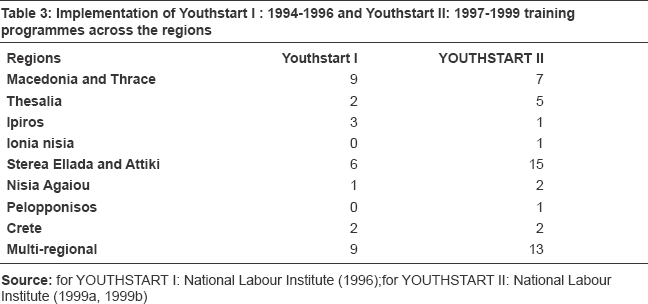
Social Affairs 1998; 1996; National Labour Institute 1996). As can be seen from
Table 3, there was a regional
distribution of these programmes, some of which were multi-regional. An evaluation
of these projects and their success in combating youth unemployment is, however,
lacking. Moreover, the institutions[21] responsible for the implementation of the programmes do
not keep detailed records of who benefited and in what way. Lack of monitoring
mechanisms of the implementation process, efficient data collection on local labour
market and availability of jobs, regular official reports on the national state of
demand for labour, mean that the capacity for judging the potential benefits of the
training programmes introduced via the YOUTHSTART initiative, are limited (interview
with officials in the National Institute of Labour).
6.6 There is no available date for the number of people who participated
in YOUTHSTART I; only 714 participated in the training programmes under YOUTHSTART
II; 206 of them were trained to work as consultants and trainers within these
programmes; therefore the number of young people trained with the aim to find a job,
was relatively small. When it comes to evaluating the effectiveness of training and
other employment related measures, the number of those who succeed in finding a job
is a key indicator of success or failure. The data from YOUTHSTART I show that only
a small number (39) of participants got employment and only two benefited from
initiatives encouraging self- employment (National Labour Institute 1998:6-8). Why?
The answer lies with implementation problems.
6.7 The implementation suffers from problems deeply rooted in the
policy styles and organisational structures of the Greek administrative system
as well as an over-developed state apparatus, playing a dominant part in the
economy and society. Difficulties range from infrastructural problems to
attitudes of officials and policy makers, to problems faced by the target
groups. It is to these problems that we will now turn our attention.
6.8 (a) One of the problems is lack of continuation of funding for
their implementation (interview with officials in GGLE). ‘As long as there is
funding, the programme operates; once the funding expires, the programme
“expires” too … ‘ (interview, ministry of Labour). Thus a major problem that
arises is the economic ‘survival’ of established institutions, such as careers
information centres, counselling centres, as no effort is made either at the
national or local level to develop ways of supporting these financially.
6.9 In addition, the tardiness in distribution of funds often
results in inter-agency conflicts over allocation of funds and in serious delays
in implementation (interviews with officials from EIYAPOE). Officials we
interviewed in the Ministry of Labour attribute this delay to the failure of the
respective agencies to meet deadlines set for submitting all relevant documents.
This argument is however, directly related to the next problem of consideration,
the administrative structure.
6.10 (b) The administrative structure accounts for
much of the problems of introducing effective policies. Lack of good
co-ordination and effective collaboration between the different agencies
involved, affect implementation. As a key informant put it, ‘from my experience
I have seen that there is bad co-ordination between agencies involved … And then
the budgets are broken down and everyone is doing the same thing … there is no
archive in Greece for keeping records of who is doing what …. as a result both
money and time are wasted …’ (interview with EIYAPOE). The actions taken by
official agencies are often fragmentary and short-sighted (interviews with
INE/GSEE, GGLE). Thus ‘different agencies [often] submit independently proposals
for the same subject, in the same field, for the same target group instead of
working together …’ (interview with GGLE). There is also lack of
cross-fertilisation between the different programmes implemented under the
YOUTHSTART initiative. ‘They are introverted, they do not want to share their
experiences and exchange ideas with other similar programmes that are currently
implemented’ (interview Labour Institute of General Confederation of Greek
Workers INE/GSEE).
6.11 In addition, lack of co- ordination between inter-agency and
centre-periphery levels, means difficulties in introducing effective
administration into traditional bureaucracies. Some key informants stressed the
lack of adequate administrative structure in the periphery with respect to
know-how and resources, which makes it difficult for them to implement new
procedures. This is exacerbated by the involvement of ‘decorative’
partners[23] -
often an add on appendix to make the up numbers - who play a non-active role in
the implementation process. Furthermore, a lack of participation of social
actors and private businesses was common in most of these programmes. Moreover,
programmes local authorities were involved in, suffered from a change of actors
after elections due to the preferential patronage appointments system.
Institutional adaptation is generally slow and this is reflected in the
personnel's approach to problem-solving and policy outlook. Long delays due to
the Kafkian nature of the Greek bureaucracy, bureaucratic lethargy and the
weakness of efficiency values and professional competence and widespread
clientelistic practices were among of the problems stressed by key informants.
The rationalisation of the local bureaucracy is necessary.
6.12 (c) Other problems touching upon issues of efficiency relate to
lack of institutionalised channels of contact and strategies of consultation
with the target groups and ill dissemination of information. ‘
.. The Ministry of Labour is only interested in publicising an official
proclamation for a programme in the local press, which the target group are not
likely to spot. This is unacceptable ….’ (interview with GGLE). Target groups
were approached and treated as a group rather than individual persons with
different needs. This is further exacerbated by the lack of personnel with the
necessary know-how and qualifications; hence a social worker may be preparing
accountancy forms or carrying our other administrative tasks in one programme
while an accountant plays the social worker's role in another.
6.13 A major problem in YOUTHSTART 1 was the 16-20 age limit, which
by definition excluded young Greek men who did not finish high school and joined
the army at the age of 18. Therefore more girls benefited from YOUTHSTART 1 than
boys, ‘despite the fact that it is boys from poor households who drop out of
school’ (interview with key informant). From the boys who participated, the
majority were high school graduates and young people from rural areas. The
programme therefore did not benefit the ‘Status Zer0’ youth,
that is those young men not in education, training or employment with no family
backing, who suffer from unjust inadequate government policies described
above.
6.14 Another problem is that these policies are geared towards
first-job seekers with no qualifications, playing the role of the once upon a
time apprenticeship. They fail to address the problem of youth ‘intellectual
unemployment’, as well as the problems faced by those who have had a job but
found themselves amongst the ranks of the unemployed. In practice, these were
seen as a time filler rather than as a way of acquiring some experiential
resources to be used in a future work career. Also, there is the problem of
‘value’ of the qualifications and skills acquired under these schemes. A key
informant in the ministry of Labour stressed that laws should be introduced
acknowledging the certificates obtained through training as ‘proper’ educational
qualifications (interview, Ministry of Labour). Moreover, training hours exclude
by default those who are casually employed in the informal economy. In addition,
there is no research on the work available in the local setting in order to
match the training to this.
6.15 Another problem is that most of those who join these programmes
join them for the wrong reasons; as an interviewee put it: ‘Some join vocational
training programmes and they do not even realise in which programme they are …
not even the title … believe me …. I have interviewed people and I asked them
“in which programme would you like to participate” and they do not know what to
answer … They come for the subsidy … they have financial problems’ (INE/GSEE).
Another interviewee added: ‘they are unemployed, they have to survive’ (Ministry
of Labour). In addition, personalistic relationships between Greece's political
parties and its citizens often determine who joins which programme and why.
6.16 (d) The YOUTHSTART programme has appeared at a time of
widespread protest and general dissatisfaction with the present educational
reforms. Public information can clearly play a significant role, issuing reports
and publicity on vocational training. The overwhelming emphasis on formal
education however, does not allow for pressure group sensitivity in so far as
vocational training is concerned. As a key informant from the INE/GSEE said:
‘there is of course the attitude that “we must help” someone, but the idea that
there should be provision for vocational training necessary for someone to be
able to find a job, is lacking…. one should not, in other words be forced to
follow the classical methods [she means manipulation of clientelistic networks]
… but via these programmes we must offer specialised training, the type of
training necessary to meet these peoples’ needs. Our attitude must change from
‘let us help this poor kid’, to ‘this person has the ability to get inserted
into society, what we need therefore to give him/her is something [training]
which suits him/her … not, ‘we will teach him something and if s/he manages to
get inserted fine, if not …well… ‘’ (interview, INE/GSEE). An evaluation of the
first phase of YOUTHSTART would have been helpful in identifying who benefited
and who did not; this however, is not yet available and it is too early to make
any estimates for the second phase.
6.17 Political and social actors as well as economic actors play a
significant part in policy implementation. The impact of these programmes on
public opinion is, however, difficult to estimate. A gradual societal response
is likely to emerge in the light of the likely increase in youth unemployment in
the future. Crucial to this will be the way in which the different actors
interact among themselves and with the Greek state. Politicians are convinced
that jobs do win votes. The problem is to convince them that these job
opportunities should be offered via training and re-training rather than via
carefully crafted manipulation of clientelist networks.
Concluding Remarks
7.1 In this article, we examined both passive measures (benefits, social
assistance) and active labour market benefits (emphasis on training) available to
young unemployed people. We have shown that particularly with reference to passive
measures, a social policy vacuum exists, with lack of income support schemes for
long-term unemployed in general and social assistance schemes for young
unemployed.
7.2 The family's role as a primary source of economic and social support
had an impact on youth transitions, in that it prolonged economic dependence of
young people on their parents. The weak welfare structures along with
statism/clientelism and familialism have created a cultural environment which has
had a centrifugal force onto young people's ability to acquire full citizenship and
independence. Due to lack of a social assistance scheme, the family and informal
networks of relatives and friends are the main providers of psychological, emotional
and economic support for the young. The gap in social protection along with the
existence of an informal economy, has led young people to engage in informal
activities or combine both formal and informal activities to generate some income,
while at the same time, together with their families, try to enhance their access to
political/clientelistic networks and thus obtain a secure and permanent job,
especially in the civil service. In this context, young people's access to
employment is influenced by and seems to be dependent on their family's economic
resources, political bargaining power and social capital. This has detrimental
effects on their acquisition of full citizenship. Young Greeks gain ‘citizenship by
proxy’, that is their citizenship rights are compromised by their economic
dependence on familial resources.
7.3 Entry into adult life has become more difficult for those who face
uncertainty, with considerable implications for transition; such transitions of
course are influenced by the historical, cultural context of society, which creates
different structures of opportunity for the young unemployed. For example,
transitions have not culminated into homelessness, as in other parts of Europe, as
strong family ties and the informal economy have acted as ‘absorbers’ of the crisis
and a safety valve against the emergence of what Wilkinson (1995) calls a
‘drop-out-society’. Thus, in the Greek context, one cannot argue in favour of an
emerging youth underclass, or of ‘underwolves’ (Wilkinson and Mulgan 1995).
7.4 Regarding active labour market policies, we looked at the
introduction of some vocational training courses and programmes, financed to a large
extent by the European Social Fund, such as Youthstart I and II. We have identified
some problems with the implementation of YOUTHSTART which meant its failure to
achieve the full integration of the young in the country's economic life. A
new policy should be introduced which would ‘try to integrate
all aspects of the process of integration of young people in adult life, including
education and training, experimentation and discovery, guidance and orientation,
economic autonomy, cultural, social and political participation, creativity and
openness’ (Fragniere and Doorten 1983:11). A prerequisite to improve the
effectiveness of existing policies is to have a more efficient
administration, with clear distinction between the roles and responsibilities of the
institutions involved; moreover, it is imperative that a transparent structure of
intervention is introduced which will enable and facilitate the effective monitoring
and evaluation of these policies. Although an attempt has been made to decentralise
labour market policies at the regional and local levels, and to encourage the
co-operation between public and private organisations, this has not resulted in the
cost effective use of available funds… Such attempts must cut across
particularistic-clientelistic forms of social organisation. The so called ‘political
credentials’ and/or ‘contacts’ as the main means for getting access to such courses
must be replaced by an axiocratic system which will promote inclusion on the basis
of their needs and citizenship rights rather than on the basis of their family's and
kin's political bargaining power. Today, despite the still wide legitimation for
statist ideology and practice, and the relatively strong family solidarity, the role
of the family as ‘a primary support unit for individuals against unemployment’ often
acts as a centrifugal force towards young people who seek employment. The new
policies must therefore try to counteract this centrifugal force, and transform it
into a centipetal one, so that young people become independent from their
families.
Tables and Graphs
Unemployment rates (percentage of civilian labour force) in the member states
of the EU-15: 1960- 1999
Year
B
DK
D
GR
SP
F
IRL
I
L
NL
A
P
FIN
S
UK
EU- 15
1960
3.0
1.5
1.0
6.1
2.4
1.5
5.8
5.7
0.0
0.7
1.9
1.7
1.5
1.7
1.4
2.4
1965
1.6
0.9
0.4
4.8
2.6
1.5
5.0
5.0
0.0
0.6
1.5
2.5
1.4
1.2
1.2
2.0
1970
1.8
0.6
0.5
4.2
2.6
2.4
6.3
5.1
0.0
1.0
1.4
2.6
1.9
1.5
2.2
2.3
1975
4.2
3.9
3.3
2.3
4.5
4.0
7.9
5.5
0.0
5.5
1.8
4.4
2.3
1.6
3.2
3.9
1980
7.4
5.2
2.7
2.7
12.0
6.2
8.0
7.1
2.4
6.4
1.9
7.6
4.7
2.0
5.6
5.8
1985
10.3
7.1
7.2
7.0
22.0
10.0
16.9
8.5
2.9
8.3
3.6
8.7
5.0
2.9
11.5
10.0
1990
6.7
7.7
4.8
6.4
16.0
8.9
13.4
9.1
1.7
6.2
3.2
4.6
3.2
1.7
7.0
7.7
1995
9.9
7.2
8.2
9.2
23.0
12.0
12.3
11.9
2.9
6.9
3.9
7.3
15.6
8.8
8.7
10.7
1999
8.3
4.6
9.0
9.4
17.0
12.0
6.0
12.2
2.7
3.6
4.3
4.7
10.1
7.8
6.5
9.6
Source: European Commission (1999b:104-105)
Youth Unemployment Rates (%) in the EU-15, 1986- 1998 (seasonally
adjusted)
data not available Sources: Data for 1986, 1989 - Eurostat (1990:45); for
1992, 1993 - Eurostat (1994); for 1998 - Eurostat (2000:61)
Implementation of Youthstart I : 1994-1996 and Youthstart II: 1997-1999
training programmes across the regions
Regions
Youthstart I
YOUTHSTART II
Macedonia and Thrace
9
7
Thesalia
2
5
Ipiros
3
1
Ionia nisia
0
1
Sterea Ellada and Attiki
6
15
Nisia Agaiou
1
2
Pelopponisos
0
1
Crete
2
2
Multi-regional
9
13
Source: for YOUTHSTART I: National Labour Institute
(1996);for YOUTHSTART II: National Labour Institute (1999a, 1999b)
Youth unemployment rates (%) in Southern European countries, 1986- 1998
(seasonally adjusted)
Male and female youth unemployment rates (seasonally adjusted, %) in the EU,
1988, 1992 and 1998
Number of pupils and students in all levels of education (ISCED 1-7), upper
secondary education (ISCED 2), in higher education (ISCED 5-7) in EU-15 and
Greece, 1975-1992
Footnotes
1
An exception here are Germany, the Netherlands Austria and Luxemburg where youth
unemployment rates are low (see ).
2
Young people need more time to find a suitable job compared to adults.
3
Those endorsing this approach argue that young people ‘do not accept work
discipline.. show little enthusiasm for the work itself’, their personal
appearance is not the appropriate one, lack appropriate skills and
qualifications (Jackson 1985:50).
4
It is claimed that young people themselves may lack motivation to search for a
job or are unwilling ‘to accept certain kinds of jobs: in particular the low
paid jobs which involve a great deal of repetitive work’. This is because young
people ‘rely on their families for support’ (an explanation which can be applied
to Greece) [and on] the benefits they receive from the state’ (Jackson
1985:53).
5
This issue remains unresearched in Greece and will be the focus of our future
research.
6
Westergaard (1992) identified four different versions of the underclass thesis.
First, there are the agnostics, arguing for need of more research to evaluate
the analytical usefulness of the argument (Smith 1992a; Smith 1992b; Westergaard
1992). Second, there are those who reject the underclass thesis and an
empirically unsupported ideological red herring (Bagguley and Mann 1992). Third,
the individualist/culturalist theories, which put emphasis on anti-social
actions, welfare dependency moral irresponsibility and deviant behaviour. An
exemplar of this position is Murray's (1990) work; he argues that single
motherhood, unemployment and crime are interwoven in the cultural reproduction
of the underclass. Fourth, structural accounts (Dahrendorf 1987); here the
underclass is seen as an outcome of social and economic change (absence of
legitimate employment due to deregulation of the labour market and increasing
flexibility). In much of the debate, there is emphasis on the youthfulness of
the protagonists (MacDonald 1997:19).
7
The unemployment rate in Greece started to increase sharply since the early
1980s, it remained in high levels all though the 1980s and it increased again
from the early 1990s onwards (see ). Thus from 2% in 1973 it reached 7.2% in 1984 and 9.4% in
1999 - slightly below the EU average (9.6%) (European Commission 1999: 104-105).
With these rates Greece is classified as a country with medium unemployment
rates, since they are comparatively low when compared with other EU countries
(see Table 1). However, there
are considerable regional variations. In 1995, in some regions, such as Crete,
unemployment rates run below 6%, whereas in others these range from 8% to 10%
(eg: Thrace, East Macedonia) and yet in others the unemployment rate is more
than 20% (eg: West Macedonia), that is well above the EU average 10.7% (Eurostat
1996). The extent of long-term unemployment is also relatively high, in that in
1995, 4.8% of the unemployed have been out of work for more than 12 months
(Demekas and Kontolemis 1997b:58). Long term unemployment is particularly
affecting women and young people (Ketsetzopoulou and Bouzas 1996:154-160). In
1995, the long term unemployment rates for women are three times higher (8.5%)
than that for men (2.5%) (Demekas and Kontolemis 1997b:58).
8
Educational attainment which once upon a time (especially during the 1960s and
1970s) was one of the factors that helped secure a job and upward social
mobility (Tsoukalas 1987; 1993) has now lost its value.
9
Post-school transition directly into primary employment.
10
Transition via a variety of experiences, such as unemployment, underemployment, a
variety of programmes.
11
They become trapped and develop ‘alternative careers’ which often involve illegal
activities (see Craine 1997:145-149).
12
Ferrera (1996) identified some common traits of the welfare states in the four
main southern European countries. These are: fragmented and ‘corporatist’ income
maintenance system; dualistic system of income maintenance with higher protected
beneficiaries (eg: public employees, white collar workers, private wage earners
of medium and large enterprises working on full contract with job security) on
the one hand, who receive generous replacement benefits and pensions, and
under-protected workers and citizens on the other (eg: irregular workers in weak
sectors with no job security, workers in the informal sector, unemployed), who
draw meagre benefits; the establishment of National Health Systems based on
universalistic principles; persistence of clientelism and patronage and high
vulnerability of public institutions to partisan pressures and manipulations;
low degree of state penetration of the welfare sphere and a ‘highly collusive
mix between public and non public actors and institutions’
(ibid).
13
Until the late 1970s, welfare state policies were rudimentary in Greece and a
debate on the need for a welfare state was almost non-existent (Petmezidou 1996:
325). ‘The dominant view in society was that economic development and the
ensuing general improvement of the standard of living would be enough to
alleviate such problems’ (ibid). The expansion of social
protection occurred in the first half of the 1980s, when the shrinking of the
welfare state was taking place in most of western Europe, because of economic
recession.
14
All major parties have exploited the unemployment problem in Greece for purposes
of re-election. The first favour asked of elected representatives by Greek
voters is to find them a job in the public sector. According to estimates by the
New Democracy party, 80% of requests by party members are for employment in the
civil service (Samatas 1993). Each party tends to their own - I diki
mas - delegates thus work as party employment agencies, exchanging
jobs for votes.
15
In a survey carried out in 1996 by Katsikas and Kavadias (1996) (cited in
INE/GSEE 1996) 51% of graduates of upper secondary education and 47% of
graduates of higher education said that the most important factor in finding a
job was having access to political networks. Only 1% of graduates of higher
education considered that high educational qualifications in itself can lead to
a job.
16
This is a powerful metaphor for people who ‘currently account for nothing and
appear to be going nowhere’ (Williamson 1997:78).
17
There is a ‘flat rate allowance for children who are not supported (decree
147/89), flat rate living allowance for repatriates (decree 57/73), a benefit
for people undergoing severe hardship (law 1331/83), flat rate maternity
allowance for mothers with no financial support (law 1331/84), flat rate payment
towards housing benefit, means tested benefit awarded to refugees of Greek
origin coming from Eastern Europe, Egypt or Albania, family allowances for Greek
repatriates, flat rate allowance for single parent families (decree 147/89),
heating allowance for handicapped people and family allowance for those covered
by the Organisation of Agricultural Insurance (OGA) scheme (European Commission
1999a:526, 534).
18
A thorough evaluation of the impact of ESF funding on Greece is lacking.
19
Of particular importance to young people are: Lingua (1987), Erasmus (1987),
Comett (1986), Petra (1987), Youth for Europe (1998), Euroform, Now and
Horizon.
20
Youthstart I identified the following target groups: young people living in
mountainous areas or islands (22%), young people with inadequate qualifications
(35%), young repatriates (6%), young graduates of secondary education (34%),
ex-drug users (3%); training of personel (3%). YOUTHSTART II was also directed
(apart from the above mentioned groups) to the following groups: high-school
graduates, young farmers, young people with phychological problems and/ or
special needs, high school or technical school graduates, school drop- outs,
young people with other health problems (National Labour Institute 1998). The
percentages mentioned above refer to percentage of programmes. Unfortunately
such figures are not available for YOUTHSTART II. An evaluation of the first
phase of YOUTHSTART is not, however, yet available and that it is too early to
make any estimates for the second phase.
21
The following main public institutions are responsible for the co-ordination and
implementation of YOUTHSTART 1 and 2: Ministry of Labour, National Labour
Institute, while numerous private and public institutions such as OAED, Centres
for Vocational Training (KEKs), local authorities, non-governmental
organisations etc. are responsible for its implementation.
22
This section is based on fifteen semi- structured interviews we conducted in 1998
and 1999 in Athens with key informants, working in agencies and institutions
responsible for implementing programmes like Youthstart. These include: OAED
(Greek Manpower Employment Organisation), GGLE (General Secretariat of Greek
Diaspora), EIYAPOE (National Institute for Reception and Integration of
Refugees), Ministry of Labour, Ministry of Justice, INE/GSEE (Institute of
Labour/Greek General Confederation of Labour), EIE (National Institute of
Labour), ERGOPLAN (independent private company participating in employment
generating schemes).
23
When a programme is submitted for funding, this has various partners, ranging
from local authorities, universities, representatives of the local business
community.
References
1.
ALLATTP.,
and YEADLES.
(1992) Youth unemployment and the family: voices of
disordered times, London:
Routledge.
2.
ALLENSh.,
and WATONA.
(1986) “The effects of unemployment: experience
and response”, in
AllenSh.,
WatonA.,
PurcellK.,
and WoodSt. (eds),
The experience of unemployment, pp.
1–16, London:
Macmillan.
3.
ANTALA.B.
(1990) Making ends meet: corporate responses to youth
unemployment in Britain and Germany,
London:
Pinter.
4.
BALDWIND.,
COLESB., and
MITCHELLW.,
“The formation of an underclass or disparate processes of
social exclusion? Evidence from two groups of ‘vulnerable
youth'” in
MacDonaldR.,
(1997) (ed), Youth, the ‘underclass’ and social
exclusion, London:
Routledge, pp.
83–95.
5.
BAGGULEYP.,
and MANNK.
(1992) ‘Idle thieving bastards? Scholarly
representations of the “underclass”’, Work,
Employment and Society, 6(1):
113–26.
6.
BLAKELYG.
(1990) Youth policy,
London: Routledge in
association with the University of Bradford and Spicers Centre for Europe
Ltd.
7.
BROWNPh.,
and CROMPTONR. (eds)
(1994) A new Europe? Economic restructuring and social
exclusion, London:
UCL Press.
8.
CAVOUNIDISJ.
(1996) “ Social welfare services and the fight
against social exclusion”, in
KatsoulisH.
(ed), Dimensions of social exclusion, vol. 1,
Athens: National Centre for
Social Research, pp.
252–271.
9.
CEDEFOP
(1992a) Occupational and qualification structures in
the field of educational and vocational guidance for young people and adults
in Greece, Spain and Italy, Berlin:
CEDEFOP.
10.
CEDEFOP
(1992b) Support policies for business start-ups and the
role of training. National reports from Portugal, Belgium, Greece: Synthesis
ReportBerlin:
CEDEFOP.
11.
CEDEFOP
(1995) Determining the need for vocational counseling
among different target groups of young people under 28 years of age in the
European Community, Berlin:
CEDEFOP, 2nd
edition.
12.
CEDEFOP
(1997) Austria, Belgium, Greece, Luxembourg and the
Netherlands, Berlin:
CEDEFOP.
13.
CHTOURISS.
(1992) Dimensions of poverty and least privileged
groups: the role of the family in social protection,
Athens: Praxis (in
Greek).
14.
COLEMANJ. C.
(1992) “ The nature of adolescence
“, in ColemanJ.
C., and
Warren-AdamsonCh.
(eds), Youth policy in the 1990s: the way forward,
London:
Routledge, pp.
8–27.
15.
COLESB.
(1995) Youth and social policy: youth citizenship and
young careers, London:
UCL Press Limited.
16.
CRAINE St.,,
(1997), The black ‘magic roundabout’: cyclical
transitions and alternative careers, in in
MacDonaldR.,
(1997) (ed), Youth, the ‘underclass’ and social exclusion,
London:
Routledge, pp.
130–152.
17.
DAHRENDORFR.
(1987), The underclass and the future of Britain, 10th
Annual Lecture, Windsor:
St. George's House.
18.
DEAKINB.M.
(1995) The youth labour market in Britain: the role of
intervention, Cambridge:
Cambridge University
Press.
19.
DEMEKASD.
G., and KONTOLEMISZ.
G. (1997a) Labour
market performance and institutions in Greece, South
European Society and Politics, 2
(2): 80–114.
20.
DEMEKASD.
G., and KONTOLEMISZ.
G. (1997b) Unemployment in
Greece: a survey of issues, Working Paper No. 97/17,
Badia Fiesolana: European
University Institute.
21.
EUROPEAN COMMISSION,
(1995) Employment in Europe,
Luxembourg: European
Commission.
22.
EUROPEAN COMMISSION,
(1999a) Social protection in the member states of the
European Union: MISSOC (Community Information System on Social
Protection), Luxembourg:
Office for Official Publications of the European
Communities.
23.
EUROPEAN COMMISSION,
(1999b) European Economy, Vol.
68, pp.
104–105.
24.
EUROSTAT
(1990) Eurostatistics: data for short term economic
analysis, Vol. 11/12,
Luxenbourg:
OOPEC.
25.
EUROSTAT
(1994) Eurostatistics: data for short term economic
analysis, Vol. 12,
Luxembourg:
OOPEC.
26.
EUROSTAT
(1995) Eurostatistics: data for short term economic
analysis, Vol. 12,
Luxembourg:
OOPEC.
27.
EUROSTAT
(1995) Education across the European Union: statistics and
indicators, Luxembourg:
OOPEC.
EUROSTAT
(2000) Eurostatistics: data for short term economic
analysis, Vol. 2,
Luxembourg:
OOPEC.
30.
FENDH.
(1994) “The historical context of transition to
work and youth unemployment”, in
PetersenC.,
MortimerJ.T.
(eds), Youth unemployment and society, pp.
77–94Cambridge: Cambridge University
Press.
31.
FERRERAM.
(1996) “ The ‘Southern model’ of welfare in
social Europe”,Journal of European Social Policy, vol.
6(1):
17–37.
32.
FRAGNIEREG.,
and DOORTENK.
(1983) Employment and youth policy,
Maastricht: European Centre
for Work and Society.
33.
FURNHAMA.
(1994) “The psychological consequences of youth
unemployment”, in
PetersenC.,
MortimerJ. T.
(eds), Youth unemployment and society, pp.
199–226Cambridge: Cambridge University
Press.
34.
GREENJ.K.,
MULROYS., and
O'NEILLM.
(1997), Young people and prostitution from a
youth service perspective, in
BarrettD.
(ed.), Child prostitution in Britain,
London: The Children's
Society, pp.
90–105.
35.
HARRISN.S.
(1989) Social security for young people,
Aldershot:
Avebury.
36.
HARTP.E.
(1988) Youth unemployment in Great Britain,
Cambridge: Cambridge
University Press.
37.
INE/GSEE,
(1996), “Unemployment: a major threat in Greece
and Europe: young people the victims”,Enimerosi, Vol 20 (in Greek).
JONESG., and
WALLACECl.
(1992) Youth, citizenship and family,
Buckingham: Open University
Press.
40.
KARANTINOSD.,
CAVOUNIDISJ.,
IOANNOUCr.,
KONIORDOSM.,
and TINIOSPl.
(1992) EC Observatory on national policies to combat
social exclusion. Consolidated Report Greece,
Athens: National Centre for
Social Research/ Commission of the European
Communities.
41.
KATROUGALOSG.S.
(1996) “The south European welfare model: the
Greek welfare state, in search for an identity”,Journal of European Social Policy, vol.
6(1):
39–60.
42.
KATSIKASCh.,
and KAVADIASG.
(1996) H elliniki ekpaideusi ston orizonta tou 2000
(Greek Education in the year 2000),
Athens:
Gutenberg (in Greek).
43.
KETSETZOPOULOUM.,
and BOUZASN.
(1996) “Labour market function and social
exclusion” in
KatsoulisH.
(ed), Dimensions of social exclusion, vol. 1,
Athens: National Centre for
Social Research, pp.
137–170.
44.
LAZARIDISG.
(1995) “Sexuality and its Cultural Construction
in Western Crete”, inJournal of Gender Studies, vol. 4, No.
3, pp.
281–295.
45.
LAZOSC.G.
(1995) Youth policies in the European Union: structures
and training, Luxembourg:
OOPEC.
46.
LEONTIDOUL.
(1993) “Informal strategies of unemployment
relief in Greek cities: the relevance of family, locality and
housing”, European Planning Studies,
1(1):
43–68.
47.
LYNCHL.M.
(1984) State dependency in youth unemployment: a lost
generation, Discussion Paper No. 184, Centre for Labour Economics,
London: London School of
Economics.
48.
MACDONALDR.
(ed) (1997) Youth, and ‘Underclass’ and Social
Exclusion, London:
Routledge.
49.
MALOUTASTh.,
and ECONOMOUD.
(1988) “ Welfare state: its Greek
version”, in
MaloutasTh.,
EconomouD.
(eds) Problems in the development of the welfare state in
Greece, pp. 13–55,
Athens:
Exantas.
50.
MINISTRY OF LABOUR and SOCIAL
AFFAIRS, (1998) Community Initiative
‘Employment'- YOUTHSTART 1997-99: Greece. Catalogue of the approved
projects, Athens:
Ministry of Labour and Social Affairs (in
Greek).
51.
MINISTRY OF LABOUR and SOCIAL
AFFAIRS (1996) Community Initiative
‘Employment'- YOUTHSTART 1994-96: Greece. Catalogue of the approved
projects, Athens:
Ministry of Labour and Social Affairs (in
Greek).
MURRAYC.
(1990), The emerging British underclass,
London: Institute of Economic
Affairs.
54.
NATIONAL LABOUR INSTITUTE,
(1996) Catalogue of the approved projects under the
Community Initiatives NOW- YOUTHSTART-HORIZON 1994-96,
Athens:
Offset.
55.
NATIONAL LABOUR INSTITUTE,
(1998) Strand YOUTHSTART,
Athens:
NLI.
56.
NATIONAL LABOUR INSTITUTE
(1999a) Catalogue of the approved projects under the
Community Initiatives NOW- YOUTHSTART-HORIZON 1994-96,
Athens: NATIONAL LABOUR
INSTITUTE, (1999b), Persiskopio tis
apasxolisis (Employment Observatory), vol. 11, August, Athens:
NLI.
57.
OECD
(1994) The OECD jobs study,
Paris:
OECD.
58.
OECD (1995)
Employment Outlook, Paris:
OECD.
59.
ORSZAGM.,
and SNOWERD. J.
(1997) Youth unemployment and government
policy, London:
Centre for Economic Policy
Research.
60.
PETERSENA.
C., and
MORTIMERJ. T.
(eds) (1994) Youth unemployment and society,
Cambridge: Cambridge
University Press.
61.
PETMESIDOUM.
(1996) “Social protection in Greece: a brief
glimpse of a welfare state”,Social Policy and Administration,
30(4):
324–347.
62.
PETMESIDOUM.
(1991) “ Statism, social policy and the middle
classes in Greece”, Journal of European Social
Policy, 1(1):
31–48.
63.
POPPLEK.,
and KIRBYR.
(1997) “Winners and losers: young people in
Europe”, in
SpybeyT.
(ed.) Britain in Europe, pp.
161–172,
London:
Routledge.
64.
RAJANA.
(1990) Vocational training scenarios for some member
states of the European Community: a synthesis report for France, Greece,
Italy, Portugal, Spain and the United Kingdom,
Berlin:
CEDEFOP.
65.
REEST.
L., and
ATKINSONP.
(1982) Youth unemployment and state
intervention, London:
Routledge and K. Paul.
66.
ROBERTSK.,
(1997), “Is there an emerging British
‘underclass'? The evidence from youth research”, in
MacDonaldR.,
(1997) (ed), Youth, the ‘underclass’ and social exclusion,
London:
Routledge, pp.
39–54.
67.
SAMATASM.,
(1993), “ Debureaucratizarion Failure in
post-dictatorial Greece: a sociopolitical control approach”,Journal of Modern Greek Studies, Vol.
11(2):
187–217.
68.
SMITHD. (ed)
(1992a) Understanding the Underclass,
London: Policy Studies
Institute.
69.
SMITHD.
(1992b) “The Future of the
Underclass”, in
SmithD. (ed.)
Understanding the Underclass,
London: Policy Studies
Institute.
70.
STATHOPOULOSP.
(1996) “ Greece: what future for the welfare
state?”, in
GeorgeV., and
Taylor-GoobyP.
(eds), European welfare policy: squaring the welfare circle,
pp. 136–154,
London:
Macmillan.
71.
SYMEONIDOUH.
(1995) “ Formal and informal forms of social
protection in Greece”, in
KiriopoulosG.
(ed), Health, social protection and family, pp.
239–254,
Athens: Centre of Health
Sciences, (in Greek).
72.
SYMESV.
(1995) Unemployment in Europe,
London:
Routledge.
73.
TSOUKALASK.
(1987), State, society and work,
Athens:
Themelio. (in Greek).
74.
TSOUKALASK.
(1993), Social development and the state: the
construction of the public sector in Greece,
Athens:
Themelio, 5th edition,
(in Greek).
75.
WALLACECl.
(1987) For richer, for poorer: young people in and out
of work, London:
Tavistock Publications.
76.
WESTERGAARDJ.
(1992), ‘About and beyond the underclass: some
notes on influences of social climate on British sociology’,Sociology, 26:
575–87.
77.
WILKINSONC.
(1995), The drop-out society: young people at the
margin, Leicester:
Youth Work Press.
78.
WILKINSONC.,
and MULGANG.
(1995), Freedom's children,
London:
Demos.
79.
WILLIAMSONH.
(1997a) Youth and policy: contexts and consequences.
Young men, transition and social exclusion,
Aldershot:
Ashgate.
80.
WILLIAMSONH.
(1997b), “Status ZerO youth and the
‘underclass’: some considerations’, in
MacDonaldR.,
(1997) (ed), Youth, the ‘underclass’ and social exclusion,
London:
Routledge, pp.
70–82.
81.
ZANNI-TELIOPOULOUK.
(1995) Determining the need for vocational counseling
among different target groups of young people under 28 years of age in the
European Community: young people's need for vocational guidance in
Greece, Berlin:
CEDEFOP.







 ). Thus from 2% in 1973 it reached 7.2% in 1984 and 9.4% in
1999 - slightly below the EU average (9.6%) (European Commission 1999: 104-105).
With these rates Greece is classified as a country with medium unemployment
rates, since they are comparatively low when compared with other EU countries
(see Table 1). However, there
are considerable regional variations. In 1995, in some regions, such as Crete,
unemployment rates run below 6%, whereas in others these range from 8% to 10%
(eg: Thrace, East Macedonia) and yet in others the unemployment rate is more
than 20% (eg: West Macedonia), that is well above the EU average 10.7% (Eurostat
1996). The extent of long-term unemployment is also relatively high, in that in
1995, 4.8% of the unemployed have been out of work for more than 12 months
(Demekas and Kontolemis 1997b:58). Long term unemployment is particularly
affecting women and young people (Ketsetzopoulou and Bouzas 1996:154-160). In
1995, the long term unemployment rates for women are three times higher (8.5%)
than that for men (2.5%) (Demekas and Kontolemis 1997b:58).
). Thus from 2% in 1973 it reached 7.2% in 1984 and 9.4% in
1999 - slightly below the EU average (9.6%) (European Commission 1999: 104-105).
With these rates Greece is classified as a country with medium unemployment
rates, since they are comparatively low when compared with other EU countries
(see Table 1). However, there
are considerable regional variations. In 1995, in some regions, such as Crete,
unemployment rates run below 6%, whereas in others these range from 8% to 10%
(eg: Thrace, East Macedonia) and yet in others the unemployment rate is more
than 20% (eg: West Macedonia), that is well above the EU average 10.7% (Eurostat
1996). The extent of long-term unemployment is also relatively high, in that in
1995, 4.8% of the unemployed have been out of work for more than 12 months
(Demekas and Kontolemis 1997b:58). Long term unemployment is particularly
affecting women and young people (Ketsetzopoulou and Bouzas 1996:154-160). In
1995, the long term unemployment rates for women are three times higher (8.5%)
than that for men (2.5%) (Demekas and Kontolemis 1997b:58).