The Australian Longitudinal Study on Women's Health was established to track the
health of three age cohorts of Australian women - 40,000 in total - over a
twenty year period. It provides opportunities for research into health and
related issues for women. In this paper, we investigate (1) baseline data from
the young cohort of 1400 survey participants and (2) follow up in-depth
interview data from a small sample of 57 of the original respondents. The focus
of the paper is on the aspirations of young women (aged 18-23) for work, their
ideal job, relationships (including children) and further education,
particularly in the context of gender inequality in labour markets.Through an
analysis of the data, we look at the extent to which gender inequalities are the
result of free choices and preferences and to what extent they are conditioned
by socio-economic structures and processes that reproduce inequalities over
time. This issue is further explored through a classification of women by socio-
economic status. In this way, we can analyse the gender dimension of labour
market inequality in general as well as the relationship of gender inequality to
class inequality in the areas of work, work choice and the ability to combine
work and family responsibilities. Analysis of the two data sets sheds light on
debates about women's workforce participation as well as establishing baseline
data for future research on the options chosen and available for this group of
young women. The results will have significance for policy debates in several
areas, including those concerned with worker entitlements, childcare, access to
higher education and workforce planning. More particularly, it makes a
significant contribution to the current debate, initiated by Catherine Hakim,
about women's supposed preference for part-time rather than full-time work.
Introduction
1.1 The aim of this chapter is to investigate the aspirations of young
women in relation to work, education and relationships, and to explore the
implications of their stated aspirations for our understanding of labour market
segmentation in Australia and elsewhere. By labour market segmentation, we refer to
the well researched fact that labour markets are invariably segmented along a number
of axes (such as race, class and gender) and that labour markets segmented by gender
result in women being concentrated in a narrow range of jobs which are characterised
by low pay, high turnover, insecurity, a high incidence of part-time and casual work
and little autonomy over the work itself (Connell, 1987; Baxter and Gibson, 1990;
Edwards and Magarey, 1995; Crompton and Harris, 1998; Jacobs, 1999). More
particularly, this chapter seeks, through data analysis of a large cohort of young
women, to challenge the validity of a recently developed theory, known as Preference
Theory, which seeks to explain labour market segmentation in terms of the
aspirations and choices of women themselves, rather than the result of social
structures such as class and gender (Hakim, 2000).
1.2 Preference Theory constitutes one side of a current and important
debate which can be characterised broadly by the questions: Are part-time and casual
jobs in particular industries freely chosen by women because of their lack of
commitment to paid work and their stronger commitment to home and family (Hakim,
1991; 1993; 1995; 1996; 2000); or, are there structural forces at work which shape
and constrain women's choices (Bruegel, 1996; Proctor and Padfield, 1999; Walsh,
1999; Looker and Magee, 2000)? This is an important debate with obvious implications
for policy- making across many areas. Through the various permutations of her
contributions, Hakim's resultant Preference Theory marks a departure from both the
more familiar explanations grounded in human capital theory (Becker, 1985) and the
contributions from the feminist sociology of work. At the core of Preference Theory
lies the concept of the heterogeneity of women (Hakim, 2000: 41).
1.3 This idea has two main aspects to it. The first is that women
(unlike men) have a choice as to whether their main activity in life is to be a
career or homemaking. Second, the basis of the choice is long-term work orientation
and commitment, which come into play early in the life cycle of women. These
orientations result in women dividing into three groups that, according to Hakim,
are not only qualitatively different but also have conflicting interests (Hakim
2000: 156). The three groups are:
Home-centred (20 per cent of women but may vary 10 per cent - 30 per
cent)
Adaptive (60 per cent of women but may vary 40 per cent - 80 per cent)
Work-centred (20 per cent of women but may vary 10 per cent - 30 per
cent)
1.4 Hakim argues that while human capital theorists have failed to
explain how and why women (and men) end up making the choices they do, sociological
theory (including feminist theory) has offered ‘almost nothing at all to explain sex
differences in labour market participation and outcomes apart from the blanket
concept of sex discrimination and facile references to sex-role stereotypes and to
cultural or institutional constraints’ (2000:29). This would seem to be a harsh,
and, it has been argued, an inaccurate judgement, but it must also be acknowledged
that Hakim has amassed and analysed an enormous amount of existing data in the
development of her alternative analytical and theoretical approach. Hakim argues
that in order for research on women and work orientation to be genuinely useful
(and, ipso facto, capable of challenging her own theory), two essential components
are necessary. Firstly, it must be based on a random subset of the wider population,
and, secondly, it must ask women directly and explicitly about their preferences.
Our research meets both these criteria and therefore makes our results both
interesting and useful in the light of this current debate.
Method and Analysis
2.1 The chapter reports on one aspect of the first four years of a major
longitudinal study, which is part of the Australian Longitudinal Study into
Women's Health (ALSWH). The ALSWH is designed to track the health of
several cohorts of approximately 45,000 women over a period of up to twenty years.
The project, which was established as a result of an Australian Government
initiative to conduct a longitudinal cohort study on women's health, aims to clarify
cause-effect relationships between a range of biological, psychological, social and
lifestyle factors and women's physical health, emotional well being and satisfaction
with health care services. To date, baseline and four year follow up data have been
collected from three cohorts of women, aged 18-22, 45-49 and 70-74. In this chapter,
we will present the results of a two-stage research project that has combined a
large quantitative study of the young cohort - 14,762 young women - with a smaller,
in depth qualitative study that has involved a sub-set of 57 of the original
cohort.
2.2 As part of the ALSWH, the young women's cohort was asked a range of
questions concerning their aspirations for ideal job; work hours, further education,
relationships and marriage at age 35 years (see Appendix 1). To correct for
over-sampling of women from rural and remote areas, all responses were weighted
(area adjusted) so that the study was representative of the Australian population
for women of this age group. Chi- square analyses were used when comparing
proportions.
2.3 In order to further extend our analysis and to obtain comparative
data, we disaggregated the data so that we could examine the influence of structural
factors such as class and race/ethnicity. In relation to class, we followed other
studies that have used local government area or postcode area as a marker for social
advantage or disadvantage (Ainley, Graetz, Long and Batten 1995; Gregory and Hunter
1995). We chose two aggregated areas in Sydney, based on the numbers of high and low
income households in Statistical Local Areas (ABS Census 1991). Low-income areas
were defined by high numbers of low-income households (<$25,000 per annum) and
with a high proportion of rental dwellings). By comparison, the high-income areas
contained high numbers of high-income houses (>$75,000 per annum) with a low
proportion of rental housing. We then identified 552 women who had participated in
the ALSWH survey from those areas and compared the aspirations of the women from the
low-income areas (403 women) with those from the high-income areas (149 women).
2.4 The data that emerged from this analysis (henceforth, Study 1 - S1)
were revealing but provided only a quantitative snapshot (see Wicks and Mishra,
1998, for detailed results from the earlier study). In order to add both a
qualitative and longitudinal dimension to our research, we approached 100 women from
the same high and low income areas of Sydney that we had accessed for the original
research four years after the initial ALSWH survey. In the end, 33 women from the
highest average income areas and 24 from the lowest average income areas agreed to
participate in telephone interviews, which were conducted at flexible times
convenient to themselves (henceforth, Study 2 - S2). The schedule of questions for
the interviews consisted of 29 questions designed to explore their aspirations for
work, ideal job, education, relationships and children (see appendix 2). The
questions also provided the opportunity for more in-depth discussion about what
appealed to them about certain jobs and also about influences from family,
neighbourhood and school. Because it had been four years since the first survey, it
also provided an opportunity for gathering longitudinal data. For the longitudinal
comparisons, the responses from the same 57 women are compared, four years apart.
This longitudinal data is by necessity quantitative in nature, as we had no
qualitative data from the original survey. In our presentation of the data, we
outline the comparative, quantitative data first, not because we wish to give it
priority but because it provides a ‘big picture’ context for the more detailed and
personal information provided by the interview data. We believe that the use of a
combination of quantitative and qualitative data is a strength of the research and
adds to the complexity and clarity of our understanding of the young women and their
aspirations. For instance, while it may seem unorthodox to submit our qualitative
data to numerical content analysis (which we present on p10) we believe this is
justified by the clarity of the picture that emerges in relation to a specific
issue, in this case the effect of class on attitudes to work.
Results: The Quantitative Study 1996 (S1)
Aspirations for Work and Education
3.1 When asked what type of work they would like to be doing at aged
35, 60 per cent of the cohort responded that they wanted full time paid work.
Consistent with the results on work, 74.5 per cent of respondents stated that at
35 they would like to have more educational qualifications than at present.
Click here for Table 1
Click here for Table 2
Aspirations for Ideal Job
3.2 From our survey, we obtained 14,762 individual responses to the
question concerning which job each respondent would like to be doing at age 35.
The jobs included everything from accountant, animal trainer to truck driver and
Prime Minister. In order to organise the responses into something more
manageable, we classified the written responses into the Australian Standard
Classification of Occupations (ASCO). The results are contained in table 2.
Click here for Table 3
3.3 At present, only 29.7 per cent are working in jobs classified as
professional, and another 14 per cent aspire to professional jobs in the future.
This also throws light on the high percentage of women who desire to improve
their educational qualifications. It is also instructive to compare the
aspirations of the young cohort with the occupational realities of the mid-life
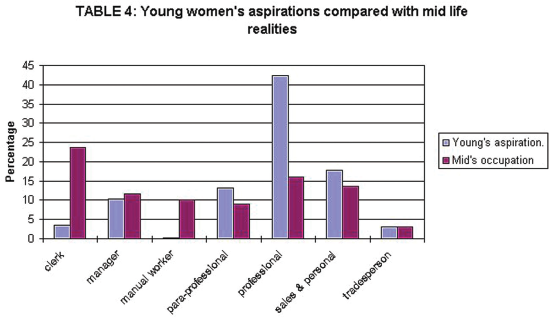
cohort. For instance, while 23 per cent of the mid-life cohort is working as
clerks, only 3.5 per cent of the young cohort want to be clerks.
Young women's aspirations compared with mid life realities
Marriage, Relationships and Children
3.4 It is apparent that this group of young women is not solely
focused on work and qualifications. When asked about their aspirations for
marriage, relationships and children the results were as follows: 85 per cent
wanted to be married at age 35 while a further 11 per cent wanted to be in a
stable relationship, and 92 per cent wanted children by aged 35. It is worth
noting that the majority of the cohort aspire to the top three occupational
categories and want one or two children by age 35.
Disaggregated Results
Social class
4.1 The effect of social class on the aspirations of the women is
apparent when we disaggregate the results. For instance, 82 per cent of the
high-income group want to be in the professional, paraprofessional or manager/
administrator groups compared to 67 per cent of the low-income group. This
difference is statistically significant. In relation to the area of sales and
personal services, traditionally an area of low pay, the trend is reversed.
Ethnicity
4.2 Identified by country of birth, ethnicity was indicative of
significant differences in aspirations for particular types of work at age 35 -
in ways that may appear unexpected. When we combine the three categories of
professional, para-professional and manager/administrator, the results were
illuminating. While 75 per cent of those born in Asia, 70 per cent of those born
in Europe (not of English speaking background), 71 per cent born elsewhere
(English speaking background - Canada, USA, South Africa, New Zealand) aspired
to have jobs within these categories at age 35, a statistically significant
lower number of those born in Australia - 65 per cent - held aspirations for
these jobs. In other words, young women who came originally from Asia and non-
English speaking backgrounds had the most ambitious aspirations. Those born in
Australia held the least ambitious aspirations for their ideal job.
The Qualitative Study 2000 (S2)
Interviews with 57 of the original cohort of young women 4 years
later
5.1 Following analysis of the data from the baseline survey, a
qualitative study was designed in order to gain more in-depth and longitudinal
data from a sample of the cohort. The questions were designed to be both in
depth and wide ranging. For the purposes of this paper, we shall limit our
discussion to those issues that were explored in the earlier, quantitative study
and from which comparisons can be drawn.
Aspirations for Work and Education
5.2 While this is clearly a much smaller sample, it is interesting
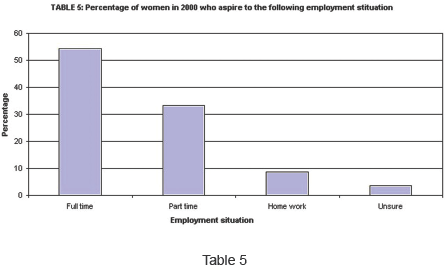
to note that the majority of the sample 31 (54.4 per cent) still aspires to full
time work when they are 35. At the same time, 41 (72 per cent) continue to
aspire to further education (despite the fact that many have now completed their
first degrees) and 35 (61 per cent) are aspiring to professional or managerial
work.
Click here for Table 6
5.3 The young women were clear in their responses on what appealed
to them about full time work. Lyn responded to the question by using phrases
such as … a sense of personal satisfaction, mental stimulation, achieving
something … and then gathered her thoughts together and expressed them this
way:
I think you are what you do these days where your work is a big part of
yourself… so, because it takes up so much of your time, it's really
important to do something you enjoy and something that is a career as
opposed to just a place you go every day to earn money.
5.4 Cate, who has ambitions for an acting career, was realistic
about the prospects of full time work in this field yet at the same time aspired
to full time work at 35.
What appeals to me about full time work is being able to do something I enjoy
for a large period of my time. If you enjoy your job then you'd like to be
doing it all the time. There is also the issue of financial stability, which
is kind of necessary!
5.5 Pam also talked about the sense of security associated with full
time work and then added:
I just generally really like work… I really enjoy work and the stimulation
and the work environment. I've actually done quite a lot of part time work
in the past and I've found that full time work is a lot more rewarding and
you can keep on top of things a lot better.
5.6 The young women were also clear on the connections between the
desire for full time work and a career. Helen, for instance, when asked what it
was about full-time work that appealed to her, responded:
I'm the sort of person…well, I guess I'm career oriented and want to do well
and… there's probably this perception that you need to be in full-time work
to really get into it and get somewhere.
5.7 Lyn had a similar view when she replied to the same
question:
I guess it's not so much the full time paid work … it's more the career that
is important and with what I am going to do (television production) I assume
that I'll be in full time work if I'm going where I want to be going in my
career.
5.8 Carrie confirmed these views and added some comments concerning
the disadvantages of part time work for career prospects.
I don't think you can really have the same sort of career aspirations through
part time work. It seems like most employers regard part time employees as
only half committed and that they (the employees) are just there for the
money rather than that they are actually dedicated to the job.
5.9 And what of those women who aspired to part time work at 35.
What were the reasons for their choice? While for the majority, their reasons
were connected to anticipated child care responsibilities, there were a variety
of other reasons for not wanting to work full time and these included a desire
for more time for themselves, a more flexible lifestyle and in some cases, an
antipathy towards paid work. The latter reason was especially relevant for the
young women from low-income areas and will be dealt with separately below.
Aspirations for Ideal Job
5.10 As with the original survey (S1) the, ‘ideal’ jobs the majority
of the women in S2, 35 (61 per cent) wanted were clustered in the professional
and manager/administrator categories. This is a grouping which does not reflect
the current labour market position of women where around 52 per cent of all
employed women in Australia work in the two occupational groups of clerical and
service workers (elementary, medium and advanced categories combined; ABS 2000 -
2001). In comparison, only 8 (14 per cent) of the respondents in the sub-study
aimed to work in this traditionally female area. While 5 (9 per cent) were
aiming at para-professional jobs, including nursing, the positions aspired to
demonstrated a wide diversity, including such non-traditional areas as; town
planning, mining engineering, cinematographer and business executive/CEO
positions
Click here for Table 7
Aspirations for Marriage, Relationships and Children
5.11 The overall proportion of women who indicated they would like
to be married at 35 was, at 47 (82 per cent), typically high. A slightly
atypical 6 (10 per cent) of women opted for a stable relationship. Of the whole
group, 4 (7 per cent) were unsure about whether they wanted a relationship or to
eventually marry and this group was composed almost entirely of high-income
young women (except for one). When asked what appealed to them about marriage,
some distinct themes emerged in the answers. Janine discusses why she would
prefer to be married when she has children:
I'd prefer to be married with children…. I just think it's a more stable sort
of situation for children. It's better if you can have two influences on
your child and preferably the influences that created the child in the first
place would be good. That would be the best situation I think you could
choose for your child.
5.12 In Mary's view, children are again the key, and reference is
also made to the broader social valuation of marriage.
We're living together at the moment and we've got ourselves set up… with dogs
and all that sort of stuff so…. If I'm going to have kids I want to be
married before I have kids. (Interviewer: Why do you feel it's important to
be married before you have kids) I think it's just the way I've been brought
up.
5.13 Veronica echoed these sentiments:
Well… I mean I primarily want to be married because I want to have children
and I feel that it's probably best to have two stable parents… Yeah I
wouldn't want to get married for my own security… it'd matter more if I were
to have children I think it would be in their better interests to have a
more stable sort of home.
5.14 Other women expressed similar views and used words such as
formality, tradition and security when describing their reasons for favouring
marriage. In addition to tradition and security for children, another important
and surprising finding was the almost equally common characterisation of the
value of marriage as a source of companionship and in the provision of emotional
rather than financial support. The following three quotes illustrate these
sentiments.
Being married…I guess having someone there to support you as well…and be
there with you. You're not on your own.
Just sort of having a partner that you can share your life experiences
with…you know…sort of having a like really close friend almost.
Probably companionship. It's just nice to think that you hopefully have
married someone that you want to spend the rest of your life with.
5.15 Taken together, these findings indicate that a ‘companionate’
rather than a ‘bread winner/homemaker’ model of marriage is present amongst this
group of women. This is reinforced when we recall that that just 5 (9 per cent)
of the group intend to be exclusively homemakers at age 35.
Click here for Table 8
Click here for Table 9
5.16 The number of children aspired to at age 35 was fairly typical
at around one third wanting more than two children and slightly under half of
the women wanting one or more children at 35. A small minority 6 (10 per cent)
of the women had not yet decided and a smaller minority 3 (5 per cent) wanted no
children at all. Changes across time in the number of children desired were
mapped. Around 57 per cent of the group had stable desires in this regard with
the other third reconsidering their earlier statements. There was no clear
pattern in these responses though 8 (14 per cent) of the group wanted more
children than previously and approximately 5 (9 per cent) wanted less. Six of
the women (11 per cent) were no longer sure how many children they wanted.
5.17 In summary, it is significant that a majority of the sample
(54.4 per cent) are still aspiring to full time work when they are 35. We note
also that 72 per cent continue to aspire to further education and 62 per cent
are aspiring to professional or managerial work. The numbers who definitely want
children at 35 is smaller at 82 per cent with 16 per cent now stating that they
are either unsure (10.5 per cent) or want no children (5.3 per cent).
Social Class and Aspirations
Full or Part-time Work
6.1 We acknowledge again that this (S2) study is based on a small
sample. Nevertheless, the effect of social class on the aspirations of the women
is apparent when the results are disaggregated. This is particularly marked in
relation to aspirations for full and part time work but also for choices
regarding marriage and children. In relation to the hours of work aspired to,
the class background of the respondents had a clear effect. While 22 (67 per
cent) of the high-income respondents aspired to full time work at 35, only 9
(37.5 per cent) of the low-income respondents had the same aspiration. In
relation to part time work the trend is reversed. (See Table 10)
Click here for Table 10
6.2 We are able to grasp the longitudinal dimensions of this set of
aspirations when we compare the responses of the women from the low and
high-income groups in 1996 and the year 2000. (See Table 11)
Click here for Table 11
6.3 It became apparent during the interviews that a discernible
pattern was emerging between the two groups in the language used by the women to
describe their reasons for wanting different types of work. Out of the six
quotes presented above, from the women describing what it is that appeals to
them about full time work, only one was from a woman from a low income
background (Helen). More typical were these comments from Karen:
I'd like to win lotto and not work at all (laughs) but part time would be
pretty ideal.
6.4 She then goes on to say
I'm hoping to have kids so I don't think I cannot work at all … I just hate
working five days and travelling. I know we have to do it (work) but I just
think there is more to life. I'd like to have kids but not like to work full
time I mean I'd like not to work at all but I think just our circumstances
wouldn't allow us to have just one person working.
6.5 With these comments we get a sense of work being something that
must be done rather than a source of fulfilment and pleasure. Amanda echoed
these comments with her reply to the question on what it was that appealed to
her about part-time work.
To be honest with you, I don't really have ambitions to be a businesswoman …
before I had but now since I got my job, it's too hard…. You don't have any
time for a social life ….you just have to work and I think… what's your life
for if you're just going to work and work. You have to enjoy life as well
and I'm planning to have kids so I don't want to be like full time working.
I want time for the children and for myself.
6.6 Amanda was not the only woman from the low-income group who had
encountered work and had not particularly liked the experience. Kirsty had
stated in 1996 that at age 35 she wanted to be in full time work. By 2000 she
had changed to wanting part time work and her reasons for this are interesting.
To the initial question on what appealed to her about part time work, she
replied that at that time she hoped to have children and that was causing her to
change her mind. Later in the interview it became apparent that she was at a
crossroads in relation to her career and future plans. Partly this was due to a
change in government policy. While in 1996 she had thought she could combine
having children with a full time career, she now felt that this would not be
possible.
6.7 Well I guess what I mean with being a teacher, they're just
bringing out the new (teachers) award and that's saying that the Minister for
Education wants schools to be open from 7am to 10pm at night and that's like a
sort of baby sitting service so I guess that would probably be an issue that
would be in the forefront of my mind and the huge amount of money that it seems
to cost to put your children into care if you're working full time.
6.8 Later in the interview she enlarged on the more personal reasons
for wanting to get out of her current job.
I get very stressed under too much responsibility so my career change would
be something where I feel I don't feel I have so much responsibility to
people that I seem to have in a teaching career.
6.9 Kirsty enlarged on other sources of stress for teachers, in
particular, the way that most of the responsibility for children's behaviour and
future prospects were now perceived to be the responsibility of teachers. She
then went on to explain:
I guess I'm looking for something that's a little less stressful … and also,
I'll probably look for a job that I don't have to come home from work and
constantly be thinking of work all the time which is what I feel like I'm
doing. You know, I come home and I've got work to do and it's a never ending
cycle and I feel like I'm chasing my tail all the time and never getting to
where I need to be… but I guess I'm a bit disillusioned in jobs and
prospects and career at the moment and so that's sort of where I'm looking
at now … maybe that's why I'm turning to home and gardening and maybe even
looking at children kind of thing.
6.10 In the case of Kirsty, we get a real sense that part of the
attractiveness of the ‘family option’ at this stage is that it provides her with
a rationale for leaving a job which she finds stressful and which has not
fulfilled her hopes and expectations. There were, of course, others in the
low-income group who had more positive experiences with and more positive
attitudes about work. There was, however, a tendency for the women from the
high-income group to be more positive and enthusiastic about the idea of work
and career and importantly about their work experiences. We decided to submit
this apparent tendency to more rigorous scrutiny by undertaking a content
analysis of the various answers provided by the respondents in relation to their
attitudes, experiences and feelings about work.
Content Analysis
7.1 In order to do this, we undertook an analysis of the S2 interviews,
using words that were indicative of a positive conception of work (such as:
interesting, stimulating, independence, identity) and alternatively, we searched for
words that were indicative of a negative or utilitarian approach to work (such as:
not enjoy, hate, dislike, boring). The results highlighted the effect of class on
the attitudes of the interviewees to work. We found that while 87 per cent of the
high-income respondents expressed positive words in relation to work, a lower 32.5
per cent of the low- income respondents expressed positive words. In terms of the
negative or utilitarian words to describe work, the situation was reversed, with 68
per cent of the high income women expressing these words while all the women from
the low income group expressed these words when they described or discussed their
plans or feelings about work (with multiple responses adding up to 116 per
cent).
7.2 These data are also evident and possibly flow through to the choices
of the women for their ideal job (see Table 12).
Click here for Table 12
Aspirations for Ideal Job
7.3 While the difference is fairly small between the aspirations of
the low and high-income groups for professional work, the differences are more
marked in the aspirations of the women in the different groups for work in two
key areas. In the category of Clerical/Sales and Personal Services, a
traditional and relatively low paid area of work for women, only 2 (6 per cent)
of women from the high-income group had aspirations to work in this sector
compared to 6 (25 per cent) of women from the low-income group. In relation to
the sector Management/Administration, historically an area dominated by men and
characterised by relatively high paying jobs, 5 (21 per cent) of the women from
the low income group compared to 10 (30 per cent) of the women from the high
income group had aspirations to work in this sector.
7.4 In relation to the direction and type of changes in aspiration
in both categories of respondents, a higher percentage of high-income young
women (36 per cent of high income compared with 20 per cent of low-income
respondents) had stable aspirations across both time points. More high income
women indicated they intended to aim for a consultancy or to hold a managerial
position in the same general area of employment they aspired to previously than
did low income young women (21 per cent and 12.5 per cent).
7.5 Kate encapsulated the confidence and ambitions of many others
from the high-income group when she answered a question on what it was about
management that appealed to her:
I just think it's sort of a natural progression, you know, to use your
experience and also to bring about some of your own ideas and vision about
how things could operate I think you can do that better from a management
position (obviously).
Aspirations for Marriage, Relationships and Children
7.6 As we have seen, significantly differing aspirations are held
amongst the two groups of young women and this is also evident in their
attitudes to partnerships. Whilst 23 (96 per cent) of the low income young women
remained committed to the ideal of marriage, slightly over a quarter of the high
income women were unsure about marriage by 35 or wanted to be unmarried but in a
stable committed relationship at that point. None of the low-income group
indicated that they would prefer such a relationship at 35. Members of this
group were unsure about whether or not they planned to marry, but did not choose
the relationship option.
7.7 A substantial minority 6 (18.2 per cent) of their high-income
counterparts did, however, choose relationships over marriage at 35. This may
prove be an effect of the young women's stage in the life course, or it may be
indicative of a decline in the pervasiveness of the marriage ideal among some
social groups. It is also instructive to take a look at the reasons given for
this choice. Amongst the women who preferred relationships to marriage the main
reasons for this departure was a perception of marriage as unnecessary
to a stable relationship. The formalisation of such a bond was seen
as redundant. This theme is taken up in Amanda's response below
I guess I don't see what marriage gives you that you don't have in a
relationship and I suppose I have a lot of negative connotations with the
whole idea of marriage. It just seems like … I mean it's a social construct
but it's not one that I feel any particular affinity for. I don't
necessarily think that having it sort of formalised in a marriage context is
necessarily important or is necessarily something that I want in my
relationship
Discussion
The Group as a Whole
8.1 The data from these cross-sectional and longitudinal studies
present a rich and complex picture of the aspirations held by a large cohort of
young, Australian women for work, marriage/relationships, children and their
ideal job. Importantly, this study has produced both quantitative and
qualitative data that has allowed the examination of the stated preferences of
young women over a range of life choices. We are now in a position to know at
least what these women want. These data also give us information that enhance
our understanding of the causes of labour market segmentation, going beyond
explanations that rely on the notion of individual choice and preferment.
8.2 In relation to preference for type of work, a majority of women
in the original, large cohort (S1) and the smaller sub-set re- questioned four
years later (S2) stated that at age 35 they wanted to be in full-time paid work
outside the home. These figures appeared to indicate a serious commitment to a
future in which paid work plays a significant and ongoing role in their lives.
The responses to the questions in the baseline survey are particularly
significant given the size and profile of the cohort. They cast serious doubt on
the schema developed by Hakim of three groups of women, the largest consisting
of ‘adapters’ with two smaller groups making up either work centred or home
centred orientations. 0ur data indicate that the young women in this large study
simply do not correspond to Hakim's three groups. These young women have a
strong commitment to work and ongoing education at the same time as wanting
marriage and children and time to spend with their children. In this they
resemble the women in the study reported by Looker and Magee (2000) who noted
that while the women in their study expected to take responsibility for most of
the child-care, this did not affect their choice of career. In this they differ
markedly from earlier studies of young women who regarded marriage as a career
in itself.
8.3 These conclusions were reinforced in the year 2000 sub-study
(S2) that demonstrated a similar percentage of the women continue to aspire to
full-time work and more education at 35. The quantitative evidence is enhanced
by comments from the women who took part in the qualitative study who
demonstrated an understanding of the links between education, hours of work and
career attainment to their ideal job. Their comments also revealed a perception
about the limitations of part-time work for their career aspirations.
8.4 How then do we make sense of the disjuncture between the
relatively low number of women aspiring to part-time work (31 per cent) and
current workforce realities which indicate that since 1991 most of the steady
upward trend in the average labour force participation rate for women in
Australia can be accounted for by an increase in women's part-time employment?
Indeed, during this period, women in the labour force were about three times
more likely than men to be employed part-time (ABS, 2002). The economist Bob
Gregory has pointed out that the other side of this picture concerns the fact
that since 1966, the proportion of women in full-time jobs has been ‘stuck’ at
30 per cent (Sydney Morning Herald, February 20, 2002). This
issue goes to the heart of the debate about preference and agency and structure
and constraint. Certainly there is evidence from this study and elsewhere that
women prefer part-time work while they are caring for pre-school children. There
is also evidence that women with school age children are more likely to want
full-time work in the future (Walsh, 1999:197). We believe that there is
sufficient evidence to conclude that many women want different work at different
times but that it is much harder to get out of part-time work than it is to get
into it. This is confirmed by other researchers, such as Rubery, Horrell and
Burchell (1994), Probert (1994), Jacobs (1999) and Walsh (1999). Yet Hakim
insists that there is now a substantial body of research which shows that ‘women
who work part-time differ systematically from women with full-time jobs, in
their work orientations and labour market behaviour’ (Hakim 2000:101). Our
findings, at the very least, cast doubt on this conclusion.
8.5 The findings on aspirations for work are reinforced by comments
from the young women on marriage, children and relationships in the sense that
marriage does not appear to be seen as a career in itself. When questioned on
what appealed to them about marriage or a permanent relationship, the women's
answers clustered around the ideas of tradition and social legitimacy, stability
for children and the notion of companionship and emotional support. None of the
women spoke of financial support as a reason for the appeal of marriage. It
seems that they see their work as providing financial security and their
relationship as providing companionship, stability for themselves and their
children and, importantly, emotional support.
Aspirations and Social Class
8.6 A much more complex picture emerged when we disaggregated the
respondents in both S1 and S2 by dividing our respondents into areas marked by
low and high-income households. On almost every significant issue, there were
clear and patterned differences in responses to questions on aspirations. The
different attitudes to work coupled with aspirations to very different kinds of
work and strategies to deal with combining work and children indicate that there
is something deeper, more structural operating here that is entrenched and
stable over time. In her most recent book, Hakim states:
8.7 Most studies find that the polarisation trend cuts across social
class and income groups, indicating that socio-economic factors are no longer
dominant, at least not for the sexual division of labour. (Hakim 2000: 127)
8.8 In this study, we have found it to be the most significant
marker of difference. In this the study is consistent with recent work by Poole
and Langan-Fox (1990), Burris (1991), and Andres et al (1999), but not with the
study by Looker and Magee (2000). These results are also consistent with the
literature on social class, which focuses on the connections between poverty and
the distribution of life chances. Bourdieu (1977), for instance, has theorised
the centrality of the education system in reproducing class inequalities. This
approach is supported by the statistical analysis of social mobility by writers
such as Goldthorpe (1980) and Gallie (1988), who demonstrate that the chances
for entering secure, well paid, ‘middle class’ jobs are much higher for the
sons, and to a lesser extent the daughters, of middle class parents than for the
children of working class parents. To these general findings on class obstacles
to social mobility has been added detailed statistical analysis by Gregory and
Hunter (1995) on inequalities among Australian neighbourhoods. These authors
have found that living in a low status neighbourhood can have a detrimental
effect on employment or level of participation in the labour market. In this
context, it is possible to see the lower occupational aspiration levels of the
young women from the low-income areas as realistic in relation to their overall
life chances. Yet, at the same time, the aspirations of the young women from the
low-income areas are still higher than the current female participation rates in
professional occupations. Clearly these general findings and the findings for
effects of class have serious political and policy implications for areas as
diverse as, child-care, workers rights, higher education, equity programs and
superannuation. They indicate that we are far from the utopia of late modernity,
and that further policy development and legislation will be necessary if we are
to ameliorate the effects of patriarchy and class on the lives of women in the
context of globalisation.
Critique of ‘Preference Theory’
8.9 Our findings on the aspirations of a group of young women as a
whole, in addition to the effect of class on those divided into high and low
income households, contradict the key tenets of preference theory, in particular
the concept of the heterogeneity of women developed and proposed by Hakim to
explain labour market segregation. Rather than finding vertical boundaries
between women who are divided (and have different interests) through
early-formed commitments to work and family, we have found (at least for this
stage of their lives) that the most significant division among the women is
horizontal - social and economic class. In addition to
casting doubt on the methodological adequacy of preference theory, these
findings alert us to some fundamental problems with the theory. These problems
relate to the reliance of the theory on the idea of free-floating preferences
that apparently exist outside relations of social power. Interestingly, power
can be seen operating in the historical processes that resulted in what Hakim
conceptualises as the five great changes in society and the labour market which
started in the 20th century and which have produced a qualitatively different
and new scenario of options and opportunities for women.[1]
8.10 Yet, crucially, it appears that for Hakim outside of these
great historical events free individual decision-making takes over when it comes
to women's preferences, which theoretically and practically take place in a
power vacuum or alternatively are determined by the unseen hand of varying
levels of the male hormone, testosterone (Hakim 2000:282). Without a concept of
power that is inherent in the process of preferment and choice
(Lukes, 1974), power operates exclusively outside human agency and history
becomes merely the context and backdrop for human action rather than its
substance and outcome (Connell, 1983).
8.11 In order to achieve an explanatory theory that is both useful
and also sociological, account must be taken of social context and the social
inter-penetration of gender, personality formation and class relations and the
resulting pre-dispositions toward various choice and preference options. It must
be capable of producing a sociological explanation that allows for the
exploration and analysis of the operation of power at the level of individual
choice. Such a theory, which is beyond the scope of this paper, would also need
to avoid the traps of structural determinism, on the one hand, and voluntarism
on the other. It would need to be able to account for ‘invention within limits’
(Bourdieu quoted in Connell, 1983:145), or, to paraphrase Marx, it would need to
account for the capacity of the young women to make history, but not necessarily
in conditions of their own choosing.
Conclusion
9.1 The data presented in this paper from a study of the aspirations of
a large cohort of young, Australian women indicate at this stage that the causes of
labour market segmentation cannot be found solely in the expressed preferences and
choices of the women themselves. This contradicts Preference Theory developed by
Hakim to explain gender labour market segmentation by reference to the preferences
and choices made by individual women. These results reveal a dramatic disjuncture
between the stated aspirations of the women and the current structure of the female
labour force and participation rates in Australia. In addition, and importantly, we
have seen that there were quantitative and qualitative differences in the
aspirations of the women when we disaggregated the cohort along the lines of social
class. It is clear from this study that the structural processes of class and gender
continue to operate in the lives of these women. As we were able to include a
longitudinal dimension to the study, it is also significant that the aspirations of
the majority of the women for full-time work, marriage and children when they are 35
have remained stable over four years. Some of these same women may choose in the
future to take part-time work, especially when their children are young. They may
then find that after a period in part-time work it is difficult to get back into the
full-time workforce. This may be particularly the case for women who find themselves
in ‘heavily female dominated occupations’ (Wing Chan, 1999). They may even adapt to
this and find that they are satisfied with a life that holds other satisfactions and
rewards. The fact remains, however, that this was not what they wanted or preferred
as young women. We will only know how their lives unfold with further research, but
we do know that at this point the majority see themselves as having multiple
identities as wives/companions, mothers, workers and careerists. In this sense, we
know what they want, and further research will tell us how what they want changes
over time and whether it matches what they actually get.
Footnotes
1
The five separate historical changes can be summarised as: (1) the contraceptive
revolution; (2) the equal opportunities revolution; (3) the expansion of white
collar occupations; (4) the creation of jobs for secondary earners; and (5) the
increasing importance attitudes, values and lifestyle choices in affluent,
modern societies (Hakim, 2000:7).
Appendix 1
Appendix
References
1.
AinleyJ., GRAETZB., LONGM., and BATTENM. (1995)
Socio-economic Status and School Education.Australian Council for Education Research. Commonwealth
Department of Employment, Education and Training. Canberra:
Australian Government Publishing
Service.
2.
AUSTRALIAN BUREAU OF
STATISTICS (1991) Census of Population and
Housing.Canberra: Australian Government
Publishing Service.
3.
AUSTRALIAN BUREAU of
STATISTICS (2000-2001). Labour Force
Survey.Canberra: Australian Government
Publishing Service.
4.
AndresL., ANISEFP., KRAHNH., LOOKERD., and THIESSENV. (1999) ‘The
Persistence of Social Structure: Cohort, Class and Gender Effects on the
Occupational Aspirations and Expectations of Canadian
Youth’. Journal of Youth Studies,
2, 3, pp.
261–282.
5.
BaxterJ., and GIBSOND. (1990). Double
Take, AGPS,
Canberra.
6.
BeckerG.S. (1985)
‘Human capital, effort and the sexual division of
labour’. Journal of Labour Economics,
3, pp.
533–538.
7.
BourdieuP. (1977) Outline of
a Theory of Practice.Cambridge: Cambridge University
Press.
8.
BruegelI. (1996)
‘Whose Myths are They Anyway? A comment’.
British Journal of Sociology, 47,
1, pp.
175–177.
9.
BurrisB. (1991)
‘Employed Mothers: The Impact of Class and Marital Status on
the Prioritizing of Family and Work’. Social Science
Quarterly, 72, 1:
50–66.
10.
ConnellR.W. (1983) Which Way
is Up? Essays on Sex, Class and Culture.Sydney: Allen &
Unwin.
11.
ConnellR. W. (1987) Gender
and Power.Sydney: Allen &
Unwin.
12.
CromptonR., and HARRISF. (1998).
‘Gender Relations and Employment: The Impact of Occupation’.
Work, Employment and Society12, 2, pp
297–315.
13.
EdwardsA., and MAGEREYS. (editors) (1995).
Women in a Restructuring Australia: Work and Welfare.Sydney: Allen &
Unwin.
14.
GallieD. (editor) (1988)
Employment in Britain.Oxford:
Blackwell.
15.
GoldthorpeJ. H. (1980) Social
Mobility and Class Structure in Modern Britain.Oxford: Clarendon
Press.
16.
GregoryR., and HUNTERB. (1995). The Macro
Economy and the Growth of Ghettos and Urban Poverty in Australia.Centre for Economic Policy Research, The Australian National
University, Discussion Paper 325, April, pp.
1–35.
17.
HakimC. (1991).
‘Grateful Slaves and Self-Made Women: Fact and Fantasy in
Women's Work Orientations'. European Sociological
Review7, pp. 101–21.
18.
HakimC. (1993).
‘The Myth of Rising Female Employment’.
Work, Employment and society7, pp. 97–120.
19.
HakimC. (1995).
‘Five Feminist Myths about Women's
Employment’. British journal of Sociology46, pp. 429–55.
20.
HakimC. (1996).
‘The Sexual Division of Labour and Women's
Heterogeneity’. British Journal of
Sociology47, pp. 178–88.
21.
HakimC. (2000)
Work-Lifestyle Choices in the 21st Century. Preference
Theory.Oxford: Oxford University
Press.
22.
JacobsS. (1999).
‘Trends in Women's Career Patterns and in Gender Occupational
Mobility in Britain’. Gender, Work and
Organization6, 1, pp.
32–46.
23.
LookerE., and MAGEEP. (2000)
‘Gender and Work: The Occupational Expectations of Young
Women and Men in the 1990's'. Gender
Issues, 18, 2, pp.
74–88.
24.
LukesS, 1974. Power: A
Radical View.London:
Macmillan.
25.
PooleM.,
LANGAN-FOX, and
OMODEIM. (1990).
‘Determining Career Orientations in Women from Different
Social-Class Backgrounds'. Sex Roles23, 9/10, pp.
471–490.
26.
ProbertB. (1994).
‘Women's working lives'. In
PRITCHARD HUGHESK. (editor) Contemporary
Australian Feminism, Melbourne:
Longman.
27.
ProctorL., and PADFIELDM. (1999)
‘Work Orientations and Women's Work: A Critique of Hakim's
Theory of the Heterogeneity of Women’. Gender, Work
and Organizations, 6, pp.
152–62.
28.
ReesT. (1992). Women and
the Labour Market.London:
Routledge.
29.
RuberyJ., FAGANC., HORRELLS., and BURCHELLB. (1994)
‘Part-time Work and Gender Inequality in the Labour
Market’. In ScottA. M. (editor) Gender Segregation
and Social Change.Oxford: Oxford University
Press, pp.
205–34.
30.
TAK WING CHAN
(1999) ‘Revolving Doors Re-examined:
Occupational Sex Segregation Over The Life Course’.
American Sociological Review, 64, pp.
86–96.
31.
WalshJ. (1999).
‘Myths and Counter-Myths: An Analysis of Part-Time Female
Employees and Their Orientations to Work and Working Hours'.
Work, Employment and Society13, pp. 179–203.
32.
WicksD., and MISHRAG. (1998)
‘Young Australian Women and their Aspirations for Work,
Education and Relationships'. In
CARSONE., JAMROZICA., and WINEFIELDT. (editors) Unemployment:
Economic Promise and Political Will.Brisbane: Australian Academic
Press, pp.
89–100.