







Abstract
In minimally invasive hip arthroplasty double offset broach handles are used, to facilitate the preparation of the femoral canal. The aim of this study was to quantify the differences in force and impulse transmission between two double offset broach handles and a single offset broach handle. Two double offset broach handles (A European version, B American version) were compared to a single offset broach handle. A surgical hammer was used to give a variable impact to the head of the broach handle. Thirty measurements for each of five falling heights were recorded for each broach handle. The force measured by a load cell connected to the broaches was used to obtain the maximum force peak and to calculate the impaction impulse. Normal data distribution was assumed and analysis of variances was performed. Results have demonstrated that the highest values of the force peak and force impulse were found in the single offset broach handle. Broach handle A had higher impulse values and lower maximum force values compared to broach handle B. The lateral lever arm has a measurable effect on the force transmission. In double offset broach handles less energy is transmitted to the tip. Surgeons have to be aware of the differences between the broach handles when using them intraoperatively.
Keywords
Introduction
The direct anterior approach for total hip arthroplasty allows a good exposure of the hip joint capsule for acetabular and femoral preparation with minimal muscle damage provided appropriate instrumentation is available (1–10). Preparation of the femur using broaches is a relatively difficult task that is greatly facilitated by using broach handles with either single or double offsets built in (11).
To reduce contact with and bruising of soft tissue a proximal anterior offset was introduced (“single offset”). A second lateral offset (“double offset”) was introduced to reduce the need for extreme adduction and elevation of the operated leg during surgery. Several different versions of double offset broach handles are available (9, 12).
The surgeon's feel of broaching and the force necessary for proper impaction of the broach is quite different using single versus double offset broaches. This difference has never been quantified. The purpose of this study was to quantify the differences in force and impulse transmission in the impact direction of the broach tip between two versions of double offset broach handles and a single offset broach handle.
Methods
In this study two double offset broach handles were compared to a single offset broach handle with regard to their force transmission during impact. The double offset broach handle A (Stryker, Mahwah, NJ-USA) is mainly in use in Europe, while the double offset broach handle B (Stryker, Mahwah, NJ-USA) is used in the USA (Fig. 1). The single offset broach handle (S) is used in conventional techniques for the preparation of the femoral canal, where no lateral offset is necessary for the broaches. All three handles have the same locking interface and can be combined with different Stryker stem systems such as Exeter, ABG II or the Accolade tapered-stem (all Stryker, Mahwah, NJ-USA).
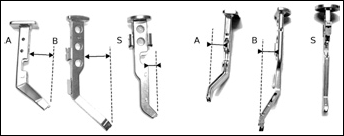
Double offset A, Double offset B with anterior and lateral offset and single offset broach handle S with anterior offset.
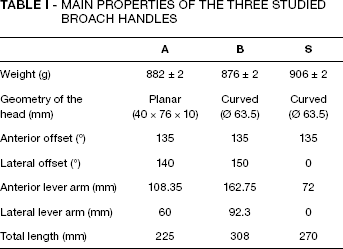
All three broach handles were made of a stainless steel alloy (17-4 PH H900), which typically has a ultimate tensile strength of 1310 N/mm2, a 0.2% yield strength of 1170 N/mm2, and a elongation of 10%. Some of the properties of the three broaches are summarised in Table I. In this study broach handle A and B were for the left operating side of the hip. Broach handle S can be used for both operating sides. In order to evaluate the force transmission during an impact in the three different broach handles, a measuring system was developed (Fig. 2). The broach handles were connected to a modified broach. The locking mechanism between handle and broach resulted in an inclination of 10°, which was added to the height of fall. The broach was fixed with two screws on a guide, which limits the movement by a vertical sliding bearing. In the linear bearing no additional lubricants were used. The guide is was connected to a load cell (HBM, Darmstadt, Germany, type U2A) where force variations were recorded with an accuracy of ±1.25 N. The force variations from the load cell were sent to a DMC signal amplifier (HBM, Darmstadt, Germany), which converted the signal from analog to digital. For each measurement an interval of 5 ms was chosen and the sampling rate was 9.6 kHz. The data was analysed with DMCPlus Software (HBM, Darmstadt, Germany, version P17).
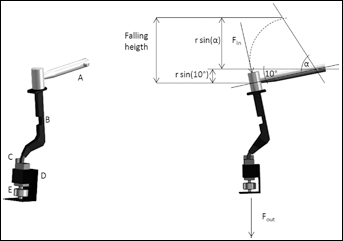
Schematic overview of experimental setup: A Surgical hammer, B broach handle, C modified broach, D guide, E load cell. The broach handle mounted on the guide introduces a inclination of 10°. Fin is the input force to the measurement system provided by the hammer while Fout is the measured force in the direction of the broach tip by the load cell.
Main Properties of the Three Studied Broach Handles
A surgical hammer, which had a mass of 1 kg, was used to provide the impact energy. The rotational movement (α) of the impact hammer was limited to 85°, 60°, 45°, 30° and 15° in order to obtain the equivalent fall heights and therefore different levels of impact energy. The radius (r) of the rotational movement was 26 cm and the pivot point was chosen in order to achieve a central alignment of the hitting surface of the hammer with the broach handle's impact surface. The fixation of the broach handles on the guiding system introduced an additional inclination of 10°, which was added to the rotational movement. Therefore, the falling height is calculated by the following expression: r∗sin(α°) + r∗sin(10°). For the comparison of the three broach handles 30 measurements at five different falling heights, and for each broach handle, were performed.
The force variation over time f(t) shows a main force peak, where the maximum value f(t)max was considered for analysis of the three broach handles. The area of the force peak between the upper time limit t2 and the lower limit t1 is defined as the force impulse

The integration of the area of the first peak was performed by importing the data into the software OriginPro (Origin Lab Corporation, Northampton, MA-US, version 7.5) and by integrating the selected time interval (t2-t1) of the main force peak.
The values of the impact impulse obtained from the integration were compared to a theoretical model in order to validate the measurements. Therefore the velocity

where m is the mass of the hammer. In the theoretical model the mass of the hammer was assumed to be concentrated in the middle of the hitting surface (Ø 44 mm) and that all kinetic energy was transmitted during the impact to the broach handles.
An impulse response refers to the reaction of any dynamic system in response to some external change and therefore describes the reaction of the system as a function of time. As the impulse response is calculated from the force distribution over time it can be influenced more or less by the maximum peak value. In an ideal impact for example, all the kinetic energy would be transmitted from one point to another in an infinitely small time interval, which means that the maximum force peak multiplied by the time interval corresponds to the impulse (calculated theoretical impulse T).
However, in reality we are neither able to create an ideal impact, nor are we able to record it, as we have to deal with several limitations of the trial set up. Since the same measurement system and the same impact hammer were used for all three broach handles, energy absorption due to friction and noise introduced by the measuring system were the same. Therefore, the variations in the impulse response are caused by the different force transmission behavior of the handles.
Due to the sample size (n = 30 in each group) normal distribution of the data in accordance to the central limits theorem was assumed.
The analysis of variances (ANOVA) was performed to check for group differences. Observed power was calculated post hoc for the main effect as well.
Tukey HSD was used for pair-wise comparison of the groups in case of variance homogeneity and Games-Howel was used in case of inhomogeneity
All tests were carried out with SPSS® (IBM®, Chicago, IL-US, version 20.0).
Results
For each handle 30 measurements for five different falling heights were carried out. Comparing the maximum force peaks of all three handles for each falling height pair-wise, all differences were statistically significant (p<0.001). The single offset handle showed the highest maximum force peaks for all fall heights. Broach handle A had the lowest maximum force peaks, while B showed values between the other two handles (Fig. 3). Comparing double offset broach handle B to A, B had an 18% higher force peak (Tab. II). Post Hoc Power Analysis using the ANOVA showed an observed power of 1.0 in all cases. The non centrality parameter λ was between 640 and 1408.
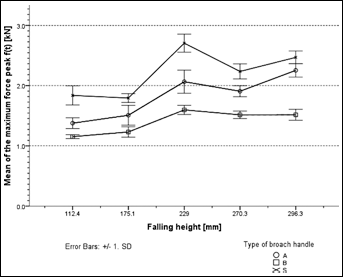
Mean force peak with standard deviation for all three broach handles at different fall heights.
Mean Value and Standard Deviation of the Maximum Force Peak F(T) [KN] of the Three Broach Handles in Study and the Difference of a in Relation to S (S>A) and B in Relation to S (S>B) Expressed in %
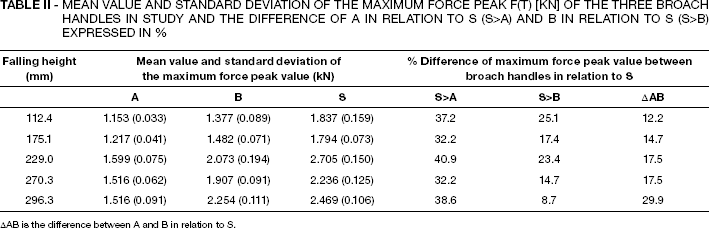
ΔAB is the difference between A and B in relation to S.
Comparing the maximum force peaks of the single offset broach handle to the double offset broach handle B an average difference of 18% was calculated. Finally comparing the single offset broach handle with the double offset A a difference of 36% was determined for the maximum force peak value.
Transmitted impulse from the broaches to the load cell could be determined by integrating the main force peak from the recorded force variations during the impact the. The theoretical, calculated values were reported as T In order to exclude the influence of different factors on the measurement the differences between each impulse value in each series of falling heights was determined.
The values of the calculated impulse are reported in Table III. The impulse values of each broach handle and the falling height are shown in Figure 4. Also in this case the measurements at 15° and 45° were higher than expected, probably due to different impact conditions. Comparing the double offset broach handle A to B a small but significant difference of approximately 5% could be found (Tab. III). In this case handle A had a higher impulse value than B. The single broach handle showed the highest force impulse value. The difference between the single offset broach handle and B was 23% and the difference between S and A was 19%.
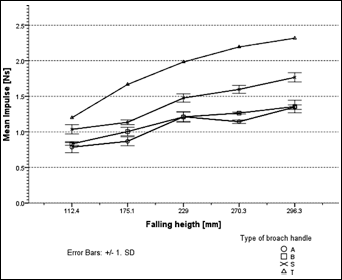
Mean impulse value with standard deviation for the three different broach handles at different fall heights compared to the theoretical calculated value (T).
Mean Value and Standard Deviation of the Impulse Value [NS] of the Three Broach Handles in Study and the Difference of a in Relation to s (S>A) and B in Relation to s (S>B) Expressed in %

ΔAB is the difference between A and B in relation to S. The theoretical impulse is reported as T.
Broach handle S showed a statistically significant difference (p<0.001), when compared to broach handle A and B for all different fall heights. The differences between broach handle B and A were statistically significant (p<0.001) for the falling heights at 15°, 30° and 60°, while no statistically difference was found between broach handle A and B at the falling heights of 45° (p = 0.985) and 85° (p = 0.890). Post Hoc Power Analysis using the ANOVA showed an observed power of 1.0 in all cases. The non centrality parameter λ was found to be between 306 and 2537.
Discussion
Correct preparation of the femoral canal is essential for the implantation of the stem. Impaction of the broaches is a delicate process in which the surgeon has to sense impaction forces. Many factors influence the impaction process. One of these factors which have to be taken into account is the handles used for broaching. No higher incidence of incorrect seating, subsidence or fracture was observed in literature with double offset broaches than single broach handles. However surgeons report that different broach designs result in a different “feel” during broaching. This study gives a quantification of the differences between the three evaluated broach handles.
The impulse gives an indication about the transmitted energy in the direction of the tip of the broaches, while the maximum force peak value gives an indication about the highest applied load during the impact. Single offset broach handles had the highest force peak value (18% higher than B and 36% higher than A) and a 24% higher impulse value then B and a 19% higher impulse value then A.
In the case of the single offset broach handle it is reasonable that impulse and maximum peak value are higher than in the two double offset broach handles as there is no additional lever arm. The impulse values from handle A and B were very similar to each other, as both handles have a lateral lever arm. Considering the introduced lever arm in the two double offset broach handles a certain amount of energy will not be transmitted in the direction of the tip but in different directions or absorbed as elastic energy. Future studies should consider the effect of the lever arm of the handles during impaction in different directions of the tip and the effects on the implantation of the prosthesis.
As the double offset broach handles have similar geometries the energy loss during impaction is similar too. However the differences of the impulse response between handle B and A was less (5%) than the difference of the values of the maximum force peak (18%). Considering only the additional lever arm of the broach handles, the difference in the force peaks of the two double offset handles should be less.
Considering the force distribution over time of the two double offset broach handles brought to the following observation: Broach handle B has a force distribution with a higher maximum force peak and over a small time interval while handle A shows a force distribution with a lower maximum forces peak over a larger time interval. This different behavior of the two double offset broach handles can be influenced by two factors: material and contact area properties have to be taken in account.
As the material properties of all three broach handles were the same, the differences of the force distribution over time can be explained by the different contact area during impact. Broach handle A has a planar surface, while S and B have a curved head. The contact area during the instant of impaction is much smaller in curved heads than in planar areas and there is a higher chance that the points of the two contact areas are getting in contact at the same time step. This would mean that we have a situation like in broach handle B, where the force distribution is limited to a small time interval with a high maximum force peak. It has to be pointed out that the contact surface during the impact can change significantly in broach handle A, for example if only the edge of the head of the hammer hits the contact surface. In this case the contact area will be reduced and we have again a higher change that the points of the two contact areas are getting in contact at the same time step. This would be a situation similar to a broach handle with a curved surface. On the other hand on a curved surface it may be difficult to guarantee the same force direction at each impact and the maximum force peak may change.
Therefore, the contact surface during the impact is a determining factor in reducing the maximum force peak, which could increase the risk of bone fractures. The axial force is transmitted to the hollow bone and hoop stresses are created by the wedge shaped broach. Therefore higher impact forces will lead also to higher hoop stresses on the bone. Broach handle B has a force distribution (higher force peak distributed in a small time interval) which reflects a more rigid behavior than broach handle A. That means the kinetic energy is maintained by the broach for a smaller time interval compared to the double offset broach handle, where the force is distributed over a larger time interval and therefore the kinetic energy is maintained for a longer time period. This can be an indication of lower stiffness due to the additional lever arm.
In summary, the single broach handle has the highest force peaks in the direction of the tip, followed by handle B and A. Higher instantaneous force peaks could increase the risk of bone fracture. The impulse values are very similar for the two double offset broach handles and different compared to the single offset broach handle. Therefore, the introduction of the lateral lever arm has a measurable effect on the force transmission.
This study clearly shows that broach handle design has a significant influence on force and impulse transmission. This study also shows that with a given comparable offset (broach handles A and B), design and material choice can significantly influence force transmission. Fracturing the femoral canal is one of the risks associated with broaching. Surgeons try to avoid this by controlling and limiting the amount of force they apply through the hammer to the broach. At the same time a surgeon usually judges the correct seating of the broach in the femoral cavity by the sound and feel of the broach handle. This is based on the surgeon's experience which is on the other hand based on the load transfer pattern of a straight broach handle. A double offset broach handle alters this experience. Therefore, a surgeon should be aware of the different load transfer pattern of such a device compared to the standard that he is used to, thus allowing him to increase the amount of force applied at each stroke or the number of strokes in order to achieve correct seating and avoid fracturing the femur.
Footnotes
Acknowledgements
The authors would like to acknowledge Mag. Dennis Huber, Experimental Orthopaedics, Medical University Innsbruck, for his help with statistics and editorial work as well as scientific collaborators Matthias Haselbacher and Martin Oberschmied, Experimental Orthopaedics, Medical University Innsbruck, for their technical support.
Financial support: None.
Conflicts of interest: None.