







Abstract
Background
The therapeutic efficacy of CP/CPPS is not very satisfactory and the impact on young male's quality of life is considerable. The aim of the present study is to evaluate the efficacy of pollen extract associated with vitamins (DEPROX 500®) in order to improve the quality of life of young patients affected by chronic prostatitis type Illb (CP/CPPS) by pain relieving.
Methods
All patients with clinical and instrumental diagnosis of CP/CPPS (class b) underwent DEPROX 500® 2 tablets in a single dose daily for 30 days. Clinical and microbiological analyses were carried out at the enrolment and after 1 month. NIH-CPSI and IPSS questionnaires have been used. The main outcome measure was the improvement of quality of life at the end of the whole study period, evaluated by questionnaires results.
Results
20 men (mean age 32.8 ∓ 6.78) were enrolled in this pilot study. The baseline questionnaire mean scores were 25.90 ∓ 2.1 and 8.01 ∓ 3.64 for NIH-CPSI and IPSS, respectively. At the follow-up examination (1 month after treatment), 18 out of 20 patients (90.0%) reported an improvement of quality of life, in terms of pain reduction. The questionnaire results after 1 month from treatment were as follows: NIH-CPSI 12.8 ∓ 2.20, IPSS 7.6 ∓ 1.58. Statistically significant differences were then reported between the two visits, in terms of NIH-CPSI scores (p<0.001). No statistically significant differences have been reported in terms of IPSS between the two groups. All patients were negative at the Meares-Stamey test evaluation. The compliance to the study protocol was 100%.
Conclusions
The pollen extract associated with vitamins (DEPROX 500®) significantly improved total symptoms, pain, and QoL in patients with non-inflammatory CP/CPPS without severe side effects.
Introduction
Chronic prostatitis has been described as one of the most common illnesses in men aged &le50 (1) with different clinical presentation such as pelvic pain, lower urinary tract symptoms (LUTS) or sexual disfunction (2). According to the National Institute of Health classification (3), Chronic prostatitis/chronic pelvic pain syndromes (CP/CPPS) class III is the most frequent category (ranging from 54 to 90% of all patients) (4), where either genitourinary symptoms or pain are usually found, but no uropathogenic bacteria are detected (5). Its therapeutic efficacy is not very satisfactory and the impact on young male quality of life is considerable. Several authors showed that oxygen free radicals which causes tissue damage by lipid peroxidation (LPO) (6), includes mainly superoxide anion (O2), hydrogen peroxide (H2O2), hydroxy free radical (OH), and nitrogen monoxide (NO). LPO has yielded several types of secondary free radicals and a large number of reactive compounds (including MDA), resulting in the destruction of cellular portion. Of course, cells are equipped with various antioxidant, such as vitamin E, vitamin C, glutathione (GSH), superoxide dismutase (SOD), catalase (CAT), and so on. These can scavenge supernumerary oxygen free radicals and protect organism from cytotoxic effect of oxygen free radicals (7, 8). Recently, Wagenlehner et al., showed that a standardized pollen extract significantly improved total symptoms, pain, and QoL in patients with inflammatory CP/CPPS without severe side effects, highlighting the role of antioxidant activity of pollen extract (9). Recently, a new drug has been introduced in Italy for the treatment of prostatitis-like symptoms: DEPROX 500® (pollen extract, vitamin B1, B2, B6, B12, PP and folic acid). The protective effect on nerves of some vitamins, such as B6 or B12, in association with antioxidant activity of pollen extract, should improve pain relieving and then patients' quality of life. The aim of the present study was to evaluate the efficacy of pollen extract associated with vitamins (DEPROX 500®) in order to improve the quality of life of young patients affected by chronic prostatitis type IIIb (CP/CPPS) by pain relieving.
Materials and Methods
Study design
In order to evaluate the efficacy of pollen extract associated with vitamins (DEPROX 500®) to improve the quality of life of young patients affected by chronic prostatitis type IIIb (CP/CPPS), all consecutive patients attending the same Urology Unit, between October 2011 and February 2012, for symptoms related to CP/CPPS, were eligible for this study.
Inclusion and exclusion criteria
Inclusion criteria were the presence of symptoms related to CP/CPPS, since at least 3 months, according to the European Association of Urology (EAU) guidelines (5), and a negative 4-glass test Meares-Stamey test (10). Subjects under 18 and over 45 years of age, affected by major concomitant diseases, with known anatomical abnormalities of the urinary tract or with evidence of other urological diseases, were excluded. Men with allergy to pollen extract, who had recently (<4 weeks) undergone oral or parental treatment or who were currently using prophylactic antibiotic drugs were also excluded. All patients positive to tests for Chlamydia trachomatis, Ureaplasma urealiticum, Neisseria gonorrhoeae or Herpes viruses (HSV 1/2) and Human Papillomavirus (HPV) were also excluded. The present study was approved by the local research ethical committee. Written informed consent was obtained from all patients before treatment. The study was conducted in line with Good Clinical Practice guidelines, with the ethical principles laid down in the latest version of the Declaration of Helsinki.
Study and treatment schedule
All eligible individuals, upon arrival at the Urology Unit, signed written informed consent and underwent a baseline questionnaire, urological examination with anamnestic interview and Meares-Stamey test that was performed by the same urologist in accordance with the procedure described in EAU guidelines (5). All patients who met the inclusion criteria underwent oral administered pollen extract associated to vitamins (DEPROX 500®), 2 tablets in a single dose daily. All patients underwent therapy for 30 days. All patients were contacted by telephone on day 30 of therapy to be sure about the correct timing and dose treatment. Each subject was scheduled for follow-up examinations at 1 month from starting therapy. At the follow-up examination, a urological visit was carried out and questionnaires collected. Moreover, all patients underwent the Meares-Stamey test (11). The main outcome measure was the improvement of quality of life at the end of the whole study period, evaluated by questionnaires results. Clinical failure was defined as the persistence of clinical symptoms after the treatment or suspension of therapy for significant reported adverse effects. In addition, spontaneously reported adverse events or those noted by the investigator were recorded during the whole study period.
Composition and characterization of the extracts used
All patients underwent oral administered DEPROX 500® 2 tablets in a single dose daily. Each administration contains pollen extract 1 gr (500 mg per tablet), vitamins B1, B2, B6, B9, B12, PP.
All compound analyses were carried out in agreement with Fiamegos et al (12).
Sample collection and laboratory procedures
All samples were collected during the urological examination and immediately taken to the laboratory, under refrigerated conditions, analyzed for cultures and aliquot for DNA extraction and polymerase chain reaction (PCR) for Chlamydia trachomatis (CT), Neisseria gonorrhoeae, HSV 1/2 and HPV detection. All subjects included in the study underwent urinary culture for common bacteria, yeasts and urogenital mycoplasmata. Microbiological culture was carried out in accordance with the methods described by Mazzoli (11). DNA extraction and purification from urine were performed by DNeasy1 Tissue Kit (Qiagen, Spa, Italy), as described in our previous study (11). The CT chromosomal DNA PCR procedure amplifying an omp1 gene sequence was performed on 10 ml of the sample extraction mixture according to the procedure described in our previous study (11). The presence of both genital herpes viruses was investigated in urine of the whole population of patients by Alpha Watch HSV 1/2 (Alphagenics- Diaco-Biotechnology, Trieste, Italy) and HSV 1/2 Genotype TechPlate (Diatech, Trieste, Italy). The presence of genital HPV was investigated in urine by Alpha Watch HPV (Alphagenic-Diaco-Biotechnology).
Questionnaires and urological examinations
The validated Italian versions of the NIH Chronic Prostatitis Symptom Index (NIH-CPSI) (13) and the International Prostatic Symptom Score (IPSS) (14) were administered to each patient. The questionnaire was self-administered when the patient arrived at the Urology Unit.
Statistical analysis
The two-tailed t-test for independent samples was used to compare QoL by clinical outcome. The Chi-square test was used to evaluate the relationship between the QoL questionnaire and the other parameters. Fischer's exact test was also used to assess the significance of other statistical analyses. The Mann-Whitney test was also performed to compare QoL mean values at different follow-up examinations and other parameters. Statistical significance was achieved if p was <0.05. All reported p-values are two sided. All data were recorded, collected and analyzed by using SPSS 11.0 for Apple-Macintosh (SPSS, Inc., Chicago, Illinois).
Results
From a whole population of 56 subjects attending our center for symptoms related to CP/CCPS, 30 were considered for enrolment in the study. 4 subjects were, however, excluded because of positivity to Chlamydia trachomatis infections. In addition, 6 patients were excluded because they were lost at follow-up. In the end, 20 men (mean age 32.8 ∓ 6.78) were enrolled in this pilot study.
Clinical presentation and microbiological results
All clinical and laboratory characteristics at enrolment time are described in Table I. All patients reported a mean symptoms time starting from 19.5 months (range 11-35). The baseline questionnaire mean scores were 25.90 ∓ 2.1 and 8.01 ∓ 3.64 for NIH-CPSI and IPSS, respectively.
Patient's Sociodemographic Anamnestic, Clinical Characteristics at Enrolment Time
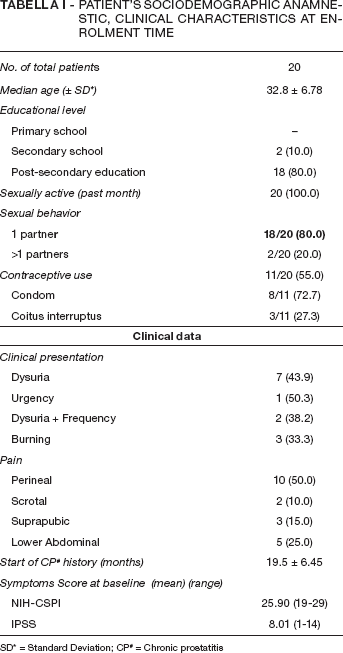
SD* = Standard Deviation; CP# = Chronic prostatitis
Clinical evaluations at follow-up
At the follow-up examination (1 month after treatment), 18 out of 20 patients (90.0%) reported an improvement of quality of life, in terms of pain reduction. The questionnaire results after 1 month from treatment were as follows: NIH-CPSI 12.8 ∓ 2.20, IPSS 7.6 ∓ 1.58. Statistically significant differences were then reported between the two visits, in terms of NIH-CPSI scores (p<0.001). No statistically significant differences were reported in terms of IPSS between the two groups. Moreover, at the microbiological examination, no patients showed an increase in the number of leukocytes in the post-massage urine. All patients were negative at the Meares-Stamey test evaluation.
Adherence to treatment schedule and adverse effects
All patients correctly took all the 30 doses of DEPROX 500®, showing a 100% compliance to the study protocol. Only 1 patient (5%), had mild adverse effects that, however, did not require treatment suspension.
Discussion
Chronic prostatitis/chronic pelvic pain syndrome continues to pose a treatment challenge for all urologists, in particular in terms of patient's quality of life improvement. Several authors demonstrated that phytotherapy has an important role in the management of patients affected by CP/CPPS, specially due to its low incidence of adverse events and probably for its non-targeted effect to specific organ only (9, 15). In this pilot study, we evaluate the effects of pollen extract associated to vitamins (DEPROX 500®) in a small cohort of young patients, for the purpose of pain reduction. We found that a 1-month therapy with DEPROX 500® is able to improve the patient's quality of life without significant adverse events. Moreover, we found that this treatment schedule is able to preserve the prostate health, demonstrated by the absence of inflammatory response parameters at the microbiological examination. Moreover, we found that this treatment schedule is well accepted by patients, despite the cost of the therapy. The compliance to our study protocol is, in fact, 100%. Other authors showed good results in terms of improvement of total symptoms, pain, and QoL by using pollen extract-based therapy only (9). We hypothesized that the good results in terms of pain reduction are due to the association with B6, B12 vitamins. Finally, the present study shows several limitations: small number of enrolled patients, short follow-up period, selected patient population and the lack of control group. However, this study will be the starting point for future controlled, randomized clinical trials.
Conclusions
In conclusions, the pollen extract associated with vitamins (DEPROX 500®) significantly improved total symptomatology, pain relief, and Quality of Life in patients with noninflammatory CP/CPPS without severe side effects.
Footnotes
Acknowledgments
We are grateful to all Santa Chiara Regional Hospital members for their technical laboratory assistance and to Professor John Denton for manuscript language revision.
Funding: None.
Competing interest statement: No conflicts of interest were declared.