






Abstract
Purpose.
Dupuytren disease is an inherited proliferative and progressive connective disease. Ectopic disease may, however, be located distant from the palmar fascia.
Methods.
Case report and review of the literature.
Results.
We describe a case of symmetric bilateral posterior subcapsular cataracts associated with symmetric bilateral Dupuytren disease and symmetric bilateral Ledderhose disease in a 56-year-old Caucasian man. His medical history was negative for glucocorticoids intake, diabetes, and exposure to radiation. Serum transforming growth factor β (TGF-β)1 concentration has been evaluated and was found to be almost double compared to the controls.
Conclusions.
We speculate that the TGF-β plays an important role for ocular and connective tissue disorders.
Introduction
Dupuytren disease is an inherited proliferative and progressive connective tissue disorder whereby the excessive myofibroblast proliferation and altered collagen matrix composition lead to a thickened and contracted palmar fascia, causing contractures that may severely limit function. Ectopic disease may, however, be located distant from the palmar fascia. Patients with bilateral disease commonly present higher incidences of concurrent ectopic disease, including Peyronie disease (i.e., penile fibromatosis) and Ledderhose disease (i.e., plantar fibromatosis) (1). The association between cataracts and Dupuytren disease has been reported (2–4).
Posterior subcapsular cataracts classically occur in patients <50 years old and their relationship with ocular inflammation, steroid intake, diabetes, trauma, or radiation seems to be well-established (5).
In this case report, we describe a case of symmetric bilateral posterior subcapsular cataracts associated with symmetric bilateral Dupuytren disease and symmetric bilateral Ledderhose disease in a 56-year-old Caucasian man.
Case presentation
A 56-year-old Caucasian man was referred to our clinic in June 2012, complaining of a progressive reduction of visual acuity in both eyes over the previous 12 months. He had never previously complained of problems with his eyes. During the ophthalmic evaluation, posterior subcapsular cataracts were pointed out in both eyes. Visual acuity was 1/10 with best correction in both eyes.
The patient had an emmetropic refraction and no past ocular history of trauma, surgery, or inflammatory diseases. His medical history was negative for glucocorticoids intake, diabetes, and exposure to radiation. He denied any excessive drinking.
The patient had had surgery for a symptomatic plantar fascia fibromatosis (Ledderhose disease) in 1996. In 2006, papillary thyroid cancer was discovered and treated successfully with a total thyroidectomy and central and laterocervical bilateral lymphadenectomy, followed by the ablation of remaining thyroid tissue with I131 (total dose of 100 mCi). The patient had not been treated with external beam radiation therapy and had had no recurrence during follow-up. The resultant hypothyroidism had been treated with daily levothyroxine 150 mcg up to the present. The patient had had paucisymptomatic bilateral Dupuytren disease for several years but as yet had never treated it. Blood tests showed normal values of serum glucose and all other biomarkers were found to be within normal limits. Serum concentration of transforming growth factor β (TGF-β)1 by immunoassay kit (R&D Systems) was evaluated as well.
After the preoperative visit, phacoemulsification with an IOL implant in the right eye was scheduled and performed successfully. Visual acuity improved to 10/10 a few days after the surgery.
Discussion
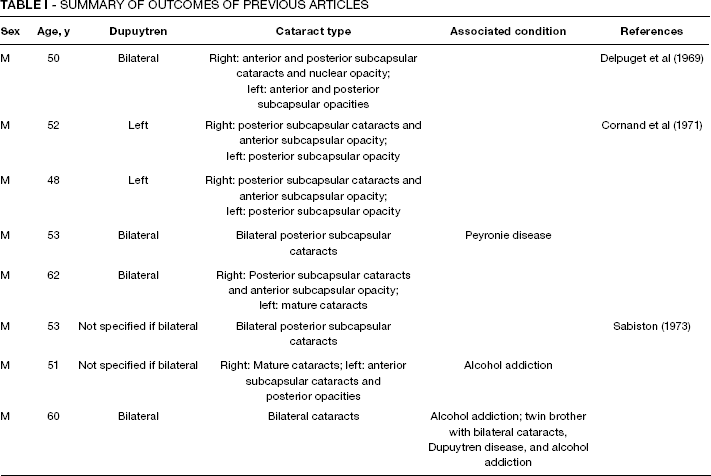
Three articles have described the association between cataracts and Dupuytren disease. In 1969, Delpuget et al (2) first described this association in a 50-year-old man. In 1971, Cornand et al (3) observed 4 cases of this in four men aged 48 to 62. In all 4 cases, both eyes were characterized by posterior subcapsular cataracts. One patient had Peyronie disease.
In 1973, Sabiston (4) observed 40 patients over a period of 5 years. He found a positive correlation between alcohol intake, Dupuytren contracture, and cataracts. In his article, he presented 3 case reports. The outcomes of the above-mentioned articles are summarized in Table I.
Summary of Outcomes of Previous Articles
The major contractile cellular component in Dupuytren disease is the myofibroblast, a cell that shares phenotypic features of both fibroblasts and smooth muscle cells.
Interestingly, TGF-β is a cytokine protein abundant in Dupuytren tissue and largely responsible for myofibroblast proliferation and fibroblast differentiation.
The hypothesis that TGF-β plays a role in the etiology of subcapsular cataracts has been gaining increasing acceptance since its cataractous effects on lens epithelial explants were first reported in 1994 (6).
Subcapsular cataracts are characterized by the presence of one or more opaque plaques apposing the lens capsule in the posterior or anterior region of the lens. They are characterized by myofibroblastic/fibroblastic transdifferentiation of lens cells and/or formation of aberrant swollen cells, abnormal migration and multilayering of cells, wrinkling of the lens capsule, and apoptotic cell death. Inappropriate TGF-β signaling in the anterior lens epithelial cells results in an epithelial-mesenchymal transition process (7). However, the pathophysiology of both diseases is multifactorial and remains a topic of research and debate.
We speculate that, in these patients, TGF-β plays an important role; therefore, TGF-β1 serum concentration has been evaluated in our case and in 2 controls submitted to surgery for senile nuclear cataracts. Serum TGF-β1 concentration was found to be almost double (18,290 pg/mL) compared to that of the senile cataract patients (9961.6 pg/mL and 8609.2 pg/mL, respectively).
Footnotes
Acknowledgements
The authors thank Giorgia Testa for technical support (Pediatric Clinic, Foundation IRCCS Policlinico San Matteo).