






Abstract
Purpose
To emphasize the demographic and occupational characteristics of ophthalmologists primarily involved in retinopathy of prematurity (ROP) care and to ascertain their practices and preferences.
Methods
A questionnaire was sent to all Turkish ophthalmologists known to be primarily involved in ROP. They were asked about personal and occupational characteristics, practices and preferences related to ROP care, and for their proposals related to ROP training.
Results
Seventy questionnaires were sent, of which 63 (90%) were returned. A total of 44 respondents reported performing laser and 13 vitreoretinal surgery. Preferred treatment was transpupillary laser photocoagulation (54.5%), mostly performed in the operating theater (84.1%) under general anesthesia (72.7%). Only 19 (30.2%) reported intravitreal injection of vascular endothelial growth factor inhibitors (anti-VEGF). Ophthalmologists from university hospitals, trained in retina during fellowship, and performing treatment for ROP more commonly performed anti-VEGF injection. Most of them studied ROP after residency and 76.2% think that ROP training during residency is inadequate for clinical practice.
Conclusions
This survey reveals considerable variation among Turkish ROP specialists regarding ROP care. The survey data are critical in order to develop quality improvement and help in planning more effective future programs for ROP care in terms of training.
Keywords
Introduction
Retinopathy of prematurity (ROP) is a vasoproliferative disorder of the developing retina which is the leading cause of childhood blindness in industrialized countries (1). Owing to recent advances in resuscitation and monitoring in the neonatal intensive care unit, and consequent improvement in survival rate of very premature babies, the number of infants at risk for ROP has increased and ROP has become an important cause of vision loss in children from developing nations (2). Although there is an increased need for ROP specialists, the number of ophthalmologists who manage ROP is limited in Turkey. The present study aimed to ascertain the demographic and occupational characteristics of ophthalmologists who provide ROP care in Turkey and to report their practices and preferences about screening and treatment of ROP.
Materials and Methods
All public and private neonatal intensive care units in Turkey were called by telephone during January 2012 in order to learn the attending ophthalmologist for ROP care or if not present, the hospital to which eligible babies were transferred for ROP screening, and their subsequent management was questioned. After detection of the contact details of the ophthalmologists who are primarily involved in screening and treatment of ROP, an e-mail survey consisted of 36 (primarily multiple-choice and some single-response) questions which took less than 10 minutes to answer was sent to all of them. All phone calls and e-surveys were performed by a single investigator (M.A.S.). The ROP specialists were asked about the demographic and occupational characteristics and their practices and preferences related to ROP care. Two subsequent e-mails were sent to nonresponders at 2-week intervals. If there was still no response, the ophthalmologist was classified as a nonresponder.
This research was conducted under the approval of the institutional review board of Etlik Zubeyde Hanim Maternity and Research Hospital. The study followed the tenets of the Declaration of Helsinki. Responses to e-surveys were printed to preformed questionnaires. Final data were analyzed using SPSS 15.0 for Windows (SPSS Inc., Chicago, IL). Kruskal-Wallis one-way analysis of variance was used for between-group comparisons and Mann-Whitney U test was used to examine multiple comparisons for variables that were not normally distributed. Bonferroni correction was used to calculate a significant p value based on the number of comparisons. Categorical variables were analyzed by likelihood ratio chi-square test or Pearson chi-square test. Arithmetic mean, standard deviation, median, and range were given as descriptive statistics for quantitative data. Qualitative data were summarized using frequency and percentages. Statistical significance was accepted when p<0.05.
Results
A total of 70 questionnaires were sent out, of which 63 (90%) were returned.
A total of 63 respondents were distributed in 25 different provinces and 48 different hospitals. The sample was well-distributed throughout the different parts of Turkey, including all 7 geographical regions.
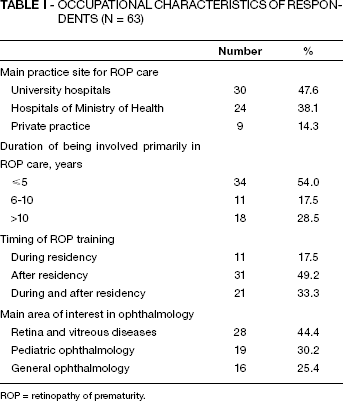
Of the 63 respondents, 34 (54.0%) were male and 29 (46.0%) were female. The mean age of the respondents was 39.4 ± 7.5 years (range 30–56 years). Occupational characteristics of respondents are shown in detail in Table I.
- Occupational Characteristics Of Respondents (N = 63)
ROP = retinopathy of prematurity.
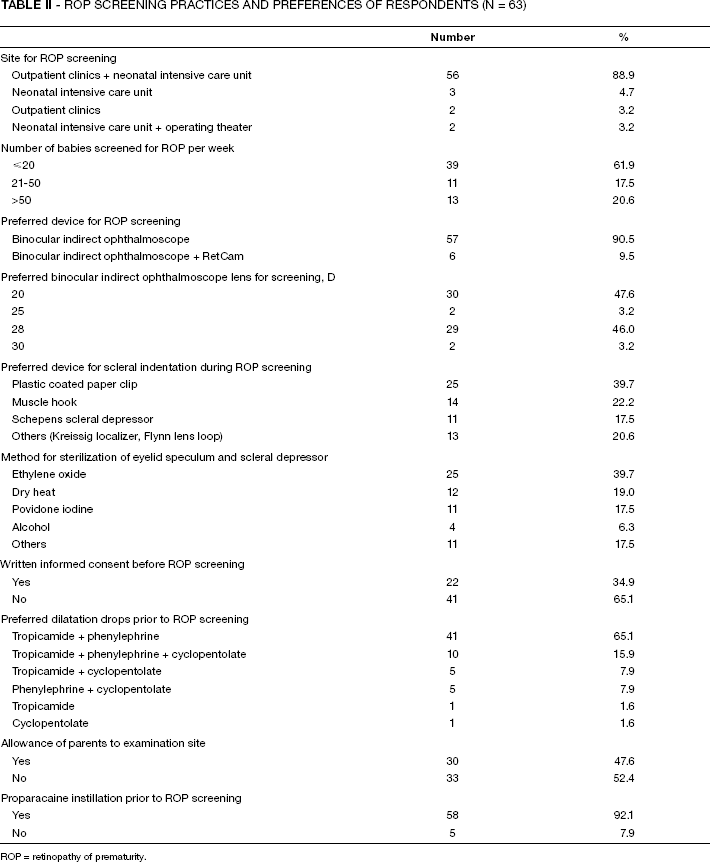
Of the 63 respondents, all reported performing screening for ROP. The ROP screening practices and preferences of respondents according to survey results are given in detail in Table II.
- Rop Screening Practices And Preferences Of Respondents (N = 63)
ROP = retinopathy of prematurity.
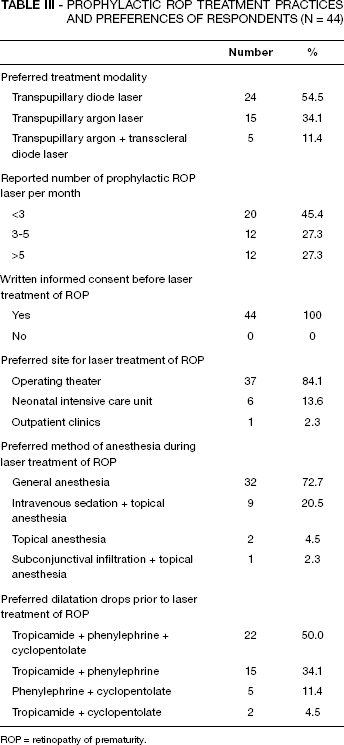
According to survey data, decision for prophylactic treatment of ROP is made when the disease is at high risk prethreshold level (type I ROP), which was defined in the Early Treatment for Retinopathy of Prematurity (ETROP) study by 54 respondents (85.7%), at low risk prethreshold level (type II ROP), which was defined in the ETROP study by 7 respondents (11.1%), and at threshold level, which was defined in the Cryotherapy for Retinopathy of Prematurity (CRYO-ROP) study by 2 respondents (3.2%) (3, 4). Of the 63 respondents, 19 reported performing screening only and a total of 44 respondents reported performing prophylactic laser treatment as well. The prophylactic ROP treatment practices and preferences of respondents according to survey results are given in detail in Table III.
- Prophylactic Rop Treatment Practices And Preferences Of Respondents (N = 44)
ROP = retinopathy of prematurity.
When ideas about intravitreal injection of vascular endothelial growth factor inhibitors (anti-VEGF) were asked, only 19 (30.2%) of them reported that they use them for selected cases. Thirty-one (49.2%) reported that they do not use it because of medicolegal liability, although they think that it should be used in selected cases, whereas 13 (20.6%) reported that they do not use it and it should not be used because of insufficient evidence of effectiveness and possible systemic side effects. Ophthalmologists who work in university hospitals (p<0.01), who are fellowship trained in retina and vitreous diseases (p = 0.003), and who perform prophylactic laser treatment (p = 0.012) and vitreoretinal surgery (p<0.01) for ROP were found to more commonly perform intravitreal anti-VEGF injection.
The thoughts of ROP specialists on appropriate timing of vitreoretinal surgery were reported as stage 4a ROP by 46 (73.0%), stage 4b by 16 (25.4%), and stage 5 by 1 (1.6). A total of 13 respondents reported performing vitreoretinal surgery for ROP. Of those, 3 (23.1%) reported that they perform less than 5 surgeries, 2 (15.4%) reported 5 to 10 surgeries, and 8 reported more than 10 surgeries per annum. All those respondents reported preferring lens-sparing vitrectomy if possible, and lensectomy + vitrectomy in extensive cases. Most of the surgeons are among those who trained in retina and vitreous diseases during fellowship (11 of the 13 surgeons) (p = 0.01), and they mostly work in university hospitals (8 of 13 surgeons) (p<0.01). Of the 63 respondents, 48 (76.2%) reported that ROP training during residency is inadequate. Thirty-eight (60.3%) of them advised that ROP training should start in residency and continue after it.
The nonresponder ophthalmologists were all from university hospitals, and their clinical practices and preferences remained unknown. Therefore, their characteristics were not incorporated into the statistical analysis.
Discussion
The management of ROP has become challenging for ophthalmologists due to concerns about medicolegal liability and logistical difficulties. A survey of the American Academy of Ophthalmology in 2006 demonstrated that only half of the retina and pediatric ophthalmology subspecialists were managing ROP and about one fifth of those were planning to discontinue in the near future (5). Appropriate screening for evaluation of ROP is critical for optimal disease management and is a highly specialized activity which requires advanced training. Underdiagnosis could lead to progression of disease and visual loss, whereas overdiagnosis could lead to unnecessary examinations and treatment. Because of the above mentioned causes, ophthalmologists are choosing to avoid ROP management and neonatologists have difficulty finding trained ophthalmologists in terms of screening and treatment of ROP. Despite all these problems, the number of the ophthalmologists who are involved in ROP care has recently started to increase in Turkey, which is demonstrated in the present survey, the results of which showed that most of the respondents (54.0%) caring for patients with ROP have been doing this for no more than 5 years.
Of the 63 respondents, 48 (76.2%) reported that ROP training during residency is inadequate. Thirty-eight (60.3%) of them advised that ROP training should start in residency and continue thereafter with ongoing training for consultants. Retinopathy of prematurity is a common problem among premature babies, but severe disease is rare. The rarity of severe ROP means that it is seen infrequently even by regular screeners. Several studies have shown that there may be important variability in diagnosis of some important parameters such as plus disease, even among recognized ROP experts specializing in pediatric ophthalmology and retina (6, 7). Thus education for ROP screening should be continuous and training programs should include visits to specialized units that take referrals for ROP management. Most of the ophthalmologists who perform ROP care in Turkey work in university hospitals (47.6%) and were mostly trained in retinal and vitreous diseases during fellowship (44.4%). A Web-based survey by Wong et al about training of pediatric ophthalmology and retina fellows in the management of ROP found that pediatric ophthalmology fellows performed fewer laser photocoagulation procedures than retina fellows (8). They stated that many clinical ROP examinations were performed by pediatric ophthalmology and retina fellows without involvement and/or direct supervision by attending ophthalmologists. A study also showed that many ophthalmologists without pediatric or retinal subspecialty training were performing ROP screening and treatment (9). Contrary to examinations, most treatment is being performed by ophthalmologists who are trained in retina and vitreous diseases. On the basis of the study by Kemper and colleagues (9), 5% of all ophthalmologists were estimated to screen for ROP and the size of the workforce for treatment was about half the size of the workforce for screening. They stated that 9% of the ophthalmologists who examine ROP, regardless of whether they completed a fellowship, reported that their training did not adequately prepare them to do so. Some institutions in Turkey also use fellows or residents as primary screeners. The reality is that examiners with less formal training than retinal specialists and pediatric ophthalmologists are performing ROP screening in response to workforce pressures.
Because of differences in ophthalmoscopic examination technique and infant cooperation, image-based examination seems to cause less variability compared to that with binocular indirect ophthalmoscopy. Telemedicine should be a primary target to extend the reach and to reduce the variability in screening. However, few ophthalmologists have a retinal imaging device for ROP screening. In the study by Kemper et al, 18% of the ophthalmologists who provide care for children younger than 1 year reported that their main practice site owns a retinal imaging device, and only 15% of them use it for ROP screening (9). Only 6 ophthalmologists (9.5%) in our study group own a wide-field digital retinal imaging system (RetCam), probably due to high cost and inadequate reimbursement for the expense of the device. Most of the respondents (90.5%) perform binocular indirect ophthalmoscopy by using 20 D (47.6%) and 28 D (46.0%) convex lenses.
Of the respondents, 58 (92.1%) use topical proparacaine in order to maintain topical anesthesia prior to screening examination, which has been shown to be associated with a reduction in pain scores especially at the time of speculum insertion (10). Forty-one (65.1%) respondents prefer tropicamide + phenylephrine combination for dilation prior to screening, and 22 (50.0%) prefer tropicamide + phenylephrine + cyclopentolate combination prior to laser treatment, which is consistent with the literature that most authors offer a combination of drops instead of a single agent for effective dilation, especially during treatment (11). Ethylene oxide was the preferred method of sterilization (39.7%) for eyelid speculum and scleral depressor. Disposable speculum and scleral depressors were reported to be the ideal tools for screening examination, which are rarely used in developing countries because of high cost. An interesting finding from this survey is that 39.7% of the respondents use plastic coated paper clips for indentation, again possibly because of low cost.
Of the 63 respondents, 44 were treating ROP. A variety of lasers and delivery methods were reported to be used. Of these, 24 (54.5%) were using transpupillary diode, 15 (34.1%) transpupillary argon, and 5 (11.4%) transpupillary argon + transscleral diode. There were no respondents using cryotherapy for prophylactic treatment of ROP. The treatment choice for ROP has shifted from cryotherapy to laser photocoagulation following studies that showed that laser treatment is at least equal to cryotherapy in terms of effectiveness (12, 13). Thus the practice of Turkish ROP specialists has moved away from cryotherapy towards laser treatment. There is variation in the methods and availability of different forms of anesthesia used during laser treatment of ROP (14, 15). The current survey showed that the methods and availability of different types of anesthesia used during laser treatment of ROP varies widely among respondents. Of the 44 ophthalmologists who are primarily involved in ROP laser treatment, 32 (72.7%) reported a preference for general anesthesia, 9 (20.5%) intravenous sedation combined with topical anesthesia, 2 (4.5%) topical anesthesia as sole method, and 1 (2.3%) subconjunctival combined with topical anesthesia. The most preferred method for laser treatment of ROP was general anesthesia in the present study, which is consistent with the literature, because of the belief that infants are more stable during and after treatment (14). Some alternative methods are also used to enable laser treatment of ROP without a delay, particularly in units without readily available pediatric anesthetists. Regarding the site where laser treatment was performed, 37 (84.1%) of the respondents reported a preference for the operating theater, which is also consistent with the literature (14). In our own practice, we encountered some organizational difficulties in obtaining timely anesthetic cover to perform general anesthesia and preferred a technique of intravenous sedation for the treatment of ROP, which is performed under the supervision of neonatologists in the neonatal intensive care unit, preventing the transfer of babies to the operating room, which may cause delays in treatment and disruption of neonatal care, which eventually may lead to complications. We also use topical anesthesia in selected cases, which was previously described in detail (16). Medicolegal liability is a concern for ROP specialists. In order to reduce the risk of medicolegal problems, besides performing appropriate screening and treatment, specialists should incorporate the families of the babies into the course of screening and treatment procedure and they should be informed accurately. A total of 47.6% of respondents were allowing parents in the examination site during screening, 34.9% were obtaining written informed consent prior to screening examination, and 100% were obtaining written informed consent prior to laser treatment.
There are a number of limitations to the present study. First, the number of subjects is small. However, because of the highly specialized nature of ROP care, the total number of ophthalmologists who are primarily involved in ROP care in Turkey is limited, and this survey includes almost all those ROP specialists. Secondly, even though we had a high rate of return for surveys e-mailed (90%), we may not be able to generalize our results to the whole population. Survey nonresponse could bias our estimates. However, this level of participation is comparable with research using surveys. Finally, some of the respondents of our survey might have attended the same ROP training programs of the Ministry of Health. This may raise the possibility that responses of those may bias the overall results. Despite the limitations of the current study, there are important implications regarding quality of care and future training and organization of ROP care. This study is critical for developing quality improvement activities and planning for more effective training programs for ROP care. A future larger nationwide survey will be helpful in order to demonstrate changing trends in ROP care.
To our knowledge, the present survey is the first national survey and the most extensive survey in the literature related to ROP screening and treatment. It provides an overview about the practices and attitudes of ophthalmologists involved in ROP care in Turkey. The results of this survey are useful in building a better picture of national ROP care. No national consensus on screening and treatment of ROP exists. Possible reasons for the wide variations related to practice in ROP care include differing beliefs and experiences of individual ophthalmologists and resource limitations. These findings suggest a need for more formalized ROP training protocols.