






Abstract
Purpose
To determine diurnal changes and zonal differences of corneal surface temperature in young healthy adults following blinking.
Methods
In this prospective, longitudinal, single–center study, 19 healthy left eyes of 19 healthy subjects (age 23.6 ± 2.2 years) were recruited. Corneal surface temperature (CST) was measured by the Ocular Surface Thermographer TG-1000 (Tomey, Germany) at 3 different time points: 8:00–10:00, 11:00–13:00, and 15:00–18:00. The CST was measured every second for 10 seconds immediately after blinking. We assessed the temperature at the corneal center and at 3 peripheral quadrants at 3 (temporal), 6 (inferior), and 9 (nasal) o'clock at the corneal limbus.
Results
Mean central/temporal/nasal/inferior corneal surface temperatures were, between 11:00 and 13:00, 34.1 ± 0.5°C/34.2 ± 0.6°C/34.4 ± 0.5°C/34.6 ± 0.5°C. During 10 seconds following eye opening and between time points 1, 2, and 3, the observed corneal surface temperature parameters did not change significantly (p≥0.3 for all). However, there was a significant difference between temperatures at the nasal limbal area and the center of the cornea (p≤0.03 at each time point). In addition, the temperature was warmer nasally than temporally until 6 seconds and 8–10 seconds after blinking (p≤0.05 for seconds 0–6; 8–10 at time points 1, 2, and 3).
Conclusions
In healthy subjects, corneal surface temperature does not change diurnally and is warmer nasally than centrally and temporally during the interblinking interval. Our study leads to the assumption that diurnal changes of corneal temperature indicate ocular surface abnormality or corneal pathology.
Introduction
All metabolic events produce heat. This is transferred to the body surface by conduction and convection. Therefore, the analysis of body temperature has been of interest for a long time and this fact made researchers develop a number of diagnostic tools measuring ocular surface temperature (OST) during recent decades (1–5). At the beginning, OST measurements were performed by contact technique using topical anesthesia, which resulted in low accuracy and poor resolution (6). Thereafter, Mapstone revolutionized OST measurement using infrared technology (1). Infrared thermometry measures the energy emitted by the ocular surface in the mid infrared region of the spectrum, considering the individual emission characteristics of the ocular surface and the thermal radiance of a black body (7, 8). The biggest advantage of infrared thermographs is that they are noncontact and allow repeated measurements (1, 8–11).
Studying OST is important to consider all parameters that might influence the results of the measurements. It is believed that OST could vary throughout the day as the ocular tissue proved to be linked with choroidal blood flow (12). To our knowledge, diurnal changes of corneal surface temperature (CST) have not been analyzed.
The purpose of this study was to determine the diurnal changes of CST and to determine the zonal differences of CST in adults following blinking.
Subjects and Methods
Subjects
Nineteen healthy left eyes of 19 healthy subjects (42% male; age 23.6 ± 2.2 years [range 20–30]) were included in our study.
Exclusion criteria included subjects with dry eye (positive McMonnies questionnaire); previous contact lens use; previous ocular surgery; history of atopy; Stevens-Johnson syndrome; or chemical, thermal, or radiation injury.
Measurement of CST
Corneal surface temperature was measured using the new Ocular Surface Thermographer TG-1000 (Tomey, Germany) in a standard clinical room at a relatively constant temperature (25.5 ± 1.5°C) and humidity (40.5 ± 2.6%) by only one examiner to eliminate potential interexaminer variations. The subject was asked to place his or her head in a standard ophthalmic chin and head rest and to look constantly straight ahead. Measurements were done at 3 different time points: 8:00–10:00, 11:00–13:00, and 15:00–18:00.
We performed the measurements under conditions described by Mori and associates (13). The subject blinked normally, then closed both eyes for 5 seconds, and thereafter kept eyes open for more than 10 seconds. Corneal surface temperature was measured every second for 10 seconds immediately after the eye refrained from blinking.
We measured CST at the corneal center and at 3 peripheral quadrants at 3 (temporal), 6 (inferior), and 9 (nasal) o'clock at the corneal limbus.
The center of the cornea was defined as a circular area with 2 mm diameter at the optical axis of the eye. For determining the nasal and the temporal limbal corneal regions, a horizontal line was drawn through the center of the cornea. Then the intersection of the line and the nasal (9 o'clock) and temporal (3 o'clock) corneal limbus were designated and defined by a 2-mm region in diameter. The inferior (6 o'clock) position was a region with 2 mm in diameter around a point at the limbal end of a vertical line through the center of the cornea to the corneal limbus (Fig. 1). The surface temperature was recorded over each region and an average value for each region was calculated.
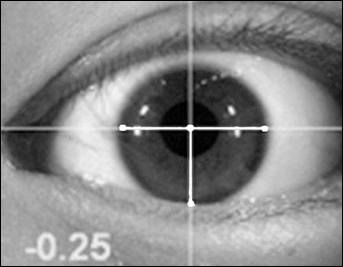
The center of the cornea was defined as a circular area with 2 mm diameter at the optical axis of the eye. For determining the nasal and the temporal limbal corneal regions, a horizontal line was drawn through the center of the cornea. Then the intersection of the line and the nasal (9 o'clock) and temporal (3 o'clock) corneal limbus were designated and defined by a 2 mm region in diameter. The inferior (6 o'clock) position was a region with 2 mm in diameter around a point at the limbal end of a vertical line through the center of the cornea to the corneal limbus. The surface temperature was recorded over each region and an average value for each region was calculated.
Statistical analysis
For statistical analysis, SPSS 18.0 was used. Comparisons between groups or variables were performed using nonparametric tests (Mann-Whitney U test for unpaired samples). A p value ≤0.05 was considered statistically significant.
Results
Mean central/temporal/nasal/inferior CST were 34.1 ± 0.5°C, 34.2 ± 0.6°C, 34.4 ± 0.5°C, and 34.6 ± 0.5°C between 11:00 and 13:00. The temperature values at different time points and regions are displayed in Table I and Figure 2. Mean CST during 10 seconds after blinking is shown in Figure 3. During 10 seconds following eye opening and between time points 1, 2, and 3, the observed CST parameters did not change significantly (p≥0.3 for all).
Central, Temporal, Nasal, And Inferior Corneal Surface Temperature Values At 3 Different Time Points
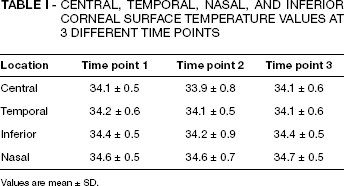
Values are mean ± SD.
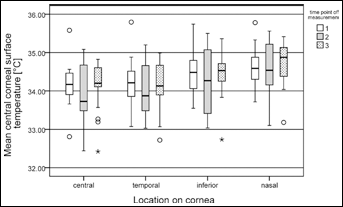
Mean corneal surface temperature immediately during the interblinking interval (10 seconds) between 8:00 and 10:00, 11:00 and 13:00, and 15:00 and 18:00. Mean ± standard deviation values at the corneal center and at 3 peripheral quadrants (temporal, inferior, nasal) are presented.
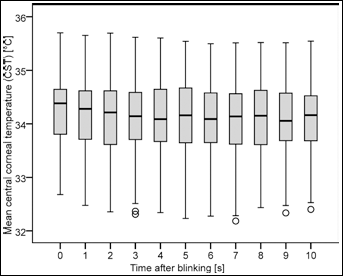
Mean ± standard deviation of central corneal surface temperature during the first 10 seconds of the interblinking interval.
The coolest area at all 3 time points was the central cornea (Fig. 2). There was a significant difference between temperatures at the nasal quadrant and the center of the cornea (p≤0.03 at each second following blinking at time points 1, 2, and 3). In addition, the temperature was warmer nasally than temporally until 6 seconds and 8–10 seconds after blinking (p≤0.05 at time points 1, 2, and 3).
Discussion
Measurement of the OST may help us to understand ocular physiology. It is known that temperature of the anterior segment of the eye, except the inner canthus, decreases with age (14). Regarding the absolute temperatures, about 50% of normal subjects show some degree of thermographic asymmetry between the orbito-ocular areas (15). Ocular thermography may also be helpful in the differential diagnosis of exophthalmos (16). It also has been shown that OST measurements help to detect early inflammation and dry eye (17). It is, therefore, of great importance to establish OST norms for healthy subjects.
The most conspicuous finding of our study is that the CST of healthy young adults does not change diurnally. The literature supports that OST increases throughout the day, especially in dry eyes (18, 19). In contrast, we found that in eyes of young, healthy subjects, between 8:00 and 10:00, 11:00 and 13:00, and 15:00 and 18:00 central, temporal, inferior, and nasal CST did not change significantly during the day. Therefore, noninvasively detected diurnal changes of CST may help us to detect early corneal inflammation or dry eye.
Similar to our findings, the literature indicates that normal CST ranges from 32°C to 36°C (average CST) and that in healthy eyes limbal temperature is warmer than the central corneal temperature by 0.45 to 1.0°C (2, 14, 20). Our prospective, longitudinal, single-center study could confirm that the central cornea is the coolest area. Furthermore, there was a significant difference between temperatures at the nasal quadrant and the center of the cornea during the interblinking interval. Differences between the nasal and central corneal temperature may be explained by the distance of the corneal center from limbal vessels and also by differences in central and peripheral corneal thickness and anterior chamber depth or tear film dynamics (2, 20).
Our study could detect that the corneal temperature was warmer nasally than temporally until 6 seconds and 8–10 seconds after blinking. The explanation for these temperature differences may include regional differences in corneal thickness, anterior chamber depth, tear film dynamics, and local differences in ocular blood flow (13, 21, 22). Kamao and associates determined that in normal or dry eye patients, the temperature of the nasal conjunctiva tended to be higher than that of the temporal area (17). They explained this difference with greater blood flow and vascularization at the nasal conjunctiva. Nasally there are more large vessels, such as the dorsal nasal artery and the angular artery; in addition, the medial rectus muscle has 2 anterior ciliary arteries—the lateral rectus muscle has only one. In the studies of Koçak et al (5) and Aliò and Padron (14), the nasal conjunctival canthus was also described to be warmer than the corresponding temporal areas.
Morgan (21) and Craig and Tomlinson (23) reported in dry eye patients that the temperature of the cornea decreases with sustained eye opening. Our results in healthy eyes showed that the temperature at the center of the cornea slightly decreases but does not change significantly with sustained eye opening over 10 seconds.
In conclusion, CST does not change diurnally in healthy subjects and is warmer nasally than centrally and temporally during the interblinking interval. Our study leads to the assumption that diurnal changes in corneal temperature indicate ocular surface abnormality or corneal pathology.