






Abstract
We conducted a systematic review to determine whether the literature supports the use of free vascularised fibular graft (FVFG) over other salvage procedures for the treatment of avascular necrosis (AVN) of the femoral head, and if there are patient-specific and defect-specific factors that may predict better outcomes after FVFG. Fifteen total studies were identified for inclusion. Three comparative studies showed an overall statistically significant superiority of FVFG over NVFG; two comparative studies demonstrated FVFG better than core decompression. One study show a better but not statistically significant superiority of FVFG comparing with vascularised iliac pedicle bone graft procedures, likely due to small sample size. This review suggests that vascularised fibular grafting is a better treatment option than core decompression and nonvascularised fibular grafting.
Introduction
Avascular necrosis (AVN), also known as osteonecrosis of the hip, is a disease in which the living elements of bone in the femoral head die due to an interruption of the blood supply. AVN can occur in many sites, but it has received the most attention in the hip. Although it has been a well-known clinical entity for centuries, only in the last two to three decades has a significant amount of research been devoted to this debilitating condition. It is estimated to account for more than 10% of the more than 500,000 total hip arthroplasties (THA) performed each year in the United States (1–2). With its disastrous clinical consequences and propensity to afflict younger patients, AVN continues to serve as the subject of considerable debate and research. Unfortunately, the available literature has done little to clarify concepts or come up with a well-accepted treatment algorithm. In fact, it has only heightened the controversy due to the variability in approaches to AVN and the results of treatment. The use of vascularised bone grafts to treat AVN was developed to prevent collapse of the femoral head and enhance vascularisation of the bone in the proximal femur. The purpose of the present review was to address two questions. Firstly, does the current literature support the use of FVFG over other salvage procedures for the treatment of AVN of the femoral head? We hypothesise that vascularised grafts, specifically FVFG, is superior to other treatments with regard to clinical outcomes, radiographic findings and durability of treatment. Secondly, we sought to determine if there are patient-specific and defect-specific factors that may predict better outcomes after FVFG compared to other procedures.
Materials and Methods
To address our hypothesis, we conducted a systematic review of the available literature according to PRISMA (Preferred Reporting Items for Systematic reviews and Meta-analyses) guidelines (Fig. 1). Three independent reviewers separately completed the search, and the results were duplicated three times by each reviewer. The searches were conducted on December 12, 2011, and were performed with use of the following databases: MEDLINE, CINAHL, PubMed, Scopus and Cochrane Collaboration systematic reviews. Search terms included osteonecrosis, avascular necrosis, vascularised graft free vascularised fibular graft, pedicled graft fibular graft. All studies with Level-IV evidence and higher (according to the Oxford Centre for Evidence-Based Medicine) (3) that met criteria were included.

Flowchart describing search process.
The inclusion criteria were as follows: 1) comparison of any bone grafting technique with any other treatment/reconstruction technique, with reporting of validated clinical outcome measures, as well as numerous case studies and reports to reinforce the strength of the procedure; 2) Level-IV or higher evidence; 3) a minimum duration of follow-up of 12 months; 4) use of the English language or any language for which successful medical translation was achievable; 5) evaluation of human subjects; 6) performance of the study from January 1, 1950 through December 12, 2011; 7) evaluation of the hip joint only; and 8) primary procedure performed, i.e. not secondary or salvage procedure. The decision to include case series and reports was made in order to show the natural history and progression of FVFG, outside of exclusively comparative reports.
The exclusion criteria included: 1) expert opinion (Level-V evidence), commentary, surgical techniques, letters to the editor, basic science, or animal studies; 2) studies utilising surgical techniques that were not considered standard practice at the time of the writing of the present manuscript; 3) studies that did not use any validated outcome measures; 4) a duration of follow-up of less than 12 months; 5) use of a language for which successful medical translation was impossible; 6) evaluation of any joint other than the hip.
Data analyses
Observed odds ratio (OR) along with its 95% confidence interval for each dichotomous outcome was calculated to compare if it is in favour of VFG (OR<1) or the other treatment (OR>1). Cohen's effect size (ES) was also used to compare VFG vs. NVFG based on a continuous variable in one study, where ES>0 implied in favour of VFG and ES<0 in favour of NVFG.
To compare the effect of different treatments, meta-analyses of the odds ratios from all selected outcomes in different studies were conducted using Comprehensive Meta Analysis (Version 2.2) software (Borenstein M, Hedges L, Higgins J, Rothstein H. Comprehensive Meta-analysis Version 2, Biostat, Englewood NJ, 2005). A random effect model was used to model the variation of the multiple outcomes within a same study, and the variation across different studies. Sensitivity analyses were also conducted using fixed effect and mixed effect models and using subset of primary endpoints data only to access the robustness of the conclusion for the tested hypothesis.
Results
Fifteen studies were identified for inclusion. There were 1,251 subjects who underwent one of four relevant surgical techniques: 1,018 underwent FVFG, 81 underwent nonvascularised fibular grafting, 87 underwent core decompression, 32 underwent FVFG following failed core decompression and 33 underwent vascularised iliac pedicle bone graft. No studies duplicated patient populations. These studies evaluated clinical and radiographic outcomes, as well as the rate of conversation to total hip arthroplasty of the various procedures. Three studies were Level-II evidence, 10 were Level-III evidence and an additional two were Level-IV evidence. The cumulative studies and their main data parameters are tabulated in Table I.
Studies Included
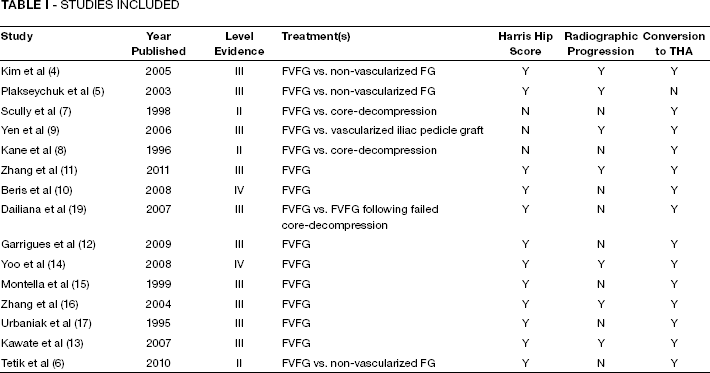
In regard to the comparative studies presented, three of the studies, by Kim et al (4), Plakseychuk et al (5), and Tetik et al (6) had compared FVFG vs. NVFG; with total of 172 (84 vs. 88) hips included in these three studies. There are a further 751 (634 + 117) hips included by Scully et al (7) and Kane et al's (8) studies comparing FVFG vs. the core decompression procedure. Only one paper (Yen et al (9)) compared FVFG vs. vascularised iliac grafting, with a total of 61 (22 + 39) hips.
Patient populations
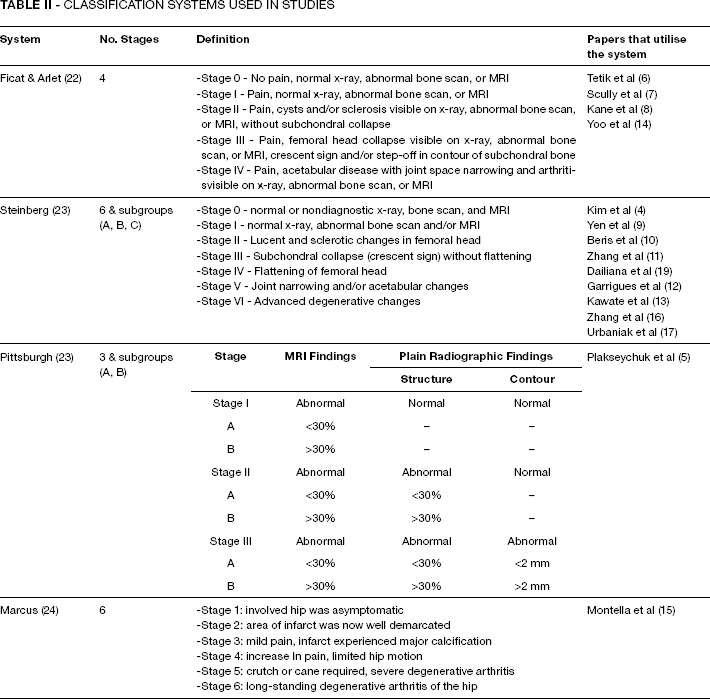
Patients undergoing FVFG in this review tended to be young (avg. age 35.1, range 13-63 years); to have earlier stages of AVN; and more likely to be male (male:female - 755:263). The defects treated in this population had progressed to the painful, symptomatic stages of disease and demonstrated moderate progression on imaging. The defects were completely isolated to the femoral side, excluding acetabular sided disease. The average duration of follow-up was 61.9 months for all studies, and ranged from 21 to 276 months. There were a variety of classification systems used to stage the patients; an overview of each type of system utilised can be seen in Table II.
Classification Systems used in Studies
Clinical outcome measures
Three studies reported clinical outcome measures in the form of functional hip scores (4–5, 9). Kim et al (4) and Plakseychuk et al (5) reported outcomes using the validated Harris Hip Score (Tab. II), as did the remaining nine studies (6, 10–17). Both preoperative and postoperative scores were available for comparison. Yen et al (9) reported their data using a modification of Merle d'Aubigne and Postel's numeric classification system and an unvalidated self-reported patient satisfaction questionnaire. Of the 13 studies for which we do have pre- and postoperative Harris hip scores, all displayed improvement postoperatively, as can be seen in Table III along with the other studies’ statistics.
Study Specific Outcome Measures
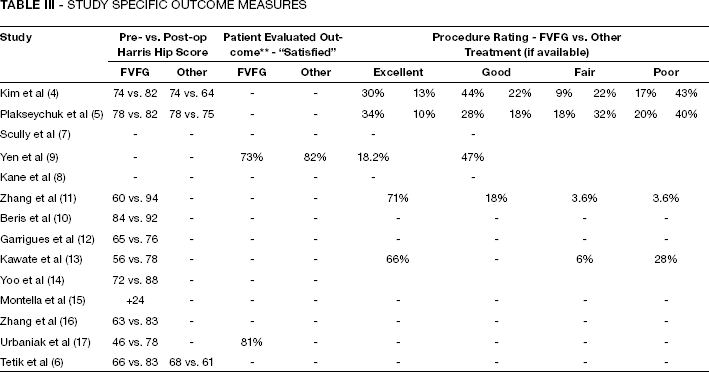
Zhang et al (11) reported that the HHS improved in 26 of 28 (93%) patients. Yoo et al (14) reported that 37 (81.5%) of the IIA classified hips were “improved or unchanged,” as were 39 (57.9%) of the IIB, and 32 (54.2%) of the IIC classified hips. Montella et al (15) did not report a specific pre- or postoperative HHS, however did claim a 24 point increase between the two categories. Zhang et al (16) reported, based on the Steinberg classification system, that stage II hips experienced an increased score ranging from 11-13 points, 15-24 points for stage III and 13-34 points for stage IV hips. Urbaniak et al (17) broke down scores categorically based on the criteria of Marcus et al. The stage-II hips improved from a preoperative average of 56 points to a postoperative average of 80 points, the stage-III hips from 52 to 85 points, the stage-IV hips from 41 to 76 points, and, lastly, the stage-V hips from 36 to 75 points. In addition to their HHS data, Tetik et al (6) further quantified results in terms of the visual analog scale (VAS), which aims to measure a subjective attitude towards a particular perception, typically pain (18). The mean preoperative VAS score for the FVFG procedure was 7, whereas the postoperative score was 2.81 (indicating decreased pain perception following the procedure). For the non-vasuclarised fibular grafting procedure, the preoperative VAS score was a 5.46, while the postoperative score was a 4.20.
Radiographic progression
Nine of the studies reported outcome measures in the form of radiographic progression and/or evidence of femoral head collapse (4–5, 9–11, 13–14, 16–17). Kim et al (4) and Plakseychuk et al (5) reported outcomes of both radiographic progression and collapse, while Yen et al (9) only reported evidence of radiographic deterioration. All statistics are tabulated in Table IV. Any unreported studies failed to quantify this information in the context of which we were examining.
Radiographic Outcomes
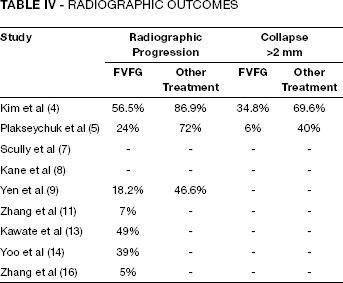
Beris et al (10) reported that their patients did exhibit signs of radiographic progression at their most recent follow-up (13 years postoperatively), displaying some of the same deformations that were originally noted. Kawate et al (13) demonstrated a significant association between preoperative collapse of the femoral head and radiographic progression (p = 0.011). Lastly, Urbaniak et al (17) reported radiographic progression in 7 of 19 stage-II hips (37%) and 21 of 22 (95%) stage-III hips had some femoral head flattening at the latest follow-up period of five years. Furthermore, 31 of the 40 stage-IV hips (78%) and 16 of the 22 (73%) stage-V hips displayed progressive collapse of the femoral head or related changes.
Procedure survival
All 15 studies reported outcome measures in the form of procedure survival with an endpoint of conversion to total hip arthroplasty (THA) as a mark of treatment failure. Fourteen of the studies reported conversations to THA as percentages, (4, 6–17, 19) while seven studies reported data in the form of a Kaplan-Meier survivorship curve (4–5, 7, 12, 14, 17, 19) in addition to percentages. The data are displayed in Table V.
Procedure Survival
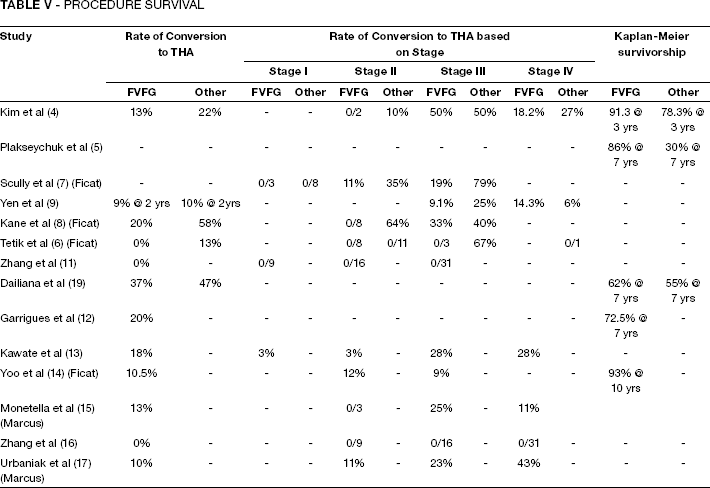
Beris et al (10) reported that their sole patient was free of any hip problems at her latest follow-up, 13 years postoperatively. Urbaniak et al (17) reported while there was no significant difference between stage III, IV and V in terms of survivorship, significance was observed between stage-II and stage-IV hips (p = 0.03).
Comparison of FVFG vs. other procedures
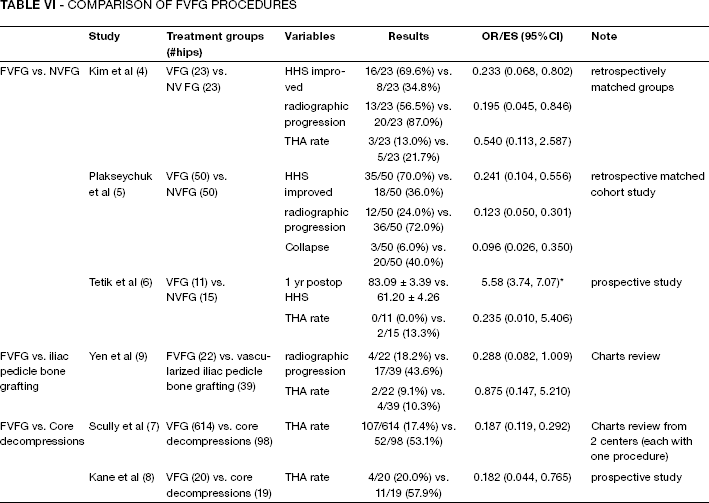
Kim et al (4), Plakseychuk et al (5) and Tetik et al (6) studied the differences between FVFG vs NVFG procedures. The FVFG procedure proved to be superior to NVFG procedures (p< = 0.001) based on the random effect model. Yen et al (9) was the only paper to compare FVFG procedures to vascularised iliac graft proedures. Although the trend suggests greater efficacy of FVFG procedures, it is not statistically significant, perhaps due to small sample size. The studies of Scully et al (7) and Kane et al (8) studies compared FVFG procedures to core decompression procedures. Both studies suggest that FVFG is the statistically superior treatment modality; the P value from the meta analysis is less than 0.001. All results are documented in Table VI.
Comparison of Fvfg Procedures
Discussion
We hypothesised that FVFG was superior to other treatment strategies for addressing AVN with regard to clinical outcome, imaging assessment, and durability of treatment. In terms of other related factors not discussed above, the average operative time of the FVFG procedure (from those papers that reported the data) ranged from two to nine hours (5, 9, 11, 16) and the most common complications included clawing of the toes, peroneal nerve palsy and superficial infections. Looking to the results, analysis of the current body of high-level evidence suggests that there is a trend for FVFG to demonstrate improved outcomes in comparison with nonvascularised fibular graft and core decompression but does not allow us to conclude that there is any difference between FVFG and vascularised iliac pedicle graft, or between FVFG and FVFG following failed core decompressions. The single-procedural studies included in this report add strength to the data and claims of the comparative procedure studies, attesting to the statistical benefits of FVFG procedures. Our review further demonstrated that there are patient-specific and defect-specific factors that do influence clinical outcome with FVFG. Although the methodological quality of studies on these procedures was initially fair, recent studies have demonstrated substantive improvement in study quality (Tab. II).
Despite numerous Level-IV studies in the literature, i.e. case-series, there are relatively few high-level studies demonstrating unambiguous improvement after FVFG, and to our knowledge no systematic reviews looking at Level-II and III studies. In the current review, five of the seven included studies showed a clear superiority of FVFG over other salvage techniques, (4–5, 7–8) while only two failed to show a clear superiority comparing FVFG with vascularised iliac pedicle bone graft and with FVFG following failed core decompressions (9, 19). All 15 studies reported outcome measures in the form of procedure survival with an endpoint of conversion to total hip arthroplasty (THA) as a mark of treatment failure. Fourteen of the studies reported conversations to THA as percentages, (6–17, 19–20) while seven studies reported data in the form of a Kaplan-Meier survivorship curve (4–5, 12, 14, 17, 19, 21). All seven comparative studies found that FVFG had a better survival with conversion to THA as an endpoint. Five of the seven studies reached statistical significance, (4–8) while Yen et al (9) reported very similar results. Dailiana et al (19) could not establish a significant relationship.
The strengths of our systematic review include the inclusion and discussion of high-level (Level-II, III and IV) evidence with inclusion and exclusion criteria developed to properly achieve the aims of the study, comparison of FVFG with non-FVFG techniques, the identification of factors that influence outcome, the identification of factors that predict better outcomes with FVFG as compared with non-FVFG techniques, and effect size statistics of studies analysed.
The major weakness of the study is that the generally low methodological quality of AVN treatment studies overall precludes confident interpretation of their results. Multiple sources of heterogeneity within studies included in our review precluded the performance of a meta-analysis. To truly assess the efficacy and durability of FVFG in comparison with other techniques, future studies should attempt to limit the deficiencies mentioned within our discussion via proper and transparent subject enrollment with clearly stated inclusion and exclusion criteria; proper independently performed randomization techniques; consistent surgical technique; longer clinical follow-up with an independent observer; validated, responsive, and reliable outcome measures; and clear reporting of data with a statement of both clinical relevance and significance, as the two are not always coincident.
In conclusion, this review suggests that vascularised fibular grafting is a better treatment option then core decompression and nonvascularsed fibular grafting, especially in young patients with early stage disease prior to radiographic evidence of collapse. The data published in the comparative studies analysed are backed by studies lacking control groups, where FVFG is the sole procedure being examined. The high levels of patient satisfaction, low THA conversion rates, and unanimous improvement in one of several qualitative metrics used to measure hip strength and viability attest to the virtues of this procedure. No treatment recommendations can be made when comparing FVFG and vascularised iliac pedicle bone graft with regard to the current review. Large randomised, prospective controlled trials comparing the efficacy of these two treatment modalities in hips are needed.