






Abstract
Background
As hip-preservation surgery is performed in a particularly young and active group of patients, the knowledge accrued in the fields of hip arthroplasty and hip fracture care regarding postoperative thromboprophylaxis cannot be extrapolated to this patient population. Recommendations based on the evidence for each particular surgical procedure and population is desirable. For these reasons, the purpose of our study is to describe the rate of clinically relevant venous thromboembolism (VTE) and anticoagulation-related complications observed in patients undergoing hip-preservation surgery through mini-open femoracetabular osteoplasty (FAO) with a formal postoperative thromboprophylaxis protocol of aspirin dosing.
Methods
A prospective case series of 407 consecutive FAO procedures in 375 patients of mean age 34.5 ± 11.1 years (range 15–62 years) were followed six weeks postoperatively to document the presence of clinically relevant VTE as well as major bleeding events, as defined by the most recent American College of Chest Physicians Evidence-Based
Results
There was one case of distal DVT in a 31-year-old male with no specific risk factors. No cases of pulmonary embolism were observed. There were no major bleeding events or reoperations due to postsurgical haematoma. There were no deaths. The crude incidence of clinically relevant VTE was 1 per 407 procedures (0.25%).
Conclusion
Aspirin is a safe and effective modality to provide thromboprophylaxis in patients undergoing hip-preservation surgery. The rate of VTE that we observed is, thus far, the lowest in comparison to other published series of hip preservation surgery that specifically focused on this complication.
Introduction
Venous thromboembolism (VTE), including deep venous thrombosis (DVT) and pulmonary embolism (PE), represents a serious and potentially fatal complication that has been documented after almost every type of elective orthopaedic surgery involving the lower extremity (13). Although enormous efforts in basic and clinical research have improved our understanding of this pressing topic, the best preventive strategy is yet to be determined.
On the basis of current evidence, various clinical guidelines recommend the utilisation of specific thromboprophylactic modalities for a variety of orthopaedic procedures (1–4). We strongly believe that the knowledge accrued in the fields of hip arthroplasty and hip fracture care (5) cannot be generalised to hip-preservation surgery, one of the fastest growing fields in the United States (6). Specifically, patients undergoing joint preserving procedures of the hip are younger and more active, and joint preserving surgery does not include violation of the intramedually canal. Consequently, evidence-based recommendations for each particular surgical procedure and population is desirable.
Although the rate of VTE after hip-preservation surgery has been reported, namely PAO (7), hip arthroscopy (8, 9) and surgical hip dislocation (10), none of those observational studies used a standardised method of prophylaxis. The aim of our study is to describe the rate of clinically relevant thromboembolic events and anticoagulation-related complications observed in patients undergoing mini-open femoroacetabular osteoplasty with a formal postoperative thromboprophylaxis protocol of aspirin dosing.
Materials and Methods
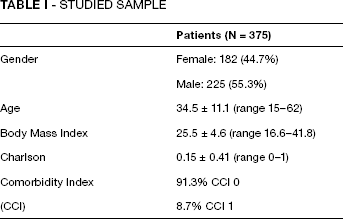
At our institution, a prospective database has been implemented to evaluate and closely monitor all patients undergoing joint preserving procedures of the hip, in particular FAO. Between June 2006 and February 2013, 375 consecutive patients (407 hips) had underwent FAO at our institution, all performed by the senior author (Tab. I). Of these patients, 32 underwent bilateral FAO procedures. Seventeen patients had a previous failed hip preservation surgery (hip arthroscopy or surgical hip dislocation). One patient had a previous episode of DVT. The two major reasons for undergoing FAO were femoroacetabular impingement (FAI) (349 hips) and mild Crowe I (11) developmental dysplasia of the hip) (DDH) (34 hips). The indication for surgery was persistent hip pain with a magnetic resonance imaging/arthrogram study demonstrating labral and/or chondral damage, in the absence of advanced osteoarthritis. Before surgical consideration, all patients failed a trial of non-operative therapy including non-steroidal anti-inflammatory drugs and/or physical therapy. The surgical technique consisted of an mini-open muscle-sparing anterior approach to the hip using the Hueter interval (sartorius and tensor fascia lata) (15). Bony alterations at the femoral head-neck junction and at the level of the anterosuperior acetabular rim were addressed, as well as the labral and chondral lesions, in a manner that has been described in detail in a previous publication (12).
Studied Sample
As thromboprophylaxis, all patients received aspirin (325 mg twice daily by mouth) for the first two to four weeks postoperatively, beginning on the day of surgery along with compression mechanical prophylaxis for the length of the hospital stay. The average hospital stay was one day (range 1–3 days). Postoperatively, partial weight bearing was recommended, using crutches for six weeks. All patients were instructed to start circumduction exercises at home as soon as possible. Patients were also allowed to swim or start stationary biking as soon as comfortable. Patients returned for their postoperative visit at week six. At this time full weight-bearing was recommended and formal physical therapy was initiated. Return to full activity, including high-impact sports, was allowed once range of motion and strength were restored and pain reduced, typically four to six months postoperatively.
We documented the patient-important outcomes of fatal and symptomatic pulmonary embolism (PE) and symptomatic DVT balanced against the hazard of an increase in symptomatic bleeding events, as it has been recommended by the most recent American College of Chest Physicians Evidence-Based Clinical Practice Guidelines (1). Any patient with a clinical suspicion for DVT or PE was evaluated with lower extremity duplex ultrasound. Routine venography or ultrasonography was not performed, so asymptomatic events were not recorded. Since minor bleeding events are difficult to define, we decided to use only major bleeding as a clinically relevant complication related to thromboprophylaxis. Major bleeding events included fatal bleeding, bleeding into a critical organ (e.g., retroperitoneal, intracranial, intraocular, or intraspinal), clinically overt bleeding (e.g., GI) associated with a ≥2 g/dL drop in hemoglobin level or requiring ≥2 units of blood transfused, and bleeding leading to reoperation (1).
Results
One patient, a 31-year-old male with a Charlson Comorbidity Index of one, was diagnosed with a symptomatic postoperative DVT using duplex ultrasound. Retrospectively, we identified no specific risk factors for VTE in this patient. He was treated successfully with Coumadin, with no further complications. No cases of PE were observed. The only patient with a previous history of DVT was also placed on aspirin and had no evidence of VTE following FAO. The overall prevalence of VTE complication following FAO was one per 407 cases (0.25%; 95% CI: 0.0067-1.46). There were no deaths in the series. No events of major bleeding were confirmed. No cases of reoperation due to postsurgical haematoma were presented.
Discussion
The best modality for prevention of venous thoromboembolism (VTE) following orthopaedic procedures still remains unknown. In recent years, various scientific bodies, namely the American Academy of Orthopaedic Surgeons (AAOS) and American College of Chest Physicians (ACCP), have produced guidelines for prevention of VTE in orthopaedic patients. Athough both the AACP and AAOS endorse aspirin as a possible modality for prevention of VTE following joint arthroplasty, none of the guidelines comment on VTE prevention following joint preserving surgery of the hip.
Although VTE following joint preserving surgery of the hip is infrequent, with the reported rate being between 0 and 3.7% (16–19), the best modality for prevention of VTE following hip arthroscopy or pelvic osteotomy remains unknown. At our institution, and based on the fact that patients undergoing joint preservation of the hip are often young with minimal comorbidities, we have used aspirin as the modality of choice for prevention of VTE in patients undergoing pelvic osteotomy or femoroacetabular osteoplasty of the hip. This study confirms that aspirin can be used as an effective and safe postoperative pharmacologic modality for prevention of VTE in patients undergoing femoroacetabular osteoplasty. In this relatively large series, only one case of clinically relevant DVT occurred. Further, there were no thromboprophylaxis-related complications such as death, bleeding, or haematoma formation.
While we are cognizant that the use of aspirin can be associated with adverse events (14), the question remains whether one could argue in favor of providing no thromboprophylaxis for patients undergoing joint preservation of the hip. This should be a subject matter of a level one study. In the mean time we continue to administer aspirin to all of our patients undergoing joint preservation of the hip at our institution. We believe that the use of aspirin, as outlined by multiple recent studies, is associated with reduced vascular events and the benefit to patients outweighs its disadvantages.
This study suffers from some shortcomings. All the patients included in this cohort are young, healthy, and active who were ambulated within hours of their surgery, and the majority were discharged from the hospital within 24 hours of their surgery. The reported incidence of VTE in this study is that of symptomatic VTE. Patients in this series were not subjected to screening for DVT or PE, a practice discouraged by both the AACP and AAOS. Thus, it is possible that some patients in this series had undetected DVT and/or PE. We decided to report the incidence of VTE within six weeks of surgery. The current literature demonstrates that the risk for VTE is the highest within a few weeks of surgery. Despite using six weeks as the minimum, the majority of patients in this study had longer follow-up, and we did not detect VTE in any patient with extended follow-up. Finally, the findings of this study are somewhat limited as we did not have a control group and patients were not randomised.
Despite the aforementioned limitations, we believe the findings of this study are compelling and of interest to the orthopaedic community. This study supports a very low incidence of VTE following joint preservation procedures and the use of aspirin VTE prophylaxis, but it also, highlights the need for a level one study in this patient population.