






Abstract
Introduction
Bipolar hip arthroplasty (BHA) in the treatment of Ficat stage III osteonecrosis of the femoral head (ONFH) has theoretical advantages over total hip replacement (THR) in that it preserves the natural acetabulum and uses an implant that allows better stability and larger range of movement. The purpose of this study was to evaluate the clinical and radiological outcomes of BHA with uncemented ingrowth stems in the treatment of ONFH.
Material and methods
Thirty-nine hips in 34 patients (two women and 32 men) with a mean age at the time of surgery of 45.31 years (range 30–66 years) operated between 1998 and 2005 were examined in a retrospective evaluation. Mean follow-up was 9.5 years (range 3–14 years). Patients were evaluated with the Harris hip score (HHS). Kaplan-Meier survivorship was calculated to examine the revision rate. Radiographic analysis included evaluation of bipolar head migration, radiolucent lines around the stem and osteolysis in the acetabulum and the femur.
Results
Evaluation of clinical results revealed an increase in HHS from 28 points preoperatively to 88.6 points at the most recent follow-up. Radiographic evaluation showed bipolar head migration in 3 hips (7.7%). Survival rate of BHA, with revision THR defined as the endpoint, was 92.31% at ten years (CI 95%). All implanted uncemented stems were stable without any radiographic signs of loosening or osteolysis.
Conclusions
The results of the present study show that implantation of BHA with uncemented ingrowth stem in Ficat stage III is still justified.
Introduction
The natural history of osteonecrosis of the femoral head (ONFH) commonly leads to femoral head collapse with subsequent osteoarthritis (1). ONFH is an entity which occurs mainly in young and active patients usually between the ages of 20 and 50. Femoral head preserving procedures are the first choice of treatment but reconstruction of postcollapse stages usually has a 50% progression rate regardless of the type of treatment (2). Total hip arthroplasty (THR) is an effective method of treatment of hip joint disability, but historical reports show poor survival of THR in the treatment of ONFH (3). Bipolar hip arthroplasty (BHA) has been introduced as a next step in the development of hemiarthroplasty (4). By confining most of the motion to the inner polyethylene/prosthetic head joint, BHA decreases wear of the natural acetabulum. The outer metal head moves against acetabular cartilage only at the extreme range of motion (5). Good results of BHA in the treatment of femoral neck fractures and nonunions without signs of acetabular wear and protrusion have expanded the indications to include patients with ONFH and osteoarthritis (6). Several papers report discrepant early and mid-term results of BHA in the treatment of ONFH (7–8–9–10–11). The purpose of this study was to present survivorship of BHA in the treatment of ONFH in our patients.
Material and Methods
Forty three bipolar hip arthroplasties were implanted in 38 patients in the treatment of ONFH between February 1998 and August 2005. During the follow-up, two patients died three years after the surgery because of causes unrelated to the operative treatment. One patient was lost to follow-up. One BHA was removed eight months after the surgery because of a deep infection. The remaining 39 hips in 34 patients were evaluated retrospectively. This group consisted of two women (three hips) and 32 men (36 hips) with a mean age at the time of surgery of 45.31 years (range 30–66).
Mean follow-up was 9.5 years (range 3–14). ONFH was diagnosed by clinical examination and radiographic analysis. Patients without characteristic risk factors related to osteonecrosis were classified as idiopathic ONFH (20 patients, 23 hips). The causes of ONFH were established in 14 patients (16 hips) and included the use of corticosteroids (six patients, seven hips), alcoholism (four patients, five hips), trauma (three patients), and renal transplantation (one patient). The Ficat and Arlet classification was used for radiographic evaluation (12). AP and axial view x-rays of both hips were taken in all patients. BHA was performed in patients with preoperative collapse of the femoral head and without acetabular involvement (Ficat stage III, 38 hips). One hip was operated on in the presence of joint space narrowing but without visible acetabular contour deformation (Ficat IV). BHA was performed after previous failed core decompression in six hips, and was a primary procedure in the remaining 33 hips. All patients were operated on using the posterolateral approach. The acetabulum had not been reamed to preserve articular cartilage. The size of the bipolar cup was established by x-ray analysis during preoperative examination. The final implant size was always the same as or smaller than that measured intraoperatively with calipers, and was checked with a trial biarticular head. Ultima Monk Bi-articular heads (Johnson & Johnson Orthopaedics, Warsaw, IN, USA) were implanted in all of the patients. Metal-on-polyethylene bearing surfaces were used in all 39 hips. Two types of uncemented stems were used: Ultima HA coated cementless stems (Johnson & Johnson Orthopaedics, Warsaw, IN, USA) in 35 hips, and Bicontact porous titanium plasma sprayed stems (B. Braun Aesculap, Tuttlingen, Germany) in four hips. After implantation, the capsule and short external rotators were reconstructed. Antibiotic prophylaxis using a first generation cephalosporin was administered on the day of the surgery and continued for three days. Deep vein thromboprophylaxis using low-molecular-weight heparin was administered for 30 postoperative days. Patients started to walk on the third postoperative day and used two crutches with partial weight-bearing for at least eight weeks after the surgery. Clinical and x-ray examination was performed three and 12 months after the surgery, and then annually. The Harris hip score (HHS) was used for clinical evaluation before surgery and at the most recent follow-up (13). X-ray examination was performed using an AP view of both hips and an axial view of the affected hip. Immediate postoperative x-rays and most recent radiographic examinations were compared to evaluate bipolar head migration, cartilage wear and stem stability (Fig. 1). A line connecting teardrops was drawn on the plain radiographs. The distance from the centre of the bipolar head to the inter-teardrop line was measured for superior bipolar head migration. The distance from the centre of the prosthetic head to Köhler's line was measured for bipolar head medial migration. Bipolar head medial or superior migration greater than 5 mm was defined as a sign of acetabular wear. Uncemented stem fixation was evaluated with the criteria described by Engh (14). Stem loosening was defined as subsidence greater than 5 mm or the presence of radiolucent lines around the stem. Cases of heterotopic ossification were classified according to Broker et al (15). BHA survival was evaluated with the use of the Kaplan-Meier method, with conversion to total hip replacement (THR) defined as the endpoint.
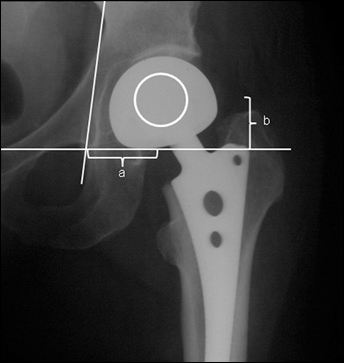
Migration of bipolar head on antero-posterior radiograph: a- medial migration was measured with the distance from center of bipolar head to Köhlers line, b- vertical migration was measured with the distance from center of bipolar head to interteardrop line.
Results
Evaluation of clinical results revealed an increase in HHS from mean 28 points (range 23–35) preoperatively to mean 88.6 (range 35–100) points at the most recent follow-up. Radiographic evaluation revealed bipolar head migration in three hips (7.7%) (Fig. 2). All three bipolar heads migrated in the supero-medial direction. In these three patients the mean distance of superior migration was 17.6 mm (range 12–26 mm) and the mean distance of medial migration was 7.3 mm (range 6–8 mm). The indication for BHA in these three patients included: idiopathic, alcohol-induced and steroid-induced ONFH. Patients with migrated bipolar heads had groin pain and poor clinical results and underwent revision THR after a mean of 53 (range 36–72) months. Two of these three migrations occurred when Bicontact stems were implanted. During revision surgeries degenerative changes of acetabular cartilage were noted in all three hips. No other cases of acetabular cartilage degeneration, excessive polyethylene wear or neck impingement were revealed. Four other patients (10.25%) complained of occasional groin pain without any signs of acetabular wear, and required administration of analgesics. One of these four patients was operated on because of Ficat IV ONFH. The Kaplan-Meier survival rate of BHA with conversion to THR defined as the endpoint was 92.31% (CI 95%) at ten years (Fig. 3). All implanted uncemented stems were stable without any radiographic signs of loosening or osteolysis. Three patients (7.7%) developed grade 2 heterotopic ossification, which did not restrict hip joint motion.

Radiographs of 32 years old man with osteonecrosis of the femoral head (ONFH) after previously failed core decompression with the adjunct of non-vascularized grafting: A) radiograph after bipolar hip arthroplasty (BHA) with Bicontact stem; B) radiograph taken at the 3-year-follow-up presenting superior-medial bipolar head migration.

Kaplan-Meier survivorship curve with conversion to total hip replacement (THR) defined as endpoint.
Discussion
The use of hemiarthroplasty in the treatment of Ficat stage III ONFH seems to have theoretical advantages over THR in that it preserves the natural acetabulum as well as allowing for larger range of motion and better stability. It had previously been revealed that BHA had better results in comparison to solid hemiarthroplasties in the treatment of ONFH, but reports of early and mid-term results were not so promising, with a high incidence of bipolar head migration and groin pain (7, 8, 10, 11, 16, 17).
The presence of polyethylene wear debris caused by neck impingement on the polyethylene insert and leading to massive osteolysis was also reported (18, 19). Bipolar heads with an elevated rim were used in this study, causing reduction of abduction without impingement to 55 degrees. Excessive wear was higher when short necks were implanted. Changes in bipolar head design include the removal of the elevated rim to increase free range of movement without impingement. Stems with highly polished necks instead of matte finish were implanted to reduce the excessive wear during impingement (20).
Preservation of acetabular cartilage is emphasized as one of the most important factors correlating with long term survival of BHA. It has previously been shown that reaming of the acetabulum increases the risk of BHA revision (21, 22). Unsatisfactory results have been published with the use of BHA in the treatment of Ficat stage IV ONFH with high incidence of bipolar head migration (23). Steinberg revealed degenerative changes of acetabular cartilage on histopathological examination in hips with radiographically normal acetabulii (24). This fact may explain the cases of groin pain and BHA migration in patients with Ficat III seen in our cohort.
Degenerative lesions of acetabular cartilage cause increased friction between the acetabulum and the outer prosthetic head; the decreased motion of the outer bearing increases the motion of the inner bearing and production of polyethylene debris (25). Increased friction in the outer bearing may be a cause of varus displacement of bipolar head with failure of self-centering mechanism, leading to impingement of the femoral neck on the outer bipolar head causing excessive polyethylene wear which may result in later osteolysis, bipolar head migration and femoral component loosening and even inter-prosthetic displacement (26). The use of BHA with long necks or proud implanted stems in dysplastic hips with high hip center improved hip joint function but degenerative change of acetabular cartilage was the cause of predominant inner bearing movement and early osteolysis (20). Acetabular cartilage seems to be a barrier that prevents migration of particulate debris which is responsible for subsequent osteolysis and weakening of subchondral bone that facilitates bipolar head migration (21). Our favourable results are supported by the fact that none of our patients underwent acetabular reaming, and the majority of patients were Ficat stage III ONFH. The bipolar head design used in our patients did not have an elevated rim, thus the risk of impingement was reduced. Similar results have been published by other groups (25–26–27) (Tab. I). Migration of the bipolar head causing groin pain was the indication for revision surgery in the majority of cases. Isolated groin pain without head migration was not reported to be a reason for revision. Lee et al revealed that 23% of BHA after 10 years of follow-up had signs of bipolar head migration but did mention any revisions in these patients (28). Although no evidence of osteolysis was found in our patients, polyethylene wear is still a concern increasing the risk of osteolysis with time.
Review of the Literature: Outcomes of Onfh Ficat Stage III with BHA and Uncemented Ingrowth Stems

All three failed hips from our group of patients were revised with standard hemispherical uncemented cups without the need for additional reconstruction, and without any further complications. Diwanji reported on the results of 25 conversions of BHA to THA with reliable pain relief and functional improvement after a mean of 7.2 years (29). Dislocation of revision arthroplasty was the most common postoperative complication.
One of the possible factors influencing survival of BHA is the type of femoral stem implanted. Smooth press-fit Austin Moore-like stems and cemented stems have been used in trials that presented poor early and midterm results (7, 8, 10, 11).
The proportion of failures caused by stem migration or loosening was the same or even higher than the proportion of failures of bipolar heads. Papers comparing BHA and THR with the use of the same type of uncemented ingrowth stem to exclude the influence of stem stability on bipolar head survival have also been published. Lee et al. compared the results of 40 BHA and 31 THR with the same type of uncemented ingrowth stem in the treatment of Ficat stage III ONFH (28). The authors revealed that patients with BHA had statistically significantly worse clinical results than the THR group. The incidence of thigh pain was comparable in both groups, but the BHA group had a 20% incidence of groin pain and a 15% incidence of gluteal pain.
Twenty three percent of the bipolar heads presented signs of migration. Because of the worse clinical results and a high incidence of migration, the authors concluded that THR was a better solution than BHA in the treatment of Ficat stage III ONFH. Conversely, Chan presented results of 28 patients treated for bilateral ONFH with BHA in one hip and THR in the contralateral hip (27). Ficat stage III ONFH was the indication for BHA, and Ficat IV for THR. No differences in patient satisfaction, clinical evaluation, thigh and groin pain, osteolysis, dislocation or revisions were observed between the two groups.
Two of the three failed hips from our group of patients had an implanted Bicontact stem. It is difficult to evaluate the influence of stem type on survival of BHA in our patients because of the small number of implanted Bicontact stems. The Bicontac stem had an excellent survival in previously published reports (30). The remaining two BHA with implanted Bicontact stems as well as the other two which have been converted to THR had good clinical and radiological results We, therefore, believe that the higher revision rate of BHA with the Bicontact stem in our patients is coincidental.
Recently published results of primary THR as well as reviews of hip arthroplasty in the treatment of ONFH do not support the use of BHA (31–32–33). The limitation of our study is that it is presenting a small series of patients only with mid-term follow-up. Polyethylene wear as well as acetabular cartilage changes may affect later survival of our patients. Our results show that implantation of BHA with uncemented stems for Ficat stage III ONFH is still justified.