






Abstract
The occurrence of pseudotumours following metal-on-metal hip resurfacing arthroplasty (MoMHRA) has been associated with high serum metal ion levels and consequently higher than normal bearing wear. Measuring ground reaction force is a simple method of collecting information on joint loading during a sit-to-stand (STS). We investigated vertical ground reaction force (VGRF) asymmetry during sit-to-stand for 12 MoMHRA patients with known serum metal ion levels. Asymmetry was assessed using two methods: a ratio of VGRF for implanted/unimplanted side and an absolute symmetry index (ASI). It was found that subjects with high serum metal ion levels preferentially loaded their implanted sides. The difference between the two groups was most apparent during the first 22% of STS. VGRF ratio showed significant and strong correlation with serum metal ion levels (Spearman's rho = 0.8, p = 0.003). These results suggest that individual activity patterns play a role in the wear of MoMHRA and preferential loading of an implanted limb during the initiation of motion may increase the wear of metal-on-metal hip replacements.
Introduction
The soft tissue reactions observed in some patients with metal-on-metal hip resurfacing arthroplasty (MoMHRA) have been referred to by a number of terms such as adverse reaction to metal debris (ARMD) (1), aseptic lymphocytic vasculitis associated lesions (ALVAL) (2), adverse local tissue reaction (ALTR) (3) and pseudotumour (4). The term pseudotumour will be used in this study. Pseudotumours can be extremely destructive, causing one or a number of symptoms such as pain, spontaneous dislocation, pathological fracture and nerve palsy (4).
The currently available data would suggest that the occurrence of pseudotumours is related to higher than normal wear, and pseudotumour is probably a response to the particulate wear debris (5). Almost all MoMHRA implants are manufactured from cobalt-chrome alloy and levels of serum Co and Cr ions have been shown to be indicative of the amount of wear of MoMHRA implants (6–7–8).
Information on joint loading can be inferred from the ground reaction force (GRF). Studies measuring telemetered hip reaction forces from instrumented prostheses have demonstrated, in terms of timing, that peak joint reaction force are concomitant with peak GRF (9). A number of studies have therefore used measures determined from the GRF to assess outcomes following arthroplasty, for subjects performing gait (10–11–12–13–14–15) and sit-to-stand (11, 15, 16) activities. The aim of the current study was to examine the relationship between serum metal ion levels and the vertical component of the GRF (VGRF) symmetry during sit to stand activity for patients who had undergone MoMHRA.
Methods
Subjects
One hundred and fifty-eight (201 hips) MoMHRA patients had their serum metal ion levels measured in an on-going study, which was approved by the local ethics committee. Blood samples were collected in accordance with a previously described protocol (17). Serum levels of cobalt and chromium were determined using inductively-coupled plasma mass spectrometry (ELAN DRC II, PerkinElmer Life and Analytical Sciences, Shelton, CT, USA) at the Laboratory of Clinical Biology, University Hospital Ghent, Belgium. Subjects were selected from this cohort for the current study according to their measured ion levels. All patients with high ion levels were invited to participate and those that accepted our invitation were recruited to the study. Thereafter, a number of case controls (low-ion patients) matched for gender, age, BMI, prosthesis manufacturer and size were invited to participate. Those that accepted the invitation were recruited to the study. Twelve subjects with unilateral MoMHRA and a healthy unimplanted hip participated in the current study (seven females and five males, with a mean age of 59 (±11) years a mean BMI of 24.5 (±2.9) and a mean follow-up since surgery of 4.3 (±1.1) years. These subjects had either a unilateral Birmingham Hip Resurfacing (BHR) (Smith and Nephew, Birmingham, UK) (n = 9) or a unilateral Conserve Plus (Wright Medical Technology, Memphis, TN, USA) (n = 3). The subjects were divided into two groups (Low Ions, n = 6, and High Ions, n = 6) based on their serum metal ion levels (Tab. I). Serum metal ion levels were considered high if they exceeded 4.4 µg/l for chromium or 4 µg/l for cobalt (18). There was no statistically significant difference between the groups in terms of height (p>0.05) despite a 10 cm difference in the means.
Subject Details

Data acquisition and processing
Motion analysis studies were performed in a dedicated motion analysis laboratory. The subjects were seated on a bench of height 550 mm with each foot on a force platform. Subjects were then asked to stand with their arms folded across their chests in order to obtain repeatable motions between subjects. Ground reaction forces were recorded at 1000 Hz using two force platforms; an AMTI OR6-1-1000 and an AMTI OR6-6-1000 (AMTI, MA, USA) were used. The output of each force platform was passed through a dedicated amplifier (MSA-6, AMTI, MA, USA) and data were collected using a VICON MX system (Vicon Ltd, Oxford, UK). The sit-to-stand activity was performed at least three times by each subject.
Post-processing was performed in Matlab (R2010, The MathWorks Inc., Natick, MA, USA). In the current study, the activity duration was defined from the total VGRF (= VGRFimplanted + VGRFunimplanted). The activity start point was determined manually as automated methods for defining this point were found to be unreliable. A point on the total VGRF versus time characteristic of what is universally described as the loading phase was chosen (point A in Fig. 1). The end point was defined automatically when the total VGRF crossed a threshold level, corresponding to the subject weight, for a second time. This period was chosen as it coincides with maximum force production (11, 19, 20) and maximum hip contact force (9). The total VGRF was normalised by body weight (% BW) and the duration was converted to a percentage of the STS activity to enable comparative analysis between subjects.
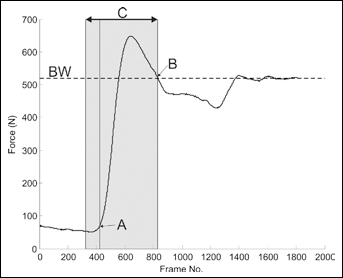
Typical total vertical ground reaction force for sit to stand. Point A defines the start of the loading phase and was defined manually. Analysis was carried out from a start point 100 frames prior to point A. Point B was where the VGRF crossed a threshold defined by the subject's body weight (BW) for a second time and defines the analysis end point. The analysis duration (C) is shown by the shaded area.
VGRF symmetry
VGRF symmetry was assessed using two methods: By deriving a VGRF ratio and using an absolute symmetry index (21, 22). The VGRF ratio was calculated by dividing the VGRF for the implanted limb by that for the unimplanted limb (Equation 1). A VGRF ratio value of 1 indicated perfect symmetry, and values greater than 1 indicated a greater proportion of weight-bearing on the implanted limb.

A symmetry index, originally described by Herzog et al and subsequently modified to an absolute symmetry index (ASI) (21–22–23), was also calculated (Equation 2).

An ASI of 0% represents perfect symmetry whereas the suggested level of acceptance for gait and stair activity are values less than 5% and 15%, respectively (24). As no threshold has been determined for STS, an ASI of 10% was adopted to determine acceptable levels of symmetry. The point of maximum VGRF and the associated VGRF ratio and ASI were recorded for each subject. The difference in VGRF ratio and ASI for Low versus High groups over the STS cycle was examined using the Mann-Whitney U test. The subjects were also divided by gender and the difference in VGRF ratio and ASI over the STS cycle was examined using the Mann-Whitney U test.
For the periods where significant differences were found between implanted and unimplanted limbs, the correlations between metal (chromium and cobalt) ion levels and the symmetry indicators were investigated using Spearman's rho. Statistical analyses were performed using PASW Statistics 18 (IBM, Armonk, NY, USA).
Results
VGRF symmetry
The values of VGRF ratio for the Low group appeared to remain symmetrical throughout STS, whereas the High group showed a tendency to preferentially load the implanted limb from 7% to 20% of STS (Fig. 2A). The difference between the Low and the High group during this period was found to be statistically significant (p<0.05, Fig. 3A). The mean VGRF for the High group during the period between 0 and 22% STS was 15.1% BW and the mean VGRF ratio was 1.44. Between 23% and 35% STS the VGRF ratio for the High group switched from loading the implanted side to the unimplanted limb. However, the difference in VGRF ratio between the Low and the High groups for the period 35% to 100% did not show any statistical significance (p>0.1). The difference in VGRF ratio between male and female patients showed no statistical significance (p>0.1) at any point over the STS cycle.

A) Mean VGRF ratio for the Low and the High groups. Ratios above 1 indicate greater loading on the implanted side. Error bars indicate standard deviation. B) Mean ASI for Low Versus High. An ASI of 0% represents perfect symmetry. Error bars indicate standard deviation.
The mean ASI for the Low and the High groups showed slightly different results to the VGRF ratio. The ASI of the Low group suggested that the VGRF was symmetrical (less than 10% threshold) between 6% to 69% STS. The VGRF of the High group showed greater asymmetry than the Low group over the whole of STS. There was a statistically significant (p<0.05) difference between the two groups from 9% to 17% STS (Fig. 3B). The ASI of the High group was under the 10% threshold in the period between 19% and 32% STS. This asymmetry was during the period when loading was transferred from the implanted to the unimplanted side. The results indicate that the subjects in the High group were preferentially loading their implanted side whereas the lower limb loading of the Low group was symmetrical. The ASI confirmed the asymmetry in VGRF for the High group but also suggested that the Low group were on the verge of asymmetry (9.9% ASI). The difference in ASI between male and female patients showed no statistical significance (p>0.1) at any point over the STS cycle.
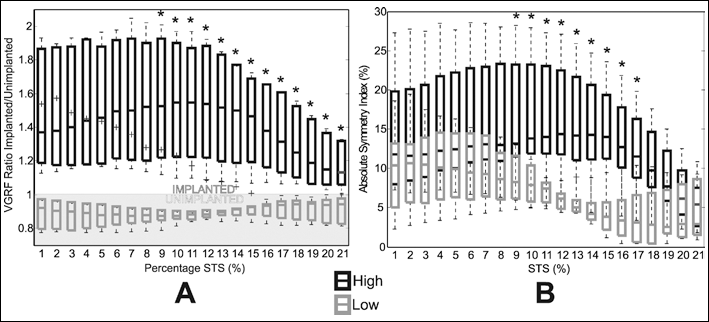
Box plot of VGRF ratio A) and ASI B) over the first 20% of STS for High versus Low groups.
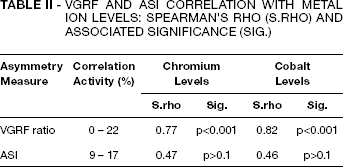
There were significant (p<0.001) and strong correlations between VGRF ratio and the levels of metal ions (Tab. II); the correlations between ASI and metal ion levels were not significant. One subject in the High group was an extreme outlier, with a cobalt level of 87.6 µg/l and a chromium level of 113.0 µg/l; the data for this subject was excluded to avoid skewing the correlation analysis. The correlations were strongest between VGRF ratio between 0 to 22% STS cycle (Fig. 4); for chromium Spearman's rho was 0.802 (p = 0.003) and for cobalt rho was 0.836 (p = 0.001).
Vgrf and Asi Correlation with Metal Ion Levels: Spearman's Rho (S.RHO) and Associated Significance (Sig.)
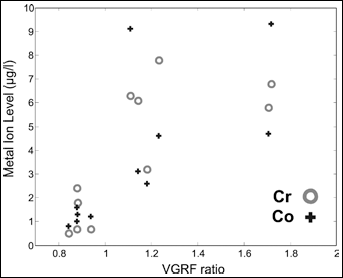
Mean VGRF ratio for 0-22% STS versus serum levels of chromium (Cr) and cobalt (Co) (µg/l).
Discussion
Subjects who have undergone MoMHRA show asymmetry in their VGRF during STS, and the degree of asymmetry correlates to the systemic metal ion levels measured in these individuals. Subjects with high systemic metal ion levels preferentially loaded their implanted limbs during the initial part of the STS. Metal ion levels are now accepted as surrogate measures of in vivo wear of metal-on-metal hip replacements. Whilst there are undoubtedly a considerable number of factors which influence the amount of wear of MoM implants, the implication of this study's findings is that loading during the sit to stand activity has an influence on the function of the bearing. The extent of asymmetry in subjects who had low serum metal ion levels and high serum ion levels was different in terms of magnitude and the side that was loaded. The difference between the High and Low groups was most apparent during the first 22% of STS. During this period the High group preferentially loaded their implanted side, whereas the Low group loaded their limbs symmetrically.
It has been shown that THR patients spend 43% of time sitting, whereas standing and gait only take up 24.5% and 10% of time respectively (25). In addition it was found that sit-to-stand is performed approximately 50 times per day in patients with total joint replacement (26). It has been shown with hip simulators that under start-up and stopping conditions, the wear of MoM implants is increased (27). In the current study it has been shown that serum metal ion levels significantly and strongly correlate with VGRF asymmetry during the first 20% of STS for subjects with MoMHRA. This, therefore, suggests that joint loading asymmetry during the initiation of a frequently performed activity such as STS can lead to an increase in wear. Although the magnitude of asymmetry was relatively small the repetitious nature of the activity means there is an increased potential for increased bearing wear. The exact causes of asymmetry during STS are not clear. However, patients with intrinsic motion patterns that contribute to asymmetrical joint loading could be potentially educated to alter these patterns during rehabilitation.
After a prolonged period of rest, such as sitting for a length of time, there is probably a loss of fluid from between the bearing surfaces of a MoM implant. Relative motion between the bearing surfaces is needed to entrain fluid into the joint; it is not clear what period of time is required for establishment of a fluid film. It is now appreciated that the development of a fluid film is dependent upon the entrainment wedge, and this explains the findings of increased wear for steeply implanted acetabular components (8). We speculate that for optimum bearing performance a balance is needed between the development of sufficient relative speed of the bearing surfaces to develop adequate lubrication and the application of load across the bearing surfaces. We suggest that individuals who preferentially load their implanted limbs during the initiation of sit-to-stand will begin applying load before substantial lubrication is established, and this may explain the correlations found by this study.
Metal-on-metal implants probably represent the class of devices that have undergone the most extensive pre-clinical testing. The complications that have emerged with these devices were not predicted by extensive pre-clinical testing. One conclusion that can be drawn from recent experiences is that understanding of hip joint loading and wear is not as complete as was thought when these devices were designed. The pseudotumour issue should lead the orthopaedic community to re-examine the theoretical and experimental pillars upon which our understanding is built. The results from the current study suggest that activities which have not previously been considered important in pre-clinical testing may play a significant role in determining the wear performance of hip replacement bearings. Furthermore, variability in how an activity is performed can influence the amount of wear experienced.
The current study has a number of limitations. Rising from a chair in a “hands-free” manner may not reflect the real activity. Studies that have previously examined GRF asymmetry during STS have incorporated methods for eliminating the effects of the subjects’ dominant side (28), preferred foot position and seat height (29). This was not carried out in the current study and represents a limitation. In this study only the STS activity was considered and incorporating gait or stair-climbing may have given a clearer picture of the contribution of asymmetry to wear. The small number of subjects in this study also represents a limitation. There is a strong association between implant positioning and metal ion levels. In this study it was not possible to decouple the relationship between implant positioning, metal ion levels and asymmetry in hip loading.
Subjects with MoMHRA display asymmetry in vertical ground reaction force during sit-to-stand. Asymmetry of VGRF at the beginning of STS correlates with metal ion levels measured in MoMHRA patients. This suggests that preferential loading of an implanted limb during the initial phase of sit-to-stand activity contributes to the wear of MoMHRA.