






Abstract
We report our failures with the use of the R3 metal-on-metal bearing. Forty six patients had an R3 acetabular system metal-on-metal THR in our centre between March 2007 and March 2009. All operations were performed using femoral components and appropriately matched femoral heads manufactured by Smith & Nephew. Twelve patients underwent revision surgery for adverse reaction to metal debris (ARMD). The median acetabular inclination was 40 degrees (range 21.1-49.1) and the median acetabular anteversion was 7.5 degrees (range 3.3-10.4). The median serum Cobalt was 9.9 µg/L (range 3.1-45) and the median serum Chromium was 5.8 µg/L (range 1.8-19.3). The time to revision was 39.2 months (range 13-53). Our current failure rate is 24%.
Introduction
Metal-on-metal (MoM) total hip replacements (THRs) were introduced for their purported advantages over conventional articulations, such as low rates of wear and increased stability (1). There has been increasing concern related to the use of a metal-on-metal (MoM) bearing in hip arthroplasty. Increasing reports have emerged of abnormal soft-tissue reactions to MoM THRs and hip resurfacing (2–3–4–5–6). These changes have been variously described as pseudotumours, aseptic lymphocytic vasculitis-associated lesions (ALVAL) and metallosis. In a study by Langton et al (7) used the umbrella term ‘adverse reactions to metal debris’ (ARMD) to encompass these conditions and to show that the incidence of pathological changes was attributable to the MoM bearing surface.
In April 2010 the Medicines and Healthcare products Regulatory Agency (MHRA) issued an alert to its members concerning large-sized femoral head MoM hip arthroplasty (8). Analysis of National Joint Registry data (9) provides unequivocal evidence that metal-on-metal stemmed prostheses are associated with higher failure rates than other types of hip replacements and they recommended that metal-on-metal bearing surfaces are not used in stemmed THRs.
The Articular Surface Replacement (ASR; DePuy, Leeds, United Kingdom) was withdrawn from distribution in the United Kingdom amid concerns regarding high failure rates, initially described in single-surgeon series and subsequently corroborated in registry data (10–11–12). Although specific design characteristics associated with the ASR may be important, other brands also perform poorly (13). Potentially, a range of surgical, patient and implant factors may contribute to the high rates of failure: implant position, component size, component design and female gender have all been implicated as risks for failure (14,15).
The R3 Acetabular System (Smith & Nephew, Memphis, USA) has been in use in UK since 2007 and supports polyethylene, metal and ceramic liners along with multiple femoral head options. This report considers only the outcome of patients who received the metal liner. The metal liner has the same design and metallurgy as the Birmingham hip resurfacing system. It was utilised with the appropriate Birmingham modular head. This initially gave us confidence in choosing the R3 metal bearing system as the BHR had shown excellent results (16).
We report our high failure rates secondary to adverse reactions to metal debris (ARMD) in our patients with the use of this implant.
Materials and Methods
As part of the metal-on-metal bearing surveillance program in our unit we carried out a retrospective review of the series of patients who had been implanted with a metal bearing R3 cup (Smith & Nephew, Memphis, USA).
The two senior authors (AJ & SJ) used the R3 acetabular system from March 2007 to March 2009. Both polyethylene and metal liners were used but only patients with MoM bearing surface were included in this study. All operations were performed using femoral components and appropriately matched femoral heads manufactured by Smith & Nephew Ltd. The femoral components used were either an uncemented Anthology/SL Plus or a cemented CPCS stem. All procedures were carried out through a posterior approach. All patients were assessed clinically and investigated with plain film radiographs, metal ion levels (Cobalt and Chromium) and inflammatory markers (ESR and CRP). Symptomatic patients or those who had adverse investigations underwent metal artefact reduction sequence (MARS) MRI.
The diagnosis of ARMD was based on the clinical history, the MARS MRI findings, the macroscopic findings at revision and the histological analysis of excised tissue.
Any evidence of periprosthetic infection, such as positive intraoperative cultures, grossly increased inflammatory markers in the blood or histological evidence of infection precluded the diagnosis of ARMD. A raised blood level concentration of Cobalt (Co) or Chromium (Cr) was not a prerequisite for the diagnosis since the sensitivity and specificity is low in patients with ARMD (17).
Radiological measurements
These were obtained from digitised supine anteroposterior films of the pelvis, which were taken obtained postoperatively and at subsequent visits. The Einzel-Bild-Roentgen-Analyse (EBRA, University of Innsbruck, Innsbruck, Austria) (18) software was used to measure the orientation of the acetabular component in terms of anteversion and inclination. EBRA is a validated program (19, 20) that enables the user to calculate the degree of inclination and version of the component from the supine radiograph. Radiographic measurements were performed by the first author (AD).
Statistical analysis
This was carried out using SPSS version 17.0 (SPSS Inc. Chicago, Illinois). The Mann-Whitney U test was used to identify significant differences between groups with non-parametric data (Cr and Co concentrations; comparison of ARMD joint orientations with controls). The relationship of the metal ion concentrations and bearing surface diameter was examined with Spearman's rank correlation. Differences were deemed statistically significant if the p-value was <0.05. Survival was calculated using the Kaplan-Meier method.
Results
Forty-six patients underwent MoM THR with the R3 acetabular system and a Smith & Nephew Ltd. stem with a mean follow up of 45.3 months. There were four bilateral cases (Tab. I).
Patient Demographics, Component Details And Metal Ion Concentrations
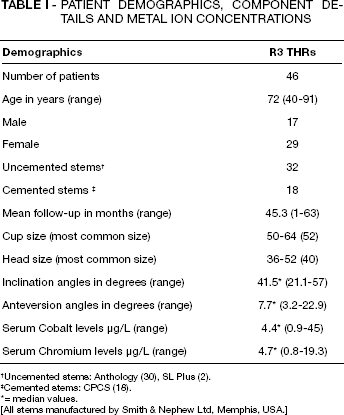
Uncemented stems: Anthology (30), SL Plus (2).
Cemented stems: CPCS (18).
=median values.
[All stems manufactured by Smith & Nephew Ltd, Memphis, USA.]
There were 12 failures in our group due to ARMD. There were 10 females and two males. The average age was 70 years (range 40-84). Nine were primary procedures and three single-stage revisions. There were five Anthology and seven CPCS femoral stems. The time to revision was 39.2 months (range 13-53). The acetabular orientation measurements and the metal ion levels are shown in Table II. Kaplan-Meier analysis showed a failure rate of 24% (Fig. 1).
Acetabular Component Orientation And Metal Ion Concentrations Of The Patients With Adverse Reactions To Metal Debris (Armd) Compared To The Remainder Of The R3 Cohort
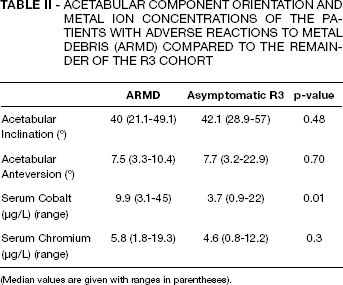
(Median values are given with ranges in parentheses).

Kaplan-Meier implant survival analysis of our R3 study group.
Of this group, eleven patients have been revised. One with a diagnosis of ARMD died due to unrelated causes while waiting for revision surgery. All patients had a MARS MRI scan which showed adverse features. Perioperatively, at all revision procedures there was either peri-articular swelling and necrosis and/or a large cystic or semi-solid tumour. The acetabular component was well fixed in all cases and therefore liner exchange to a polyethylene was undertaken only. Furthermore, all the femoral stems well fixed in all cases and they were not revised. In all cases, the femoral head-neck junction demonstrated signs of corrosion seen as black material at the taper. The taper was cleaned with a dry swab to remove the corrosion material and a titanium alloy adapter sleeve (Merete Medical GmbH, Berlin, Germany) was inserted over the taper and a ceramic femoral head (BIOLOX-CeramTec) was impacted onto the adapter sleeve.
Joint orientations, bearing surface size and metal ion concentrations
There was no difference in the median inclination angles of the acetabular component in the ARMD group from the remainder of the unrevised R3 cohort. There was no difference in the anteversion angles between the ARMD and the asymptomatic group (Tab. II).
Blood metal ion concentrations in the ARMD group were elevated, with the median blood Co ion level approximately three times greater than in the asymptomatic group. Seven patients were found to have blood levels of either Co or Cr which were greater than 7 μg/L (the level quoted in the Medicines and Healthcare products Regulatory Agency as having increased potential for soft tissue reaction) (21).
In the failure group, there was no correlation between increasing bearing diameter and Cobalt (Spearman's ρ = 0.19, p = 0.52) or Chromium levels (Spearman's ρ = 0.15, p = 0.61).
Diagnosis of ARMD
Histopathological analysis of tissue samples was available for nine patients. In seven patients, it consistently showed widespread infiltration of histiocytes with areas of tissue necrosis. These characteristics are consistent with the description of ALVAL (22). In two patients, tissue sample was non diagnostic. More specifically, in one of those patients histological analysis showed fibrofatty connective tissue with no joint tissue present, and in the other patient it showed fibrinoid material with reactive synovium. In the latter two patients and the other patient where histological results were not available, diagnosis of ARMD was based in the exclusion of periprosthetic infection (negative intraoperative samples and/or normal inflammatory markers), on clinical history, MARS MRI and intraoperative macroscopic findings.
Finally, in one patient, five out of seven intraoperative samples produced positive microbiological cultures (light growth of Gram positive bacillus after extended incubation). There were no histological samples for analysis. It was concluded that the patient had a superimposed periprosthetic infection and antibiotics were administered. There are no signs of infection at present.
Discussion
The Birmingham Hip Resurfacing (BHR) is the most widely used resurfacing and is the only device with 10 year registry follow-up (23). It has been rated as 10A rating by ODEP (Orthopaedic Data Evaluation Panel) (24). Studies from different centres have shown encouraging clinical results with the longest follow-up being 13 years (25–26–27–28).
There have been reports of soft-tissue reactions in peri-prosthetic tissues, in patients with hip resurfacings. Pandit et al (6) reported on a series of fourteen patients with a BHR who had a symptomatic ʺpseudotumourʺ.
It is suggested that edge-loading of components either because of component malposition or poor component design is the underlying problem leading to excessive wear and local debris-related soft tissue problems (29). In the study by Glyn-Jones et al (30) (16 BHRs, 10 non BHRs) the authors measured the abduction angle of the acetabular component on pelvic radiographs for the pseudotumour cases: there was a wide variation in this angle, but the majority were in the range 30° to 50°. We could not demonstrate any difference in the acetabular inclination or anteversion between the asymptomatic and ARMD group. The median inclination and anteversion angles for both groups were within acceptable limits (Fig. 2).
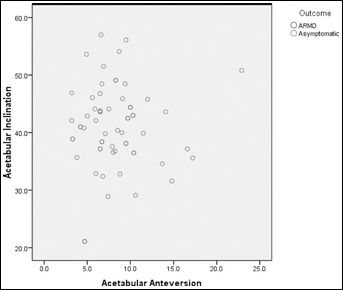
Scatter diagram showing acetabular component inclination versus anteversion for all patients in the study group.
In a study by Underwood et al (31) the authors have shown that the pre-revision whole blood metal ion levels of the patients with failed BHR implants were significantly higher than those of patients with a well-functioning BHR. In our group the median serum Co ion level was greater in the ARMD patients than the asymptomatic group. That was true for Cr ion levels as well but not significantly so.
The identification of high serum levels of metal ions is an indication that the hip is functioning poorly. The MHRA have suggested that whole blood cobalt or chromium levels of greater than 7 ppb are associated with significant soft-tissue reactions and failed MoM hips (21). We advise surgeons to have a high index of suspicion of ARMD in well-positioned MoM THRs even in the absence of elevated levels of metal ions. We had 5 patients in the ARMD group where both Co and Cr blood ion levels were below 7 µg/L. Asymptomatic patients may have severe soft-tissue destruction, a fact which has been reported in other centres (32).
The R3 cup metal liner shares the same metallurgy and bearing geometries as the BHR. Both the metal liner and the components of the BHR system are manufactured from as-cast cobalt and chromium alloy without heat treatment. The logical assumption based in our study is the possible generation of metal debris from taper junctions which could explain the poor performance of the stemmed THRs. But wear mechanisms and corrosion at modular junctions is difficult to differentiate from bearing surface wear. The BHR does not have any taper junction and is therefore completely free of metal release from taper problems but in a study by Matthies et al (33), the authors showed that there was no significant difference in median linear wear rates between BHR resurfacings and modular BHR hips.
In our study, revision consisted of a liner and modular head exchange in all cases addressing the underlying problem at the taper junction. We did not observe extensive damage to the trunnion and therefore we retained all the well-fixed femoral implants. In a recent study on taper analysis by Matthies et al (Paper presentation, AAOS Annual Meeting, New Orleans, 2014), the authors showed that the stem-neck interface contributes only negligible volumes of metal debris material and therefore they supported the retention of a well-fixed macroscopically undamaged stem at revision surgery in patients with problematic MoM THRs.
A recent analysis of National Joint Registry data (9) provides unequivocal evidence that metal-on-metal stemmed prostheses are associated with higher failure rates than other types. The authors recommended that metal-on-metal bearing surfaces are not used in stemmed THRs and that all patients with metal-on-metal THR undergo at least annual review with both clinical and radiological examination for the duration of the longevity of the implant.
In conclusion, we identified a high failure rate with the metal bearing R3 acetabular system. We are not aware of any other studies on the clinical outcomes of this acetabular component. In June 2012, the Smith & Nephew Ltd. company withdrew the metal liner option for the R3 from the market. We advocate that all patients with an R3 MoM THR should be followed up according to the MHRA guidelines.