







Abstract
Most femoral neck fractures are osteoporotic fractures in the elderly. The one-year mortality after neck fracture in this group is 24%.
For hemiarthroplasty (HA) the bipolar heads have a risk reduction for reoperation due to acetabular erosion compared with monoblock heads. Surprisingly, the bipolar head had an increased reoperation risk for dislocation, infection and for periprosthetic fracture.
Total hip arthroplasty (THA) after fracture has a four-fold raised risk for dislocation compared with THA after osteoarthritis. A larger head on the same neck (head to neck ratio) results in a theoretically larger range of movement and hence less risk for dislocation. The dual mobility bearing has, theoretically, the largest range of movement and good clinical results.
Functional results are better for THA compared with HA. Arthroplasty for fracture has much better results compared with arthroplasty after a failed internal fixation; the risk for reoperation is more than doubled for the latter.
A Swedish hip arthroplasty register study found a 20-fold higher risk for periprosthetic fracture when comparing uncemented HA with matt cemented HA. Also a polished cemented stem had 13½-fold higher risks compared with a matt.
The mortality during the first day after surgery is higher for cemented compared with uncemented arthroplasties, but lower after one week, one month and one year. Analysing the time points together resulted in no difference.
A matt cemented THA with a maximum head size, maybe dual mobility, has the best results, and is also for the low-demanding elderly.
Treatment for displaced intracapsular femoral neck fractures (Fig. 1) has varied over time. There has been a consensus that replacement by hip arthroplasty is advantageous. There is also a consensus that surgery performed a short time after the trauma is better for the patient. The question remains if there is any advantage in replacing the healthy acetabulum with a prosthetic cup, or indeed if it is even advisable to do so.
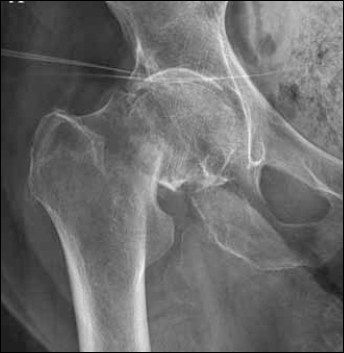
Intracapsular femoral neck fracture.
Most femoral neck fractures are osteoporotic fractures in the elderly. The one-year mortality rate after neck fracture treated with hemiarthroplasty (HA) is 24% (men 32% and women 20%) (1).
There are three types of femoral HA components: monoblock stem; modular stem with a unipolar head or with a bipolar head. Modular stems have the advantage of a free adjustment of femoral offset. Bipolar heads have a risk reduction of 0.30 for reoperation due to acetabular erosion compared with monoblock heads (1). Surprisingly, in this study the bipolar stems had increased reoperation risk ratios of 1.42 for dislocation, 1.31 for infection and 1.70 for periprosthetic fracture compared with unipolar. Generally the risk was higher for bipolar (hazard ratio 1.28).
When a THA was performed after fracture, the risk for dislocation was found to be raised four-fold compared with THA after osteoarthritis (2). A larger head on the same neck (head to neck ratio) results in a theoretically larger range of movement and hence less risk for dislocation. The dual mobility bearing (Fig. 2) was found to have the highest “jump distance” (head lift-out distance before dislocation) (3). Together with a large head to neck ratio it results in a decreased dislocation risk. The theoretical range of movement for dual mobility is: 126° abduction/adduction; 186° flexion/extension; and 220° rotation (4). Revision THA has, together with THA after fracture, a high risk for dislocation. In a study of five (2-3-4-5-6-7-8-9-10) years follow-up, where dual mobility bearing had been used on 163 revision THAs (5), there were 3.7% single dislocation, 1.2% cup loosening and 0.6 % poly wear and exchange.
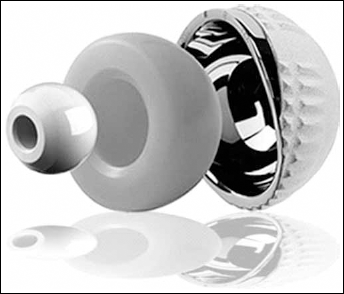
Dual mobility bearing.
In analysing functional results 14 months after surgery, Leonardsson (6) found both health related quality of life (EQ-5D), patient satisfaction and pain, to be better for THA compared with HA. The same EQ-5D result was found by Keating et al 2006 (7).
Arthroplasty performed directly after fracture has much better results, compared with the same arthroplasty performed after a failed internal fixation. The risk for reoperation is more than doubled for the latter (1).
Two authors found advantages for cemented stems over uncemented. Taylor et al 2012 found more reoperations for uncemented (8). Leonardsson 2012 in a register study found a 20-fold higher risk for reoperation for periprosthetic fractures when comparing uncemented HA to matt cemented HA (9). Also polished cemented stems had 13½-fold higher risks compared with matt cemented stems.
Mortality has been analysed in the Australian hip arthroplasty register (10). The first day after surgery mortality was higher for the cemented compared with uncemented, but lowers after one week, one month and one year. Analysing the time points together resulted in equal mortality risks for cemented and uncemented.
To summarise, unipolar HA seem better than bipolar HA. THA has better functional results than HA, and is also for the eldery. An argument for THA in the low demanding elderly is that their marginal for an independent living is so narrow that the worse functional results with an HA, compared with THA, might rule out their possibility for independent living. Cemented arthroplasty has better results than uncemented in terms of periprosthetic fracture risk. Cemented matt stems have better results than cemented polished for the same reason.