






Abstract
Purpose
Epidermolysis bullosa acquisita (EBA) is a very rare disease of a chronic autoimmune subepidermal blistering, usually manifesting as skin fragility, blisters and erosions. In this article, we report a successful THA in a patient with osteonecrosis of the femoral head with EBA and methicillin-resistant staphylococcus aureus (MRSA) skin carriage.
Methods
A 59-year-old woman had severe and debilitating left hip pain due to osteonecrosis of the femoral head. She had suffered from EBA for the past 7 years. She had received several courses of intravenous steroid pulse therapy in the past, and taking 6 mg of prednisone and 100 mg of minocycline per day for infected skin blisters. Severe blisters and scars covered her body, especially at the prone area. A bacteriological examination taken using a cotton-swab returned MRSA at the nasal cavity and anterolateral part of the proximal femur.
Results
We employed an antibiotic prophylactic protocol used for one-stage revision for infected hip prosthesis. Primary THA was performed using the anterior approach with antibiotic-loaded cement, and the skin was fully covered with a soft and conformable foam dressing.1-year post-op, there are no signs of infection. The Harris Hip Score improved from 37 pre-op to 93.4 at 1 year post-op.
Conclusions
Although care must be taken by medical professionals to avoid the prescription of unnecessary antibiotics, when used appropriately, there appears to be substantial benefits to be gained in the field of joint replacement for patients who are at high risk of infection.
Keywords
Introduction
Total hip arthroplasty (THA) gives a great benefit in terms of pain relief and functional recovery. However the presence of multiple comorbidities represents a contraindication for THA (1). The indication of THA for a patient with high risk of infection is challenging. Methicillin-resistant staphylococcus aureus (MRSA) nasal carriage shows an increased infection rate after joint replacement (2). We report a successful THA in a patient with osteonecrosis of the femoral head and epidermolysis bullosa acquisita (EBA) who was a MRSA nasal and skin carrier and also on steroids. The risks of infection is extremely high due to the contamination by MRSA during the operation and perioperative and postoperative haematogenous infection from the skin erosions.
Case report
A 59-year-old woman presented at our hospital complaining of severe and debilitating left hip pain. She had suffered from EBA for the past 7 years. She had received several courses of intravenous steroid pulse therapy in an attempt to treat the EBA in the past. She was taking 6 mg of prednisone and 100 mg of minocycline per day for infected skin blisters.
Standard x-ray showed a collapsed left femoral head. Bilateral osteonecrosis of the hip was revealed by magnetic resonance imaging. On physical examination, severe blisters and scars covered her body, especially at the hip area (Fig. 1). C-reactive protein was 0.4 mg/dL and white blood cell count was 7.8 × 10⁹/L. A bacteriological examination taken using a cotton-swab returned MRSA at the nasal cavity and anterolateral part of the proximal femur.
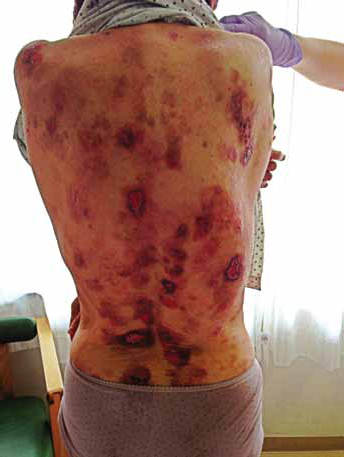
Severe blisters and scars covered her body, especially at the prone area due to an epidermolysis bullosa acquisita.
With a diagnosis of osteonecrosis of the femoral head, THA using the anterior approach was planned, taking the greatest precautions with regard to infection. We also gained the approval of the Infection Control Committee at our hospital because the risk of infection was high.
Preoperatively, the patient was admitted to a single room unit at our hospital 7 days before the operation. An intravenous injection of 0.5 mg vancomycin twice daily was administered preoperatively for 5 days. The dose was doubled from the third day because the trough level at day 3 was lower (2.8 μg/mL) than the optimal concentration (5-15 μg/mL). The patient received a body wash with shampoo once or twice daily.
On the day of the operation, the patient showered on the ward before the operation and intravenous antibiotic infusion (vancomycin) within 30 min before skin incision, was performed. No organism was identified by bacteriological examination using a cotton-swab at the skin incision area sampled just before the operation.
The anterior approach was selected (Fig. 2A). To avoid intraoperative iatrogenic skin blisters, the whole lower leg was draped with a cotton roll bandage (Fig. 2B). The skin was covered with an incise drape minimally around the skin incision area, and the remaining area with a soft and conformable foam dressing (Mepilex®) (Fig. 2C). Operating time was 2 h and 34 min. An antibiotic-loaded cement (1.5 g of vancomycin and 0.4 g of amikacin per 40 g of cement; Surgical Simplex®, Stryker Orthopaedics, Mahwah, NJ, USA) was used with X3 Rim Fit cup (Stryker Orthopaedics), and Exeter femoral stem (Stryker Orthopaedics). A drain was not used.
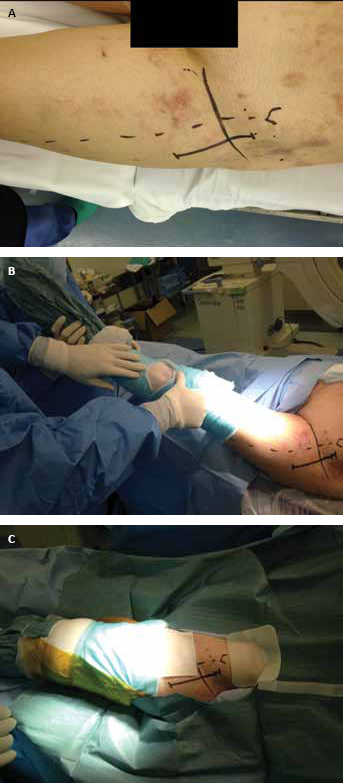
The anterior approach was selected. A) Although a bacteriological examination taken at out-patient consultation using a cotton swab returned methicillin-resistant staphylococcus aureus (MRSA) at anterolateral part of the proximal femur, no organism was retrospectively identified just before the operation. B) To avoid intraoperative iatrogenic skin blisters, the whole lower leg was draped with a cotton roll bandage. C) The skin was covered with an incise drape minimally around the skin incision area, and the remaining area with a soft and conformable foam dressing.
When the incise drape was detached at the end of the operation, the epidermis was exfoliated with the drape (Fig. 3A). A soft and conformable foam dressing (Mepilex®) and gentle fixation tape (Mepitac®) were used for wound dressing (Fig. 3B).
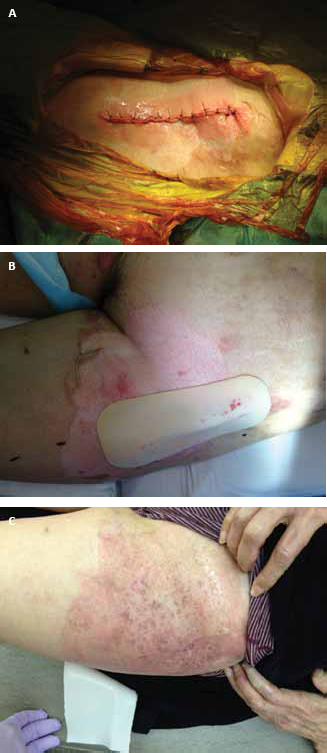
Postoperatively, an intravenous antibiotic injection of vancomycin was administered for 2 weeks. The skin healed without any superficial infection (Fig. 3C). At 2 weeks post-op, C-reactive protein was 0.5 mg/dL and white blood cell count was 8.4 × 10⁹/L. Oral antibiotics, 500 mg of levofloxacin hydrate and 450 mg of rifampicin, were given for 3 months post operation. After discontinuation of those antibiotics, regular taking of 100 mg of minocycline per day as same as previous medication for avoiding skin ulcer infection was restarted. And blood test including C-reactive protein was monitored every 3 months until 12 months post-op. At 1-year post-op there are no signs of infection. The Harris Hip Score improved from 37 pre-op to 93.4 at 1 year post-op.
Discussion
With advances in medical care comes increasing life expectancy. As a consequence, there is an increasing demand for improved activity of daily living with greater musculoskeletal function. THA is the most effective surgical option for an arthritic painful hip, however it use can be discouraged in patients with serious medical complications or high risks of infection (1).
EBA is a rare disease, with a prevalence of 0.2 per million. It is a chronic autoimmune subepidermal blistering disease characterised by circulating and tissue-bound autoantibodies targeting type VII collagen, which is the major component anchoring fibrils at the dermal–epidermal junction (3). EBA usually manifests as skin fragility, blisters and erosions at mucocutaneous areas, especially trauma-prone areas (3).
The patient in this case report had skin blisters and erosions on her back and buttocks, which worsened with the increased pressure when lying and sitting (Fig. 1). It is possible that long-term oral antibiotics may have contributed to a microbial substitution resulting in her being a carrier of MRSA on her skin. Factors such as a steroid use, skin fragility and being an MRSA carrier limited the possibility of THA because of the high risk of infection. However, in this particular case, we considered that the benefits of THA outweighed the possible risk of infection. The patient's hip pain was expected to worsen and the stress caused from the pain itself would result in the EBA deteriorating further, increasing the likelihood of skin erosions. Several previous reports of successful primary THA in MRSA carriers lent weight to our decision to perform THA (4), taking the greatest precautions to prevent further infection and prevent additional skin fragility.
Patients with a pre-operative MRSA colonisation are at significantly increased risk of a surgical site infection (SSI): for THA of up to 7.06, and for total knee arthroplasty of up to 18.65 (odds ratio) (2).
Decolonisation for nasal MRSA in patients with lower limb joint replacement is controversial (2). In the general operative setting, several articles revealed success with different forms of the decolonisation procedure as a temporary elimination of colonised microorganisms such as chlorhexidine baths, mupirocin nasal ointment, topical antimicrobials, and oral antibiotics (5-6-7). Similarly, in the orthopaedic operation, several studies have reported that mupirocin was effective at reducing SSI caused by s. aureus (8). Although those various methods of decolonisation (possible in outpatient procedure) might have been effective for our patient, we did not conduct any of them except for daily body wash with shampoo and intravenous injection of vancomycin for several reasons. Firstly, in our case, the chlorhexidine baths was not possible due to ulcers. Secondly, the nasal decolonisation such as mupirocin ointment was not enough since the current patient was a carrier of MRSA at not only nasal but also skin sites. Also such treatment has not been proven with MRSA (9), and there is a risk of creating mupirocin-resistant MRSA (10). Additionally, Murphy et al reported a higher risk of SSI from MRSA in a patient who underwent joint replacement despite effective pre-operative eradication of MRSA using mupirocin (2). Thus we thought intravenous antibiotic injection was more favourable. Concerning antibiotic prophylaxis, although some recent articles suggest dual antibiotic prophylaxis for MRSA (11), vancomycin alone was administered in our patient because our preoperative sample showed high susceptibility to vancomycin.
Skin fragility was also a concern in this patient. The anterior approach was selected because lateral and posterior lesions were expected to be under pressure with postoperative positions. It is possible that changing the wound dressing might have caused new blisters around the surgical site. To minimise the chance of this happening, a soft and conformtable foam dressing (Mepilex®) and gentle fixation tape (Mepitac®) was applied, and the skin healed without any complications.
In conclusion, we report the successful use if THA in a patient with EBA and at high risk of infection. Although care must be taken by medical professionals to avoid the prescription of unnecessary antibiotics, when used appropriately, there appears to be substantial benefits to be gained in the field of joint replacement for patients who are at high risk of infection.
Footnotes
Acknowledgement
We would like to thank Dr Kenichi Oe for his cooperation in the discussion of the treatment.
Financial support: None.
Conflict of interest: None.