






Abstract
Background
Porous tantalum acetabular components (PoTa) are well-studied, but less is known about widely used porous titanium (PoTi) acetabular components. We performed a comparative survival analysis between PoTi and PoTa acetabular components.
Methods
Primary or revision THA performed using PoTi (n = 2,976) or PoTa (n = 184) acetabular components with minimum 2-year follow-up (PoTi n = 1,539; PoTa n = 157) were analysed. Univariate and multivariate logistic regression were performed to test the effect of porous metal acetabular component type on revision surgery for aseptic cup loosening. Multivariate model was adjusted for acetabular defect severity according to the Paprosky Classification.
Results
Only PoTi components used in revision THA failed. Survival of the PoTi acetabular component was 98.6% when used in revision THA at mean 48.3-month follow-up. After adjusting for severity of acetabular defect, there was no difference in survival between PoTi and PoTa acetabular components when used in primary or revision THA.
Conclusions
After adjusting for acetabular defect severity, both PoTa and PoTi acetabular components had excellent survival at mean 44.4-month (range 4.3-91.5 months) follow-up when used in primary and revision THA.
Keywords
Introduction
Total hip arthroplasty (THA) is among the most effective surgical interventions for improving health-related quality of life (1). There is an anticipated increase in demand for primary THA in the United States over time (2). In addition, the current rate of increase in number of THA revisions per year exceeds that of primary THA (3). Efforts to improve the likelihood of success of primary and revision THA are thus of critical importance.
Implants that undergo osseointegration are required to achieve a pain-free cementless THA. Various acetabular component coatings have been designed to facilitate bony ongrowth, including beads, fibre mesh, plasma spray, grit-blast, and hydroxyapatite. The most recent advance in acetabular component surface technology is porous metal, a three-dimensional structure with interconnecting porous channels similar to trabecular bone developed to achieve enhanced osseointegration in acetabular reconstruction (4, 5). Porous tantalum (PoTa) has a dodecahedron architecture with 80% porosity and average pore diameter of 500 μm, whilst a newer porous titanium (PoTi) (Tritanium®) has similar architecture with 60%-70% porosity and pore diameter ranging from 250-650 μm. Basic science studies have validated both porous metals by demonstrating excellent bony ingrowth potential as well as mechanical strength (6, 7).
PoTa acetabular components are clinically well-studied with favourable short- to mid-term survival, but less is known about widely used PoTi acetabular components (8-9-10-11-12-13-14-15-16). There is a paucity of literature comparing the outcomes of PoTi and PoTa cups. The aim of this study was to perform a comparative survival analysis between PoTi and PoTa acetabular components evaluating revision surgery and periacetabular radiolucencies at minimum 2-year follow-up.
Methods
Study design
We utilised a retrospective cohort study design. Of all patients who underwent primary or revision THA at a single high-volume orthopaedic hospital from 2006 to 2011 (primary THA, n = 10,393; revision THA, n = 1597), the source population were those with acetabular reconstructions performed via the posterior approach using the PoTi (n = 2,976) or PoTa (n = 184) acetabular components described below. Inclusion criterion was minimum 2-year available follow-up (PoTi primary n = 1,100, revision n = 439, total n = 1,539; PoTa primary n = 22, revision n = 135, total n = 157). The PoTi acetabular component was the Stryker Tritanium Shell, inclusive of cluster and multi-hole designs. The PoTa acetabular component was the Zimmer Trabecular Metal Shell, inclusive of modular and revision designs. Products of different companies were compared out of necessity; Zimmer, the only manufacturer of PoTa cups, does not produce PoTi cups. Exclusion criteria were any primary or revision THA performed with acetabular components other than those described above, or any cases without minimum 2-year available follow-up. All surgeons were fellowship-trained in adult reconstruction, experienced in use of the acetabular components in this study.
The main study endpoint was revision for aseptic cup loosening. Patients revised for any other reason, and those who were not revised, were censored at the end of the follow-up period. The mean durations of clinical follow-up were as follows: 40.2 months (range 24.0-85.4 months) for PoTi components in primary THA; 48.3 months (range 4.3-89.4 months) for PoTi components in revision THA; 65.0 months (range 33.6-90.5 months) for PoTa components in primary THA; and 62.3 months (range 25.3-91.5 months) for PoTa components in revision THA. Though minimum 2-year follow-up was available for all patients, study follow-up of less than 2 years duration was due to the endpoint of revision for aseptic cup loosening occurring within 2 years of index surgery.
Paprosky classification of acetabular defect at the time of index surgery, radiolucencies in DeLee and Charnley acetabular zones at most recent follow-up or at the time of revision, date of revision (if any), and reason for revision were recorded. Acetabular defects and periacetabular radiolucencies were evaluated by 2 blinded raters. Each rater evaluated radiographs independently. The raters evaluated 10 standardised training cases prior to evaluation of the study cases.
Statistical analysis
Primary and revision THA cases were analysed separately. Kaplan-Meier survival curves were plotted, stratified by each group (PoTi or PoTa acetabular components in primary or revision THA). Violation of the proportional hazards assumption was detected on Kaplan-Meier curves. Thus, univariate and multivariate logistic regression were performed to test the effect of porous metal acetabular component type on revision surgery for aseptic cup loosening. Multivariate model was adjusted for acetabular defect severity according to the Paprosky Classification. SAS software version 9.4 (SAS Institute Inc.) was used for all analyses. Statistical significance was set at p<0.05. As the outcome of revision for aseptic cup loosening was rare, Firth penalised maximum estimation was obtained in the logistic regression to reduce bias. The power to detect a difference in revision rate greater than 18% between groups was >0.80 with a sample size of 44 patients in each group.
Results
Patient demographics across types of implants and surgeries for the source population are given in Table I.
Demographics of patients who underwent primary or revision THA with porous metal acetabular components
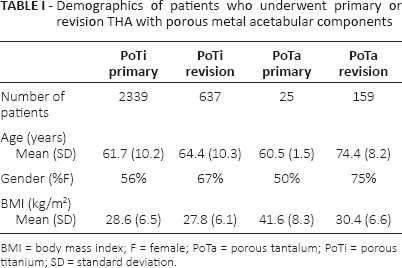
BMI = body mass index; F = female; PoTa = porous tantalum; PoTi = porous titanium; SD = standard deviation.
Severity of preoperative acetabular defect according to the Paprosky Classification was greater in revision THA than primary THA for a given type of porous metal component utilised in the source population. The severity of acetabular defects was greater in cases with PoTa than with PoTi (Tab. II).
Comparison of acetabular defect severity in patients who underwent primary or revision with porous metal acetabular components
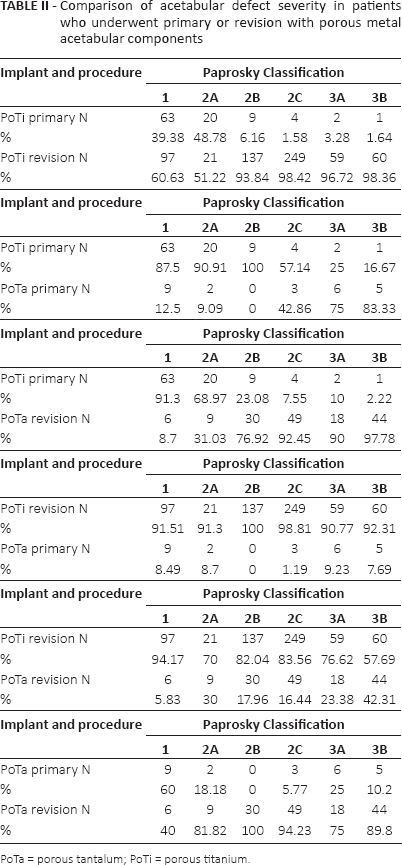
PoTa = porous tantalum; PoTi = porous titanium.
Only PoTi components used in revision THA failed. Survival of the PoTi acetabular component was 98.6% when used in revision THA (Fig. 1).
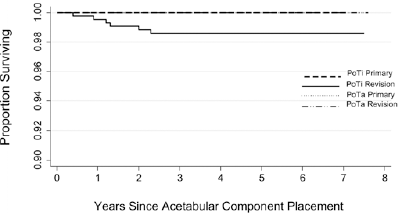
Kaplan-Meier survival curves for porous metal acetabular components in primary and revision THA. PoTa = porous tantalum; PoTi = porous titanium.
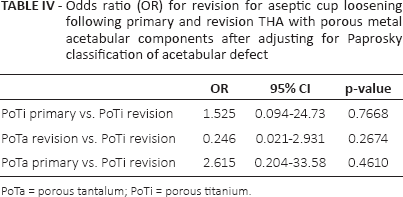
PoTi components were more likely to require revision when used in revision THA than primary THA (OR = 0.030, 95% CI 0.002-0.540) (Tab. III). However, after adjusting for severity of acetabular defect, there was no difference between PoTi and PoTa acetabular components when used in primary or revision THA (Tab. IV).
Odds ratio (OR) for revision for aseptic cup loosening following primary and revision THA with porous metal acetabular components
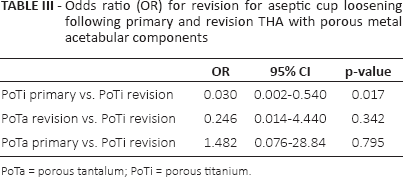
PoTa = porous tantalum; PoTi = porous titanium.
Odds ratio (OR) for revision for aseptic cup loosening following primary and revision THA with porous metal acetabular components after adjusting for Paprosky classification of acetabular defect
PoTa = porous tantalum; PoTi = porous titanium.
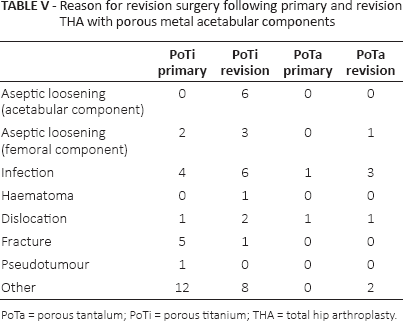
All reasons for revision in the source population are shown in Table V.
Reason for revision surgery following primary and revision THA with porous metal acetabular components
PoTa = porous tantalum; PoTi = porous titanium; THA = total hip arthroplasty.
There was no significant difference in number of periacetabular radiolucencies between PoTi and PoTa components when used in either primary or revision THA (p = 0.3521).
Discussion
Porous metal acetabular components were created to achieve improved osseointegration over earlier acetabular component designs used in THA (4). Several studies have demonstrated excellent short- to mid-term outcomes with PoTa components used in patients with severe acetabular bone loss, pelvic irradiation, as well as hip dysplasia (11, 13, 16). There is short-term data that show PoTi acetabular components also perform well in primary and revision THA, but this data is far less abundant than that available for PoTa components (3, 14, 15). We are not aware of any prior comparative survival study of modern PoTa and PoTi components in primary and revision THA.
Though our study may provide guidance in acetabular component selection in THA, we understand our work has limitations. First, this is a retrospective study vulnerable to unknown confounding factors with data limited by the accuracy of patient records available. Secondly, we did not have access to records from outside institutions, so revisions performed elsewhere may not have been captured. Third, a single manufacturer PoTi acetabular component was studied, so our findings may not be generalisable to PoTi components of all manufacturers. Fourth, much higher numbers of PoTi components as compared to PoTa components were studied, which makes the relative strength of our PoTi data stronger than that of PoTa. We recognise that the PoTa primary THA group is underpowered to detect a significant difference. Finally, there were differences in follow-up between groups, which may have introduced bias into the comparative analysis.
Only PoTi components used in revision THA required revision for aseptic loosening. Acetabular defect severity was greater in patients reconstructed with PoTa components than with PoTi components. After adjusting for defect severity, both PoTa and PoTi acetabular components had excellent survival when used in primary and revision THA at short to mid-term follow-up. Periacetabular lucencies were not observed more frequently with one porous metal component versus another.
Prospective investigation may further reinforce and expand our findings. Future work includes a multicenter study of porous metal acetabular components, with PoTi components from multiple manufacturers, to increase the sample size of the current study and confirm the generalisability of our findings.
Footnotes
Financial support: None.
Conflict of interest: None.