







Abstract
Background/Aims
Static cold storage (SCS) of the liver for transplantation is limited by time. Continuation of metabolic activity leads to depletion of energy stores and loss of cellular function, which results in poor post-transplant function. Machine perfusion (MP) applied at the end of preservation may improve the viability of marginal liver grafts and provides information on the quality of the organ. We attempt to define the limits to SCS in terms of easily measurable perfusion parameters and investigate whether MP can improve liver viability.
Methods
Rat livers were cold-stored for 0, 24, 48, 72, and 120 h, after which they were treated with subnormothermic machine perfusion (SNMP). Livers cold-stored for 48 and 72 h were transplanted orthotopically with or without SNMP. During SNMP easily measurable parameters were monitored and adenosine triphosphate (ATP) content was measured following preservation and SNMP.
Results
ATP increased significantly during SNMP, but the recovered ATP content deteriorated with increased duration of SCS, with minimal improvement after 72 h of SCS. Vascular resistance during SNMP increased with extended preservation. After 48 h of SCS, orthotopic transplantation survival increased significantly from 50% to 100% with SNMP, but did not improve after 72 h.M
Conclusions
Vascular resistance and ATP recovery suggest a decrease in viability after 48 h of SCS. Survival data confirms the loss of post-transplant graft function and supports the use of ATP and vascular resistance as useful indicators. Further, we show that the recoverability of a liver using SNMP is limited to 48 h of SCS.
Introduction
Reduction of metabolic activity by lowering the temperature facilitates the preservation of solid organs and provides enough time for the logistics of liver transplantation. In combination with specialized preservation solutions, static cold storage (SCS) of the liver slows the depletion of energy stores and loss of cellular function, and renders sufficiently high organ quality up to approximately 24 of preservation (1, 2). However, SCS is limited, as evidenced by decreasing transplant survival with a longer duration of preservation (3, 4). Improvement of the quality of livers after preservation would extend the limitations of SCS to allow better allocation of organs and result in a reduction in graft failure and retransplantation.
Machine perfusion (MP) has been employed at the end of ischemia to recover organs prior to transplantation, improving both the quality of organs after preservation and transplant outcome (5–8). In addition, MP allows the realtime measurement of parameters that correlate with graft quality, which facilitates more informed and objective decision making in the organ allocation process (9, 10). As a result, MP potentially reduces the unnecessary discarding of viable livers.
MP has been shown to improve various metabolic functions after a limited duration of SCS (11), after WI (6, 12) and following sequential warm (WI) and cold ischemia (CI) (5, 13). It is commonly accepted that WI and CI do not affect all cell types equally, with hepatocytes being particularly susceptible to WI, while CI has a greater affect on the sinusoidal endothelium (14, 15). However, numerous studies suggest interplay between the two and an overlap in their injury mechanisms. In a model of donation after cardiac death (DCD) Qing et al found that the limits to CI - reflected in survival, histological and biochemical injury - are impacted by the duration of WI (16). They report that the limit for CI is reduced from 20 h to 6 h if WI is increased from 10 min to 30 min.
The limitations of MP in recovering cold ischemically injured livers have not yet been examined. Moreover, it has not yet been attempted to define the limit of SCS in the context of perfusion-preservation. Here, we expose livers to extended durations of SCS while monitoring various metabolic and hemodynamic parameters during subnormothermic machine perfusion (SNMP). In an orthotopic transplantation model we examine the effect of perfusion on survival and determine whether perfusion parameters reflect transplant outcome and thus define the limits to SCS with and without MP.
Materials and Methods
Animals and experimental groups
Forty-four male and female Lewis rats (180-250 g) were used for all experiments (Charles River Laboratories, Wilmington, MA, USA). The animals were maintained in accordance with National Research Council guidelines and the experimental protocols were approved by the IACUC of Massachusetts General Hospital (Boston, MA, USA). The donor livers (n = 26) were procured and subjected to SCS for 0 (fresh), 24 h, 48 h, 72 h, and 120 h after which the liver underwent 3 h of subnormother-mic machine perfusion (SNMP) the tissue was analyzed for adenosine triphosphate (ATP) content and compared to preservation without SNMP. For two groups selected based on perfusion characteristics, livers were orthotopically transplanted after 48 h and 72 h, with or without SNMP treatment (n = 4 per group).
Liver procurement
Following anesthesia with isoflurane (Baxter, Deerfield, IL, USA) the abdomen was opened by transverse incision. The right phrenic vein was ligated, and the liver was freed of its surrounding ligaments. The infrahepatic inferior vena cava (IHIVC) was mobilized, by ligating the adrenal vein, lumbar plexus, and right renal vein. The bile duct was cannulated (Surflo 28-gauge polyethylene stent; Terumo Medical Corp, Somerset, NJ, USA) and dissected. The gastroduodenal and splenic vein branches of the portal vein (PV) were ligated and dissected. The PV and IHIVC were cross-clamped, and the liver was flushed with cold University of Wisconsin (UW) solution (CoStorSol, Preservation Solutions, Elkhorn, WI, USA). Cuffs fashioned from 16G and 14G catheters (Becton Dickinson, Franklin Lakes, NJ, USA) were applied to the PV and IHIVC. The suprahe-patic inferior vena cava (SHIVC) was tailored for a sutured anastomosis. Livers were then stored in UW solution in a temperature-controlled cold room (4°C).
Sub-normothermic machine perfusion (SNMP)
After SCS, the liver was flushed with 10 mL of room temperature Williams medium E (WE, Sigma-Aldrich, St Louis, MO, USA) and placed in the organ chamber. The liver is perfused in a recirculating system that consists of a peristaltic Masterflex L/S pump (Cole Palmer, Vernon Hills, IL, USA), a membrane oxygenator (Radnoti, Monrovia, CA, USA) and a bubble trap (Radnoti). After the system was primed with WE, the liver was connected to the system by insertion of an 18G IV catheter (BD, Franklin Lakes, NJ, USA) into the 14G portal vein cuff. Outflow flowed freely into the organ chamber. Temperature of the system was maintained at room temperature (21 ∓ 1.0°C) and was controlled by the ambient air temperature. The total perfusate volume was 500 mL and consisted of WE supplemented with insulin (2 U/l Humulin; Eli Lilly & Co, Indianapolis, IN, USA), penicillin (40000 U/l)/streptomy-cin (40000 μg/l) (Gibco/Invitrogen, Camarillo, CA, USA), L-glutamine (0.292 g/l; Gibco/Invitrogen), hydrocortisone (10 mg/l, Pharmacia & Upjohn/Pfizer, New York, NY, USA). Livers were perfused for 3 h, followed by ATP analysis or orthotopic liver transplantation.
Liver transplantation
Recipients were anesthetized using isoflurane, 5% for induction, tapered off to 0.5% at the end of the procedure. Recipient hepatectomy commenced 20 min prior to the end of SNMP or SCS, after which the donor liver was flushed with sterile PBS containing 10 U/ml of heparin (APP pharmaceuticals, Schaumberg, IL, USA). Implantation of the donor liver began with a sutured anastomosis of the SHVC using 7-0 prolene suture (Ethicon, Somerville, NJ, USA). Anastomosis of the PV and IHVC was achieved by inserting the cuffs into the recipient vessels as described by Kamada (17), allowing for an anhepatic period of 13 min to 17 min. After completing the anastomosis of the bile duct the recipient was administered 1 mL to 2 mL of sterile PBS through the penile vein, the abdomen was irrigated and closed and finally the skin was closed and the animal was allowed to recover under a heat lamp.
Liver function, viability, and metabolic assessment
Perfusate samples were taken from the outflow every 30 min and were analyzed for alanine aminotransferase using Infinity ALT liquid stable reagent (Thermo Electron, Victoria, Australia). Blood gas analysis was performed on PV inflow and IHIVC outflow every 30 min using a Rapidlab 845 blood gas analyzer (Bayer, Pittsburgh, PA, USA) to determine the hepatic oxygen consumption using the perfusion flow (V), the concentration of oxygen in the inflow (O2-IN), outflow (O2-OUT), and the liver weight. Oxygen concentration (nM) was calculated as 0.0031 • pO2 • V. Vascular resistance over the portal vein was calculated by dividing the hydrostatic pressure on the vein by the flow rate. For determination of tissue ATP content, the liver was flash-frozen in liquid nitrogen and stored at -80°C. Tissue was then crushed in liquid nitrogen and analyzed using an luminescence-based cell viability assay (Biovision, Milpitas, CA, USA). ATP was normalized to protein content using a Coomassie brilliant blue (Bradford) assay (Fisher Scientific, Pittsburgh, PA, USA). Bile was collected throughout and quantified gravimetrically.
For the first week post-transplantation, daily blood samples (80 μL) were taken from surviving transplant recipients and every 5 days thereafter until 30 days post-transplantation. A metabolic panel was used in a Piccolo xpress chemistry analyzer (Abaxis, Union City, CA, USA) to analyze aspartate aminotransferase (AST), ALT, total bilirubin, glucose, blood urea nitrogen (BUN) and albumin. Animals weight was monitored with the same interval as the blood sampling.
Statistical analysis
Linear regression and Pearson correlation coefficient (R) were used to analyze the relationship between ATP and SCS time. A two-tailed T-test was used to analyze the increase of ATP after perfusion and for change in vascular resistance from baseline. ATP content after different preservation times was analyzed using a one-way analysis of variance (1-way ANOVA). A log-rank (Mantel-Cox) test was used to analyze survival data between preservation groups and livers with high and low mean vascular resistance (≥1.6 cm • H2O • min/ml). Vascular resistance and ALT release between groups over time was analyzed using a two-way analysis of variance (2-way ANOVA) with post-hoc Bonferroni corrections. A minimum of 2 measurements was available for each perfusion parameter and time point analyzed.
Results
To determine easily measurable indicators of graft quality, perfusion parameters and post-perfusion energy status in the form of ATP concentration were determined after various durations of SCS. Confirming previous work (18), ATP content decreased with increased duration of preservation (Fig. 1A). Moreover, a linear correlation between ATP content after perfusion and SCS time was observed up to 72 h of preservation (r2 = 0.99). SNMP was able to increase the ATP content of livers cold-stored for all durations (p≤3.2
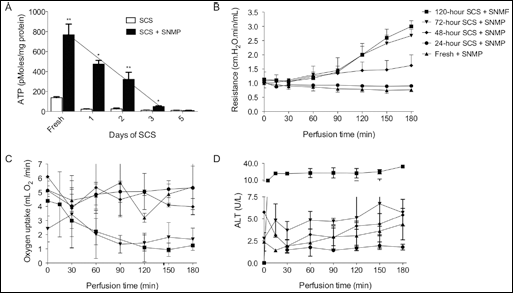
ATP and parameters during SNMP. ATP content of fresh livers, after static cold storage (SCS; white bars) and after SCS with subnormo-thermic machine perfusion (SNMP; black bars). (A) Vascular resistance measured during SNMP of livers after SCS and fresh (B). Oxygen uptake rate from perfusate (C) and alanine transaminase release into the perfusate (D). Error bars = SEM * = p≤0.05 for change with SNMP ** = p≤0.05 for change with SNMP, and for changes between SCS duration.
While vascular resistance decreased slightly during perfusion of fresh livers and livers preserved for 24 h, a gradual increase could be observed after longer SCS (Fig. 1A). When livers were cold-stored for 72 h or 120 h, a significant increase in resistance was seen from the start of perfusion (p≤0.03). Compared to 48 h of SCS, resistance was also higher after 72 h and 120 h (p≤0.01). A high resistance profile during perfusion (mean vascular resistance ≥1.6 cm • H2O • min/ml) was associated with decreased survival after transplantation (p = 0.025). Oxygen consumption showed a similar pattern with reduced oxygen uptake from the perfusate after 72 h and 120 h of SCS (Fig. 1C). The release of ALT to the perfusate did not differ significantly between livers preserved for up to 72 h; however, release of ALT was significantly increased after 120 h (p = 0.015; Fig. 1D). Bile production during SNMP was negligible in all but the fresh group.
The change in vascular resistance and ATP recovery between 48 h and 72 h of SCS suggested a decrease in viability after 48 h. For this reason these groups were selected for orthotopic transplantation. Livers were transplanted after 48 h and 72 h of SCS, with or without SNMP at the end of preservation. MP significantly improved 30-day survival after 48 of SCS (p = 0.02), but not after 72 (Fig. 2A). Long-term survival was 100% after 48 h of SCS if recovered by 3 h of SNMP, while 50% of the recipients did not survive the first week if the liver was not machine perfused. After 72 h of SCS no recipients survived more than 2 days, regardless of treatment with SNMP. While all survivors lost weight in the first week after transplantation, recipients of machine-perfused livers showed recovery and an increase in body weight towards the end of the third week post-transplantation (Fig. 2B). Survivors in the group without SNMP did not recover their body weight during the 30 days of follow-up. Due to poor survival in most groups, there were no noteworthy significant differences in AST, ALT, total bilirubin, glucose, blood urea nitrogen (BUN), and albumin post-transplantation (not shown).
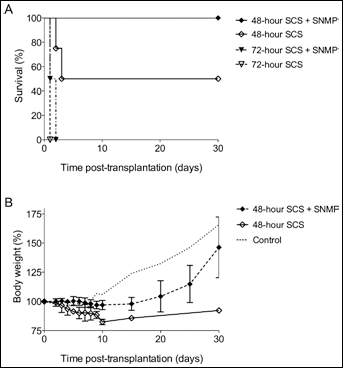
Post-transplantation survival and weight. Kaplan-Meier survival curve of livers after transplantation. Livers were cold-stored (SCS) for 48 h or 72 h and underwent either subnormothermic machine perfusion (SNMP) or direct transplantation (A). Curve of weight progression after transplantation, normalized to percentage of weight at transplantation. The control curve shows the weight progression of recipients of livers cold-stored for 3 h in UW solution (B). Error bars = SD.
Discussion
In this study we examined several easily measureable parameters during subnormothermic machine perfusion after increasing duration of static cold storage to determine whether these parameters were able to reflect a limitation to cold preservation in a transplantation model. Moreover, in this model we determined whether applying SNMP could improve survival after extended SCS. We conclude that the parameters measured during SNMP, particularly ATP and vascular resistance, adequately reflect a significant loss in viability after more than 48 h of storage, which was confirmed in the transplant survival results after 48 h and 72 h of SCS.
The most relevant indicator of viability appears to be ATP, which, while still recoverable after 48 h, shows only minor improvement during SNMP after 72 h of SCS. Hence, the minor ATP recovery after 72 h of SCS corresponds to the lack of survival of these grafts after transplantation. While SNMP significantly recovers ATP after 48 h and leads to a significant gain in survival, this is not seen after 71 h, suggesting that CI injury has surpassed a limit of recoverability. Improving the energy status of the liver before implantation has been reported as an important mechanism of MP (5, 19). A reduction in energy status, most frequently ATP content, has often been correlated to the duration of ischemia (18, 20). Clinically, the energy status after preservation has been demonstrated to correlate with transplant outcome (21), however, this has been negated by others that have suggested that the recovery of ATP during reperfusion is a more important indicator (22). Additional studies have shown that the extent of ischemic injury directly affects the ability of the liver to recover ATP during oxygenated reperfusion, which is in turn linked to post-transplant survival (20, 23, 24). Since, ATP measurement requires a biopsy, less invasive alternatives have been sought as a surrogate index of viability. Bile flow rates have been shown to correlate to ATP content and duration of ischemia and may be useful as a prognostic indicator (8, 25, 26). MP has been shown to improve bile secretion during reperfusion (27, 28) and bile flow during MP may predict transplant success (29, 30). As a result of the extended preservation times we applied in this study and the subnormothermic nature of the system, bile production was insufficient for reliable analysis. This is in part an effect of SNMP, as at room temperature bile production is reduced compared to normothermic sanguineous perfusion.
This study focuses on improvement of the graft as a whole using SNMP. However, it has been shown that sinusoidal endothelial cells are more severely affected by cold conditions (15) and has also been shown to recover more slowly than hepatocytes following CI (31). In part, the increased vascular resistance that we observe during MP after prolonged SCS is likely to stem from a degree of endothelial dysfunction. Hepatic resistance should therefore be considered as an indicator of endothelial function rather than hepatocyte viability. Vascular resistance during MP is also associated with poor transplant outcome, with increased resistance predicting primary non-function post-transplantation (30). We confirm this association here through the observation of high vascular resistance with prolonged ischemic injury and a correlation between high resistance during SNMP and poor transplant outcome.
Conclusions
The goal of this study was to determine whether easily measurable machine perfusion parameters could be used to identify a time limit to cold liver preservation and whether MP could improve liver viability after extended preservation. Vascular resistance over the portal vein and ATP recovery after perfusion indicate that the ability of SNMP to recover cold ischemic livers greatly decreases after 48 h of preservation. This limit is confirmed by transplantation, which is successful after 48 h of cold preservation, but not after 72 h. Moreover, this study demonstrates that SNMP can significantly improve the transplant outcome of livers after extended preservation.