






Abstract
Purpose
We have previously demonstrated widespread microbial contamination in the dialysis and replacement fluid circuits of bicarbonate-buffered, continuous renal replacement therapies (CRRTs). It is not known whether different CRRT fluids have an impact on bacterial activity.
Methods
In this study the in vitro growth and biofilm formation associated with seven strains of bacteria (Burkholderia cepacia, Escherichia coli, Staphylococcus aureus, Stenotrophomonas maltophilia, Pseudomonas aeruginosa, Pseudomonas fluorescens, and Staphylococcus epidermidis) in five CRRT fluids (Prismocitrate, Monosol S, Accusol 35, tri-sodium citrate and Ci-Ca K2) were studied. The fluids were each inoculated with light and heavy concentrations of each of the bacterial strains and incubated at 22 or 37°C for up to 72 h with and without bacterial growth medium. Bacterial growth was assessed by spectrophotometry. Biofilm formation was assessed by a standard microtiter plate assay.
Results
Unsupplemented fluids did not support bacterial growth or biofilm formation after 72 h incubation. When supplemented with bacterial growth medium, some fluids, in particular Accusol 35, Ci-Ca K2, and tri-sodium citrate, had an inhibitory effect on bacterial growth, although none suppressed growths across the panel of tested organisms.
Conclusions
Different CRRT fluids have different impacts on bacterial growth and biofilm formation, but all remain susceptible to extrinsic contamination.
Keywords
Introduction
The potential for clinically significant trans-membrane transfer of pyrogens is well recognized in chronic hemodialysis (HD) and has led to the establishment of strict standards for fluid purity in this setting. Little attention had been paid to the scale of the problem in continuous renal replacement therapy (CRRT), although preliminary evidence has indicated the potential for contamination of the bicarbonate-based dialysis fluid circuit (1). We have subsequently confirmed frequent breaches of microbial integrity in industry-standard, bicarbonate-based, continuous veno-venous hemofiltration (CVVH), with widespread evidence of both bacterial growth and biofilm formation in the replacement fluid circuit (2).
These findings are of particular concern given the need for systemic infusion of replacement fluid into vulnerable, critically-ill patients. The optimal CRRT technique for minimizing microbial contamination remains unclear. It is also unclear whether alternative CRRT fluids might help mitigate the problem.
We compared the effects of commonly used CRRT fluids on in vitro bacterial growth and biofilm formation.
Materials and Methods
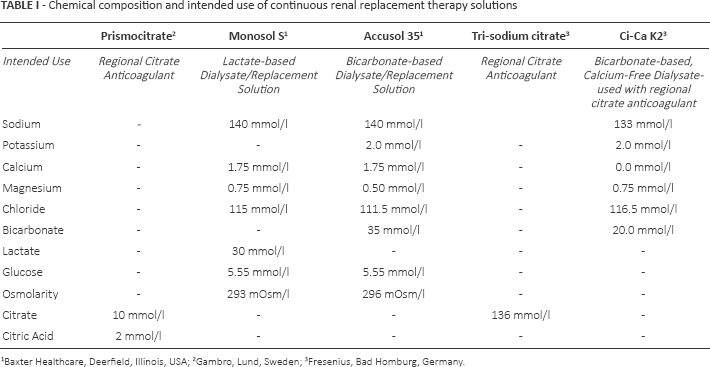
We compared the effect of 5, commonly-used CRRT fluids (Monosol S - lactate-based solution (Baxter Healthcare, Deerfield, Illinois, USA), Accusol 35 - bicarbonate-based solution (Baxter Healthcare), Prismocitrate - citrate-based anticoagulant (Gambro, Lund, Sweden), 4% tri-sodium citrate (Fresenius, Bad Homburg, Germany) and Ci-Ca K2 - bicarbonate-based, calcium-free dialysis fluid (Fresenius) on bacterial growth and biofilm formation. Their chemical compositions and intended uses are shown in Table I. All of the experiments described below were performed in duplicate on separate occasions to ensure that results were reproducible.
Chemical composition and intended use of continuous renal replacement therapy solutions
Baxter Healthcare, Deerfield, Illinois, USA;
Gambro, Lund, Sweden;
Fresenius, Bad Homburg, Germany.
Sterility assessment
For each type of CRRT fluid at least 4 bags from different manufacturing lots were assessed for sterility. This was achieved by culturing 250 mL aliquots by membrane filtration onto Reasoner's 2A medium (R2A AGAR; Oxoid, Basingstoke, UK) and incubating for 10 days at 37°C and 22°C.
Growth of bacteria in CRRT fluids
Seven strains of bacteria were obtained from the National Collection of Type Cultures (NCTC), Colindale, UK. These were Staphylococcus aureus (NCTC 6571), Staphylococcus epidermidis (NCTC 11047), Escherichia coli (NCTC 10418), Pseudomonas aeruginosa (NCTC 10662), Stenotrophomonas maltophilia (NCTC 10257), Pseudomonas fluorescens (NCTC 10688) and Burkholderia cepacia (NCTC 10661).
Each of these strains was inoculated into each CRRT fluid at a final target inoculum of 5 × 10⁵ CFU/ml (‘high’ inoculum). The inoculated fluids were incubated in microtiter wells for 72 h at 37°C and growth was monitored using a Synergy HT spectrophotometer (BioTek Instruments, Winooski, VT, USA) at 690 nm. The experiment was repeated using a reduced inoculum of 100 CFU/ml (‘low’ inoculum). Both experiments were then repeated using an incubation temperature of 22°C. Biofilms were assayed, after 72 h incubation, using a standard method (3). Briefly, this involved fixing the bacterial film with methanol, staining with crystal violet, releasing the bound dye with 33% glacial acetic acid, and measuring the optical density (OD) of the solution at 570 nm by using a spectrophotometric plate reader.
Inhibitory effect of CRRT fluids on bacterial growth
To examine if the constituents of CRRT fluids had any inhibitory impact on bacterial growth, each fluid was supplemented with nutrients in the form of IsoSensitest broth (CM0473; Oxoid, Basingstoke, UK). This was achieved by adding 23.4 g of dehydrated powder to a liter of each CRRT fluid followed by filter sterilization. Each supplemented fluid was inoculated with the seven bacterial strains listed above at both high and low inocula (as described above). The inoculated fluids were incubated in microtiter wells for 48 h at 37°C and growth was monitored by spectrophotometry at 690 nm. Experiments were repeated at 22°C.
Effect of CRRT fluids on bacterial biofilm formation
Tryptone soya broth (CM0129; Oxoid, Basingstoke, UK) was used to supplement each CRRT fluid by adding 30 g/l of dehydrated powder followed by filter sterilization. Biofilm assays were performed in exact accordance with the procedures outlined by Stepanovic et al (3) and involved overnight incubation at 37°C with a high inoculum of bacteria in microtiter wells.
Results
A sterility assessment of at least 4 bags of each type of CRRT fluid found no microbial contamination after 10 days incubation of culture media. For growth experiments, viable counts confirmed the high inoculum as a final concentration of bacterial cells within the range: 3.5 – 6 × 10⁵ CFU/ml. Low inocula were within the range: 60–180 CFU/ml.
Fluids without nutrient supplementation did not support bacterial growth or biofilm formation during 72 h incubation at either 22°C or 37°C, even when a relatively high inoculum was used.
The incorporation of nutrients allowed insights into the ability of CRRT fluids to affect growth and biofilm formation. All strains grew well after 24 h incubation at 37°C in control wells (i.e., IsoSensitest broth or tryptone soya broth reconstituted with deionized water rather than CRRT fluids).
Figure 1 shows the increase in spectrophotometric absorbance at 48 h incubation with higher values, indicating greater bacterial growth. Results are presented as the averages for each duplicate experiment.
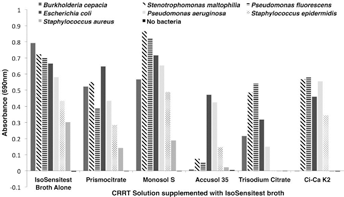
Growth of various bacteria after incubation at 37°C for 48 h in various continuous renal replacement therapy fluids supplemented with IsoSensitest broth.
The CRRT solutions showed varying degrees of bacterial growth inhibition. Accusol 35 severely restricted the growth of B. cepacia, S. maltophilia, P. fluorescens and S. aureus, whereas Ci-Ca K2 completely inhibited the growth of B. cepacia and S. aureus, and tri-sodium citrate completely inhibited the growth of both staphylococcal strains that were used. Monosol S and Prismocitrate showed the least evidence of bacterial inhibition. At 22°C, the growth of several bacteria was severely limited and no firm conclusions on the impact of CRRT fluids could be made (data not shown).
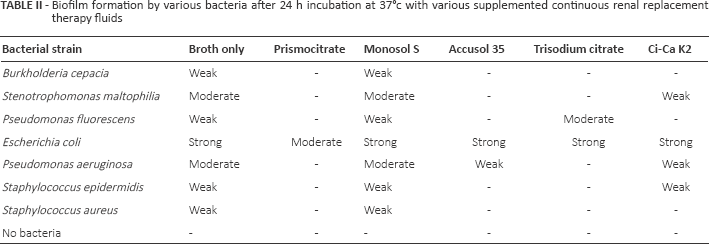
All 7 strains of bacteria used were able to form biofilms and were classified as showing weak, moderate, or strong adherence according to the criteria of Stepanovic (3). Table II shows the effects of the CRRT solutions on biofilm formation. E. coli was strongly adherent and retained moderate to strong adherence in the presence of all CRRT fluids. All other strains were affected to varying degrees by the presence of CRRT fluids. For example, the weak biofilm-forming ability of both staphylococci was abolished in the presence of Prismocitrate, Accusol 35, and tri-sodium citrate but was unaffected by Monosol S. Prismocitrate resulted in greater suppression of biofilm formation across the range of tested bacterial strains than other fluids.
Biofilm formation by various bacteria after 24 h incubation at 37°c with various supplemented continuous renal replacement therapy fluids
Discussion
Bacterial contamination of dialysis fluid has been well recognized in chronic HD for decades (4). The potential for clinically significant cross-dialyzer transfer of pyrogens has led to the establishment of strict standards for water and dialysis fluid purity (4). The International Organization for Standardization (ISO) requires that standard dialysis fluid contains a total viable microbial count of <100 CFU/ml and an endotoxin concentration <0.25 EU/ml, while the more stringent requirements for ultrapure fluid for convective therapies are <0.1 CFU/ml and <0.03 EU/ml, respectively (5), given the need for systemic infusion of the preparation.
Maintenance of optimal water quality now requires considerable infrastructural investment by renal services, whether supply is from a central water plant or from portable reverse osmosis units used for treatment remote from the main dialysis unit – for instance, in critical care areas. Although readily available, these standards have yet to be applied to CRRT – at least, in part, because the scale and clinical relevance of fluid contamination remains incompletely defined in this setting. The first indication that a problem existed was in an evaluation of a fractional dialysis fluid quantification method for continuous veno-venous HD (CVVHD) (6). Four of fifteen dialysis fluid collections, cultured for the presence of urease-producing bacteria, revealed heavy contamination with P. aeruginosa.
In a subsequent study, the bacterial integrity of this same, bicarbonate-based, CVVHD technique was specifically assessed (1). Fluid sampled from source dialysis fluid bags showed no clear evidence of contamination. However, 6 of the 18 dialysis fluid circuits studied during the course of treatment showed heavy microbial growths, most commonly of the types of environmental bacteria involved in chronic HD contamination. These were detected after an average of around 50 h of therapy, although in two cases, they were detected within 24 h of treatment initiation. Contamination appeared to spread in an antegrade fashion and, once present, positive cultures persisted until the end of therapy. The main caveat to this study was that therapy could have been regarded as “non-standard” with the use of multiple-component circuitry and with bicarbonate dialysis fluid manufactured in-house.
We therefore went on to assess the microbiological integrity of CVVH performed using fully integrated, industry-standard circuitry and industry-manufactured bicarbonate replacement fluid (2). Of the replacement fluid samples taken at the end of the 24 studied therapies (the lack of available ports precluded this, during treatment), 9 cultures (using highly sensitive techniques) and 1 endotoxin assay, breached standards for ultrapure water (4). Electron microscopy revealed the luminal surfaces of 13 harvested tubing samples to be contaminated with biofilm. Only 7 circuits proved to be entirely free from microbial contamination.
The results of these studies raises a number of questions, namely:
What is the source of this contamination? It seems the most likely source is from breaches of aseptic technique during connection of fresh fluid bags to circuits. Realtime surveillance to confirm source and route of contamination are required in larger-scale studies (7).
What is the clinical relevance of these findings? Certainly contamination was at a level that would be of concern in chronic therapy but the potential impact needs to be confirmed in the target population before considering technical measures that might mitigate the problem such as in-line endotoxin filters (discussed in more detail, elsewhere (8)).
A further question is: What is the potential impact of fluid type on the risk of bacterial growth? Despite the different CRRT circuit technologies and fluid preparation techniques assessed in the various studies, to date, one common thread has been the use of bicarbonate buffer. Bicarbonate-based dialysis fluid may be particularly vulnerable to bacterial contamination (9). It was the purpose of the present study, therefore, to assess the propensity of other fluids, used in different CRRT techniques, to support or inhibit bacterial growth. The study examined solutions used in both lactate- and bicarbonate-based CRRT as well as different fluid components of commercially-available regional citrate anticoagulation techniques.
Bacterial detection techniques used in our previous work (2) were highly sensitive and compatible with recommendations for assurance of ultrapure water quality. The techniques used in the present study (including nutrient supplementation) had a different purpose – to provide insights into the relative impact on bacterial activity of different fluids that might not have been differentiated at the lower (but nevertheless potentially clinically relevant) levels of contamination seen in our previous work. In addition, although the compositions of the regional citrate anticoagulants tested (Prismocitrate and tri-sodium citrate) would not have reflected solute concentrations in the final circulating fluid product, their inclusion, we felt, allowed insights into any discrete local effects on bacterial activity.
Our results revealed that none of the three dialysis fluid/ replacement solutions (Monosol S, Accusol 35, Ci-Ca K2) showed consistent suppression of bacterial growth across tested species. Given that evidence of contamination in our previous studies had occurred in the presence of bicarbonate-buffered solutions, the fact that Accusol 35 seemed to result in greatest overall suppression of bacterial growth raises concerns that alternative, non-bicarbonate solutions may provide a more favorable environment for bacterial activity in clinical practice.
In addition, we speculated upon the possibility of at least a local inhibitory effect of Prismocitrate and tri-sodium citrate on bacterial activity before dilution to low concentrations within the final fluid product. We found neither to have a consistent impact on either bacterial growth or biofilm formation.
Conclusions
Different CRRT fluids appear to have different impacts on bacterial growth and biofilm formation. However, all remain susceptible to extrinsic contamination, which must therefore be a consideration in future CRRT technology and practice.
Footnotes
Financial Support: Financial support for all consumables was provided by The Northern Counties Kidney Research Fund, Newcastle upon Tyne, UK.
Conflict of interest: None of the authors have any interests to disclose and there are no conflicts of interest.
Meeting presentations: The results of this study were presented in poster format at the American Society of Nephrology annual meeting, San Diego, October 27 to November 1, 2009.