






Abstract
Introduction
The aim of the study was to compare shear bond strengths of brackets bonded with a composite resin before and after expiration dates.
Methods
Forty-five freshly extracted premolar teeth were randomly divided into 3 groups of 15. Ormco Mini 2000 (Ormco Corp, Glendora, Calif) bicuspid metal brackets were used in the study. Group I: the brackets were bonded with Blugloo (Ormco Corp, Glendora, Calif) adhesive paste before the expiration date. Groups II and III: the brackets were bonded with same light cure composite resin 1 and 2 years after the expiration date. All of the groups were cured with a LED light. After bonding, the shear bond strengths of the brackets were tested with a universal testing machine. One-way ANOVA with post-hoc Tukey tests were used to compare shear bond strengths of the groups. The chi-square test was used to determine significant differences in the adhesive remnant index (ARI) scores between the groups. Significance for all statistical tests was predetermined at p<0.05.
Results
No statistically significant difference was found in shear bond strengths and ARI scores between three groups (p<0.05). There was a greater frequency of ARI scores of 2 and 3 and 4 in all groups.
Conclusions
Expiration dates do not have a significant effect on the shear bond strength of the composite material. Further studies are needed to investigate in other ways such as cytotoxicity of the composite resins after expiration date.
Background
Expiration date is the recommendation of time that products such as food, medication or chemicals can be stored, during which the defined quality of a specified proportion of the goods remains acceptable. Manufacturers are required to stamp an expiration date on their products. The expiration date of composite resins specifies the date that the manufacturer guarantees the full potency and safety of the product.
Sometimes clinicians overstock composites and cannot use them before expiration date. There is very little information in the literature about features of composite resins used after expiration date. Garcia et al (1) evaluated the conversion degree, micro-hardness, and surface roughness of composite resins used 180 days after their expiration date and they stated that micro-hardness for the composites reduces if used after their expiration dates. However, to our knowledge there is no study that evaluates shear bond strength of composite resins after expiration date. Therefore, the aim of the study was to evaluate and compare shear bond strengths of brackets bonded with a composite resin before and after expiration dates.
Methods
Forty-five human permanent premolar teeth extracted for orthodontic reasons and without any caries or visible defects were used in this study. Each tooth was individually embedded in auto-polymerizing acrylic resin (Meliodent; Heraeus Kulzer, Hanau, Germany). The specimens were kept in distilled water at room temperature except during the bonding and testing procedures. Before bonding, the facial surfaces of the teeth were cleaned with a mixture of water and pumice. The teeth were rinsed thoroughly with water and dried with oil and moisture-free compressed air. Each tooth was etched with 37% phosphoric acid gel (Gel Etch®, 3M Unitek) for 30 seconds, rinsed with a water/spray combination for 30 seconds, and dried until a characteristic frosty white etched area was observed. Ormco Mini 2000 (Ormco Corp, Glendora, Calif) premolar metal brackets were used. The surface area measured and calculated with a digital caliper was 9.63 mm2. Teeth were divided into 3 groups of 15.
Group I: The brackets were bonded with Ortho Solo Primer and Blugloo (Ormco Corp, Glendora, Calif) adhesive paste before expiration date.
Group II: The brackets were bonded with Ortho Solo Primer and Blugloo (Ormco Corp, Glendora, Calif) adhesive paste one year after expiration date.
Group III: The brackets were bonded with Ortho Solo Primer and Blugloo (Ormco Corp, Glendora, Calif) adhesive paste two years after expiration date.
Both of the groups were cured with a LED light (MiniLED™, Satelec, Merignac, France). After bonding, the shear bond strengths of the brackets were tested with a universal testing machine (Elista, İstanbul, Turkey).
Each specimen was loaded into a universal testing machine (Instron Universal Test Machine, Elista, Istanbul, Turkey), with the long axis of the specimen kept perpendicular to the direction of the applied force. The standard knife edge was positioned in the occluso-gingival direction and in contact with the bonded specimen. Bond strength was determined in the shear mode at a crosshead speed of 0.5 mm/min until fracture occurred. The values of failure loads (N) were recorded and converted into megapascals (MPa) by dividing the failure load (N) by the surface area of the bracket base (9.63 mm2).
After debonding, all teeth and brackets in the test groups were examined under 10x magnification. Any adhesive remaining after debonding was assessed and scored according to the modified ARI (2). The scoring criteria of the index are as follows:
All of the composite with an impression of the bracket base remained on the tooth.
More than 90% of the composite remained on the tooth.
More than 10% but less than 90% of the composite remained on the tooth.
Less than 10% of the composite remained on the tooth.
No composite remained on the tooth.
Statistical Analysis
Descriptive statistics, including the mean, standard deviation, minimum, and maximum values, were calculated for each of the tested groups. One-way ANOVA with post-hoc Tukey tests were used to compare shear bond strengths of the groups. The chi-square test was used to determine significant differences in the ARI scores between the groups. Significance for all statistical tests was predetermined at p<0.05. All statistics were performed with SPSS version 17.0.0 (SPSS Inc., Chicago, III).
Results
The descriptive statistics on the shear bond strength (MPa) for the groups are presented as boxplots in Figure 1. Analysis of variance indicated no statistically significant difference in shear bond strengths between groups (p<0.05) (Tab. I).
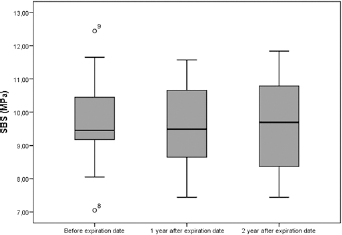
Shear bond strengths (SBS) (MPa) of the groups. Results presented as box plots. Horizontal line in the middle of each boxplot shows median value; horizontal lines in box give 25% and 75% quartiles; lines outside box give 5th and 95th.
The results of the independent t-test comparing the shear bond strength of the groups
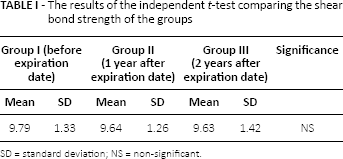
SD = standard deviation; NS = non-significant.
Frequency distribution of the ARI scores is presented in Table II. Chi-square comparison revealed no significant difference in ARI scores between all groups (p<0.05). There was a greater frequency of ARI scores of 2 and 3 and 4 in both groups, which indicates that failures were shown to be cohesive characteristics.
Frequency distribution of the adhesive remnant index (ARI) scores and the chi-square comparison of the groups
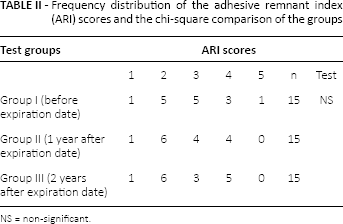
NS = non-significant.
Discussion
Overstocking materials like composite resins can cause the expiration date to pass before use. The official adhesive material expiration date itself is usually determined conservatively, and very expensive materials are being wasted.
In this study, the shear bond strength of brackets bonded with a composite resin before and after expiration date was compared. There were no statistically significant differences found between all groups, indicating that brackets may be bonded safely with this composite resin up to one year after expiration date. Many studies have evaluated the shear bond strength of orthodontic brackets (3–13). To best of our knowledge, this is the first study to compare the shear bond strength of brackets bonded with a composite resin before and after expiration date. Thus, we were not able to compare the results of the study. On the other hand Garcia et al (1) found that micro-hardness of the composites reduces if used after their expiration dates. This difference could be due to difference of composite resins or difference between micro-hardness and shear bond strength.
The stability of chemical material is variable. A material which is stable in its container at recommended temperature range, may become unstable once the container is opened and/or at lower or higher temperatures. Clinicians should be advised to store their materials as recommended to the expiration date.
After the recommended expiration date, the material does not definitely become useless, as it may only have reached the limit of the active ingredient potency. If, however, other chemical features have changed, or material becomes toxic, use of the material may be unhealthy. Bal et al (14) compared the cytotoxic effects of expired and non-expired resin-based composite materials and they concluded that expiration dates have a significant effect on the cytotoxicity of the composite materials.
ARI scores are used to define the site of bond failure between the enamel, the adhesive, and the bracket base. Bond failures within the adhesive or at the bracket- adhesive interface is preferred because it decreases the shear force stress at the enamel surface and increases the probability of maintaining an undamaged enamel surface (14). In this study, the results of the ARI score comparisons indicated no significant differences between all groups. The failures mostly showed cohesive characteristics in all groups, as preferred.
The most important weakness of the study was that it evaluated only the shear bond strength of a composite resin before and after its expiration date. Before using composite resins that have passed their expiration date, further studies are needed to investigate other effects, such as cytotoxicity.
Conclusions
Expiration dates have not had a significant effect on the shear bond strength of the composite material. Further studies are needed to investigate in other ways such as cytotoxicity of the composite resins after expiration date.
Footnotes
Conflict of interest: None of the authors has financial interest related to this study to disclose.