







Abstract
Introduction
Serum soluble CD30 (sCD30), a 120-kD glycoprotein that belongs to the tumor necrosis factor receptor family, has been suggested as a marker of rejection in kidney transplant patients. The aim of this study was to evaluate the relationship between sCD30 levels and anti-HLA antibodies, and to compare sCD30 levels in patients undergoing hemodialysis (HD) with and without failed renal allografts and transplant recipients with functioning grafts.
Methods
100 patients undergoing HD with failed grafts (group 1), 100 patients undergoing HD who had never undergone transplantation (group 2), and 100 kidney transplant recipients (group 3) were included in this study. Associations of serum sCD30 levels and anti-HLA antibody status were analyzed in these groups.
Results
The sCD30 levels of group 1 and group 2 (154 ± 71 U/mL and 103 ± 55 U/mL, respectively) were significantly higher than those of the transplant recipients (group 3) (39 ± 21 U/mL) (p<0.001 and p<0.001). The serum sCD30 levels in group 1 (154 ± 71 U/mL) were also significantly higher than group 2 (103 ± 55 U/mL) (p<0.001). Anti-HLA antibodies were detected in 81 (81%) and 5 (5%) of patients in groups 1 and 2, respectively (p<0.001). When multiple regression analysis was performed to predict sCD30 levels, the independent variables in group 1 were the presence of class I anti-HLA antibodies (β = 0.295; p = 0.003) and age (β = -0.272; p = 0.005), and serum creatinine (β = 0.218; p = 0.027) and presence of class II anti-HLA antibodies (standardized β = 0.194; p = 0.046) in group 3.
Conclusions
Higher sCD30 levels and anti-HLA antibodies in patients undergoing HD with failed renal allografts may be related to higher inflammatory status in these patients.
Introduction
The immunologic status of potential kidney transplant recipients has an impact on graft survival. Many factors such as the HLA matching between the donor and the recipient, recipient's sensitization history prior to transplant, and immune profile of the response to donor antigens determine the success of kidney transplantation (1–3). Research on various immunologic biomarker candidates is still ongoing and anti-HLA antibodies, particularly donor-specific antibodies (DSA), are the best-known immunologic parameter that indicate increased immunologic responsiveness prior to transplantation (4, 5).
In the last decade, however, several authors have suggested another potential biomarker, serum soluble CD30 (sCD30), a 120 kD glycoprotein of the tumor necrosis factor (TNF) and nerve growth factor (NGF) receptor superfamily groups, which is released into the bloodstream after activation of CD30+ T cells. The authors also showed that pre- and post-transplantation assessment of this biomarker may provide highly clinically relevant information concerning the risk of allograft rejection in subsequent kidney transplants (6, 7). Previous reports have also shown that pre-transplantation serum levels of sCD30 may represent a biomarker for outcomes in kidney transplantation, independent of alloantibody sensitization (8, 9). The sensitivity and specificity of this molecule increase when combined with the evaluation of anti-HLA antibodies (10).
However, serum sCD30 levels have shown to be increased in most patients with chronic kidney disease due to chronic inflammation and persistent activation of circulating T cells (11–15). Further studies should address how immunological and metabolic conditions that occur in patients with end-stage renal disease (ESRD) might lead to CD30+ T cell activation (15, 16). Therefore, we aimed to compare sCD30 levels and evaluate their relation with anti-HLA antibodies in patients undergoing hemodialysis (HD) with and without failed renal allografts and transplant recipients with functioning grafts.
Methods
Patients
A total of 100 patients undergoing HD who had a history of failed renal transplantation (group 1), 100 patients undergoing HD who had never undergone transplantation (group 2), and 100 renal transplant recipients with functioning allografts (group 3) who were followed up for more than 6 months were included in the study. Data on age, sex, duration of HD treatment, the etiology of ESRD, time of renal transplantation, type of donor, age of donor, cause of graft failure, and history of nephrectomy were captured through a review of medical records. Re-transplanted patients and patients with a history of transfusion or pregnancy were excluded from the study. Renal transplant recipients with Epstein-Barr virus (EBV), cytomegalovirus (CMV) viremia, and post-transplant lymphoproliferative disease (PTLD) were also excluded.
In the HD study group, patients were receiving dialysis 3 times a week for a 4-hour period with a standard bicarbonate-containing dialysate bath, using a biocompatible HD membrane (Polysulphone, FX-80 series; Fresenius). Blood flow rates ranged from 300 to 400 mL/min, and the dialysate flow rate was kept constant at 500 mL/min. The aim for all patients undergoing HD was to maintain their target dry body weight and receive an adequate dose of dialysis (double-pool Kt/V≥1.4).
The demographic and clinical characteristics of the study groups are shown in Tables I and II. Transplant recipients were treated using a triple-drug maintenance immunosuppressive regimen including a calcineurin inhibitor (cyclosporine or tacrolimus), azathioprine or mycophenolate mofetil or sodium, and prednisone. Induction therapy (anti-thymocyte globulin (ATG), 2 mg/kg per day; Fresenius) was used in transplantations from deceased donors. All patients received prednisone, beginning with a dosage of 120 mg daily, with a rapid taper reaching a daily maintenance dosage of 10 mg within the first month and 5 mg daily within the first year. The target blood levels of the transplant recipients were 50–150 ng/mL and 5–10 ng/mL for cyclosporine and tacrolimus, respectively. After it was confirmed that allograft failure was irreversible, immunosuppression was tapered and eventually completely stopped. No patients in group 1 were receiving immunosuppressive treatment during the study period and sampling.
Demographic and laboratory characteristics of the study groups
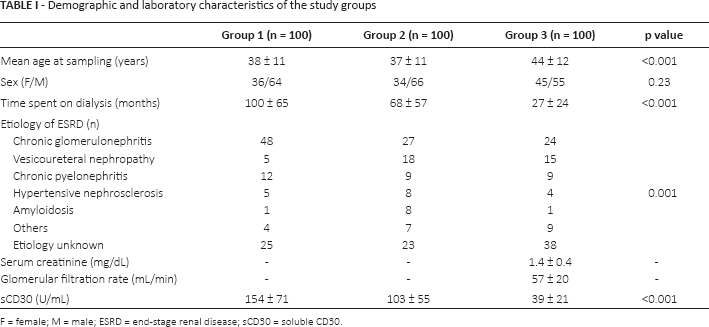
F = female; M = male; ESRD = end-stage renal disease; sCD30 = soluble CD30
Demographic features of the patients with the history of renal transplantation
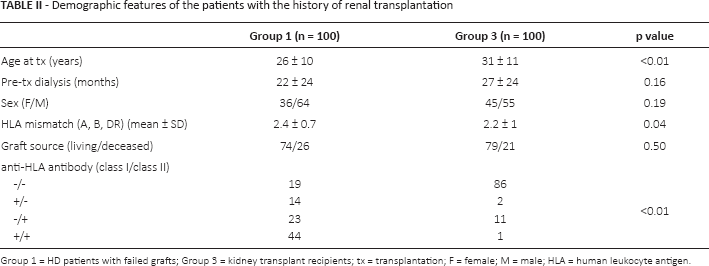
Group 1 = HD patients with failed grafts; Group 3 = kidney transplant recipients; tx = transplantation; F = female; M = male; HLA = human leukocyte antigen.
Examinations of the patients conformed to good medical and laboratory practices and the recommendations of the Declaration of Helsinki on biomedical research involving human subjects.
All subjects gave their informed consent for the study, which was approved by the Local Ethics Committee of Istanbul Medical Faculty on human research.
Sample Collection
Peripheral blood samples were collected and aliquots of serum were stored at -80°C until assayed for sCD30 levels and anti-HLA antibody status. Samples were drawn from patients at a mean time of 76 ± 62 months after graft failure in group 1, 68 ± 57 months after initiation of HD in group 2, and 159 ± 71 months after transplantation in group 3. In patients undergoing HD, blood samples were drawn just before the first HD session of the week. Serum samples were also drawn from 20 healthy subjects for the measurement of sCD30 levels. Estimated glomerular filtration rate (eGFR) was calculated using the modification of diet in renal disease (MDRD) formula in renal transplant patients (17).
Anti-HLA Antibody Screening and Identification
All serum samples were screened for the presence of the immunoglobulin (Ig) G-type anti-HLA class I- and II-specific antibodies using commercial enzyme-linked immunosorbent assay (ELISA) kits in accordance with the manufacturer's instructions (LATM20x5). Microtiter trays read at 630 nm using an ELISA reader (Bio-Tek ELX 800; Bio-Tek instruments) were analyzed using One Lambda software. The positive threshold (cut-off) was calculated as 0.2 times the average positive serum control minus the blank. Samples with positive screening results were further tested to confirm the screening results and to determine HLA specificities using ELISA anti-HLA antibody identification kits (LATP140x2 and LAT240).
sCD30 Measurement
A commercially-available sCD30 ELISA kit (Bender Med Systems) was used for the analysis of sCD30 levels in accordance with the manufacturer's instructions. The detection limit of the assay was 6.3 U/mL All tests were performed in duplicates and the mean concentration of sCD30 was determined by extrapolation from the standard curve measured at 450 nm.
HLA Typing
Patients and kidney donors were typed for class I HLA-A and HLA-B using complement-dependent cytotoxicity (CDC), and for class II HLA-DRB1 using a low-resolution polymerase chain reaction (PCR)-sequence-specific primer (SSP), as described elsewhere (18, 19). In the event of ambiguity in class I typing, PCR-SSP was also performed.
Statistical Analysis
Statistical analyses were performed using the SPSS for Windows version 15.0. Data are expressed as mean ± SD. Parametric and nonparametric tests were used according to the distribution pattern of the data of each variable. Statistical comparisons of individual groups were based on Student's t-test for continuous variables and on Fisher's exact test for discrete variables. Relationships were determined with Pearson's correlation coefficient. Multiple linear regression analysis was applied to identify independent determinants of sCD30 levels after adjustment for independent variables correlated with CD30 levels. All statistical tests were 2- sided and the level of significance was 0.05.
Results
Demographic characteristics of all patients are shown in Table I. Patients in group 3 were significantly older than patients in groups 1 and 2. Time spent on dialysis was longer in group 1 compared the other groups. The time periods between transplantation and blood sampling (144 ± 67 vs. 159 ± 71 months, p = 0.12) and source of grafts were also similar between groups 1 and 3 (Tab. II).
In group 1, mean graft survival was 67 ± 59 months (range, 0–249 months), and causes of graft loss in this group were biopsy-confirmed chronic allograft nephropathy (n = 56), chronic antibody mediated rejection (n = 19), recurrence of primary disease (n = 13), primary non-function (n = 4), viral infections (n = 4), surgical complications (n = 2), and hyperacute rejection (n = 2). Of the 100 patients with failed allografts, 36 had undergone nephrectomy at a mean of 3.3 ± 6.9 months (range, 0–29 months) after graft failure and sera were obtained at a mean of 94 ± 69 months (range, 0–251 months) after nephrectomy. Although it did not reach statistical significance, the number of HLA mismatches was higher in group 1 (2.4 ± 0.7) when compared with group 3 (2.2 ± 1) (p = 0.04) (Tab. II).
In renal transplant recipients with functioning allograft (group 3), 21 (21%) patients received ATG induction treatment. Fifty patients in group 3 were on cyclosporine and 23 were on tacrolimus-based triple immunosuppressive regimen. The remaining 27 patients were either on double or triple immunosuppressive treatment without calcineurin inhibitors.
Serum sCD30 levels of group 1 (154 ± 71 U/mL) were significantly higher than group 2 (103 ± 55 U/mL) (p<0.001) (Fig. 1). sCD30 levels of both groups 1 and 2 were significantly higher than in kidney transplant recipients (group 3) (39 ± 21 U/mL) (p<0.001 and p<0.001, respectively). In group 1, there were no differences regarding sCD30 levels between patients with and without allograft nephrectomy (168 ± 76 U/mL vs. 145 ± 66 U/ mL, p = 0.109). In group 3, no significant difference was found for sCD30 levels among patients on cyclosporine-based (38 ± 24 U/mL), tacrolimus-based (43 ± 18 U/mL), and mTOR–inhibitor-based treatments (38 ± 19 U/mL) (p = 0.44). The sCD30 levels of healthy subjects were found as 21 ± 3 U/mL. The sCD30 levels of both groups 1 and 2 were significantly higher than in healthy controls (p<0.001 and p<0.001, respectively). Serum sCD30 levels of group 3 and healthy controls were similar (39 ± 21 U/mL vs. 21 ± 3 U/mL, p = 0.725).
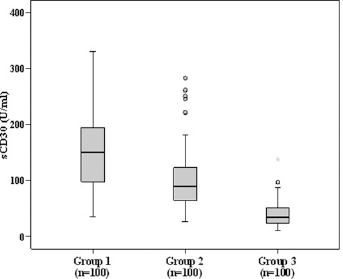
sCD30 levels in the study groups: Group 1 (154 ± 71 U/mL), Group 2 (103 ± 55 U/mL) and Group 3 (39 ± 21 U/mL) (p<0.001).
In group 1, 81 patients had anti-HLA antibodies, whereas only 5 patients had anti-HLA antibodies in group 2 (p<0.001). In group 1, 80% (65/81) of patients with anti-HLA antibodies had DSA. In group 1, sCD30 levels in 81 patients who were anti-HLA positive (160 ± 71 U/mL) were significantly higher than patients who were antibody negative (122 ± 61 U/mL) (p = 0.034). There was no significant difference for the presence of anti-HLA antibody between patients with and without transplant nephrectomy. In group 3, 11 (78%) of the 14 patients who were antibody positive developed DSA. Excluding the multispecific samples, the frequency distribution of anti-HLA antibodies in the study group were as follows for class I: A2 (10%), A23 (7%), A24 (6%), A68 (5%), A1 (4%), A3 (4%), B7 (4%), B51 (4%), A33 (%3), A32 (3%), B62 (3%), B61 (3%), and B58 (3%) and for class II: DR3 (8%), DR7 (8%), DQ5 (7%), DR12 (7%), DR13 (7%), DR15 (6%), DQ7 (6%), DQ2 (6%), DR16 (6%).
In the correlation analysis, the sCD30 levels in group 1 were significantly associated with age (r = -0.220, p = 0.03), and the presence of anti-HLA antibody (r = 0.205, p = 0.04), particularly class I anti-HLA antibody (r = 0.244, p = 0.014). In group 2, sCD30 levels were significantly associated only with age (r = -0.390, p<0.001). In group 3, sCD30 levels of kidney transplant recipients were significantly associated with with age (r = -0.304, p = 0.002), the presence of class II anti-HLA antibody (r = 0.209, p = 0.037), serum creatinine (r = 0.295, p = 0.003) (Fig. 2A), and eGFR levels (r = -0.230, p = 0.021) (Fig. 2B). In all study groups, sCD30 levels were not correlated with sex, time on transplantation, type of donor, cause of graft failure, or history of nephrectomy. In all study groups, sCD30 levels were significantly correlated only with age (standardized β = -0.299; p<0.001) (Fig. 3).
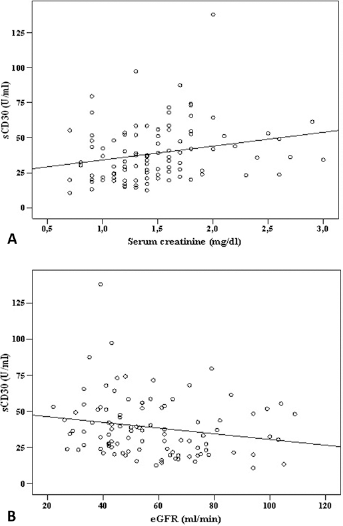
(A) Correlation between sCD30 and serum creatinine (r = 0.295, p = 0.003) in renal transplant recipients. (B) Correlation between sCD30 and eGFR (r = -0.230, p = 0.021) in renal transplant recipients.
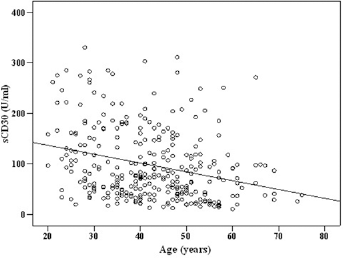
Correlation between sCD30 and age (standardized β = -0.299; p<0.001) in the study patients.
When multiple regression analysis was performed to predict sCD30 levels, independent variables were found as presence of class I anti-HLA antibodies (standardized β = 0.295; p = 0.003) and age (standardized β = -0.272; p = 0.005) in group 1, and serum creatinine (standardized β = 0.218; p = 0.027) and presence of class II anti-HLA antibodies (standardized β = 0.194; p = 0.046) in group 3.
Discussion
The results of this study showed that sCD30 levels were higher in patients undergoing HD when compared to renal transplant patients. This parameter was even more increased in patients with failed allografts than in patients undergoing HD who had never undergone transplantation. In previous studies, elevated serum levels of sCD30 have been detected in patients with ESRD, CD30+ hematopoietic malignancies, certain viral infections, and several autoimmune diseases (8, 20–23). Although patients with ESRD have changes of the immune system including defective antigen presentation and persistently present Th1-type cytokine-mediated chronic inflammation (20), it is still unknown why sCD30 levels are relatively high in patients undergoing HD. One explanation for this could be that uremia-related inflammation might activate T cells and enhance CD30 expression (15, 21).
In the present study, the sCD30 levels of renal transplant recipients showed a negative correlation with serum creatinine and eGFR levels. Several studies showed a significant decrease of sCD30 levels following transplantation, particularly in the first month when compared with pretransplant levels; however, it is not clear why sCD30 levels change so significantly within a short time period (24, 25). Possible explanations for the marked reduction in sCD30 levels might be the increased renal elimination of sCD30 by the functioning renal graft, the influence of different immunosuppressive treatments, and the improvement of uremia-related inflammation effects on sCD30. Approximately 25% of patients on kidney waiting lists have anti-HLA antibodies before transplantation. In a previous study from our group (26), we found higher rates of IgG type anti-HLA antibodies in patients with a history of failed allografts compared with patients who had never been transplanted. The present study showed similar results; the rates of anti-HLA antibody presence in patients undergoing HD who had never undergone transplantation and patients with failed allografts were 20% and 81%, respectively. In the present study, patients in group 1 had also significantly higher sCD30 levels and anti-HLA antibodies than patients in groups 2 and 3. Furthermore, the presence of anti-HLA antibodies was associated with higher sCD30 levels, which indicates that patients with higher sCD30 levels have increased alloreactivity.
Some studies suggested that CD30 may serve as a marker for human T lymphocytes that produce Th2 cytokines (27), whereas others demonstrated a strict association between CD30 expression and Th1 cytokine production (28). Although a marked CD30 association with T cell-mediated response was shown, high sCD30 levels measured before transplantation might also be a sign of consequent antibody production. In support of this view, high sCD30 levels were previously reported to be correlated with the risk of vascular rejection, production of DSA, and poor graft survival (29, 30). However, a disadvantage of sCD30 as a marker for alloreactivity is that it is a nonspecific immune marker that can fluctuate over time, depending on infectious status (31).
In line with previous observations (8, 21), we found significantly higher sCD30 levels in young patients than in adults in the present study. The association of sCD30 levels may (32) or may not be lower in patients receiving tacrolimus as compared with cyclosporine. Our results showed no significant difference in sCD30 levels in favor of one or the other calcineurin inhibitor. A limitation of this study is that we did not perform repeated measurements of sCD30 levels in the same individual at different time points. It has been demonstrated that T cell levels as well as other immune parameters show fluctuations, and these changes are mainly influenced by the circadian system, immunologic events, intoxications, and infections or other factors in patients undergoing HD (31, 33, 34).
In conclusion, sCD30 levels were higher in patients undergoing HD, probably due to uremia and chronic inflammation. However, higher sCD30 levels and their association with anti-HLA antibodies in patients undergoing HD with failed allografts may be related to higher inflammatory status in these patients, and these higher CD30 levels may be predictive for the risk of graft intolerance and immune activation against allografts in subsequent transplantations.
Footnotes
Financial support: No grants or funding have been received for this study.
Conflict of interest: None of the authors has financial interest related to this study to disclose.