






Abstract
Purpose
Methods
Results
Conclusions
Introduction
Many individuals with end-stage renal disease (ESRD) have adequate arteries and veins for construction of an arteriovenous fistula (AVF), but after construction in some cases, the fistula is too deep to cannulate for hemodialysis because of a thick layer of overlying adipose tissue. The traditional approach to this situation has been the surgical transposition of the fistula to a superficial subcutaneous position with reanastomosis or elevation of the vein. Surgical lipectomy also has been reported (1–3). However, these methods require additional incisions that are vulnerable to surgical site complications and, therefore, limit patient and surgeon acceptance of the procedure. There have been a few case reports describing the use of liposuction to superficialize deep fistula veins with no clinically significant surgical complications (4–6). We report our experience with liposuction to gain a greater understanding of the safety and efficacy of the procedure.
Methods
This prospective, single-center, nonrandomized trial was conducted between September 2009 and January 2011. The objective was to study the safety and efficacy of using liposuction to enable cannulation of deep AVFs. The Western Institutional Review Board approved the study and provided oversight of the rights and safety of the participants. The study was conducted according to the International conference of Harmonization/Good Clinical Practices and the Declaration of Helsinki (7). Inclusion and exclusion criteria (Tab. I) were developed in accordance with the guidelines of the National Kidney Foundation Kidney Disease Outcomes Quality Initiative (8). The principal investigator designed the study and onsite investigators collected the data. Thirteen participants provided written consent and were enrolled (four men, nine women) to participate in the study procedure. Mean body mass index (BMI) was 39.1 kg/m2 (range, 28-57 kg/m2). The study was limited to brachiocephalic and radiocephalic fistulas due to the basilic vein's location under the deep fascia.
Inclusion and Exclusion Criteria
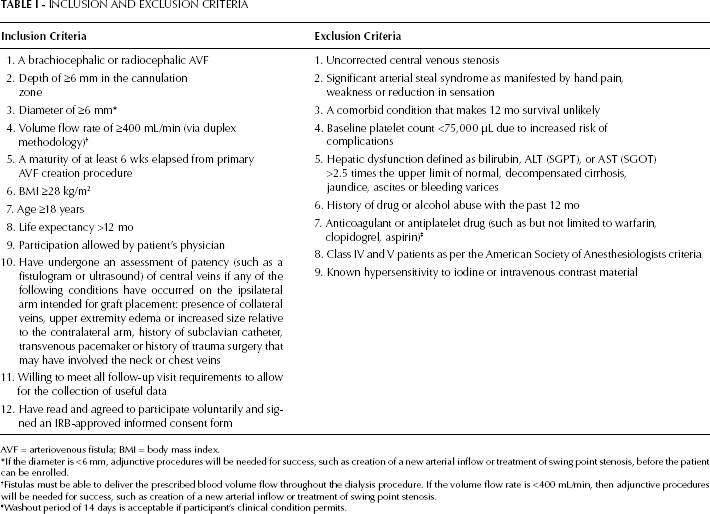
AVF = arteriovenous fistula; BMI = body mass index.
If the diameter is <6 mm, adjunctive procedures will be needed for success, such as creation of a new arterial inflow or treatment of swing point stenosis, before the patient can be enrolled.
Fistulas must be able to deliver the prescribed blood volume flow throughout the dialysis procedure. If the volume flow rate is <400 mL/min, then adjunctive procedures will be needed for success, such as creation of a new arterial inflow or treatment of swing point stenosis.
Washout period of 14 days is acceptable if participant's clinical condition permits.
The primary endpoint was the date of the first successful cannulation with two 17-gauge needles for hemodialysis. Secondary endpoints included the depth and diameter of the outflow vein, blood volume flow measurement of the AVF for patency evaluated by duplex ultrasound and time to fistula abandonment, need for percutaneous or surgical intervention and whether a surgical site healing complication occurred. Following the recommended standards for reports dealing with arteriovenous hemodialysis accesses (9), we defined primary patency as the interval from liposuction until any subsequent procedure to maintain patency. We defined secondary patency as the interval between liposuction and access abandonment.
Study procedure
Liposuction was performed only after the fistula had matured but was not able to be cannulated because it was too deep. Local tumescent anesthesia was utilized in all cases (Bupivacaine, Lidocaine, NaHCO3, and epinephrine), along with intravenous conscious sedation. After adequate tumescence, liposuction was performed in the following manner. Ultrasonic-powered lipolysis was utilized in the first six cases because it was the standard method of liposuction of the Plastic Surgeon investigator. We used one or two 3-6 mm stab wounds to fragment or liquefy the tissues prior to aspiration (LySonix® 3000 Soft Tissue Aspirator, Mysonix, Inc., Mentor Corporation, Farmingdale, NY, USA). The last four cases were done without introducing energy in an effort to prevent skin necrosis. Intraoperative B-mode ultrasound was used in all cases to set safety boundaries for the liposuction to protect the fistula from injury. In ultrasound power-assisted liposuction, the power supply feeds a 22.5 kHz electrical signal to piezoelectric crystals mounted in the handpiece. The active elements of the handpiece then vibrate at that same frequency. The vibration is amplified and transmitted down the probe, where the distal end vibrates and causes the tissue in front of the probe to fragment or liquefy (10). After ultrasound-powered liquefaction, liposuction is performed using a 2.5-6 mm cannula for additional adipose tissue removal in the planned cannulation zone (Fig. 1). Two or three liposuction cannula access sites were used. The liposuction access sites were left open and not sutured. We utilized a lightly compressive absorbent bandage as a dressing; no drains were utilized.
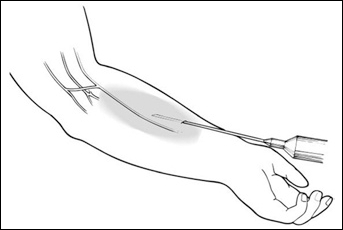
Liposuction in cannulation zone.
Follow-up regimen
Clinical safety assessments and evaluation of the AVF were performed at weeks 1, 2, 4, 8 and 12, and 6 and 12 months following the study procedure. AVF function was assessed by physical examination and duplex ultrasound. Measurements of AVF depth, diameter and intra-access flow were made at each follow-up visit. Medical events, hospitalizations, access interventions, complications and adverse events were recorded. Safety oversight was under the direction of the investigators (EDL and JFB). In addition to their study visits, the patients were monitored by an access center and received percutaneous or surgical interventions when indicated according to K/DOQI criteria to try to prolong secondary patency of the access.
Statistical analysis
Independent t tests were used to compare the means of continuously measured variables between two groups, but due to deviations from normality as well as the small sample size, the nonparametric Mann-Whitney test was also applied. The chi-square test of independence was computed to test the independence of two dichotomously measured variables, but because of the small sample size, Fisher's exact test was also applied.
Results
The mean preoperative fistula depth was 8.1 mm and mean BMI was 39 kg/m2. Eight of the fistulas were brachiocephalic and five were radiocephalic. During the liposuction procedure, an average of 253 mL of tissue was extracted. Liposuction cannulas ranged in size from 2.5 to 6 mm but the size utilized most commonly was 4 mm. In 9 of 13 patients, ultrasonic power was utilized to liquefy the adipose tissue prior to liposuction. Figure 2 shows days of patency after liposuction.
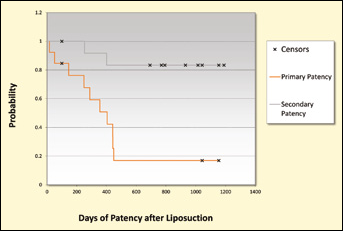
Primary and secondary patencies after liposuction.
Follow-up of the participants
One subject was excluded from statistical analysis because she underwent the procedure twice. One subject missed the 1, 2, 8 and 12-week visits, another subject missed the 4-week visit, and one subject died prior to the 8-week visit due to endocarditis. None of the surviving subjects missed the 6-mo visit and three missed the 12-mo visit. Therefore, 10 patients were included in final data analysis.
Statistical analyses
Table II presents descriptive statistics for the continuously measured variables. Skewness and kurtosis were computed to assess the variables for normality. Skewness and kurtosis values of zero are indicative of a normal distribution, and skewness values between –1 and +1 signify no problematic deviations from normality, whereas kurtosis values between -3 and +3 are acceptable (11, 12). For the current data, all measures of kurtosis were acceptable but some of the skewness values were slightly outside of the acceptable range. Thus, due to these deviations from normality as well as the small sample size, t-tests were used to compare the means between the two groups and the nonparametric Mann-Whitney test was also applied to support the analyses.
Descriptive Statistics for Continuously Measured Variables
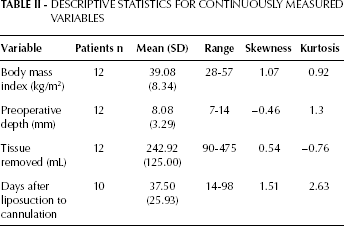
Table III shows the results of independent t tests that were used to compare the means of BMI, preoperative fistula depth, volume of tissue removed and number of days after lipoplasty for patients with and without a serious adverse event. None of the t-tests was significant at p≤0.05, but for preoperative fistula depth, the nonparametric Mann-Whitney test indicated that the group with no serious adverse events had a significantly greater preoperative depth than the group with a serious adverse event (p<0.05).
Independent t-Tests Comparing Participants with and without a Serious Adverse Event *
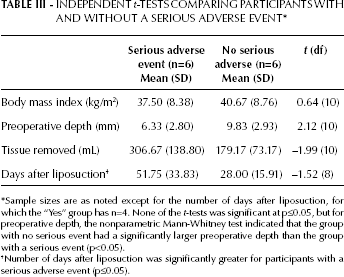
Sample sizes are as noted except for the number of days after liposuction, for which the “Yes” group has n=4. None of the t-tests was significant at p≤0.05, but for preoperative depth, the nonparametric Mann-Whitney test indicated that the group with no serious event had a significantly larger preoperative depth than the group with a serious event (p<0.05).
Number of days after liposuction was significantly greater for participants with a serious adverse event (p≤0.05).
Table IV shows the results of an independent t-test that compared the means for the number of days to cannulation between groups of subjects who did/did not have ultrasonic liposuction. The t-test was not significant at p≤0.05 nor was the nonparametric Mann-Whitney test.
Independent t-Test Comparing Participants who Did/Did not have Ultrasonic Liposuction
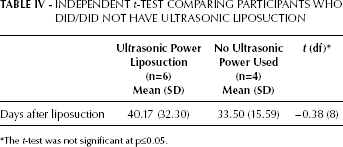
The t-test was not significant at p≤0.05.
Table V shows the contingency Table for whether ultrasonic power-assisted liposuction performed cross tabulated with whether there was a serious adverse event. Although there was a trend toward the occurrence of more serious adverse events when ultrasonic power-assisted liposuction was performed (62.5%) than when it was not (25.0%), this trend was not significant according to the chi-square test of independence, χ2(1)=1.50, p>0.05. Because the chi-square test of independence is not reliable when cell counts are small, Fisher's exact test was also computed and also produced a nonsignificant result (p>0.05).
Association of Serious Adverse Event(S) with Ultrasonic Energy-Assisted Liposuction
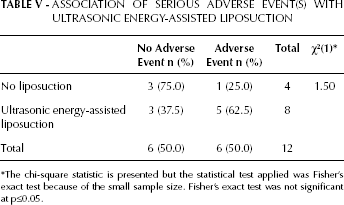
The chi-square statistic is presented but the statistical test applied was Fisher's exact test because of the small sample size. Fisher's exact test was not significant at p≤0.05.
Primary endpoint
Eleven of the 13 subjects (85%) underwent successful two-needle cannulation a mean of 33.7 days after the study procedure. One subject died of endocarditis prior to cannulation. The most obese subject (BMI = 57 kg/m2) had a hematoma and wound necrosis and his fistula remained deep and required surgical transposition in order to achieve successful cannulation. Projection and palpability of the fistula tended to increase over time (Figs. 3 and 4).
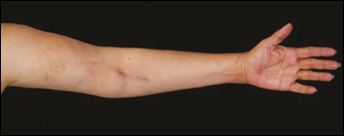
Participant 6 preoperatively.
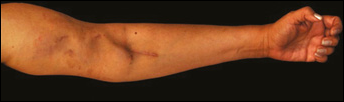
Participant 6, postoperative day 60.
BMI was positively related to time to cannulation but the correlation (r=0.451) did not reach statistical significance. The volume of tissue removed during suction lipoplasty correlated positively with number of days to cannulation (r=0.74, p=0.01).
Secondary endpoints
The preoperative depth of the fistula was significantly greater than the postoperative depth at all postoperative visits except for days 7 and 14 (paired t testing, p≤0.05).
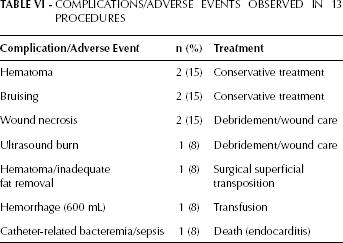
There were no significant changes in preoperative flow at any of the postoperative visits. There were significant increases from preoperative diameter to 8 weeks, 6 mo and 12 mo (p≤0.05). There were 10 adverse events related to the 13 study procedures (Tab. VI). Times to cannulation were significantly greater in subjects who had a serious adverse event (Tab. III).
Complications/Adverse Events Observed in 13 Procedures
Discussion
AVF is the method of choice for vascular access even in obese patients. With the exception of “super obesity” (commonly defined as BMI ≥50 kg/m2), BMI has not been confirmed as a factor in predicting AVF revision or failure (13). In obese patients, however, AVF formation requires more extensive procedures in order to achieve patency (1). If such extra measures are not taken, obesity remains a challenge for functional AVF creation and is an independent predictor of fistula failure (6).
The Fistula First recommendation for reliable access cannulation is for a vein depth of <6 mm (14). Thus, in order to make veins accessible in obese patients with AVF, superficialization procedures are used commonly. These surgical techniques include vein elevation and transposition, lipectomy and, more recently, liposuction.
The 1-year primary and secondary patency rates for vein elevation or transposition are reported as 60% and 83% (15), respectively, and for lipectomy (with fewer diabetic patients) it is 71% and 98%, respectively (2). Both of these studies were radiocephalic AVFs with better secondary patency rates after lipectomy. In obese patients, Barnard et al (1) performed lipectomies to access upper arm cephalic vein AVFs rather than radiocephalic AVFs. Their results at 1 year showed primary and secondary patency rates of 49.3% and 95.0%, respectively. The present study resulted in a 1-year cumulative primary patency rate following the lipoplasty procedure of 50% and our 1-year cumulative secondary patency rate was 83% (Fig. 2).
There have been reports of successful cases of vein superficialization via liposuction. Ochoa et al (6) used liposuction over a shielding device to superficialize an upper arm AVF in a patient with a BMI of 36 kg/m2. Liposuction using intraoperative ultrasound for safety was reported by Causey et al (4) and Krochmal et al (5). Previous AVF liposuction case reports have not described any clinically significant surgical complications, although Bourquelot and colleagues (2) described one case of a subcutaneous hematoma that resulted in irreversible thrombosis of the vein in their lipectomy study.
After performing this study, the author/Principal Investigator (EDL) currently uses suction lipoplasty when only a small amount of tissue (<10 mm) requires removal to enable cannulation and no longer uses ultrasonic power to preliquefy the tissues. We do this to try to minimize tissue trauma to avoid skin necrosis. The finding of greater amounts of tissue removed being associated with more surgical site complications and delays in cannulation could have been caused by more intraoperative bleeding in those patients. Because of the very high blood flow in a limb with an AVF the risk of hematomas may be increased compared with one without a fistula. In an effort to reduce hematomas, we have further refined the procedure by utilizing the Hemaclear® tourniquet (OHK Medical Devices, Haifa, Israel) for preventive hemostasis (16). This nonpneumatic, surgical exsanguination tourniquet is a sterile elastic stockinet that rolls up the patient's arm beginning at the hand. There is an elastic silicone ring within the stockinet that provides sufficient pressure (220±30 mmHg) to block arterial flow into the limb. The stockinet can be cut to provide access to the incision area.
Our study had mixed results: a majority of subjects had prompt, uncomplicated cannulation but a few had wound necrosis, large hematomas and prolonged time until cannulation. However, 85% of the AVFs were cannulated successfully at a mean of 35 days after liposuction. We conclude that liposuction is an effective method of enabling cannulation of excessively deep vein fistulas but because of the substantial risk of serious surgical site complications, it may not be the ideal method.
Further study of the results achieved with these refinements will be necessary to determine guidelines for liposuction and its overall clinical utility.
Footnotes
Acknowledgments
Christian Krauthammer performed survival analysis. The principal investigator prepared the manuscript, which has been reviewed by all authors who vouch for the accuracy and completeness of the data. Janet L. Tremaine ELS provided editorial assistance. Jane Zagorsky PhD performed the descriptive statistics and hypothesis testing.