






Abstract
Background
In platinum-taxane resistant epithelial ovarian cancer (EOC), we aimed to determine the effectiveness.
Patients and Methods
Between 2004 and 2013, patients afflicted with platinum-taxane resistant EOC and who were administered a 30-minute i.v. infusion of single-agent gemcitabine at a dose of 1,250 mg/m2 on the 1st, 8th and 15th days, every 28 days, were examined retrospectively.
Results
Twenty-six patients with platinum-taxane resistant EOC were included in the study. The overall survival (OS) was 48 months. The median survival after becoming platinum-taxane resistant was 16 months for the study population. Median time to progression (TTP) and median survival after becoming platinum-taxane resistant for patients who received second-line treatment were 3.3 months and 16 months, respectively; for patients who received third-line treatment with gemcitabine, these were 3.7 months and 19 months, respectively. Administration of gemcitabine as second- and third-line chemotherapy in platinum-taxane resistant EOC, provides similar TTP and OS outcomes (p = 0.4, p = 0.9) with a similar response and toxicity rate.
Conclusions
Second- and third-line gemcitabine at a dose of 1,250 mg/m2 on days 1, 8 and 15 every 28 days as a 30-minute i.v. infusion in platinum-taxane resistant EOC is an effective treatment option with a tolerable and manageable toxicity.
Introduction
Epithelial ovarian cancer (EOC) is the most lethal gynecological malignancy and constitutes 25% of female genital cancers. It was estimated that more than 22,000 new EOC cases and more than 14,000 deaths due to EOC would occur in 2014 in the United States (1). The most effective chemotherapy for first-line treatment is the combination of platinum and taxane (2). In platinum-taxane resistant EOC, many drugs, including gemcitabine, docetaxel, liposomal doxorubicin, etoposide, vinorelbine and topotecan, are used in second-line treatment, and the response rates of these drugs are similar (3). Gemcitabine (2′, 2′-difluorode-oxycytidine) is a synthetic nucleoside analog of cytidine (4). Gemcitabine is used in the treatment of different solid tumors including mainly pancreatic cancer (5), breast cancer (6), non-small cell lung cancer (7) and ovarian cancer (8). Which chemotherapy is more efficient as third-line treatment in platinum-taxane resistant EOC is not known. The aim of this study was to determine the efficacy and safety of gemcitabine 1,250 mg/m2 administered on the 1st, 8th and 15th days, every 28 days, as second- and third-line treatment of platinum-taxane resistant EOC.
Materials and Methods
EOC patients who received gemcitabine treatment after becoming platinum-taxane resistant between 2004 and 2013 were examined retrospectively. The study was approved by the ethics committee of Trakya University Faculty of Medicine. The patients who developed progression 6 months after platinum-taxane treatment were considered platinum-taxane resistant. Twenty-six patients were included in the study, to whom a 30-minute infusion of gemcitabine was administered at a dose of 1,250 mg/m2 on the 1st, 8th and 15th days, every 28 days for therapy. Complete blood count and renal and liver function tests were performed before each chemotherapy cycle, Ca125 was measured and radiological imaging was performed every 8 weeks. Disease progression was defined according to the Response Evaluation Criteria in Solid Tumors (RECIST) for advanced disease. Response and toxicities were analyzed using Pearson's chi-square test or Fisher's exact test. Survival estimates for second- and third-line therapy were calculated using the Kaplan-Meier method.
Results
The mean age of the patients was 52 years (range 36-75 years). The Eastern Cooperative Oncology Group performance status of all patients was ≤2, and all patients had International Federation of Gynecology and Obstetrics (FIGO) stage IIIC or IV EOC at the time of diagnosis. Optimal surgery had been performed in all patients. Twenty-five of 26 patients had metastatic disease when they became platinum-taxane resistant (24 liver, 1 lung). Twenty-five patients had serous cell histology, and 1 had clear cell histology. Fourteen patients received gemcitabine, 7 patients received liposomal doxorubicin, 2 patients received tamoxifen, 2 patients received docetaxel and 1 patient received topotecan as second-line chemotherapy. Twelve patients received gemcitabine as third-line chemotherapy. Progression developed in less than 3 months in 11 patients and in less than 6 months in 15 patients following platinum-taxane treatment (Tab. I).
Patient characteristics
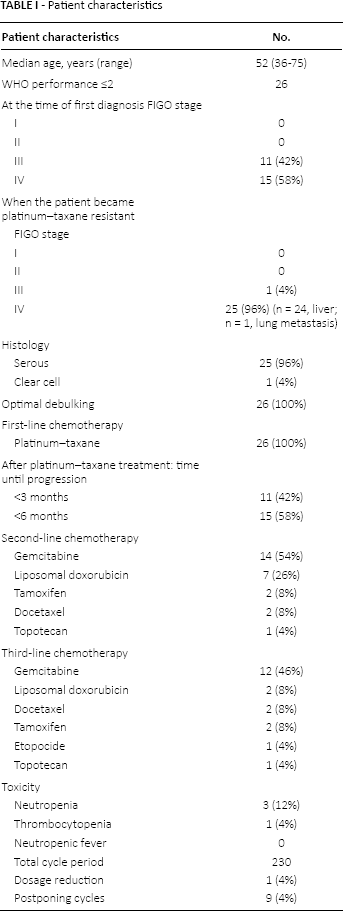
In the evaluation of treatment response, stable response was obtained in 8 patients (31%), and partial response was obtained in 1 patient (4%). Among patients in whom a stable response was obtained, 4 patients received gemcitabine as second-line treatment and 4 patients received gemcitabine as third-line treatment. There was no difference between patient age groups in terms of responses to gemcitabine treatment.
The median overall survival (OS) was 48 months (95% confidence interval [95% CI], 24.36-71.63), and the median survival after becoming platinum-taxane resistant was 16 months (95% CI, 9.71-22.28) for the whole population. In platinumtaxane resistant EOC, median time to progression (TTP) was 3.3 months (95% CI, 2.63-4.16), and the median survival was 16 months (95% CI, 6.75-25.24) after becoming platinum-taxane resistant in the patients who received second-line gemcitabine. In the patients who received third-line gemcitabine, TTP was 3.7 months (95% CI, 2.75-4.86) and the median overall survival was 19 months (95% CI, 11.71-26.27). When the patients who received gemcitabine as second-line and third-line chemotherapy in platinum-taxane resistant EOC were examined, it was found that TTP and OS were similar, and there was no statistically significant difference (p = 0.4 and p = 0.9, respectively) (Tab. II).
Evaluation of response
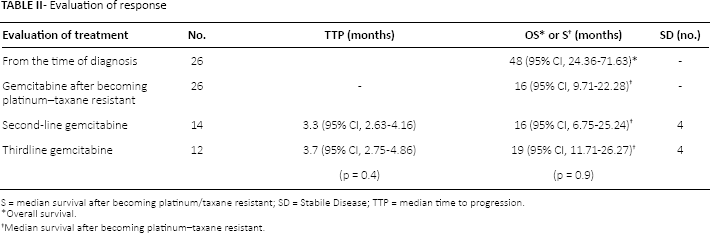
S = median survival after becoming platinum/taxane resistant; SD = Stabile Disease; TTP = median time to progression.
Overall survival.
Median survival after becoming platinum-taxane resistant.
In a total of 230 chemotherapy cycles, grade 3 neutropenia (12%) developed in 3 patients and grade 3 thrombocytopenia (4%) developed in 1 patient according to WHO toxicity grading. Neutropenic fever, toxic death or an increase in renal and liver function tests did not occur. Administration of gemcitabine at a dose of 1,250 mg/m2 on the 1st, 8th and 15th days, every 28 days, as a 30-minute i.v. infusion was well tolerated.
Discussion
In platinum-taxane resistant EOC, many different chemotherapy regimens are effective as second-line treatment (Tab. III) (3, 9, 10). One of them is single-agent gemcitabine. In platinum-taxane resistant EOC, an increase in survival rates has been observed compared with in studies performed in previous years. The reason for this increase may be due to the development of new chemotherapies and advances in palliative care. The use of gemcitabine for ovarian cancer was first reported by Lund et al (8) with 800 mg/m2 on days 1, 8, and 15, every 28 days. In this study, TTP was 2.8 months, OS 6.2 months and response rate was 19%.
Salvage chemotherapy in recurrent platinum refractory ovarian cancer patients
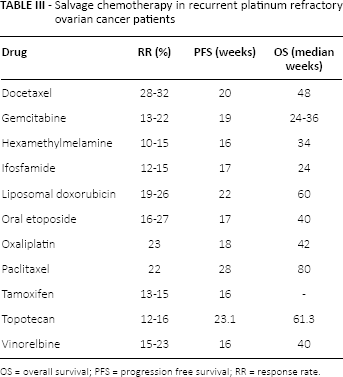
OS = overall survival; PFS = progression free survival; RR = response rate.
There are a limited number of studies with gemcitabine 1,250 mg/m2 on days 1, 8 and 15, every 28 days (11, 12). It is interesting that different TTPs and survival rates in studies with single-agent gemcitabine use in EOC have been reported.
In many studies, gemcitabine administration (800-1,250 mg/m2) has a manageable and acceptable toxicity profile (12, 13). In gemcitabine dose studies; the most important dose-limiting side effect was myelosuppression (11, 14). In platinum-taxane resistant EOC, single-agent gemcitabine is generally administered at a dose of 800-1,000 mg/m2 with a concern for toxicity (8, 11, 13, 15–18). Von Minckwitz et al reported that gemcitabine 1,250 mg/m2 had a manageable and tolerable toxicity profile (12). In the phase II study performed by Markman et al, in which 1,250 mg/m2 gemcitabine was administered, they completed the study by decreasing the dose (11). In our study, TTP was found to be similar to the results of the study by von Minckwitz et al (12). In studies with single-agent gemcitabine in platinum-taxane resistant EOC, the rates of WHO grade 3-4 neutropenia were found to be in a wide range, 7%-42% (Tab. IV). For the administration of gemcitabine at a dose of 800 mg/m2, Yoshino et al (13) and Silver and Piver (15) reported rates of grade 3-4 neutropenia of 37% and 7%, respectively. For administration of gemcitabine at a dose of 1,000 mg/m2, the rate of grade 3-4 neutropenia was reported to be 42% by D'Agostino et al (17), 27% by Suprasert et al (19), 24% by Markman et al (11) and 21% by Shapiro et al (16). Von Minckwitz (12) reported 21% grade 3-4 neutropenia with 1,250 mg/m2 gemcitabine. In our study, this rate was 12%. This big difference in toxicity rates suggests that there may be a genetic predisposition triggering myelosuppression for gemcitabine or its metabolites (Tab. IV). Single-agent gemcitabine toxicity was manageable. There were no toxic deaths or cases of febrile neutropenia. The dose was reduced in 1 patient and delayed in 9 chemotherapy cycles.
Gemcitabine as a single agent for salvage treatment of ovarian cancer
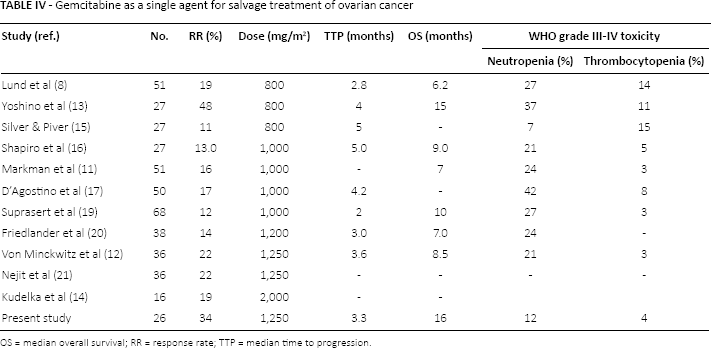
OS = median overall survival; RR = response rate; TTP = median time to progression.
As far as we know, there has not been a study comparing second-line and third-line use of single-agent gemcitabine in platinum-taxane resistant EOC. Our study showed that administration of single-agent gemcitabine at a dose of 1,250 mg/m2 on days 1, 8 and 15, every 28 days, is an efficient treatment. It had an acceptable side effect profile and a manageable toxicity profile. In second-line or third-line use of single-agent gemcitabine in platinum-taxane resistant EOC, TTP and OS rates were similar; there was no statistically significant difference. This shows that the efficacy of gemcitabine in platinum-taxane resistant EOC is maintained in the third-line use. In each case of metastatic disease, a decrease in the performance status of the patient is an expected process. In the early phases, when the condition of the patient is still relative good, but the patient suffers from platinum-taxane resistant EOC, more toxic drugs (e.g., liposomal doxorubicin, docetaxel and topotecan) may be selected as second-line chemotherapy, and a more tolerable chemotherapeutic agent like gemcitabine may be selected as third-line chemotherapy.
Conclusion
In platinum-taxane resistant EOC, administration of single-agent gemcitabine at a dose of 1,250 mg/m2 on days 1, 8 and 15, every 28 days, as a 30-minute i.v. infusion is an effective treatment option which has a tolerable and manageable toxicity.
Gemcitabine has similar survival rates for second- and third-line treatment in platinum-taxane resistant EOC. This suggests that the efficacy of gemcitabine is also maintained in third-line treatment, with a tolerable and manageable toxicity. Therefore gemcitabine may be preferred as a third-line therapy instead of a second-line therapy. The fact that a wide range of gemcitabine toxicity rates was found suggests that there may be a genetic predisposition for gemcitabine or its metabolites which triggers myelosuppression.
Footnotes
Financial support: No financial support was received for this submission.
Conflict of interest: The authors have no conflict of interest.