






Abstract
We hereby present a case of pre-treated unresectable sarcoma recurrence of the trunk which showed an excellent response to concomitant tri-modal therapy, consisting of re-irradiation, chemotherapy and regional hyperthermia even with a strong compromised re-irradiation dose. No significant toxicity of the combined therapy and fast achievement of the pain and neurological symptoms relief are reported. The case shows that concurrent trimodality treatment can be considered as a therapeutic option for the management of pre-treated unresectable recurrence even in the re-irradiation setting.
Introduction
Locally recurrent sarcomas, especially in the case of previously irradiated large tumors that are adjacent to critical organs and thus unsuitable for radical resection, are one of the most difficult and challenging malignancies to manage. To date, there are no guidelines that give detailed recommendations for the selection and treatment of patients with pretreated inoperable recurrence. We report a case of irresectable recurrent sarcoma of the thoracic trunk that was successfully treated with reirradiation in combination with hyperthermia and chemotherapy.
Case report
In May 2002, a 56-year-old woman underwent surgical resection for a malignant fibrous histiocytoma (MFH) in the paravertebral muscle Th 7/8 and had an early recurrence 7 months later. The recurrence was again surgically removed, followed by adjuvant radiotherapy with total dose of 48.6 Gy. Pathological reports revealed a storiform-pleomorphic subtype of MFH. During a follow-up period of 10 years, no evidence of recurrence was found. However, the 66-year-old patient recently complained about back pain that progressed in a short time. For further differential diagnosis of this new clinical manifestation, magnet resonance imaging (MRI) of the thorax was performed and showed a large tumor (12.3 × 3.7 cm) in the upper thoracic cavity with infiltration of thoracic vertebrae 5–8, neuroforamina and spinal canal (Fig. 1). To confirm the malignancy, a catheter biopsy was done. The pathological reports from the material obtained indicated a storiform-pleomorphic subtype of MFH with moderate differentiation confirming the local recurrence of the aforementioned MFH 10 years before. Furthermore, distant metastases could be ruled out on computed tomography (CT) of the neck, thorax and abdomen.
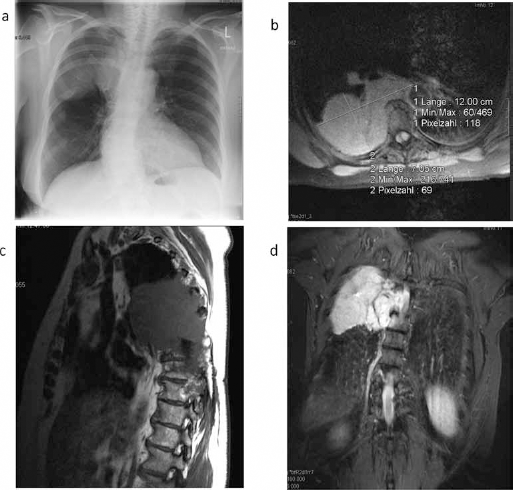
Extension of tumor in December 2012 before trimodal therapy: a) X-ray of thorax; b) axial magnet resonance imaging (MRI) scan of T1 sequence; c) sagittal MRI image of T1 sequence; and d) coronal MRI image of T1 sequence with contrast agent. The tumor had a maximum diameter of 12 cm and infiltrated bony structures of spinal column, ribs and intervertebral foramina.
The case was discussed by the multidisciplinary tumor board. Because of the large longitudinal extension and the extensive infiltration into several vertebrae, neuroforamina and the spinal canal, the patient seemed to be ineligible for radical surgery. Palliative reirradiation alone was deemed to be insufficient to control such a large tumor because of dose limitations after adjuvant radiotherapy in 2002. The final consensus decision was a concurrent trimodal therapy consisting of reirradiation (image-guided radiotherapy), chemotherapy and hyperthermia.
Prior to radiation treatment, a planning CT was performed in supine position on a vacuum bag. A total dose of reirradiation was determined for 35 Gy (ICRU 50) in 14 fractions with a dose per fraction of 2.5 Gy, 5 times per week for a total duration of 3 weeks. The total radiation dose to spinal cord was kept to 25.2 Gy with 1.8-Gy fraction size, taking the maximum dose from the previous irradiation to the spinal cord into account, which was 54 Gy. Before each fraction, the patient alignment was verified with kilovoltage cone beam CT. Chemotherapy with ifosfamide 1.3 g/m2 body surface was given intravenous weekly, with 3 cycles during the reirradiation. Hyperthermia was performed twice a week. After application of 4 sessions (of 6 planned), hyperthermia was stopped at the request of the patient, due to subjective intolerance.
At the end of the trimodality therapy, a remarkable tumor regression was observed on the cone beam CT (Fig. 2). The pain and neurological symptoms were completely relieved. Four weeks after therapy, a staging CT scan was performed and demonstrated further tumor regression (6.2 × 2.3 cm). Three months after treatment, another CT scan showed again tumor regression (5 × 2.3 cm) (Fig. 3). The patient reported neither pain nor neurological deficiency. No toxicity was documented. She was quite satisfied with her physical condition and quality of life and refused further therapy. Ten months later, no signs of tumor progression were found on a CT scan.
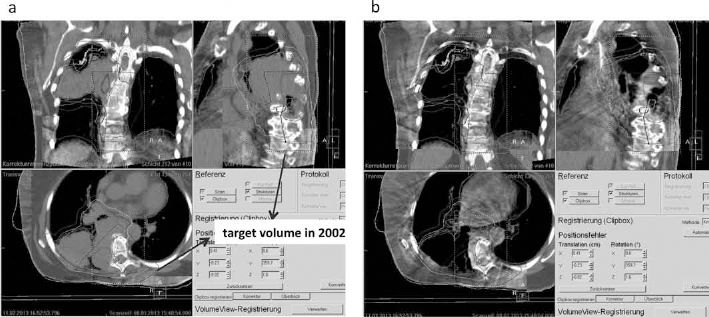
Planning computed tomography (CT) scan (a) and cone beam CT (b) at the time of the last fraction, presented in the iView program. Macroscopic tumor regressed massively.
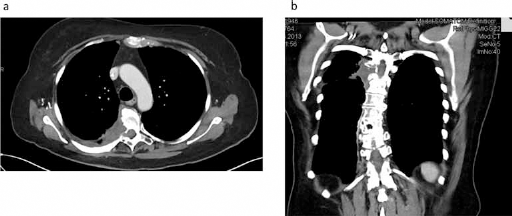
a, b) Computed tomography 3 months after trimodal therapy. The remarkable tumor regression remained.
Discussion
There are no guidelines for the management of preirradiated inoperable recurrent soft tissue sarcomas. Generally, radiotherapy alone will be considered to achieve local tumor control and symptoms relief, since there is strong evidence for its therapeutic efficacy in the primary setting (1, 2). Due to pretreatment irradiation in the present case, a radical radiotherapy dose was impossible. Therefore options were considered to improve its clinical effect. Chemotherapy has been proven to be effective for high-risk soft tissue sarcoma (3, 4), and can be successfully combined with radiotherapy in the neoadjuvant setting (2, 4, 5). Doxorubicin and ifosfamide are the standard chemotherapeutic agents, with response rates for the monotherapy of up to 25% (2–5). When combined with radiotherapy, ifosfamide appears to be more favorable, because of its mild toxicity profile (6).
Hyperthermia is another therapeutic option to improve the effectiveness of irradiation and chemotherapy in various tumors including sarcomas (4, 7–9). Hence, the combination of radiotherapy with chemotherapy and hyperthermia was applied.
The outcome, with a good response, durable control and low toxicity, was above any expectations that could have been arrived at via any logical predictions, and hence it is worth presenting here. And yet, this is only one case. The possibility of applying this triple modality for inoperable recurrent soft tissue sarcomas should be further investigated in prospective studies.
Footnotes
Financial support: There was no financial support in this case.
Conflict of interest: All authors declare no conflict of interest.