






Abstract
Non-small-cell lung cancer is a term that encompasses a number of subtypes of lung cancer. In recent years, several intracellular pathways have been studied in order to discover a potential target for novel anticancer therapies such as anaplastic lymphoma kinase (ALK) and reactive oxygen species 1 (ROS1). Increased interest in oncologic treatment research has resulted from the observation that ALK- and ROS1-associated tyrosine kinases show molecular analogies in some of their domains. This discovery led to the hypothesis that target therapy against ALK translocation could have efficacy also in ROS1-positive tumors. Crizotinib is an oral tyrosine kinase inhibitor that binds the ALK tyrosine kinase domain, blocking its function. We report the case of a woman with heavily pretreated metastatic lung adenocarcinoma harboring ROS1 positivity who experienced a prolonged and dramatic clinical benefit from crizotinib therapy.
Introduction
Non-small-cell lung cancer (NSCLC) is the leading cause of cancer-related mortality worldwide. A high proportion of patients present with metastatic disease at diagnosis, carrying a poor prognosis.
However, in the last decade, survival of these patients increased due to a new personalized biomolecular treatment, while chemotherapy efficacy reached a plateau. Non-small-cell lung cancer is recognized as a set of distinct oncogene-addicted diseases, caused by driver mutations that could represent druggable targets. This paradigm is the basis of therapeutic success obtained among epidermal growth factor receptor (EGFR)–mutated NSCLC with oral tyrosine kinase inhibitors (TKIs) erlotinib (1), gefitinib (2), and afatinib (3) and in the anaplastic lymphoma kinase (ALK) translocated NSCLC with crizotinib (4). Reactive oxygen species 1 (ROS1) protein rearrangements have been identified in approximately 1%–2% of patients with NSCLC, with the first identification performed in 2007 (5). Although the predominantly used test for ROS1 rearrangements is the fluorescent in situ hybridization assay, immunohistochemistry (IHC) has also been used to screen for ROS1 rearrangements and showed to be a promising tool for ALK (6, 7). Patients with ROS1 rearrangements show clinical and pathologic features in common with ALK-positive patients, such as adenocarcinoma histology, younger age, nonsmoking history, Asian ethnicity, and advanced stage (8). Moreover, ROS1 and ALK share a high degree of homology within their respective tyrosine kinase domains, and this observation led to the hypotheses that ALK TKIs may also inhibit ROS1 (9). Based on promising preclinical data with different ALK TKIs, several clinical trials among patients with ROS1-positive NSCLC are ongoing. As observed by Shaw and colleagues (10) in a phase I trial, patients with ROS1-positive NSCLC treated with crizotinib obtained a disease control rate (DCR) of 76% after 8 weeks of treatment and an overall response rate (ORR) of 56%, with a manageable and favorable adverse events profile, similarly to the ALK-positive group.
There is some evidence in the literature about the predictive role of ALK positivity with respect to pemetrexed efficacy (4, 11), while little is known about the predictive function of ROS1 positivity to specific chemotherapy drugs. Nevertheless, a small, retrospective case series suggested that ROS1-positive patients might have a lengthy progression-free survival using pemetrexed-containing therapy (12).
We describe the case of a young woman with heavily pretreated ROS1-positive metastatic lung adenocarcinoma. The patient achieved a long-lasting response from first-line and maintenance treatment and then a dramatic benefit from crizotinib.
Case Report
In October 2010, a 37-year-old woman, a light and intermittent smoker, without comorbidities and in optimal health condition (Eastern Cooperative Oncology Group performance status [ECOG PS] 0), developed a right laterocervical swelling, which was revealed to be, at ultrasound evaluation, a lymph node package suspected of metastatic adenopathies. Subsequent computed tomography (CT) of the chest and abdomen showed multiple adenopathies in the bilateral supraclavicular fossa, in the right laterocervical region, and in the mediastinum, 2 pulmonary nodules (a 25-mm nodule localized in the middle lobe and a 10-mm one in the right inferior lobe), a wide venous thrombosis engaging the left neck vein, and signs of pulmonary embolism. Pathology of one of the laterocervical adenopathies showed lung adenocarcinoma (IHC: TTF1+, CK7+, CK20-, AE1/AE3+, CAM5.2+, Napsina+, CDX2-, CD10-). Molecular analysis did not show any EGFR, KRAS, BRAF, or ALK gene alterations. Therefore, according to metastatic disease and good PS, from December 2010 to April 2011 the patient received first-line therapy with carboplatin (AUC5 d1q3w) and pemetrexed (500 mg/mq d1q3w) for 6 cycles with partial response (PR), followed by pemetrexed maintenance until February 2012. Subsequently, due to progression of disease (PD), the patient entered in a randomized phase 3 clinical trial evaluating the activity of erlotinib plus tivantinib/placebo in previously treated advanced NSCLC. In August 2012, due to further PD, with increasing number and diameter of lymph nodes and of the middle pulmonary lobe nodule, the patient received 6 cycles of third-line chemotherapy with carboplatin (AUC5 d1q3w) and gemcitabine (1250 mg/mq d1.8q3w) with stable disease, followed by fourth-line chemotherapy with docetaxel (75 mg/mq d1q3w) until February 2013. Since December 2012, we observed a progressive PS deterioration, reaching ECOG PS 3, worsening dyspnea, and the appearance of an 80-mm right supraclavicular adenopathy. The CT scan performed after the second cycle of docetaxel showed an increase in number and diameter of all adenopathies and pulmonary nodules and the appearance of pleural, pericardial, and peritoneal effusion, and left adrenal metastasis. A new lymph node biopsy was then performed along with a new biomolecular characterization of disease, which revealed strong positivity for ROS1 IHC (Fig. 1). Hence, from March 2013, the patient underwent fifth-line therapy with oral crizotinib 250 mg twice daily. Her clinical condition improved rapidly and dramatically. After approximately 2 months of treatment, the patient had ECOG PS 0, and the right supraclavicular adenopathy was reduced to less than 10 mm at clinical examination. The CT scan performed for treatment evaluation in May 2013 showed PR (Fig. 2). Her tolerance to the treatment was good, with grade 2 ankle edema and grade 3 afebrile neutropenia (Common Terminology Criteria for Adverse Event version 4.0). In August 2013, while still receiving crizotinib, the patient underwent new CT scan evaluation, which demonstrated increased pleural effusion. Nevertheless, considering the persistent clinical benefit and the lack of further valid therapeutic options, we decided to carry on with crizotinib and subsequent radiologic evaluation, performed in December 2013 and March 2014, confirming PR, with partial regression of the pleural effusion and of the other known nodules. The patient was in good health condition (PS 0) until March 2014, when her clinical condition rapidly worsened; CT scan revealed a PD with a massive pulmonary embolism. The patient died in May 2014.
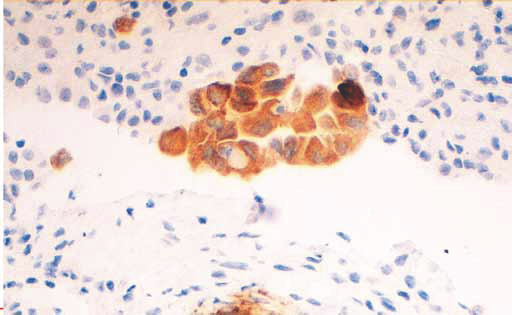
Immunohistochemical staining of reactive oxygen species 1.
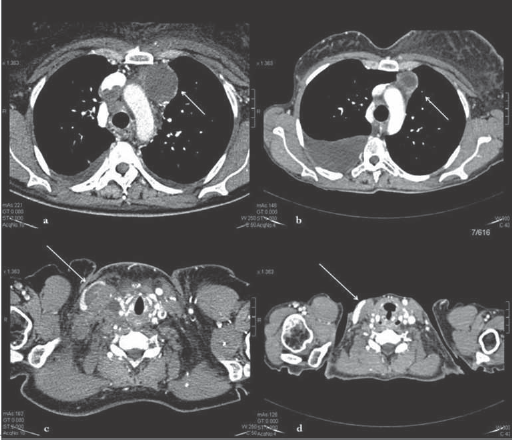
Computed tomography scan performed in March 2013, before the beginning of treatment, and in December 2013, after 9 months of treatment,
Discussion
Reactive oxygen species 1–positive lung adenocarcinoma represents a genomic subset of NSCLC, showing the features of an oncogene-addicted disease. Several aspects of ROS1-positive patients are in common with ALK-positive ones, including the efficacy of ALK TKIs in both these diseases. Crizotinib, a c-MET/ALK/ROS1 TKI, is not yet approved for ROS1-rearranged NSCLC and several clinical trials are ongoing testing the activity of this drug and other TKIs, for the first and subsequent lines setting. In a European retrospective study among 28 patients with ROS1-positive NSCLC treated with crizotinib, an ORR of 77% and a DCR of 88% were observed, along with an association between crizotinib primary resistance and concomitant KRAS mutation or progression in the brain (13).
Formal screening recommendations for ROS1 fusions have not been established and there is an urgent need for standardized ROS1 testing.
As noted in a recent investigation, ROS1 testing is part of the current clinical practice of a substantial subset of US oncologists and pathologists, whereas it is less common in Europe and virtually nonexistent in Japan (14). Nevertheless, clinicians should be aware of the importance to screen patients for ROS1 rearrangements due to the clinical and therapeutic implications of this driver genomic alteration.
Footnotes
Acknowledgement
The authors thank Professor Antonio Marchetti, Chair of Pathology, University of Chieti, Italy, for analyzing the presence of ROS1 with immunohistochemistry in his laboratory and Simonetta Viviani, MD, for her contributions to the production of this article.
Financial support: None.
Conflict of interest: None.