






Abstract
Aims and background
Few data describe the activity of panitumumab after cetuximab-irinotecan-based regimen failure in patients with KRAS wild-type metastatic colorectal cancer (WT MCRC).
Methods
The aim of this study is to assess if panitumumab has some activity in this setting.
Results
We retrospectively analyzed 25 patients with KRAS WT MCRC who received panitumumab from July 2009 to January 2013 after progression on cetuximab. All patients had previously received cetuximab and irinotecan (20 patients) or oxaliplatin (5 patients). We withdrew cetuximab for intolerance in 4 patients (16%). Twenty-one patients (84%) who had previously responded to cetuximab (overall response rate [ORR] plus stable disease ≥5 months) received panitumumab off-label after progression on cetuximab because they were strongly motivated to continue treatment without chemotherapy. The median number of cycles of panitumumab was 7 (range 1-54). Only 20 patients were evaluable for ORR (5 patients received 1-2 cycles and then died). We observed 1 (5%) partial response, 5 (25%) stable disease, median duration 9 months. Median progression-free survival (PFS) and overall survival (OS) were 5 (3-28) and 8 (5-41) months, respectively. All patients were evaluable for toxicity. No patients developed anemia or neutropenia. One patient (4%) developed grade 2 thrombocytopenia, 8 patients (32%) grade 2-3 dry skin or rash, and 2 patients (8%) grade 2 nausea-vomiting (Common Terminology Criteria for Adverse Events version 4.03).
Conclusions
Our data, with all the limits of a retrospective analysis, show longer PFS and OS as compared to other series in the same setting, demonstrating that panitumumab has treatment effectiveness in patients with KRAS WT MCRC who progressed on prior cetuximab. Further confirmatory prospective studies with a larger series of patients are necessary.
Introduction
For nearly 40 years, fluoropyrimidine 5-fluorouracil was the only drug available for the treatment of metastatic colorectal cancer (MCRC). Over the past 5-10 years, the therapeutic armamentarium for MCRC has significantly expanded with the development and approval of 3 cytotoxic agents—irinotecan, oxaliplatin, and oral fluoropyrimidine capecitabine (1)—and of 4 biological agents—anti-vascular endothelial growth factor antibodies bevacizumab and aflibercept and the anti-epidermal growth factor receptor (EGFR) antibodies cetuximab and panitumumab. The introduction of these biological agents has been a major advance in the treatment of MCRC. The incorporation of the targeted therapies into various cytotoxic chemotherapy regimens has clearly improved the median overall survival (OS) of MCRC, which is presently in the range of 24-48 months (2, 3).
The 2 monoclonal antibodies cetuximab and panitumumab bind with high affinity to the EGFR and competitively inhibit the natural growth factor ligands binding to the EGFR, thereby promoting receptor internalization (4). This inhibitory effect leads to repression of downstream signaling pathways, which mediate cell growth, proliferation, survival mechanisms to chemotherapy and/or radiation therapy, invasion/ metastasis, and even angiogenesis (5, 6). At the time when this analysis was performed, cetuximab (an immunoglobulin G [IgG]1 chimeric antibody) had been shown to have activity alone and in combination with chemotherapy in the first-, second-, and third-line setting for patients with MCRC whose tumor expressed wild-type (WT) KRAS (7-9). Panitumumab, a fully humanized IgG2 antibody, at the same time, had been shown to have activity as a single agent in chemorefractory MCRC. The drug was indicated for the treatment of patients with KRAS WT MCRC that has progressed on or following fluoropyrimidines, oxaliplatin, and irinotecan-containing chemotherapy regimens (6). Subsequently, 2 phase III clinical trials had shown that panitumumab improved outcomes when added to FOLFOX in first line (10) or FOLFIRI in second line among patients with KRAS WT MCRC (11).
In Italy, at the time when this analysis was performed, panitumumab was reimbursed by the National Health System only if used as monotherapy in patients with KRAS WT MCRC after failure of chemotherapy regimens not containing cetuximab or if containing cetuximab, interrupted, without evidence of progressive disease, for infusional reaction.
Although the 2 monoclonal antibodies cetuximab and panitumumab have never been compared directly in a randomized clinical trial, they produce similar response rates when used alone as well as in combination with cytotoxic agents (12). At the time when this analysis was performed, no data beyond individual case reports existed describing the experience of patients receiving both antibodies in a sequential way (13-15). The safety and clinical efficacy of panitumumab following progression on cetuximab has not been well-documented previously. There are few data that describe the activity of panitumumab monotherapy after cetuximab-irinotecan-based regimen failure.
Methods
We performed a retrospective analysis at our institute of the use of panitumumab after progression on cetuximab in 25 patients with KRAS WT MCRC. The aim of this study was to assess if panitumumab has some degree of clinical activity in patients with KRAS WT MCRC that has progressed on prior cetuximab. The primary endpoint of our analysis was progression-free survival (PFS), which was measured from the first day of panitumumab treatment until the first objective or clinical sign of progressive disease or death. Secondary endpoints included overall response rate (ORR) and OS. The ORR was evaluated according to the Response Evaluation Criteria in Solid Tumors criteria (16). Overall survival was defined as the period from the start of panitumumab until the date of death or last follow-up. SPSS version 12 survival analysis software was used.
The KRAS mutational status was evaluated by using polymerase chain reaction and direct sequencing in all 25 patients: KRAS exon 2 (at codons 12 and 13) in 12 patients (48%) and KRAS exon 2 (at codons 12 and 13) and exon 3 (at codon 61) in 13 patients (52%).
Results
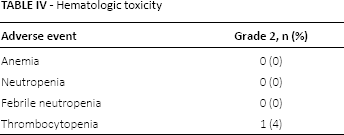
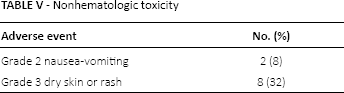
We retrospectively analyzed 25 patients (17 men and 8 women) with KRAS WT MCRC who received panitumumab from July 2009 to January 2013 after progression on cetuximab. Median age was 63 years (range 40-78). The primary site tumor was colon in 16 patients (64%) and rectum in 9 patients (36%). Metastases were synchronous in 9 patients (36%) and metachronous in 16 patients (64%). The sites of metastases were only liver in 11 patients (44%), liver and lung in 2 patients (8%), and other sites in 12 patients (48%). The patient characteristics are reported in Table I. All patients had previously received cetuximab associated with irinotecan (20 patients) or oxaliplatin (5 patients) and subsequently received panitumumab monotherapy. Three patients (12%) had received at least 1 prior line of chemotherapy, 10 patients (40%) 2 lines, 7 patients (28%) 3 lines, 3 patients (12%) 4 lines, and 2 patients (8%) 5 prior lines of chemotherapy. We decided to withdraw cetuximab because of intolerance in 4 patients (16%) (1 infusional reaction), while 21 patients (84%) with Eastern Cooperative Oncology Group Performance Status 0-1 who had previously responded to cetuximab (ORR plus stable disease lasting more than 5 months) received panitumumab off-label after progression on cetuximab because they were strongly motivated to continue treatment without chemotherapy. Median cycles of panitumumab were 7 (range 1-54). The median number of previous chemotherapy lines was 2 (range 1-5). Six patients received 1 subsequent line of chemotherapy after panitumumab: metronomic capecitabine 1 patient, mitomycin C 1 patient, raltitrexed 2 patients, oxaliplatin plus raltitrexed 1 patient, capecitabine plus bevacizumab 1 patient. Only 20 patients were evaluable for ORR (5 patients received 1-2 cycles and then died). Among the 20 evaluable patients, we observed 1 partial response (5%) and 5 stable disease (25%) with a median duration of 9 months (Tab. II). Median PFS was 5 months (range 3-28) (Fig. 1) and median OS 8 months (range 5-41) (Fig. 2) (Tab. III). All patients were evaluable for toxicity. Hematologic toxicity was mild: no patient developed anemia or neutropenia. One patient (4%) developed grade 2 Common Terminology Criteria for Adverse Events (CTCAE) version 4.03 thrombocytopenia (Tab. IV). Nonhematologic toxicity was moderate: 8 patients (32%) developed grade 2-3 CTCAE version 4.03 dry skin or rash, 2 patients (8%) grade 2 CTCAE version 4.03 nausea-vomiting. No patients developed hypersensitivity reactions (HSR) (Tab. V).
Patient characteristics (total enrolled = 25)
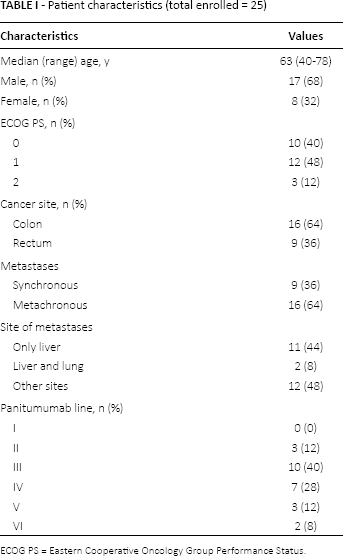
ECOG PS = Eastern Cooperative Oncology Group Performance Status.
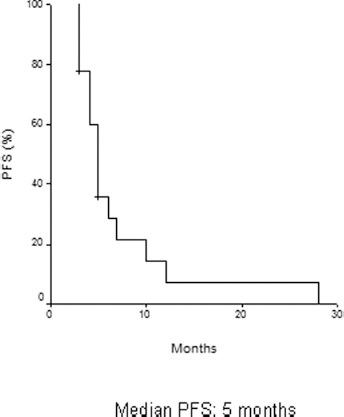
Progression-free survival (PFS) (median 5 months).
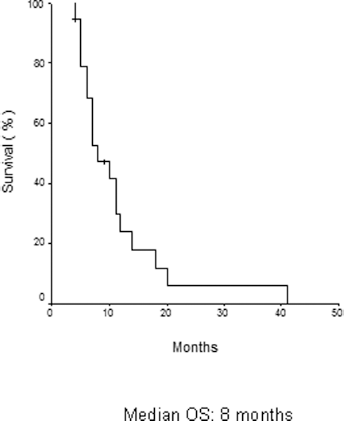
Overall survival (median 8 months).
Objective response
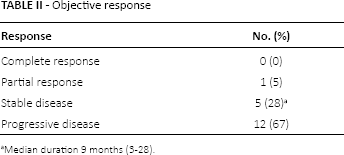
Median duration 9 months (3-28).
Efficacy
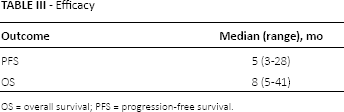
OS = overall survival; PFS = progression-free survival.
Hematologic toxicity
Nonhematologic toxicity
Discussion
Panitumumab has minimal benefit in patients with KRAS WT MCRC who have developed disease progression on prior cetuximab. Our data, with all the limits of a retrospective analysis, show a longer median PFS (5 months) and median OS (8 months) as compared to other series in the same setting published at the time when this analysis was performed. The response rate may be explained by the limitations of a retrospective analysis and the absence of a standardized schedule of examination re-evaluation. Metges and colleagues (17) (PANERB study) prospectively analyzed 32 patients with KRAS WT MCRC who received panitumumab after progression on cetuximab and reported an ORR of 22% and a disease control rate (ORR plus stable disease) of 73% in 11 patients who had previously responded to cetuximab and irinotecan. The PFS was 3.6 months; OS was not reported. Wadlow and colleagues (12) treated 20 patients in the same setting and reported stable disease in 45% of patients, without any objective response. Median PFS was 1.7 months and median OS 5.2 months. If we also consider the pivotal open-label phase III trial of panitumumab plus best supportive care (BSC) compared with best supportive care alone in patients with chemotherapy-refractory metastatic colorectal cancer (naive to anti-EGFR therapy), panitumumab monotherapy significantly improved ORR versus BSC: 10% versus 0%, with a median PFS of 8 weeks versus 7.3 weeks for BSC and no difference in OS (6).
More recently, Pietrantonio and colleagues (18) reported the outcome of single-agent panitumumab in patients with KRAS WT MCRC without progression on prior cetuximab-based regimens and the potential role of biomarkers for patient selection in an Italian multicenter, cooperative, observational prospective study. They obtained an ORR of 30% and a disease control rate (the sum of patients with both partial response/complete response and stable disease) of 67% in 30 patients, with median PFS of 4.2 months and median OS of 9.6 months.
It is not clear why patients who had progressed on cetuximab can get clinical benefit from panitumumab. Although these 2 antibodies target the same receptor (EGFR), they may bind to different epitopes on it and may inhibit EGFR signaling through distinct mechanisms.
Our relatively small experience and retrospective analysis strengthens the suggestion that cetuximab and panitumumab may exert their antitumor activity through different mechanisms.
Although the use of panitumumab after progression on cetuximab in patients with KRAS WT MCRC should not be adopted in clinical practice, further confirmatory prospective studies with larger series of patients (in the all-RAS WT MCRC population) are necessary and further work in this direction required to investigate this interesting issue.
Advantages associated with panitumumab therapy include markedly reduced potential for HSR, the use of an every-other-week schedule, and no need for a loading dose.
Single-agent panitumumab could represent an alternative treatment strategy with satisfactory outcomes in patients with refractory KRAS WT MCRC who have experienced failure of standard therapy including cetuximab-based regimens after a period of response (response rate plus stable disease ≥5 months) to cetuximab itself.
It would be necessary, in light of new and updated data on the all-RAS WT MCRC population (19), to re-evaluate our findings in the same setting, also considering the mutational analysis of NRAS, BRAF, and PI3KCA (20).
Footnotes
Financial support: None.
Conflict of interest: None.