






Abstract
Purpose
The aim of this outcome study was to evaluate the management of advanced pancreatic cancer in a real-world clinical practice; few such experiences have been reported in the literature.
Methods
A retrospective analysis was performed of all consecutive patients with advanced pancreatic ductal adenocarcinoma followed at our medical oncology unit between January 2003 and December 2013.
Results
We evaluated 78 patients, mostly with metastatic disease (64.1%). Median follow-up was 10.77 months, by which time 74 patients (94.9%) had died. Median overall survival was 8.29 months. Median age was 67 years. In univariate analysis, pain at onset (p = 0.020), ECOG performance status (p<0.001), stage (p = 0.047), first-line chemotherapy (p<0.001), second-line chemotherapy (p<0.001) and weight loss at diagnosis (p = 0.029) were factors that had an impact on overall survival. In multivariate analysis, the presence of pain at onset (p = 0.043), stage (p = 0.003) and second-line chemotherapy (p = 0.004) were confirmed as independent prognostic factors.
Conclusions
Our data, derived from daily clinical practice, confirmed advanced pancreatic cancer as an aggressive malignant disease with a very short expected survival. Second-line treatment seems to provide an advantage in terms of overall survival in patients who showed a partial response as their best response to first-line treatment.
Introduction
Pancreatic cancer accounts for 3% of all cancers and is the fifth leading cause of cancer-related death in Western countries (1). Its incidence closely mirrors its mortality rate, with only 1% to 4% of patients being alive 5 years after diagnosis (2). The incidence increases with age and the median age at diagnosis is 65 years (3, 4). The prevalent histology is ductal pancreatic adenocarcinoma (>80% of pancreatic neoplasms), followed by neuroendocrine tumors and other very rare histologies. About 75% of all ductal pancreatic carcinomas, which are much more aggressive than neuroendocrine tumors, occur in the head or neck of the pancreas, 15%-20% in the body, and 5%-10% in the tail (5). Surgery with curative intent is the principal treatment for pancreatic cancer mainly for patients with early-stage disease (stage I and some stage II), but unfortunately only 20% of patients are candidates for radical surgery (5, 6). In the adjuvant setting, administration of gemcitabine or 5-fluorouracil (5-FU) for 6 months is recommended (5, 7–8–9). Gemcitabine or 5-FU alone (Mayo Clinic bolus 5-FU schedule) improves the 5-year survival rate from 9% to 20% in R0/R1 resected patients, without any differences in disease-free survival or overall survival (OS), but gemcitabine is associated with fewer toxic side effects than bolus 5-FU (8). The role of adjuvant chemoradiation is still controversial (7). Neoadjuvant chemotherapy or chemoradiotherapy could be useful in patients with larger tumors and/or tumors with vessel encasement that are borderline resectable or technically unresectable, in order to achieve downsizing of the tumor so that it may become resectable (5). In the remaining cases (patients with resectable pancreatic cancer, patients with unresectable tumors), neoadjuvant chemotherapy or chemoradiotherapy should only be performed within clinical trials (5, 10, 11). In metastatic disease, gemcitabine alone or in association with other drugs was considered the gold standard, with a median survival of 6.2 months and a response rate of less than 20% (12). Meta-analysis of randomized trials with a combination of gemcitabine and platinum analogues or gemcitabine and capecitabine suggested a survival benefit for these combinations in patients with a good performance status (PS) (5, 12–13–14). The combination of 5-FU, irinotecan and oxaliplatin (FOLFIRINOX) yielded a response rate of 31.6%, a median survival of 11.1 months, and a 1-year survival rate of 48.4% in the FOLFIRINOX arm in a phase III trial (15). The ESMO-ESDO clinical practice guidelines recommend FOLFIRINOX as a novel therapeutic option for patients ≤75 years of age with a good PS (0 or 1) and a bilirubin level ≤1.5 the upper limit of normal (5).
The aim of this outcome study was to evaluate the management of advanced exocrine pancreatic cancer in a real-world clinical practice and match it with the international guidelines and randomized phase III trials. In fact, to our knowledge few experiences concerning the management of advanced exocrine pancreatic cancer in daily clinical practice have been reported in the literature.
Materials and Methods
Patient selection
A retrospective analysis of all consecutive patients with advanced pancreatic ductal adenocarcinoma followed at the Medical Oncology Unit of Mater Salutis Hospital, Legnago (Italy) between January 2003 and December 2013 was performed. All information was obtained from the patients’ clinical records and review of their medical history. The collected clinical data included the pathologically confirmed diagnosis of exocrine pancreatic cancer; blood tests for kidney, liver and bone marrow function (serum creatinine, total leukocyte and neutrophil count, platelet count, hemoglobin, total bilirubin, transaminase); Eastern Cooperative Oncology Group (ECOG) performance status (PS); number of comorbidities; disease stage (based on physical examination and CT scan of thorax and abdomen); and patient status at last follow-up visit (alive/dead).
Treatment schedule
The GEMOX regimen consisted of a fixed dose rate of gemcitabine, 1,000 mg/m2 (10 mg/m2 per minute) on day 1, followed by a 2-hour infusion of 100 mg/m2 oxaliplatin on day 2; treatment was repeated every 2 weeks. The gemcitabine-alone regimen consisted of the administration of 1,000 mg/m2 once a week (30-minute i.v. infusion) for 3 weeks out of 4. The XELIRI regimen consisted of irinotecan 240 mg/m2 on day 1 and capecitabine 2,000 mg/m2/daily on day 1 to 14 repeated every 3 weeks. The administration of irinotecan alone consisted of a dose rate of 80 mg/m2 on day 1 once a week for 6 weeks out of 8 in consecutive cycles. Abraxane was administered at a dose rate of 125 mg/m2 on days 1, 8 and 15 every 28 days. Erlotinib was administered orally at a dose of 150 mg daily.
Treatment toxicity and antitumor activity were evaluated according to the National Cancer Institute Common Terminology Criteria for Adverse Events (NCI-CTCAE) version 3.0 and Response Evaluation Criteria In Solid Tumors (RECIST), respectively.
Outcome definition
Follow-up time was defined as the total time patients were followed at our institution. OS was estimated starting from the first day of the first cycle of chemotherapy to the last visit or the date of the patient's death, censoring surviving patients at the time of last follow-up. Univariate analysis for OS, taking into account all prognostic factors, was done according to the Kaplan-Meier method, with statistical significance (p<0.05) of differences being estimated by the log-rank test. Multivariate analysis was done with the Cox regression model, including the covariates into the model. We chose to consider only OS and not progression-free survival (PFS) because, in the absence of a prospective design to determine whether disease progression occurred at defined intervals, this measurement is fraught with potential bias, as patients may be followed with differing frequencies depending on whether or not they are in a clinical trial, or which therapy they are receiving. The chi-square test, t-test, or Fisher's exact test was used to exclude any possible relationship between the results and the different prognostic variables.
Results
We evaluated 78 patients, mostly with metastatic disease (64.1%); 47 patients (60.3%) were men and 31 (39.7%) were women. The median follow-up was 10.77 months (range 1.00-109.87 months). At the last follow-up 74 patients (94.9%) had died, 3 patients (3.8%) were alive with metastases, and 1 patient (1.3%) was alive with no evidence of disease. Median OS was 8.29 months (range 1.00-110.46 months) (Fig. 1).
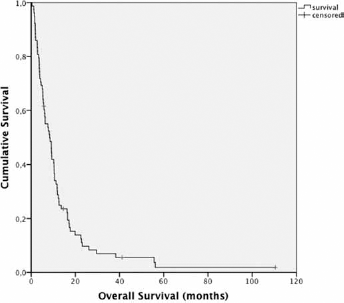
Overall survival of the general case study.
Clinical presentation
The patients’ median age was 67 years (range 41-83 years); 25 (32.1%) were young patients (aged <65 years) and 47 (60.3%) were elderly (≥65 years). The diagnosis was based on histological examination in most cases (67.9%). Twenty-seven patients (34.6%) were treated with biliary drainage because of malignant biliary tract obstruction at the onset: in 12 patients (42.9%) an internal biliary drain was placed, in 5 patients (17.9%) an external biliary drain was placed, and in 11 patients (39.3%) a surgical bypass was performed. In 20 patients (25.6%) pancreatic cancer was associated with diabetes mellitus: type 1 in 13 patients (65.0%) and type 2 in 7 patients (35.0%). A majority of patients (71.8%) had 1 or more comorbidities at the time of diagnosis. Pain was the predominant symptom at the onset (50.0% of patients). Median loss of body weight at diagnosis was 10 kg (range 0-50 kg). The median hemoglobin value at diagnosis was 12.9 g/dL; the presence of anemia at diagnosis did not seem to statistically influence OS (p = 0.715). Seven patients (9.9%) developed thrombosis, especially pulmonary embolism (71.4%), which was treated with low-molecular-weight heparin in all cases.
Treatment
Twenty patients (25.6%) underwent surgery for the primary tumor and adjuvant chemotherapy was delivered to 16.7% of patients (gemcitabine in all cases); neoadjuvant chemotherapy was administered in 3.8% of cases.
Most patients (82.1%) received first-line chemotherapy, mostly (56.3%) with gemcitabine and oxaliplatin (GEMOX); the median number of cycles was 6 (range 1-12), with a median duration of chemotherapy of 3.33 months. 31.7% of patients showed disease stabilization (SD) as their best response to treatment, 15.9% had a partial response (PR), 1.6% a complete response (CR), and 50.8% had progression of disease (PD) as their best response. The median value of carbohydrate antigen 19.9 (CA19.9) at the beginning and at the end of chemotherapy was 831.10 U/mL (range 2-689,900) and 578.95 U/mL (range 0-82,127), respectively. A decrease in CA19.9 after first-line chemotherapy (76.9% of patients) did not seem to statistically impact on OS (p = 0.949). Grade 3 neutropenia (15.4%) and grade 3 peripheral neurological toxicity (15.4%) were the most common side effects; no other grade 3 and 4 toxicities were observed except for grade 3 anemia in 1 patient (7.7%). Five patients (25.0%) needed blood transfusions during chemotherapy.
Only 13 patients (16.6% of total, corresponding to 20.3% of patients receiving first-line chemotherapy) proceeded to second-line chemotherapy. This consisted of gemcitabine in 4 patients (30.8%), XELIRI in 3 patients (23.1%), GEMOX in 2 patients (15.4%), irinotecan in 2 patients (15.4%), capecitabine in 1 patient (7.7%), and erlotinib in 1 patient (7.7%); 15.4% of patients showed SD as their best response to treatment, 23.1% had PR, and 61.5% showed PD as their best response. Grade 3 fatigue (2 cases) was the most common side effect.
Three patients (3.8% of total, corresponding to 23.1% of patients receiving second-line chemotherapy) proceeded to third-line chemotherapy: gemcitabine in 1 patient (33.3%), gemcitabine and abraxane in 1 patient (33.3%), and XELIRI in 1 patient (33.3%). Grade 2 and 3 thrombocytopenia were observed each in 1 patient (50.0%).
Radiotherapy was delivered to 4 patients (5.1%), with only palliative and symptom-relieving intent. Palliative surgery (gastroenteric anastomosis) was performed in 12 patients (15.4%).
Outcome
In univariate analysis, the presence of pain at onset (p = 0.020; Fig. 2), ECOG PS (p<0.001; Fig. 3), stage (p = 0.047; Fig. 4), first-line chemotherapy (p<0.001; Fig. 5), second-line chemotherapy (p<0.001; Fig. 6) and weight loss ≤10 kg at diagnosis (p = 0.029; Fig. 7) had a statistically significant impact on OS. The chi-square test confirmed a statistical relationship between first-line chemotherapy and ECOG PS (p<0.001); there was no statistical relationship between the other prognostic factors. The general case study is summarized in Table I. In multivariate analysis, the presence of pain at onset (p = 0.043), stage (p = 0.003) and second-line chemotherapy (p = 0.004) were confirmed as independent prognostic factors. In particular, for second-line chemotherapy the difference was confirmed with statistical significance (p = 0.010) in patients showing PR as their best response to first-line treatment (OS = 23.09 months) versus patients showing SD (OS = 10.56 months) or PR (OS = 5.66 months) as their best response to first-line treatment.
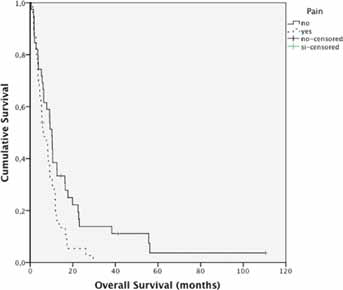
Univariate analysis for overall survival considering the presence of pain at onset.
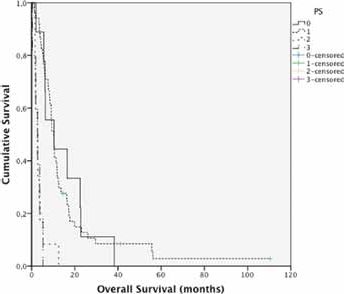
Univariate analysis for overall survival considering ECOG performance status.
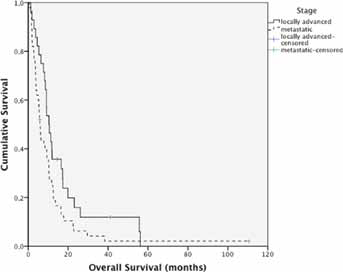
Univariate analysis for overall survival considering stage at diagnosis (locally advanced vs. metastatic).
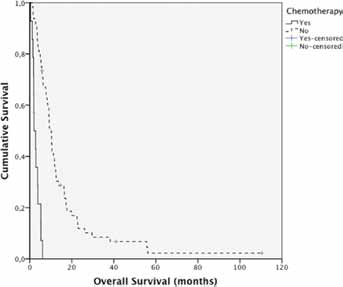
Univariate analysis for overall survival considering first-line chemotherapy.
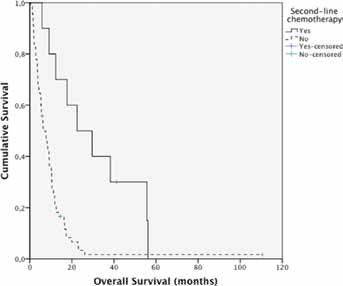
Univariate analysis for overall survival considering second-line chemotherapy.
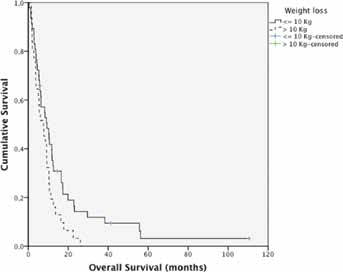
Univariate analysis for overall survival considering weight loss at diagnosis.
The general case study
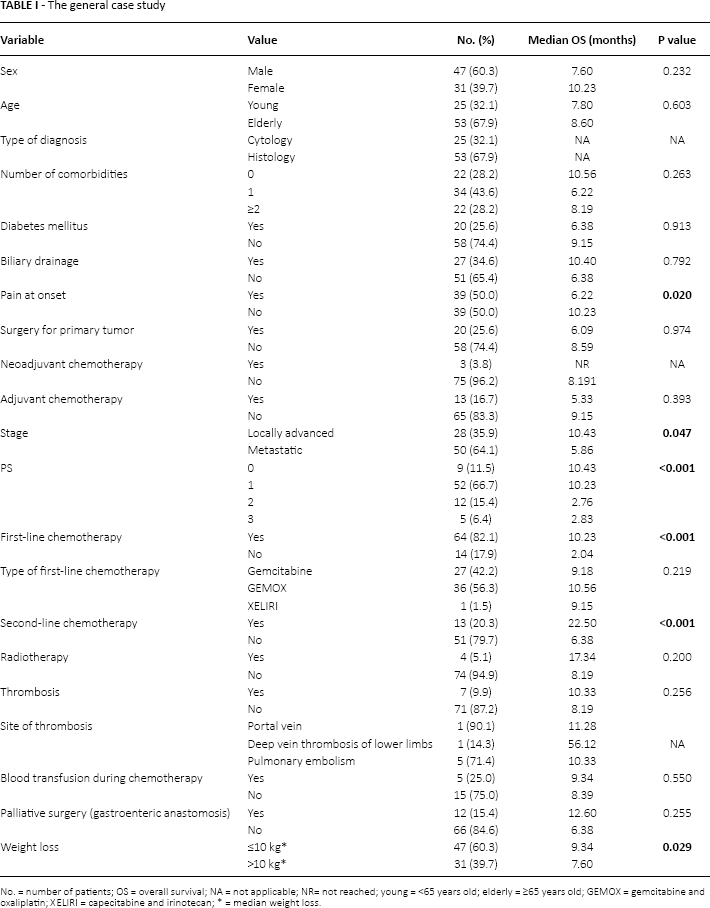
No. = number of patients; OS = overall survival; NA = not applicable; NR= not reached; young = <65 years old; elderly = ≥65 years old; GEMOX = gemcitabine and oxaliplatin; XELIRI = capecitabine and irinotecan; * = median weight loss.
Discussion
Pancreatic cancer is an aggressive malignant disease, and the expected survival is very short especially in advanced disease (13). Our data confirmed the dismal prognosis of advanced pancreatic cancer, with a median OS of 8.29 months. It is self-evident that a better ECOG PS at diagnosis and during treatment is related to an improvement in OS, as was also statistically confirmed in our study by the chi-square test. The issue is different when analyzing the different schemes of first-line therapy in advanced pancreatic cancer. In fact, the data in the literature regarding the first line of treatment are contrasting. Sultana et al (12), in a meta-analysis of 51 randomized controlled trials (including 9,970 patients), examined the different therapeutic approaches comparing chemotherapy versus best supportive care, fluorouracil (FU) versus FU combination chemotherapy, gemcitabine versus FU, and gemcitabine versus gemcitabine combination chemotherapy. They found that chemotherapy improved survival compared with best supportive care (HR = 0.64), that FU-based combination chemotherapy did not result in better OS compared with FU alone (HR = 0.94), and that there was insufficient evidence of a survival difference between gemcitabine and FU; survival was improved after gemcitabine combination chemotherapy compared with gemcitabine alone (HR = 0.91), supporting the use of gemcitabine-based combination chemotherapy in the treatment of advanced pancreatic cancer.
These results were confirmed by Heinemann et al (13) in their meta-analysis of 15 trials (including 4,465 patients) with a significant survival benefit for gemcitabine plus X with a pooled HR of 0.91 (p = 0.004). The analysis of platinum-based combinations indicated an HR of 0.85 (p = 0.010), while for fluoropyrimidine-based combinations the HR was 0.90 (p = 0.030); no risk reduction was observed in the group of trials combining gemcitabine with irinotecan, exatecan or pemetrexed (HR = 0.99). In 5 trials (1,682 patients) a meta-analysis including information on baseline PS was conducted: patients with a good PS had a marked survival benefit when receiving combination chemotherapy (HR = 0.76; p<0.0001), and combination chemotherapy for patients with an initially poor PS appeared to be ineffective (HR = 1.08; p = 0.40).
In contrast, in a randomized phase III trial, Colucci et al (16) compared gemcitabine alone (arm A = 199 patients) versus gemcitabine plus cisplatin (arm B = 201 patients), obtaining a median OS of 8.3 months versus 7.2 months in arms A and B, respectively (HR = 1.10; p = 0.38) and a median PFS of 3.9 months versus 3.8 months (HR = 0.97; p = 0.80). They concluded that the addition of weekly cisplatin to gemcitabine did not improve the outcome of first-line treatment in advanced pancreatic cancer; furthermore, combination therapy was associated with more hematological toxicity, while there was no relevant difference in nonhematological toxicity.
More recently, new combination therapies such as FOLFIRINOX and nab-paclitaxel plus gemcitabine have been investigated. Conroy et al (15), in a randomized phase II-III trial, compared FOLFIRINOX (171 patients) with gemcitabine (171 patients) in first-line therapy for metastatic pacreatic cancer in patients with ECOG PS 0-1. The median OS was 11.1 months in the FOLFIRINOX group versus 6.8 months in the gemcitabine group (HR = 0.57; p<0.001), the median PFS was 6.4 months in the FOLFIRINOX group versus 3.3 months in the gemcitabine group (HR = 0.47; p<0.001), and the objective response rate (ORR) was 31.6% in the FOLFIRINOX group versus 9.4% in the gemcitabine group (p<0.001); however, FOLFIRINOX was associated with an increase in toxicity (p<0.001).
Von Hoff et al (17) have compared nab-paclitaxel plus gemcitabine (431 patients) versus gemcitabine (430 patients) in a randomized phase III trial of first-line therapy for metastatic pancreatic cancer in patients with a Karnofsky PS score ≥70. The median OS was 8.5 months with nab-paclitaxel plus gemcitabine versus 6.7 months with gemcitabine (HR = 0.72; p<0.001), the median PFS was 5.5 months in the nab-paclitaxel plus gemcitabine group versus 3.7 months in the gemcitabine group (HR = 0.69; p<0.001), and the ORR was 23% in the nab-paclitaxel plus gemcitabine group versus 7% in the gemcitabine group (p<0.001). The combination of nab-paclitaxel plus gemcitabine was associated with an increased rate of peripheral neuropathy (17% vs. 1% in the gemcitabine group) and myelosuppression (38% vs. 27%).
Similar results were obtained by Goldstein et al (18) in a randomized phase III trial (861 patients) comparing nab-paclitaxel plus gemcitabine versus gemcitabine in metastatic pancreatic cancer patients with a Karnofsky PS score ≥70. The median OS was 8.7 months in the nab-paclitaxel plus gemcitabine group versus 6.6 months in the gemcitabine group (HR = 0.72; p<0.001), with long-term (>3 years) survivors in the nab-paclitaxel plus gemcitabine arm only (4%). In particular, nab-paclitaxel plus gemcitabine was favored in poor-prognosis cancer patients over gemcitabine alone (HR = 0.612, p<0.001 for CA19.9 level equal to or above the median and HR = 0.81, p = 0.079 for a neutrophil-to-lymphocyte ratio >5).
In our experience, there were no differences between GEMOX and gemcitabine alone in first-line chemotherapy (p = 0.219), confirming the results obtained by other authors (16) and the European Clinical Practice Guidelines (5). In the current dataset, we presented a median OS of 10.56 months for GEMOX and 9.18 months for gemcitabine alone, greater than those reported by other studies, which instead reported a median OS of 8.3 months for gemcitabine alone versus 7.2 months for the combination of gemcitabine plus platinum compounds (16).
Concerning second-line chemotherapy, there is no firmly established standard chemotherapy for patients after progression on first-line treatment (5). Rahma et al (19) carried out a systematic analysis of second-line studies (34 clinical trials including 1,503 patients, from 2000 to 2012) in advanced pancreatic cancer that progressed on or following gemcitabine. Patients who received treatment (1,269 patients) had a median OS of 6 months compared with 2.8 months for patients (234 patients) who received best supportive care only (p = 0.013). The data obtained by our study in multivariate analysis are of remarkable importance and show statistical significance (p = 0.004) for second-line chemotherapy, confirming the results presented by Rahma et al (19). In particular, the difference was confirmed with statistical significance for patients obtaining PR as their best response to first-line treatment (p = 0.010). To our knowledge, this is the first data in the literature showing that second-line treatment can impact on survival in advanced pancreatic cancer based on the best response to first-line treatment.
The presence of pain at the onset was an independent prognostic factor (p = 0.043) in our study. In a previous study (20), a single-center retrospective study involving 209 patients with pancreatic cancer, patients who initially had back pain had a significantly poorer survival rate. Other authors (21) found that pain reduction after treatment (≤30% of baseline level vs. >30%; OS = 7.6 vs. 11.5 months) was an independent predictor of survival in advanced pancreatic cancer treated with intraarterial chemotherapy.
Weight loss >10 kg at diagnosis was found to have a statistically significant negative impact on OS (p = 0.029) in our study, confirming the negative prognostic role of cachexia in pancreatic cancer, even if the impact of cachexia and sarcopenia on survival in pancreatic ductal adenocarcinoma has been insufficiently studied, with very few publications in the literature (22).
It is self-evident that stage at diagnosis (locally advanced vs. metastatic) was related to different median OS (p = 0.003).
We are aware of the limitations of a retrospective study, the small size of the cohort, and the fact that data from a single center might reflect only the habits of a particular set of physicians. However, the present study, through the analysis of unselected cases, was able to evaluate the oncological approach to advanced pancreatic cancer in a real-world clinical practice. In fact, the patients described here represent the complete consecutive series of patients who underwent systemic treatment with chemotherapy at our unit in the considered time frame, and were treated in a homogeneous way and carefully staged before the beginning of treatment and at regular intervals thereafter. Furthermore, follow-up was complete in all patients. Moreover, the patients were treated over an 11-year period (2003-2013) during which the use of the new combination therapies such as FOLFIRINOX (15) and nab-paclitaxel plus gemcitabine (17, 18) were not routinely used. Conversely, only few patients are candidates for either FOLFIRINOX or nab-paclitaxel plus gemcitabine due to restrictive eligibility requirements, such as ECOG PS, age, bilirubin level and cardiac function. This was confirmed recently by Peixoto et al (23), who retrospectively analyzed the clinicopathological variables and outcome of patients with metastatic pancreatic cancer treated at their center, applying eligibility criteria for FOLFIRINOX and nab-paclitaxel plus gemcitabine in accordance with the pivotal phase III trials, PRODIGE and MPACT, respectively. A total of 473 patients were included: 25% were eligible for FOLFIRINOX and 45% for nab-paclitaxel plus gemcitabine. Univariate analysis showed that patients eligible for FOLFIRINOX and nab-paclitaxel plus gemcitabine had longer median OS than the ineligible group (p<0.001, with a median OS of 8.6 versus 4.7 months for FOLFIRINOX; p = 0.008, with a median OS of 6.7 versus 4.9 months for nab-paclitaxel plus gemcitabine). However, after accounting for ECOG PS in the multivariate model, eligibility for either FOLFIRINOX or nab-paclitaxel plus gemcitabine was no longer predictive of better OS.
In conclusion, our data from daily clinical practice confirmed that advanced pancreatic cancer is an aggressive malignant disease with a very short expected survival. The addition of second-line treatment seems to provide an advantage in terms of OS in patients who achieved PR as their best response to first-line treatment. It is hoped that the use of novel therapies can further improve the survival data with acceptable toxicity. In addition, the identification of whole-genome sequencing may be directed more and more towards individually tailored therapy (24).
Footnotes
Financial support: No funding was received to support this article.
Conflict of interest: The authors have no relevant affiliations or financial involvement with any organization or entity with a financial interest in or financial conflict with the subject matter or materials discussed in the manuscript. This includes employment, consultancies, honoraria, stock ownership or options, expert testimony, grants or patents received or pending, or royalties.