






Abstract
Purpose
The purpose of this study was to investigate the clinical outcomes and prognostic factors of concurrent chemoradiotherapy (CCRT) for locally recurrent biliary tract cancer (BTC) after curative surgical resection.
Methods
We performed a retrospective cohort study of patients with locally recurrent BTC treated with CCRT between October 2004 and December 2013. The study included and analyzed 42 patients with a history of curative-intent surgical resection of confirmed adenocarcinoma originating from the biliary tract.
Results
The median time to recurrence after surgery was 16.1 months (range, 4.5-77.8 months). Median follow-up after CCRT was 26.9 months (range, 5.2-81.9) with no grade 3 or higher gastrointestinal toxicities. Analysis of the first site of failure showed local progression (LP) developed in 20 patients (47.6%); among these, 16 (38.1%) had isolated LP. The median values were 15.8 months (range, 1.7-81.7) for LP-free survival (LPFS), 10.6 months (range, 1.7 - 81.7) for progression-free survival (PFS) and 41.2 months (range, 5.2-81.9) for overall survival (OS). Multivariate analysis showed that the level of pre-CCRT carbohydrate antigen (CA) 19-9 and the chemotherapy regimen were significant prognostic factors for LPFS and PFS; pT stage was the only significant prognostic factor for OS.
Conclusions
CCRT for locally recurrent BTC showed promising outcomes as a salvage modality, but LP was still frequent. The pre-CCRT CA 19-9 level and the chemotherapy regimen were prognostic factors for LPFS and PFS.
Introduction
Biliary tract cancer (BTC) including the gallbladder and bile duct is a relatively uncommon malignancy, accounting for less than 1% of all cancers in the United States (1). Surgical resection is the only accepted curative treatment modality, but tumors are resectable in only about 30% to 50% of cases (2-4). Furthermore, local recurrence (LR) after complete resection of BTC is common (approximately 30% to 40%) (5, 6). Repeated surgical resections are not indicated for the majority of patients with LR because of the location and extent of the recurrent disease.
Although no randomized trials have confirmed the benefits of adjuvant radiotherapy (RT) for patients with unresectable BTC, the reported outcomes show promising survival rates and local control (7, 8). Chemotherapeutic agents such as 5-fluorouracil (5-FU), capecitabine and gemcitabine are frequently used concurrently with RT to enhance the RT effects in patients with unresectable BTC (9). In locally recurrent BTC, concurrent chemotherapy with RT (CCRT) could be a useful local modality that is an alternative to salvage surgery and could be used palliatively to maintain the flow of bile and alleviate pain (10, 11). The application of RT for locally recurrent BTC is advancing with the development of RT techniques that safely deliver higher RT doses for maximum local control. These techniques include 3-dimensional conformal RT, intensity-modulated RT, stereotactic body ablative RT, and proton beam RT (12-14). However, the knowledge about the outcomes of locally recurrent BTC treated with CCRT is limited. Therefore, we evaluated the clinical outcomes and prognostic factors of salvage CCRT for locally recurrent BTC.
Patients and Methods
Patients
This retrospective study was performed with approval and exemption of participant consent by the Samsung Medical Center Institutional Review Board (IRB No. 2016-04-033). Included were patients with locally recurrent BTC without distant metastases except to the paraaortic lymph nodes who received upfront salvage CCRT at Samsung Medical Center between October 2004 and December 2013. During this period, according to data from the Samsung Medical Center Radiation Oncology registry, 96 patients received salvage RT to the liver and/or abdomen. Among these patients, 54 were excluded: 21 for recurrent tumors of the stomach, duodenum or primary colorectal region; 12 for pancreatic primary tumors; 2 for carcinomas other than adenocarcinoma; 12 for RT alone; 5 for distant metastases at other sites than the paraaortic lymph nodes; and 2 for CCRT after several cycles of chemotherapy. A total of 42 BTC patients with local recurrence after curative surgical resection who were treated with CCRT as a salvage approach were included.
Definition of local recurrence
Diagnosis of LR was usually made by radiology examination including computed tomography (CT) with or without fusion positron emission tomography (PET)-CT. Changing patterns of tumor marker status (usually carbohydrate antigen 19-9 [CA 19-9]) were also used as indicators of recurrence in some patients. The main finding of LR was a soft tissue lesion with or without sudden development and gradual increase in LR risk area size including the hepatobiliary ligament, around the celiac axis and superior mesenteric vessels, and around the pancreatic head and periaortic area. Mainly after June 2008, PET-CT was generally performed to evaluate recurrent masses and other body sites. Biopsy was performed in a limited number of patients with no significant change in soft tissue lesion size in high risk areas and without definite PET-CT uptake, but with continuous elevation of CA 19-9.
Radiotherapy
For RT planning, CT images with intravenous (IV) contrast agent were obtained from all patients. Gross tumor volume (GTV) was defined as a soft tissue lesion with abnormal findings such as interval size increment and uptake on PET-CT. Clinical target volume (CTV) was defined as GTV plus 5 to 10 mm and regional lymphatics including the hepaticoduodenal ligament, the celiac and superior mesenteric vessels, and the paraaortic area between the upper margin plus 1 cm of the origin of the celiac artery to the lower part plus 1 cm of the left renal artery. GTV plus 10 mm without elective irradiation of regional lymphatics was targeted only in patients with low performance status, a large recurrent mass of more than 3 cm, or a disease-free interval exceeding 18 months. Planning target volume (PTV) was defined as CTV (or GTV) plus 10 to 15 mm for motion variation. The described PTV was treated using a 3-dimensional conformal technique to 54 Gy at 1.8- to 2.0-Gy daily fractions, including a final 9- to 10-Gy gross tumor boost with repeated planning CT.
Chemotherapy
In BTC patients with local recurrence, 5-FU or capecitabine as a radiosensitizer was used concurrently with RT. IV bolus 5-FU (500 mg/m2/day) was injected from the first to the third day of RT and repeated from the 20th to the 22nd day. In other patients, 850 mg/m2 capecitabine was administered twice daily for every day of the RT course. Further planned chemotherapy after salvage CCRT was not routinely administered. Depending on the physician, patients with good performance who tolerated CCRT received further chemotherapy with capecitabine (14 days of 1,000 mg/m2 twice daily with 1 week rest) and cisplatin (IV 75 mg/m2 the first day of capecitabine) or gemcitabine (IV 1,000 mg/m2/day on the first and eighth days) and cisplatin (IV 75 mg/m2/day with gemcitabine).
Follow-up and evaluation
During CCRT, patients were examined at least once a week and followed-up 1 month after CCRT completion. Routine follow-up continued at 3- to 6-month intervals. Treatment-related toxicities were assessed weekly during treatment and at every follow-up visit and graded according to the Common Terminology Criteria for Adverse Events (version 4.0). Treatment response was evaluated using CT images at 1 and 3 months after CCRT completion according to the revised Response Evaluation Criteria in Solid Tumors (RECIST v 1.1). Local progression (LP) was defined as tumor progression within the CTV or hypothetical CTV (in patients targeted for GTV only). Other-site progression was defined as distant metastasis (DM).
Statistical analyses
The duration of LP-free survival (LPFS), DM-free survival (DMFS), progression-free survival (PFS) and overall survival (OS) was measured from the date of the start of CCRT to the date of the detected event or last follow-up for patients followed without events. The Kaplan-Meier product-limit method was used for survival estimates. To compare survival curves estimated using the Kaplan-Meier product-limit method according to possible prognostic factors, a log-rank test was used. Multivariate analysis was performed with significant prognostic factors of PFS obtained from univariate analysis. A Cox proportional hazards model was used for analysis with the Schoenfeld residual method. All statistical analyses were performed using IBP SPSS Statistics 23.0, and a p value of less than 0.05 was considered statistically significant.
Results
Patients
LR was diagnosed by biopsy in 2 patients and interval size increment without PET-CT evaluation in 7. The remaining 33 patients were diagnosed using CT and PET-CT. Median time to LR was 16.1 months (range, 4.5 to 77.8 months).
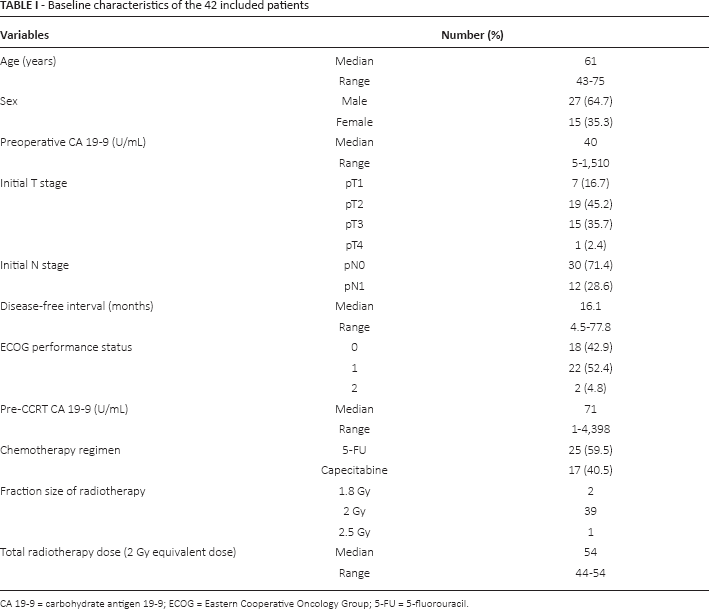
The characteristics of all patients are presented in Table I. The median age was 61 years and the male-to-female ratio was 1.8:1. Among the 42 patients, the primary tumor site was the common bile duct in 33 patients (78.6%), the ampulla of Vater in 7 (16.7%), the gallbladder in 1 (2.4%), and the intrahepatic bile duct in 1 (2.4%). Pathological T (pT) and N (pN) staging was defined by the seventh edition of the American Joint Committee on Cancer (AJCC) staging system. The initial pT3/4 and pN1 stages by surgery before LR were 15 (35.7%)/1 (2.4%), and 12 (28.6%), respectively. The median preoperative CA 19-9 level was 40 U/mL and the median level before salvage CCRT because of local recurrence after curative resection was 71 U/mL. An interval increase in the level of CA 19-9 was observed in 32 patients (76.2°%). The doubling time for CA 19-9 (DT-CA 19-9), defined as days for the CA 19-9 value to double during 2 successive evaluations before salvage CCRT, was less than 90 days in half the patients.
Baseline characteristics of the 42 included patients
CA 19-9 = carbohydrate antigen 19-9; ECOG = Eastern Cooperative Oncology Group; 5-FU = 5-fluorouracil.
Salvage CCRT and further treatment
All 42 patients received 3-dimensional conformal RT with concurrent capecitabine or IV 5-FU. The median daily fraction size was 2 Gy (range, 1.8-2.5 Gy) and total dose was 54 Gy (range, 40-60 Gy). From initiation of salvage CCRT, the GTV in 19 patients (45.2%) was targeted and irradiated. In the others, CTV including GTV and regional lymphatics were treated to 44-45 Gy; then the GTV was boosted with 9-10 Gy. Concurrent IV 5-FU was used in 25 patients (59.5%), and capecitabine in 17 (40.5%). Twelve patients (28.6%) with good performance status and tolerance of CCRT received further chemotherapy: capecitabine/cisplatin in 2 and gemcitabine/cisplatin in 10 patients. The median duration of CCRT was 36 days (range, 20-49 days).
Toxicities
The treatment-related toxicities during and/or after salvage CCRT up to 3 months are listed in Table II. No grade 3 or higher toxicities occurred in this period except for hematological toxicities. Grade 3 toxicities were detected in 1 patient with thrombocytopenia (platelets <50,000/uL), 1 with anemia (hemoglobin <8.0 g/dL), and 4 patients with leukocytopenia (white blood cells <2,000/μl). The decreases in blood cells were transient and most patients recovered within 4 weeks.
Treatment-related toxicities during CCRT and at 3-month follow-up
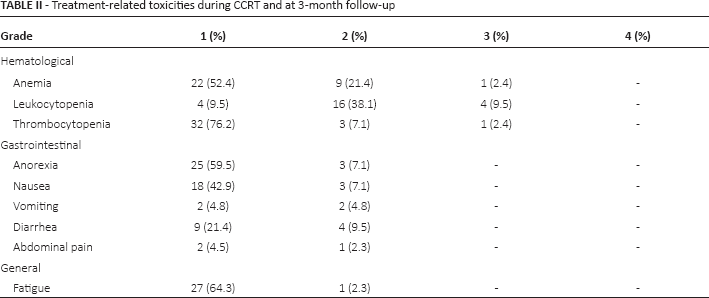
Acute gastrointestinal toxicities were tolerable in most patients. Less than 10% complained of moderate toxicities including anorexia, nausea, vomiting, diarrhea or abdominal pain.
Treatment response and failure pattern
At evaluation 1 month after completion of salvage CCRT, complete response was obtained in 1 patient, partial response in 23, stable disease in 15, and progressive disease in 3. During follow-up (median, 26.9 months; range, 5.2-81.9 months), recurrence was detected in 33 patients (78.6%). LP was the most frequent first failure in 20 patients (47.6%) including 4 who also had DM. The other 13 patients failed at distant sites. Median time to failure was 8.5 months (range, 1.7-40.4 months), and time to LP was 8.8 months (range, 1.7-40.4 months).
Survival and prognostic factors
The median values for all patients were LPFS 15.8 months (range, 1.7-81.7), DMFS 40.4 months (range, 2.0-81.7), PFS 10.6 months (range, 1.7-81.7), and OS 41.2 months (range, 5.2-81.9). The Kaplan-Meier curves for survival are shown in Figure 1, with LPFS 34.7%, DMFS 53.2%, PFS 19.8%, and OS 56.9% at 3 years.
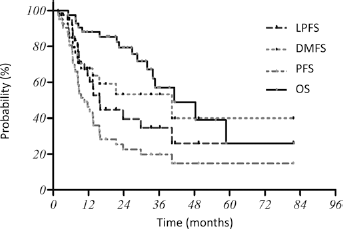
Kaplan-Meier curves for local progression-free survival (LPFS), distant metastasis-free survival (DMFS), progression-free survival (PFS), and overall survival (OS) for all included patients. LPFS was 34.7%, DMFS was 53.2%, PFS was 19.8%, and OS was 56.9%.
The differences in LPFS, DMFS, PFS and OS curves were analyzed according to probable prognostic factors and the results of the univariate analysis are presented in Table III. Significant differences or tendencies to differences for survival curves were observed according to pT stage, pre-CCRT CA 19-9 value, chemotherapy regimen, and further chemotherapy. The survival curves according to these factors are presented in Figure 2.
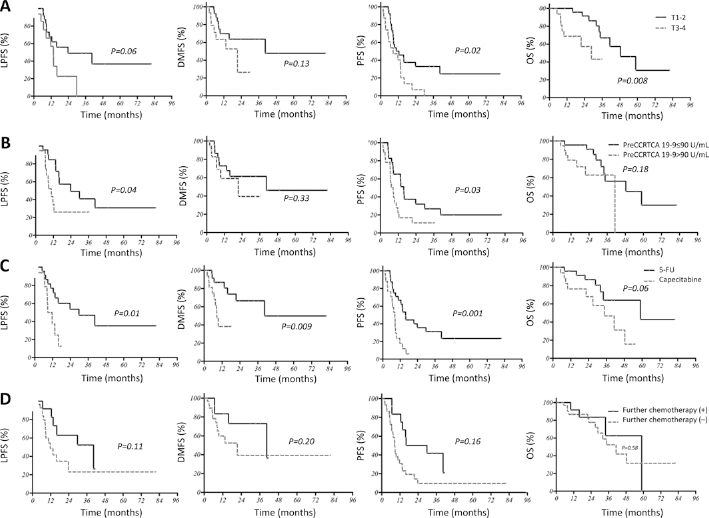
Kaplan-Meier curve differences for LPFS, DMFS, PFS, and OS curves according to probable prognostic factors. Pathological T stage (
Probable prognostic factors of LPFS, DMFS, PFS and OS in univariate analysis
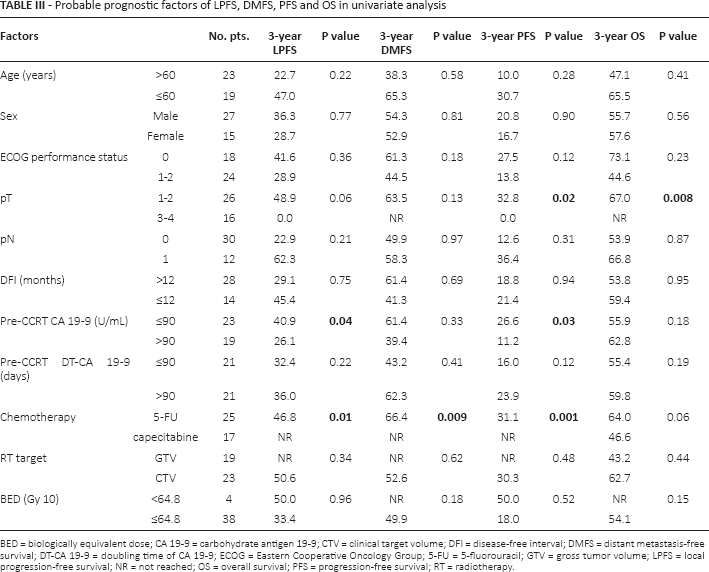
BED = biologically equivalent dose; CA 19-9 = carbohydrate antigen 19-9; CTV = clinical target volume; DFI = disease-free interval; DMFS = distant metastasis-free survival; DT-CA 19-9 = doubling time of CA 19-9; ECOG = Eastern Cooperative Oncology Group; 5-FU = 5-fluorouracil; GTV = gross tumor volume; LPFS = local progression-free survival; NR = not reached; OS = overall survival; PFS = progression-free survival; RT = radiotherapy.
In a multivariate analysis with the 4 prognostic factors obtained from univariate analysis, pre-CCRT CA 19-9 and chemotherapy regimen were significant prognostic factors for LPFS and PFS (Tab. IV). Chemotherapy regimen was also a significant prognostic factor for DMFS. In contrast, pT stage was the only significant prognostic factor for OS. The Kaplan-Meier survival curves according to the number of prognostic factors (pre-CCRT CA 19-9 and chemotherapy regimen) are displayed in Supplementary Figure S1 (Kaplan-Meier survival curves according to the number of prognostic factors. Available online at www.tumorijournal.com). The curves were significantly different according to the presence of the prognostic factors pre-CCRT CA 19-9 and chemotherapy regimen.
Probable prognostic factors of LPFS, DMFS, PFS and OS in multivariate analysis
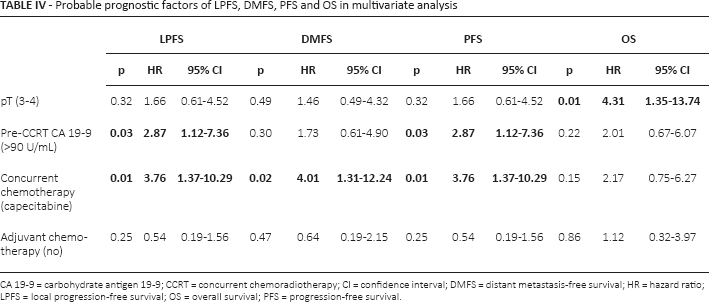
CA 19-9 = carbohydrate antigen 19-9; CCRT = concurrent chemoradiotherapy; CI = confidence interval; DMFS = distant metastasis-free survival; HR = hazard ratio; LPFS = local progression-free survival; OS = overall survival; PFS = progression-free survival.
Discussion
In this retrospective study evaluating the clinical outcomes of salvage CCRT for 42 patients with locally recurrent BTC, a promising outcome was the 56.9% 3-year OS without severe gastrointestinal toxicities. However, recurrence developed in the majority of patients within a year. LP was the main failure pattern in almost half of the patients. The PFS and LPFS curves were significantly lower in patients with >90 U/mL CA 19-9 before salvage CCRT.
The most important treatment modality for BTC is complete surgical resection. After complete surgical resection, however, LR is the most important treatment failure, occurring in 30% to 60% of patients during 24 to 29 months of median follow-up and consequently poor OS at 30% to 50% at 5 years (2-4). This finding is due to the fact that en bloc resection is difficult for BTC and sufficient surgical margins are hard to obtain because of the longitudinal spread along the bile duct. Though adjuvant RT for BTC has never been evaluated in a randomized controlled trial, adjuvant RT with or without chemotherapy is increasingly applied to BTC patients to reduce LR and potentially improve OS after surgical resection. Adjuvant RT is mainly given to patients with risk factors such as close or positive surgical margins or T3-4 tumor stage and/or lymph node metastasis (15-17). Adding RT and/or chemotherapy considerably reduces LR, even in patients with a high risk of recurrence of about 40% at 5 years, similar to the results for patients without recurrence risk factors (17).
In patients with LR alone, repeated operations might be considered first as salvage treatment. A few reports provide results about salvage treatment for locally recurrent BTC after complete surgical resection. Takahashi et al (18) reported the outcomes of repeated surgical resection for locally and/or metastatic recurrent BTC. The survival outcomes of patients who underwent repeated operations were significantly better than the outcomes of those who did not (18). Salvage surgery, however, is provided for only 12% to 18% of patients with recurrence because of the proximity of critical structures such as major arteries and veins and the liver, and because of inaccessibility due to previous surgery including reconstructed bowel (18).
Although RT with or without chemotherapy is an established local modality in oncology, reports on the clinical outcomes of its application for locally recurrent BTC are rare. Our group reported the results of salvage RT with or without chemotherapy in patients with locally recurrent BTC in a previous study, with promising outcomes at 24 months' median OS (19). In that study, local control was significantly high in patients who received CCRT and had lower levels of CA 19-9. These factors were also significant prognostic factors for OS in patients who received RT with or without chemotherapy for locally recurrent BTC.
In the present study, all included patients received CCRT. Similar to the results of our previous study, the CA 19-9 level was a significant prognostic factor for LPFS and PFS. Among patients with CA 19-9 levels exceeding 90 U/mL, LPFS was only 26.1% and PFS was 11.2% at 3 years after CCRT. RT dose escalation using intensity modulation or particle beams might be necessary in patients with higher CA 19-9 levels to maximize local control and PFS. Though this study did not detect local control benefits for RT dose escalation, only 4 patients (9.5%) received a biologically equivalent dose of 64.8 Gy or higher. Several studies have reported higher local control with favorable OS using stereotactic body ablative RT, which delivers a relatively higher RT dose with a short fractionation regimen for unresectable BTC (20, 21).
Multivariate analysis showed that OS differences were significant for pT1-2 vs. pT3-4 tumors with a hazard ratio of 3.67 (95% confidence interval 1.09-12.41). We observed a tendency toward higher recurrence rates by LP and DM in pT3-4 patients. Other approaches to salvage CCRT such as sequential intensive chemotherapy or RT dose escalation could be considered to improve clinical outcomes in patients with locally recurrent BTC who were initially staged pT3-4 after surgery. Although no concrete evidence supports adjuvant RT for completely resected BTC, the application of adjuvant treatment including RT could be a strategy for locally advanced disease considering the poor prognostic features after salvage CCRT.
A concurrent chemotherapy regimen of capecitabine showed significantly lower LPFS/DMFS and PFS compared to 5-FU in our study. As an adjuvant modality, concurrent capecitabine and RT after gemcitabine and capecitabine showed promising outcomes of 65% 2-year OS and 52% PFS in a prospective phase II trial (22). Capecitabine is frequently used as a concurrent radiosensitizer because of its high compliance and convenience as an oral agent (23, 24). The equivalent efficacy of capecitabine with 5-FU as a radiosensitizer has been repeatedly confirmed in neoadjuvant treatment for gastrointestinal cancer, especially rectal cancer (25).
Capecitabine acts as an antineoplastic agent by converting 5-FU via thymidine phosphorylase (TP) in tumor and normal tissues (26). It is also confirmed that the anticancer activity of capecitabine is affected by the level of TP expression (27). Considering the contribution of TP to angiogenesis-dependent growth, migration, and higher T stage, relatively low expression of TP in BTC patients might indicate locally confined rather than distant failure (28). To verify the true expression rate of TP and the efficacy of capecitabine for locally recurrent BTC, further large prospective studies including tissue sampling are needed.
This study has several limitations. Selection bias originating from the retrospective single-center study design was inevitable. Second, the sample size and follow-up period were not sufficient to evaluate the actual prognostic significance of the clinical variables. Third, it was hard to prove the superiority of CCRT in locally recurrent BTC because there was no control group treated with chemotherapy alone. Another limitation was that most LR diagnoses after surgical resection were based on clinical manifestations including interval size increment and/or PET-CT findings rather than biopsy. This limitation makes generalizing the results directly difficult, though the study reflects real clinical situations and high sensitivity and specificity of PET-CT for BTC have been reported (29).
Despite these limitations, this is the first report to analyze the clinical outcomes and prognostic factors of patients who received salvage CCRT for locally recurrent BTC. The results provide useful information about failure patterns, modification of RT, and prognostic factors for salvage CCRT for locally recurrent BTC. For patients with BTC, early application of CCRT before CA 19-9 levels reach 90 U/mL or higher or using RT with 5-FU rather than capecitabine as a radiosensitizer should be considered. Large-scale prospective trials are needed to verify the clinical outcomes and prognostic factors of salvage CCRT for locally recurrent BTC.
Abbreviations
Biliary tract cancer
Carbohydrate antigen 19-9
Concurrent chemoradiotherapy
Computed tomography
Clinical target volume
Distant metastasis
Distant metastasis-free survival
CA 19-9 doubling time
5-fluorouracil
Gross tumor volume
Intravenous
Local progression
Local progression-free survival
Local recurrence
Overall survival
Positron emission tomography
Progression-free survival
Planning target volume
Radiotherapy
Thymidine phosphorylase
Footnotes
Financial support: The research was supported by a Samsung Medical Center grant (GF01130081), a Basic Science Research Program through the National Research Foundation of Korea (NRF-2015R1D1A1A01060945) funded by the Ministry of Education, and a grant from the Marine Biotechnology Program (20150220) funded by the Ministry of Oceans and Fisheries of Korea.
Conflict of interest: The authors declare that they have no conflicts of interest related to this work.