







Abstract
While promoting the country’s tourism industry, governments devote significant resources to support the overall economy. In other words, nations’ macroeconomic factors play an important role in governments’ development of tourism industry. This research note focuses on the effects of economic factors that influence the development of tourism industry and foreign-exchange earnings from tourists in Taiwan using a logistics growth curve. The empirical results show that the logistics growth curve has high explanatory power and that macroeconomic factors (gross domestic product and exchange rate) have significant effects on foreign-exchange earnings from tourists. This research note’s contribution to understanding foreign-exchange earnings from tourism lies in the evidence it provides that the logistics growth curve can help in the estimation of expected average consumption per tourist in the longer term.
Governments develop their own country’s tourism industry not only to generate the adequate revenues from foreign-exchange earnings but to stimulate or maintain (at least) national economic growth (Lorde et al., 2010). In promoting their country’s tourism industry, governments devote significant resources to support the overall economy. In other words, the nations’ macroeconomic factors play an important role in the government development of the tourism industry. The links between the two domains are obvious yet replete with complex consequences. There should be little doubt, for example, that business cycles can influence the development of tourism-linked industries (Chen, 2013, 2013a, 2013b). Meanwhile, Chao et al. (2012) mention that political relations between countries may be another sensitive motive, for example, in Taiwan tourists from Mainland China have been a major contributor to the growth of foreign-exchange earnings from US$2,638,000 in 1961 to US$11,769,000,000 in 2012, representing a 4461-fold increase (Figure 1) since 2008, when the Taiwanese and Chinese governments entered into the “Cross-Strait Agreement” signed between the Straits Exchange Foundation and the Association for Relations Across the Taiwan Strait concerning mainland tourists traveling to Taiwan. This agreement, among other accomplishments, enhanced the “foreign-exchange earnings from tourism” -to-gross domestic product (GDP) ratio from 1.48% in 2008 to 2.45% in 2012. But Taiwan is small and the number of tourists is close to saturation. Eventually, foreign-exchange earnings from tourism will approach some saturation point in the future. In the study, the situation of Taiwan’s foreign-exchange earnings from tourism is discussed by using Rogers’ (2003) initial findings explaining a specific phenomenon that will finally approach saturation point. In general, the term “diffusion” we use in this study represents the phenomenon of a sharp growth of Taiwan’s foreign-exchange earnings from tourists, which makes it a little different from the definition of diffusion used in innovation research.
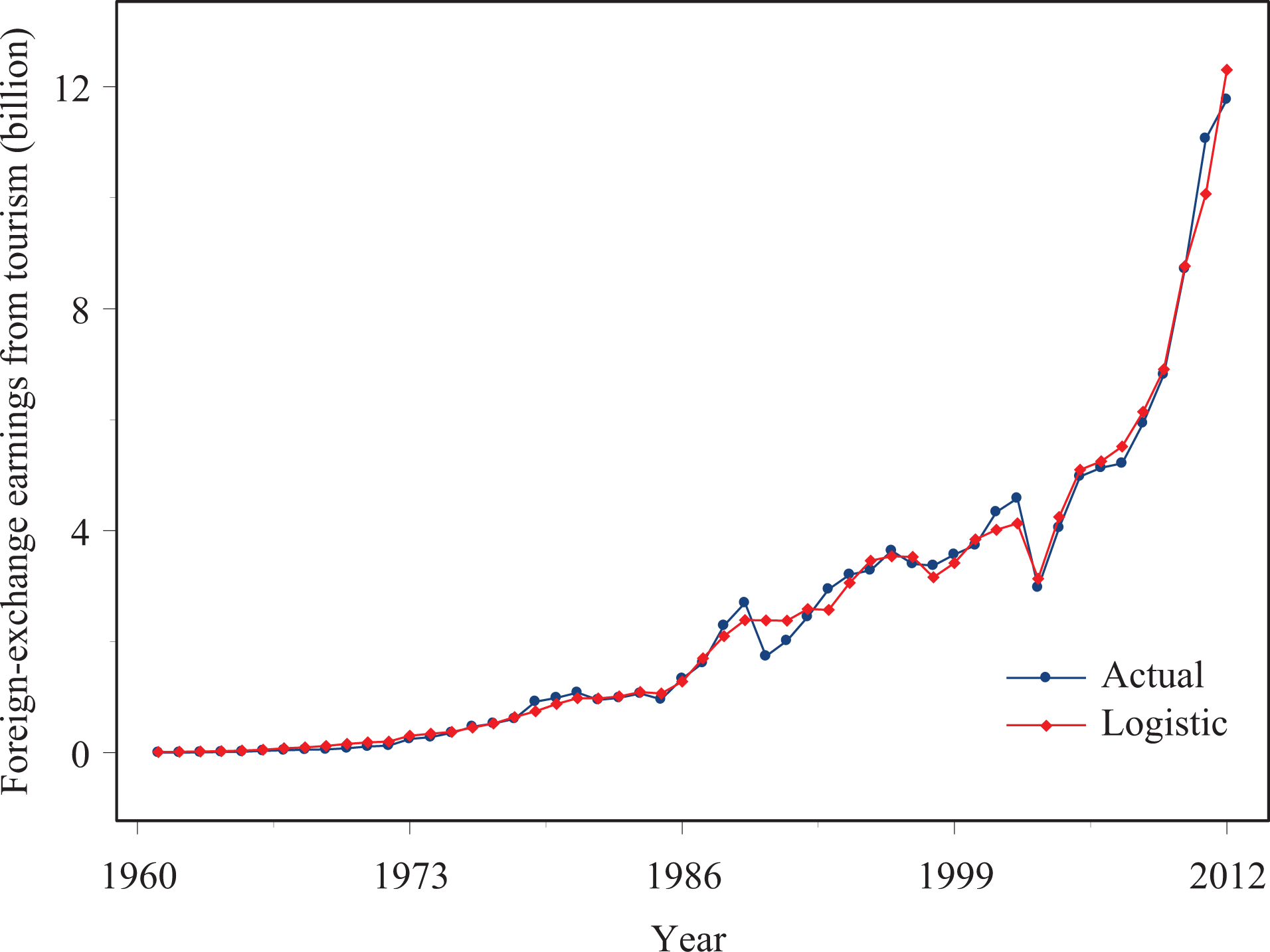
Actual values and fitted values of the foreign-exchange earnings from tourism in Taiwan.
The present article focuses on the effects of economic factors influencing the tourism industry and its diffusion model of foreign-exchange earnings from tourists in Taiwan. In previous research, Martin and Witt (1987), Moshirian (1993), Toh et al. (2001), Webber (2001), and Shareef and McAleer (2005) use such economic factors as the GDP, the consumer price index (CPI), and the exchange rate (ER) to identify and clarify relationships among tourism demand, tourism expenditure, and tourism competitiveness. The findings indicate that the host country’s CPI and ER movement directly affect tourism expenditure. Furthermore, GDP reflects the country’s wealth and economic condition which in turn may influence tourists’ willingness to visit. The research methods that typically come into play in these studies are the GJR-GARCH model (Shareef and McAleer, 2005), cointegration analysis (Lim and McAleer, 2001; Wu et al., 2012), and panel data analysis (Fuleky et al., 2014; Nikolaos, 2012). Few studies adopt other methods to address tourism issues. Therefore, the current study adopts three major macroeconomic factors (i.e., GDP, CPI, and ER) to identify and clarify the relationships among macroeconomic factors and foreign-exchange earnings from tourism by using the logistic growth curve. Compared with previous research, the difference between this work and others is that most tourism studies adopted binary logistic models or logistic regression models to predict a categorical variable from a set of predictor variables. However, we adopt the logistic growth curve that can be used to model functions increasing gradually at first, more rapidly in the middle, and slowly at the end of the growth period, leveling off at a maximum value after some period of time. To this end, the data cover the period between 1961 and 2012 derived from Taiwan’s National Statistics, Tourism Bureau, and Central Bank. According to Figure 1, the growth trend of Taiwan’s foreign-exchange earnings from tourism has exhibited an S-shape pattern (i.e., a sigmoid curve), which is also reflective of a diffusion process that can be determined by logistic growth curve analysis (Pearl and Reed, 1920). For the purposes of the current study, we use the logistic growth curve to detect (1) the diffusion of foreign-exchange earnings from tourism in Taiwan, and (2) the important explanatory factors regarding the expansion of foreign-exchange earnings from tourism in Taiwan.
Given the data on foreign-exchange earnings from tourism in Taiwan, this study uses the following model to analyze the expansion of such earnings:

where yt denotes foreign-exchange earnings from tourism at time t, y* measures the potential number of tourists in Taiwan when t → ∞ and when yt → y*. The definition of y* is a fraction of a population defined by Frank (2004) and Lee and Huang (2011) as:

The variable y* is calculated by multiplying γ by POPt, where the coefficient γ gives the expected consumption expenditure from a tourist and POPt is the number of tourists in Taiwan at time t. Parameters α and bt are measures of the diffusion process timing and the diffusion speed, respectively. We use GDP, CPI, and ER as key determinants to describe the relative growth rate of the diffusion, which is defined as:

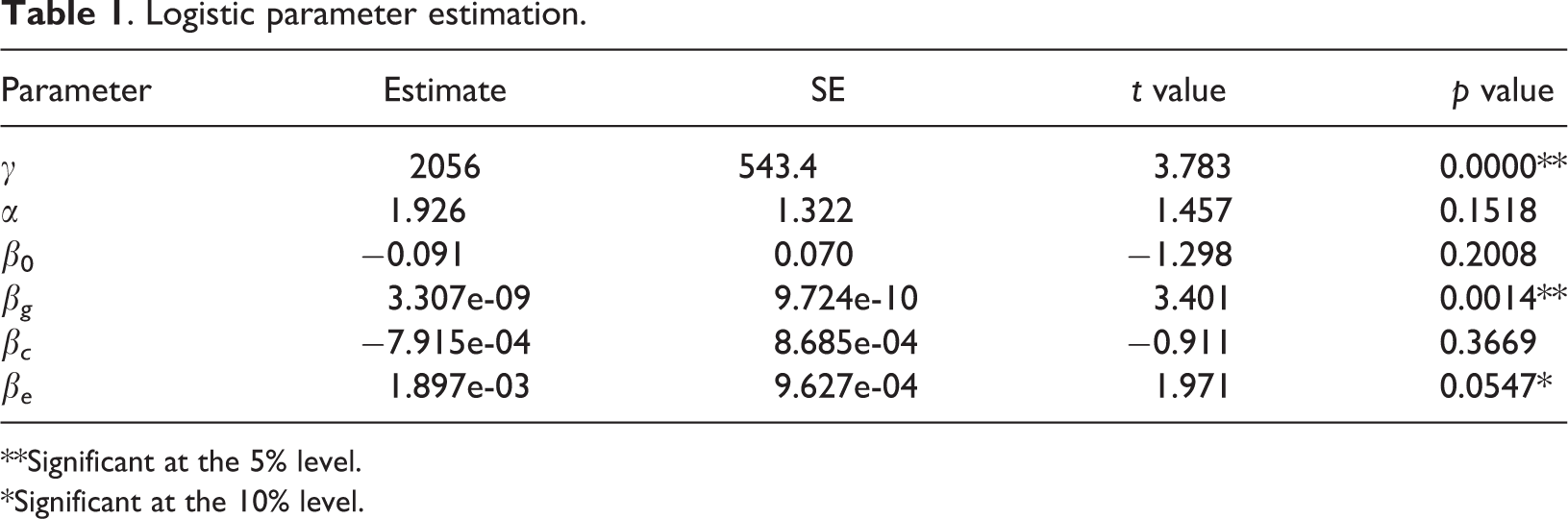
Table 1 shows the results of estimating parameters and Figure 1 graphs the observations and fitted values under the logistic growth curve, where the coefficient of determination is 99.4%. Economic variables such as GDP and ER are statistically significant. The coefficient of GDP is positive, meaning that nations with similar GDP can likely enhance citizens’ wealth because of sufficiently funded public infrastructure, public transportation, and human resource configurations. Furthermore, entities in the private sector will be more likely in the context of such GDP levels to strengthen the quality of tourism and, generally, promote the development of their country’s tourism industry. Although Taiwan’s “foreign-exchange earnings from tourism”-to-GDP ratio was only 2.45% in 2012, the development of Taiwan’s tourism industry has promoted Taiwan’s overall economic environment. Examples of this kind of promotion include increases in the number of Taiwanese tourists visiting different parts of Taiwan and increases in Taiwanese tourist consumption abilities. Because of decreased exports and economic recession in recent years, Taiwan’s central bank would like to depreciate its ER. For instance, the ER between Taiwan and the United States has been adjusted until its value is below New Taiwanese Dollar NTD$30 to USD$1, in order to activate long-term competitiveness, given that Taiwan is an export-oriented country. No doubt, the depreciated NTD provides a huge benefit for the tourism industry at the same time. In this study, the CPI was not significant because most foreign tourists visiting Taiwan came from Japan, the United States, and Hong Kong before 2008, and the CPI in each of these countries was higher than the CPI in Taiwan. Therefore, Taiwan’s CPI was not a factor influencing foreign tourists’ willingness to travel to Taiwan.
Logistic parameter estimation.
**Significant at the 5% level.
*Significant at the 10% level.
Under the logistics growth curve (equations (1) and (2)), the estimator of γ is 2056, indicating that we expect Taiwan’s foreign-exchange earnings from tourism will achieve US$2056 × POPt. In other words, γ indicates that the consumption per tourist will eventually reach about US$2056. According to statistics from Taiwan’s Tourism Bureau, the real average consumption per tourist in Taiwan was US$1610 in 2012, which was below the expected average consumption value per tourist (i.e. γ). The difference between the real and expected average consumption per tourist was caused by the slowdown in the Taiwan economy since the US subprime crisis in 2007. During the depressed Taiwan economy, the tourism industry is often stagnant because of the decline in willingness to consume (Ritchie, 2004; Ritchie et al., 2010). In view of the successful development of cultural, travel, and tourism industries in Korea, the Taiwan Government proposed in 2008 “Challenge 2008 Six-Year National Development Plan” and the Cross-Strait Agreement to increase the number of tourists, especially those from China. Besides, the Taiwan Government invests in the tourism industry through civic participation (e.g., Build-Operate-Transfer (BOT), Build-Own-Operate (BOO), Rehabilitate-Operate-Transfer+Build-Operate-Transfer (ROT + BOT) methods) to capitalize about US$4.28 billion in 2014. This is the reason why, even though the government did not increase the budget, tourism is still blooming.
The first and second derivatives of equation (1) with respect to time can help to analyze the diffusion of foreign-exchange earnings from tourism in Taiwan:

where
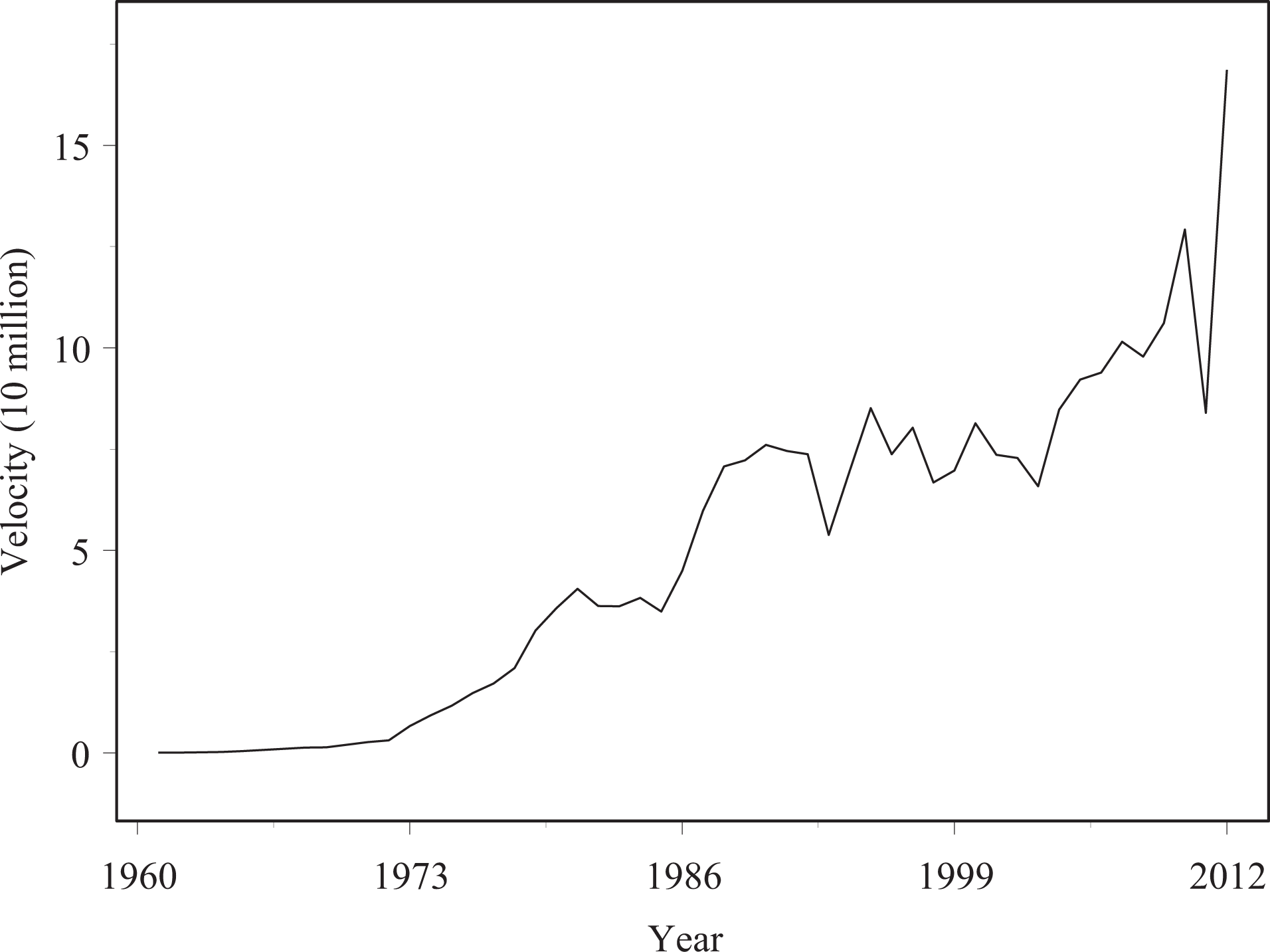
The velocity of the diffusion of foreign-exchange earnings from tourism.
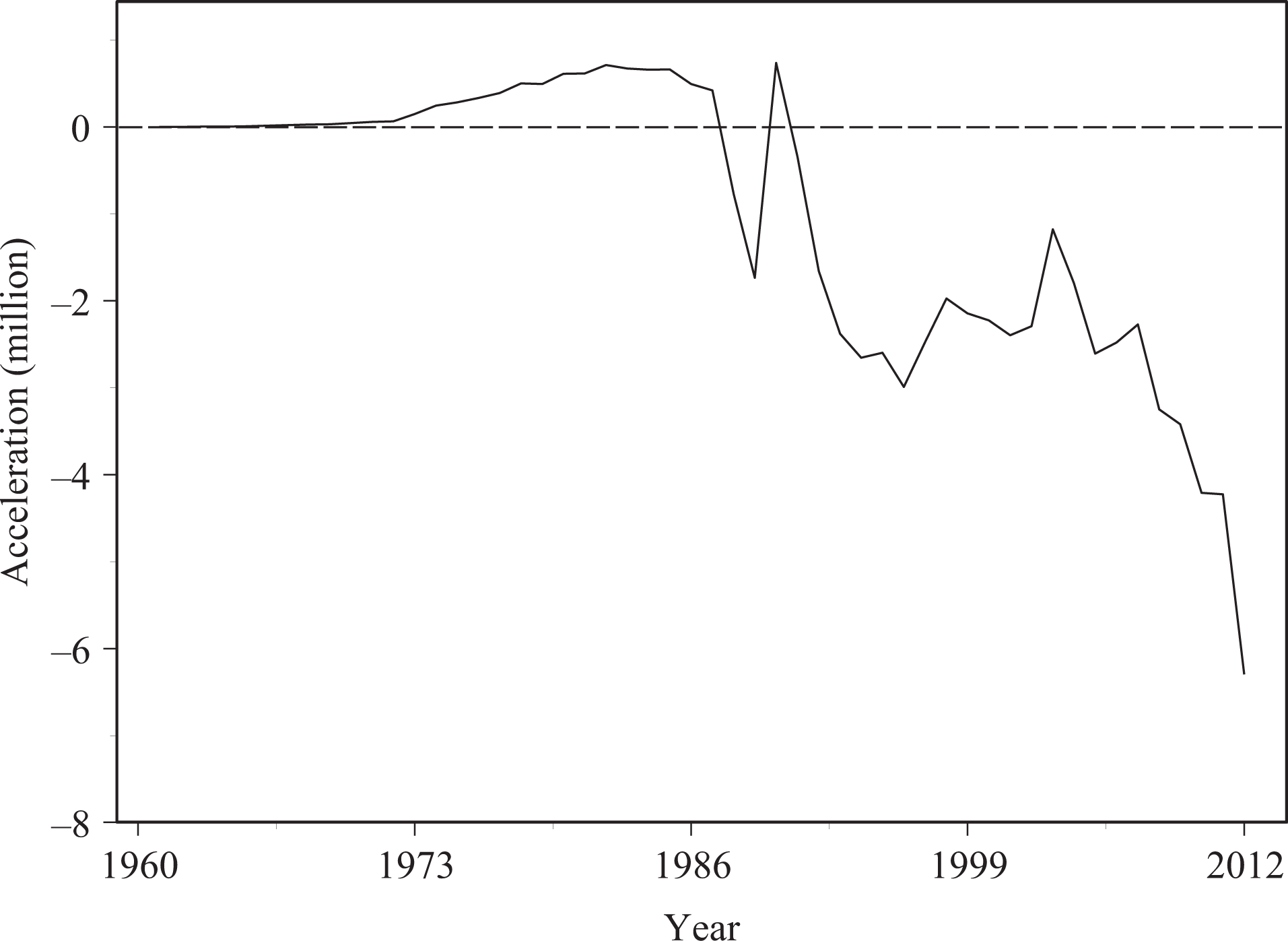
The acceleration of the diffusion of foreign-exchange earnings from tourism.
The current study’s empirical results show that the logistics growth curve has high explanatory power and that macroeconomic factors (e.g. GDP and ER) have significant effects on foreign-exchange earnings from tourism as expected. This research note’s major contribution to understanding foreign-exchange earnings from tourism is the evidence that the logistics growth curve can help to estimate the expected average consumption per tourist in the longer term.
Footnotes
Declaration of conflicting interests
The author(s) declared no potential conflicts of interest with respect to the research, authorship, and/or publication of this article.
Funding
The author(s) received no financial support for the research, authorship, and/or publication of this article.